Mars Mahadasha Ketu Antardasha: the abrupt-cut sub-period
The Ketu antardasha is the sixth sub-period of the seven-year Mars mahadasha and, at under five months, it shares with Mars's own opening the shortest slot in the sequence. It follows the Mercury antardasha, nearly a year of negotiation, contracts and quick commerce, and replaces that crowded register with Ketu's instinct for severance. The tradition holds that Ketu acts in the manner of Mars, kuja vat ketu in the old formula, so the pairing doubles a single cutting fire, with Ketu turning the blade inward toward release rather than conquest. The classical texture is the abrupt cut: endings that arrive faster than deliberation, surgical removals in the literal and the figurative sense and sudden clarity about what no longer needs defending. A well placed natal Ketu makes the severance clean and even liberating; an afflicted one can make the same weeks feel like losses without explanation.
Where the sub-period falls in the Vimshottari sequence
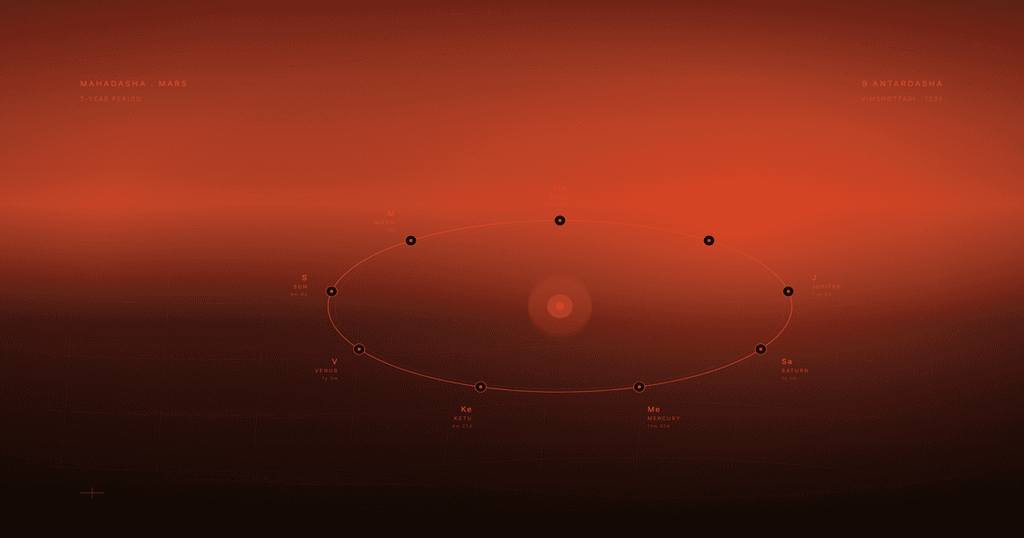
The 7-year Mars mahadasha divides into nine antardasha sub-periods in fixed Vimshottari order starting with Mars itself. The Ketu sub-period sits at position 6 of 9. Exact start and end dates for any chart can be computed from the natal Moon nakshatra-pada and the date of Mars mahadasha onset. The Tempora dasha engine produces this to the day.
The arithmetic of this period
Ketu holds 7 years of the 120-year cycle, the same share as Mars, so the Ketu antardasha inside the Mars mahadasha runs 7 × 7 / 120 = 0.41 years, which is 4 months and about 27 days. That equality of shares is why this sub-period and the mahadasha's own opening antardasha have identical lengths. Five sub-periods run first: Mars 4 months 27 days, Rahu 1 year 18 days, Jupiter 11 months 6 days, Saturn 1 year 1 month 9 days and Mercury 11 months 27 days, a combined 54 months or so. The Ketu antardasha therefore opens about four and a half years into the mahadasha and closes just before the four-years-eleven-months mark, sitting wholly inside the fifth year.
Coming this late changes what the cut means. By the fifth year the Mars cycle has already built, expanded and consolidated through four full sub-periods, so Ketu's five months tend to prune a structure that exists rather than prevent one from forming; the same antardasha early in a cycle would read closer to hesitation than to harvest. The full sequence is laid out in the Mars mahadasha overview, and Ketu's conduct when it holds a seven-year major period of its own is covered in the Ketu mahadasha page.
The textual record on this pairing
In the BPHS antardasha chapters, Mars mahadasha section, Ketu's placement decides which of two branches the period follows. Ketu in a kendra or trikona, in the 3rd or 11th, or supported by benefics brings royal beneficence, small land gains early that grow substantial later, the birth of a son and a measure of state authority. Tied to a yogakaraka with strength, the text adds reputation, gains through employees, command of an army and royal friendship.
In the 6th, 8th or 12th from the dasha lord the same lord delivers quarrels, dental trouble, fevers, danger from thieves and wild animals and distress in the family. Where Ketu stands connected to the 2nd or 7th, the chapter records a health caution and closes with a prescribed charity as remedy. Phaladeepika's bhukti chapter lists thunder danger, weapon wounds and loss of country for this pairing, an assignment that sits beside the harsher BPHS branch. The engine reads both texts as inputs and conditions them on where natal Ketu actually sits.
Friendship status and pairing reading
In the classical Parashari friendship matrix, Mars views Ketu as friend. The friend-pair classification means the 4 months 27 days sub-period classically delivers outcomes where Mars's register (action, courage, brothers, surgery, property and the warrior register) and Ketu's register (moksha, dissolution, past-life karma, spiritual fire and the detachment register) integrate constructively. Events typically surface from both karaka domains in alignment rather than friction.
The Ketu karaka overlay
Ketu is the karaka of moksha, dissolution, past-life karma, spiritual fire and the detachment register. Across the 4 months 27 days sub-period, this karaka set overlays on top of Mars's 7-year action, courage, brothers, surgery, property and the warrior register register. The combined reading is the central output of the sub-period.
How Ketu's natal dignity shapes the reading
Ketu's natal sign and house set the floor for the 4 months 27 days sub-period. Ketu at exaltation gives the strongest reading. Own-sign and mooltrikona placement gives clean expression. Debilitation introduces friction that the sub-period must work through. Combust and retrograde state, conjunctions with malefics or benefics and the dispositor's strength all further modulate the reading. See the Ketu mahadasha overview for the per-dignity breakdown.
Event classes typical to Mars-Ketu sub-period
The 4 months 27 days Mars mahadasha Ketu antardasha typically surfaces events across these specific domains:
- Constructive integration of Mars-register with Ketu-register: friend-pair sub-periods classically deliver outcomes where both planets' karakas align rather than friction.
- Events in Ketu's natural karaka domain: moksha, dissolution, past-life karma, spiritual fire and the detachment register.
- Events specific to the natal house Ketu occupies in the chart.
- Events where the Mars-mahalord and Ketu-antarlord houses (both natal and ruled) interact (aspect, mutual reception or natal conjunction).
Transit confirmation protocol
The sub-period reading sets a structural pressure floor of 4 months 27 days. Specific event timing inside that window requires the pratyantara (sub-sub-period) overlay and a transit cross-check.
Two transit overlays do most of the work. The standard targets to track: transit Ketu aspecting natal Mars, transit Mars aspecting natal Ketu, transit Saturn through the natal 12th house from natal Mars, transit Mars-Ketu conjunctions. These transits intensify the Mars-Ketu dynamic within the broader sub-period and concentrate event timing on those windows.
The pratyantara (sub-sub-period) inside the antardasha gives finer timing. The Mars-Ketu-Mars pratyantara (about 1 month 15 days) and the Mars-Ketu-Ketu pratyantara (about 22 days) carry the most concentrated spiritual-insight and karmic-completion signal within the 11-month sub-period. The Mars-Ketu-Saturn pratyantara (about 1 month 23 days) reads as the durable-withdrawal window. Cross-checking the pratyantara against the transit overlay gives event timing to the week. Tempora's dasha engine produces this data to the day for any chart.
This period against the 2026 to 2028 sky
Ketu's own movements in this window are dated precisely. It sits in Leo from 9 June 2025 until 27 December 2026 and then moves into Cancer, holding that sign until 15 July 2028, so a Mars-Ketu antardasha running across late December 2026 has its sub-period lord change signs mid-stream, relocating the withdrawal to a different natal house. The solar eclipse of 12 August 2026 lands on the Cancer-Leo cusp, on the axis the nodes then occupy, and the tradition weighs eclipse seasons heavily for natives running a node's sub-period. Both signals come with limits. A sign change and an eclipse describe the sky; they acquire personal meaning only through the houses Leo and Cancer hold in the individual chart, and a native whose chart is quiet at that cusp may pass the eclipse season with nothing to file. The natal state of Ketu, its house, its dispositor and its conjunctions, remains the floor under all of it.
What the framework does not predict
The Mars-Ketu reading is structural. It flags a 5-month window where the conditional probability of three named event classes lifts above chance, but it does not predict that any specific native will experience a specific event inside that window, nor the direction of any event that does fire.
A withdrawal or spiritual-deepening event during the sub-period can read as the necessary release that prepares the native for the Mars-Venus expansion that follows or as a difficult loss whose meaning takes years to integrate; the broader chart determines which. The framework times the pressure, not the result and timing finer than the antardasha band needs the pratyantara sequence and the transit overlay for the date in question.
How this connects to the broader Mars Mahadasha
The Mars-Ketu sub-period is the sixth antardasha inside the 7-year Mars Mahadasha. Reading the sub-period in isolation captures the 4 months 27 days; reading it inside the Mahadasha gives the broader arc that places the action meets withdrawal reading in its proper structural context.
The Tempora Mars Mahadasha method article covers the dispositor analysis, natal-house framework and the broader 6-year texture that this sub-period sits inside. The conditional probability framework holds across the full series: each antardasha is a flagged window for specific event classes whose probability is elevated relative to chance.
Frequently asked questions
How long is the Mars Mahadasha Ketu Antardasha and where does it fall in the Vimshottari sequence?
The Mars Mahadasha Ketu Antardasha runs 4 months 27 days. It is the sixth antardasha inside the 7-year Mars Mahadasha, opening after the Mars-Mercury antardasha (11 months 27 days). The full sequence inside the Mars Mahadasha runs Mars-Mars, Mars-Rahu, Mars-Jupiter, Mars-Saturn, Mars-Mercury, Mars-Ketu, Mars-Venus, Mars-Sun and Mars-Moon. Exact start and end dates can be computed from the natal Mars nakshatra-pada and the date of Mars Mahadasha onset.
What does Ketu signify in this sub-period and why does it read as action meets withdrawal?
Ketu is the karaka of detachment, spirituality, past-life karma, sudden cuts, mystical insight, isolation, moksha, renunciation, beyond-material direction. During the broader Mars Mahadasha's action and will reading, Ketu contributes the abrupt-cut overlay. The sub-period sits at the sixth position in the antardasha sequence and reads as the Mars action and will register meeting Ketu's withdrawal, mystical insight, sudden cuts and karmic-completion significations.
How does Ketu's natal dignity shape the Mars-Ketu sub-period reading?
Ketu's natal house, sign and aspectual state set the floor for the 5-month sub-period. Ketu exalted in Scorpio (per most modern schools) or Sagittarius (per some classical sources), in own sign no traditional own-sign assignment for the lunar nodes or in angular houses (1st, 4th, 7th, 10th) softens the reading toward more auspicious outcomes. Ketu debilitated in Taurus (per most modern schools) or Gemini (per some classical sources) introduces friction. Aspects from Saturn bring sustained structural pressure; aspects from Mars bring competitive or confrontational pressure.
What kinds of events historically correlate with the Mars-Ketu sub-period?
Three event classes correlate. Spiritual practice events: Retreats, teacher encounters, formal initiations, deepened daily practice, mystical experiences. The Mars-Ketu sub-period is the most concentrated spiritual-practice window in the Mars Mahadasha for n. Career-withdrawal events: Voluntary departures from high-status roles, business closures by choice, pivots toward meaningful rather than maximally-rewarded paths. The Ketu cuts that look like loss from outside but feel like li. Relationship and pattern completion events: Long-running relationships ending by mutual recognition, long-held grievances resolving, family patterns closing. The texture is karmic completion rather than crisis. The framework reads these as a structural-pressure window for the event class, not a deterministic predictor.
How does this sub-period connect to the broader Mars Mahadasha?
The Mars-Ketu sub-period is the sixth antardasha inside the 7-year Mars Mahadasha. It opens after the Mars-Mercury antardasha (11 months 27 days). The sub-period reading is best held in tandem with the broader Mars Mahadasha reading from the Tempora Mars Mahadasha method article, which covers the natal house and dispositor framework that sets the texture of the full 16 years.
What does the Tempora framework not predict about this sub-period?
The framework identifies a structural-pressure window of approximately 4 months 27 days. It does not predict whether a specific native will experience a specific event in that window. It does not predict outcome direction. It does not predict timing finer than the sub-period band without overlaying the pratyantara (sub-sub-period) and the transit overlay for the date in question. The readings carry conventional weight from classical literature; the framework treats them as structural-pressure flags to cross-check against transit data.
Why are the Mars-Mars and Mars-Ketu antardashas exactly the same length?
Both Mars and Ketu hold 7 years of the 120-year Vimshottari cycle, and an antardasha is the mahadasha length multiplied by the sub-lord's share of that cycle. Inside the 7-year Mars mahadasha each of them works out to 7 multiplied by 7 divided by 120, which is 0.41 years or 4 months 27 days. The two periods sit far apart in the sequence, the Mars antardasha opening the cycle and the Ketu antardasha arriving sixth, in the fifth year.
What should a native running Mars-Ketu around the 12 August 2026 eclipse expect?
The 12 August 2026 solar eclipse falls on the Cancer-Leo cusp while Ketu occupies Leo until 27 December 2026. The tradition treats an eclipse as weighty for a native running a nodal sub-period, with the effect delivered through the natal house the eclipse degree occupies. It sharpens the period's themes of severance and release where the chart is sensitive at that cusp; it predicts no specific event, and a chart with nothing there may register little.
What do the classical texts say about Mars-Ketu?
In the BPHS antardasha chapters, Mars mahadasha section, a well placed or benefic-supported Ketu brings land gains, a son's birth and state authority, while Ketu in the 6th, 8th or 12th from the dasha lord brings quarrels, fevers and family distress, with a caution and remedy attached to 2nd or 7th connections. Phaladeepika's bhukti chapter assigns thunder danger, weapon wounds and loss of country, in line with the harsher branch. The engine conditions both records on natal Ketu's actual position.
Read next
- Mahadasha: the nine-period Vimshottari framework · the broader cluster this sub-period sits inside
- Mars Mahadasha Venus Antardasha · the next sub-period in the Vimshottari sequence
- Venus Mahadasha Ketu Antardasha · the complementary sub-period in the prior Mahadasha
- Jupiter Mahadasha Ketu Antardasha · the same antardasha planet in a different Mahadasha
- Mahadasha and Vimshottari planetary periods · the full nine-period framework
- Calibrated lift: the discipline that turns Vedic astrology into research
This article represents conventional Vedic teaching and Tempora Research method documentation. It does not constitute financial, legal or professional advice. Internal audit log maintained.