Jupiter Mahadasha Ketu Antardasha: the wisdom-detachment sub-period
Fourth of nine, the Ketu antardasha opens as the 2 years 3 months 6 days of the Mercury sub-period end, and the classical contrast is stark: Mercury's window multiplied words, transactions and connections, while Ketu's 11 months 6 days ask what any of it was for. Ketu holds no seat in the Parashari friendship matrix, so the pairing is treated as neutral by convention and coloured almost entirely by where the node sits natally. The tradition assigns this exact combination the texture of dharmic subtraction: pilgrimage in the older texts, sudden disinterest in built positions, insight arriving through loss of appetite rather than through gain. It is the shortest sub-period the mahadasha has yet produced, and classical sources treat the brevity as part of the teaching. All of it is inherited texture, held apart from any empirical claim.
Where the sub-period falls in the Vimshottari sequence
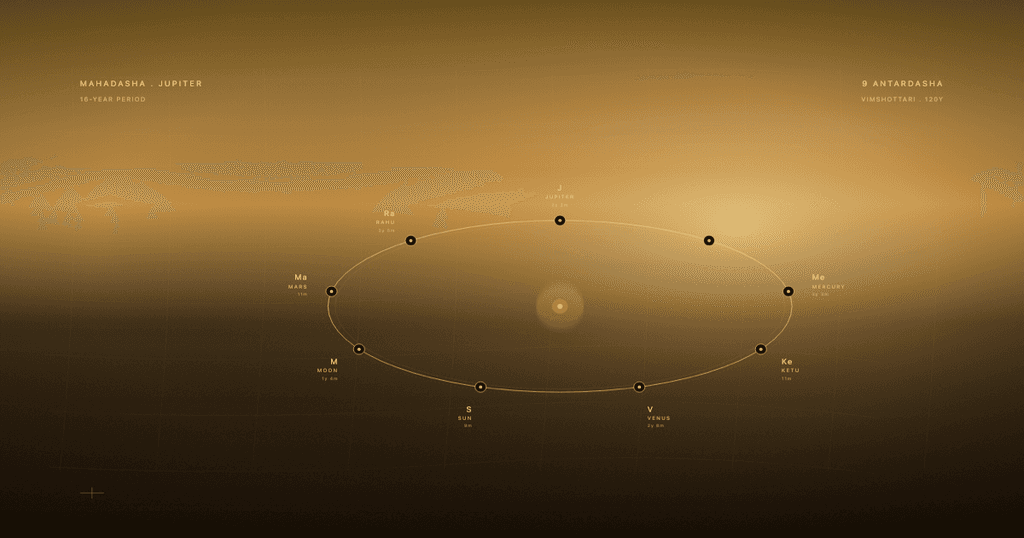
The 16-year Jupiter mahadasha divides into nine antardasha sub-periods in fixed Vimshottari order starting with Jupiter itself. The Ketu sub-period sits at position 4 of 9. Exact start and end dates for any chart can be computed from the natal Moon nakshatra-pada and the date of Jupiter mahadasha onset. The Tempora dasha engine produces this to the day.
Friendship status and pairing reading
In the classical Parashari friendship matrix, Jupiter views Ketu as neutral. The neutral-pair classification means the 11 months 6 days sub-period takes the colouring of the natal placement of both planets. Jupiter's register (wisdom, dharma, children, expansion, teaching and the dignified-blessing register) and Ketu's register (moksha, dissolution, past-life karma, spiritual fire and the detachment register) can integrate constructively or friction-prone depending on the broader chart configuration.
The Ketu karaka overlay
Ketu is the karaka of moksha, dissolution, past-life karma, spiritual fire and the detachment register. Across the 11 months 6 days sub-period, this karaka set overlays on top of Jupiter's 16-year wisdom, dharma, children, expansion, teaching and the dignified-blessing register register. The combined reading is the central output of the sub-period.
How Ketu's natal dignity shapes the reading
Ketu's natal sign and house set the floor for the 11 months 6 days sub-period. Ketu at exaltation gives the strongest reading. Own-sign and mooltrikona placement gives clean expression. Debilitation introduces friction that the sub-period must work through. Combust and retrograde state, conjunctions with malefics or benefics and the dispositor's strength all further modulate the reading. See the Ketu mahadasha overview for the per-dignity breakdown.
Event classes typical to Jupiter-Ketu sub-period
The 11 months 6 days Jupiter mahadasha Ketu antardasha typically surfaces events across these specific domains:
- Configuration-dependent Jupiter-Ketu integration: neutral-pair sub-periods take the colouring of the natal placement of both planets.
- Events in Ketu's natural karaka domain: moksha, dissolution, past-life karma, spiritual fire and the detachment register.
- Events specific to the natal house Ketu occupies in the chart.
- Events where the Jupiter-mahalord and Ketu-antarlord houses (both natal and ruled) interact (aspect, mutual reception or natal conjunction).
Transit confirmation protocol
The sub-period reading sets a structural pressure floor of 11 months 6 days. Specific event timing inside that window requires the pratyantara (sub-sub-period) overlay and a transit cross-check.
Two transit overlays do most of the work. The standard targets to track: transit Ketu aspecting natal Jupiter, transit Jupiter aspecting natal Ketu, transit Saturn through the natal 12th house from natal Moon, transit Mars-Ketu conjunctions. These transits intensify the Jupiter-Ketu dynamic within the broader sub-period and concentrate event timing on those windows.
The pratyantara (sub-sub-period) inside the antardasha gives finer timing. The Jupiter-Ketu-Jupiter pratyantara (about 1 month 15 days) and the Jupiter-Ketu-Ketu pratyantara (about 22 days) carry the most concentrated spiritual-insight and karmic-completion signal within the 11-month sub-period. The Jupiter-Ketu-Saturn pratyantara (about 1 month 23 days) reads as the durable-withdrawal window. Cross-checking the pratyantara against the transit overlay gives event timing to the week. Tempora's dasha engine produces this data to the day for any chart.
What the framework does not predict
The Jupiter-Ketu reading is structural. It flags a 11-month window where the conditional probability of three named event classes lifts above chance, but it does not predict that any specific native will experience a specific event inside that window, nor the direction of any event that does fire.
A withdrawal or spiritual-deepening event during the sub-period can read as the necessary release that prepares the native for the Jupiter-Venus expansion that follows or as a difficult loss whose meaning takes years to integrate; the broader chart determines which. The framework times the pressure, not the result and timing finer than the antardasha band needs the pratyantara sequence and the transit overlay for the date in question.
How this connects to the broader Jupiter Mahadasha
The Jupiter-Ketu sub-period is the fourth antardasha inside the 16-year Jupiter Mahadasha. Reading the sub-period in isolation captures the 11 months 6 days; reading it inside the Mahadasha gives the broader arc that places the wisdom meets detachment reading in its proper structural context.
The Tempora Jupiter Mahadasha method article covers the dispositor analysis, natal-house framework and the broader 20-year texture that this sub-period sits inside. The conditional probability framework holds across the full series: each antardasha is a flagged window for specific event classes whose probability is elevated relative to chance.
The arithmetic of this period
The duration is fixed by the constants: Jupiter holds 16 of the 120 cycle years and Ketu holds 7, so the antardasha runs 16 x 7 / 120 = 0.933 years, which is 11.2 months, conventionally 11 months 6 days.
Three sub-periods come before it. Jupiter's own antardasha takes about 2 years 2 months, Saturn's about 2 years 6 months and Mercury's about 2 years 3 months, a running total near 6 years 11 months. The Ketu window therefore spans roughly year 6.9 to year 7.9 of the Jupiter mahadasha, ending just before the exact midpoint at year 8.
Its placement between neighbours does classical work. Ketu sits as a narrow pass between the two longest stretches of the whole period, Mercury's 2 years 3 months before it and Venus's 2 years 8 months after, eleven lean months separating the working season from the season of enjoyment. Position in the larger arc matters too: a subtraction window at the seven-year mark interrogates a mahadasha still in progress, which is a milder proposition than the same lord closing a period, where detachment has to be final rather than corrective.
BPHS and Phaladeepika on this period
The Ketu entry in the BPHS antardasha chapters, Jupiter mahadasha section, is unusually tempered even in its favourable branch: a Ketu supported by benefics is promised only moderate enjoyment and wealth, with coarse food or food from others and gains arriving by means the text itself calls undesirable. When Ketu stands in the 6th, 8th or 12th from the dasha lord or keeps malefic company, the chapter lists royal wrath, imprisonment, disease and friction with father and brothers. It still allows a generous clause, assigning a Ketu in the 4th, 5th, 9th or 10th from Jupiter palanquin and elephant comforts, business profits and wealth from a foreign dignitary. Where Ketu is tied to 2nd or 7th lordship the text notes bodily strain and prescribes Mrityunjaya japa as the remedial measure. Phaladeepika's chapter on bhukti effects concurs with the harder branch, listing weapon wounds, discord with servants and threats to bodily safety. In the Tempora engine these classical readings enter as inputs whose weight is set by the natal Ketu, its house and its dispositor.
This period against the 2026 to 2028 sky
Ketu itself moves once in the 2026 to 2028 window and the move is pointed. On 27 December 2026 the nodal axis shifts and Ketu leaves Leo for Cancer, the sign where the mahadasha lord is exalted. Jupiter holds Cancer fully from 27 May 2026, tastes Leo from 23 October 2026 to 3 February 2027, and when it steps back from that taste the two lords of this page share Cancer from 3 February 2027 until Jupiter's final Leo entry on 19 June 2027.
Classical doctrine reads a node lodged beside a dignified benefic ambivalently, the blessing shadowed or the shadow blessed depending on the school, and a native running Jupiter-Ketu months through the first half of 2027 would find the sky staging exactly the pairing the dasha names. The 12 August 2026 solar eclipse on the Cancer-Leo cusp is nodal by construction as well, landing while Ketu still holds Leo. Every one of these signals is a collective condition: the whole planet shares those sign placements for those months, an eclipse touches a chart only where the chart is touchable, and the sub-period is finally read from natal Ketu, its dispositor and its house.
That natal condition splits the tradition's verdict. Ketu placed in the moksha houses, the 4th, 8th or 12th, or with a strong dispositor, is read as giving this antardasha its cleaner form, renunciation with direction and study that deepens rather than scatters. Ketu on the 1st-7th axis or afflicted turns the same window disorienting, exits made abruptly and regretted slowly. The node's own 7-year period is treated in the Ketu mahadasha overview.
Frequently asked questions
How long is the Jupiter Mahadasha Ketu Antardasha and where does it fall in the Vimshottari sequence?
The Jupiter Mahadasha Ketu Antardasha runs 11 months 6 days. It is the fourth antardasha inside the 16-year Jupiter Mahadasha, opening after the Jupiter-Mercury antardasha (2 years 3 months 6 days). The full sequence inside the Jupiter Mahadasha runs Venus-Venus, Venus-Sun, Venus-Moon, Venus-Mars, Venus-Rahu, Venus-Jupiter, Venus-Saturn, Venus-Mercury and Venus-Ketu. Exact start and end dates can be computed from the natal Moon nakshatra-pada and the date of Jupiter Mahadasha onset.
What does Ketu signify in this sub-period and why does it read as wisdom meets detachment?
Ketu is the karaka of detachment, spirituality, past-life karma, sudden cuts, mystical insight, isolation, moksha, renunciation, beyond-material direction. During the broader Jupiter Mahadasha's pleasure, relationship and refinement reading, Ketu contributes the detachment overlay. The sub-period sits at the fourth position in the antardasha sequence and reads as the Jupiter dharma and expansion register meeting Ketu's detachment, sudden cuts, spiritual insight and karmic completion.
How does Ketu's natal dignity shape the Jupiter-Ketu sub-period reading?
Ketu's natal house, sign and aspectual state set the floor for the 11-month sub-period. Ketu exalted in Scorpio (per most modern schools) or Sagittarius (per some classical sources), in own sign no traditional own-sign assignment for the lunar nodes or in angular houses (1st, 4th, 7th, 10th) softens the reading toward more auspicious outcomes. Ketu debilitated in Taurus (per most modern schools) or Gemini (per some classical sources) introduces friction. Aspects from Saturn bring sustained structural pressure; aspects from Mars bring competitive or confrontational pressure.
What kinds of events historically correlate with the Jupiter-Ketu sub-period?
Three event classes correlate. Spiritual practice events: Retreats, teacher encounters, formal initiations, deepened daily practice, mystical experiences. The Jupiter-Ketu sub-period is the most concentrated spiritual-practice window in the Jupiter Mahadasha. Career-withdrawal events: Voluntary departures from high-status roles, business closures by choice, pivots toward meaningful rather than maximally-rewarded paths. The Ketu cuts that look like loss from outside but feel like li. Relationship and pattern completion events: Long-running relationships ending by mutual recognition, long-held grievances resolving, family patterns closing. The texture is karmic completion rather than crisis. The framework reads these as a structural-pressure window for the event class, not a deterministic predictor.
How does this sub-period connect to the broader Jupiter Mahadasha?
The Jupiter-Ketu sub-period is the fourth antardasha inside the 16-year Jupiter Mahadasha. It opens after the Jupiter-Mercury antardasha (2 years 3 months 6 days). The sub-period reading is best held in tandem with the broader Jupiter Mahadasha reading from the Tempora Jupiter Mahadasha method article, which covers the natal house and dispositor framework that sets the texture of the full 16 years.
What does the Tempora framework not predict about this sub-period?
The framework identifies a structural-pressure window of approximately 11 months 6 days. It does not predict whether a specific native will experience a specific event in that window. It does not predict outcome direction. It does not predict timing finer than the sub-period band without overlaying the pratyantara (sub-sub-period) and the transit overlay for the date in question. The readings carry conventional weight from classical literature; the framework treats them as structural-pressure flags to cross-check against transit data.
Where does the Ketu antardasha fall inside the 16-year Jupiter mahadasha?
Fourth of the nine sub-periods. The three before it, Jupiter's own (about 2 years 2 months), Saturn's (2 years 6 months) and Mercury's (2 years 3 months), sum to close to 6 years 11 months, so the 11 months 6 days Ketu window runs from roughly year 6.9 to year 7.9 of the mahadasha, finishing just short of the halfway mark. The duration comes from 16 x 7 / 120 = 0.933 years.
What does the 27 December 2026 nodal shift into Cancer mean for this sub-period?
From that date Ketu occupies Cancer, the sign of Jupiter's exaltation, and once Jupiter returns from its Leo taste on 3 February 2027 the two lords of this combination share the sign until 19 June 2027. Classical schools disagree on whether a node beside a dignified benefic shadows the blessing or refines it, so the honest reading is a flagged window rather than a promised outcome. The shift is worldwide and sign-level; whether it matters for a given native depends on the natal chart's Cancer houses and the natal Ketu.
What do the classical texts say about Jupiter-Ketu?
BPHS, antardasha chapters, Jupiter mahadasha section, keeps even the good branch modest here, promising a benefic-supported Ketu moderate enjoyment with gains by roundabout means, then lists imprisonment, disease and family friction for a Ketu afflicted or badly placed from Jupiter, with health cautions and Mrityunjaya japa where Ketu ties to the 2nd or 7th. Phaladeepika's chapter on bhukti effects agrees with the harder reading, citing weapon wounds and discord with servants. Both texts therefore lean cautious on this pairing and the engine scales that caution by the natal Ketu's placement.
Read next
- Jupiter Mahadasha: how to read the 20-year period · the broader Mahadasha this sub-period sits inside
- Jupiter Mahadasha Venus Antardasha · the next sub-period in the Vimshottari sequence
- Ketu Mahadasha Ketu Antardasha · the complementary sub-period in the prior Mahadasha
- Mahadasha and Vimshottari planetary periods · the full nine-period framework
- Calibrated lift: the discipline that turns Vedic astrology into research
This article represents conventional Vedic teaching and Tempora Research method documentation. It does not constitute financial, legal or professional advice. Internal audit log maintained.