Mercury Mahadasha Venus Antardasha: the creative-commerce window
The Venus antardasha takes over from Ketu, whose 11 months 27 days of withdrawal closed the mahadasha's opening phase with a deliberate quieting. Venus reverses the direction of attention: after the south node's austerity the chart turns outward again, toward partnership, pleasure, trade and the aesthetics of the work, for a substantial 2 years 10 months. Mercury and Venus are mutual friends in the classical matrix and near neighbours in every sky, the two graces of skill and taste, and the tradition counts their pairing among the smoother passages the Vimshottari sequence offers. Its assigned texture is craft made profitable and pleasant, the messenger selling what the artist makes. A dignified natal Venus lets the period compound into lasting partnerships and comfortable commerce; a debilitated or combust Venus keeps the charm at the surface, agreements that please the room and fray afterwards.
Where the sub-period falls in the Vimshottari sequence
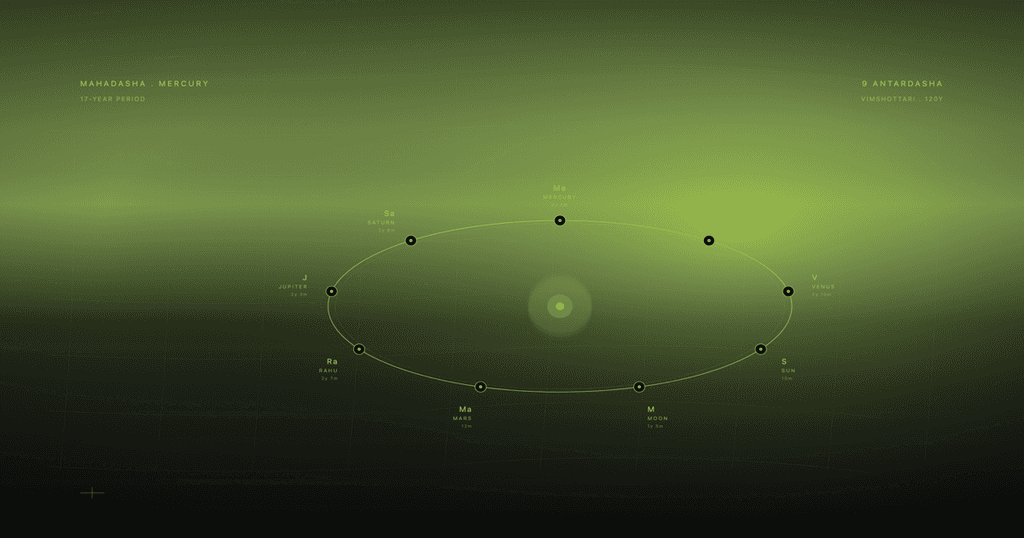
The 17-year Mercury mahadasha divides into nine antardasha sub-periods in fixed Vimshottari order starting with Mercury itself. The Venus sub-period sits at position 3 of 9. Exact start and end dates for any chart can be computed from the natal Moon nakshatra-pada and the date of Mercury mahadasha onset. The Tempora dasha engine produces this to the day.
Classical Mercury-Venus Friend-Pair pairing
Mercury and Venus are classical friends. The Venus antardasha inside Mercury mahadasha is the longest sub-period of the Mercury mahadasha (2 years 10 months) and classically pleasure-supportive: aesthetic-commerce, marriage-with-intellectual register, luxury-publishing or significant relational-intellectual integration.
Friendship status and pairing reading
In the classical Parashari friendship matrix, Mercury views Venus as friend. The friend-pair classification means the 2 years 10 months sub-period classically delivers outcomes where Mercury's register (intelligence, communication, commerce, writing and the youthful-skill register) and Venus's register (marriage, partnership, luxury, arts, comfort and aesthetic-relational refinement) integrate constructively. Events typically surface from both karaka domains in alignment rather than friction.
The Venus karaka overlay
Venus is the karaka of marriage, partnership, luxury, arts, comfort and aesthetic-relational refinement. Across the 2 years 10 months sub-period, this karaka set overlays on top of Mercury's 17-year intelligence, communication, commerce, writing and the youthful-skill register register. The combined reading is the central output of the sub-period.
How Venus's natal dignity shapes the reading
Venus's natal sign and house set the floor for the 2 years 10 months sub-period. Venus at exaltation gives the strongest reading. Own-sign and mooltrikona placement gives clean expression. Debilitation introduces friction that the sub-period must work through. Combust and retrograde state, conjunctions with malefics or benefics and the dispositor's strength all further modulate the reading. See the Venus mahadasha overview for the per-dignity breakdown.
Event classes typical to Mercury-Venus sub-period
The 2 years 10 months Mercury mahadasha Venus antardasha typically surfaces events across these specific domains:
- Constructive integration of Mercury-register with Venus-register: friend-pair sub-periods classically deliver outcomes where both planets' karakas align rather than friction.
- Activation of Mercury-Venus Friend-Pair (where the natal configuration supports it).
- Events in Venus's natural karaka domain: marriage, partnership, luxury, arts, comfort and aesthetic-relational refinement.
- Events specific to the natal house Venus occupies in the chart.
- Events where the Mercury-mahalord and Venus-antarlord houses (both natal and ruled) interact (aspect, mutual reception or natal conjunction).
Transit confirmation protocol
The sub-period reading sets a structural pressure floor of 2 years 10 months. Specific event timing inside that window requires the pratyantara (sub-sub-period) overlay and a transit cross-check.
Two transit overlays do most of the work. The standard targets to track: transit Mercury aspecting natal Venus, transit Venus through the natal 7th house, transit Mercury or Venus through the natal 2nd house of wealth, transit Saturn through the natal 7th house. These transits intensify the Mercury-Venus dynamic within the broader sub-period and concentrate event timing on those windows.
The pratyantara (sub-sub-period) inside the antardasha gives finer timing. The Mercury-Venus-Mercury pratyantara (about 4 months 8 days) and the Mercury-Venus-Venus pratyantara (about 4 months 16 days) carry the most concentrated marriage and partnership signal within the 32-month sub-period. The Mercury-Venus-Mercury pratyantara (about 2 months 20 days) reads as the emotional-bonding window often associated with engagement or first-meeting events. Cross-checking the pratyantara against the transit overlay gives event timing to the week. Tempora's dasha engine produces this data to the day for any chart.
What the framework does not predict
The Mercury-Venus reading is structural. It flags a 34-month window where the conditional probability of three named event classes lifts above chance, but it does not predict that any specific native will experience a specific event inside that window, nor the direction of any event that does fire.
A marriage or wealth event during the sub-period can read as the formal recognition of compatibility and accumulation built across the earlier Mercury Mahadasha sub-periods or as a one-off event that does not predict the broader relationship texture; the chart's deeper compatibility analysis determines durability. The framework times the pressure, not the result and timing finer than the antardasha band needs the pratyantara sequence and the transit overlay for the date in question.
How this connects to the broader Mercury Mahadasha
The Mercury-Venus sub-period is the third antardasha inside the 17-year Mercury Mahadasha. Reading the sub-period in isolation captures the 2 years 10 months; reading it inside the Mahadasha gives the broader arc that places the articulation meets pleasure reading in its proper structural context.
The Tempora Mercury Mahadasha method article covers the dispositor analysis, natal-house framework and the broader 6-year texture that this sub-period sits inside. The conditional probability framework holds across the full series: each antardasha is a flagged window for specific event classes whose probability is elevated relative to chance.
The arithmetic of this period
The constants give 17 times 20 over 120, which is 2.8333 years, exactly 2 years 10 months. Venus holds the third position: Mercury's own sub-period of 2 years 4 months 27 days plus Ketu's 11 months 27 days occupy the first 3.4 years, so this antardasha runs from roughly year 3.4 to year 6.2 of the 17-year span charted in the Mercury mahadasha overview.
An antardasha in the first half of a long mahadasha builds rather than harvests. The Venus window arrives while the mercurial register is still compounding, so its partnerships and ventures become inputs to the decade that follows instead of rewards for it, and the adjacent periods make the arc legible: Ketu's silence before it, the Sun's brief bid for singular authority after it and Venus in between doing the patient relational groundwork both neighbours lack. The same 2 years 10 months at the cycle's end would read as payout; here it reads as investment.
Setting the same antardasha inside other hosts shows what Mercury's 17 years buy it. The Venus sub-period runs exactly 1 year inside the Sun mahadasha (6 times 20 over 120) and 1 year 8 months inside the Moon mahadasha (10 times 20 over 120), against 2 years 10 months here. Only the Rahu, Saturn and Venus mahadashas grant Venus a longer minor period, which is why classical writers treat the Mercury-Venus stretch as a full chapter rather than an interlude.
What the tradition records for Mercury-Venus
For this pairing the BPHS antardasha chapters, Mercury mahadasha section, promise religious rites, ambitions fulfilled through king and friends and agricultural gains when Venus stands in a kendra or in the 5th, 9th or 11th, and the list escalates to kingdom, wealth and property, reservoir construction, charity and extraordinary business gains when the same strength holds from the dasha lord. A Venus weak in the 6th, 8th or 12th from Mercury inverts the reading toward heart disease, defamation, fevers, dysentery and separation from kin. Where Venus carries lordship of the 2nd or 7th the text attaches a health caution and prescribes Durga mantras as the remedial measure. Phaladeepika's bhukti chapter assigns adoration of gods, clothing, ornaments and the meeting of friends, in step with the favourable Parashari branch, so the two authorities agree on this combination. The engine reads that agreement as a classical input still subject to the natal chart's conditions.
This period against the 2026 to 2028 sky
Neither lord of this pairing carries a dated event in the engine's 2026 to 2028 transit calendar, so the honest statement is that no headline transit defines this sub-period in that window. Finding it in a life is therefore pure Vimshottari arithmetic: the natal Moon's nakshatra sets the sequence, the mahadasha onset date anchors it and the Venus window falls out of the sums to the day, 3.4 years after the Mercury mahadasha begins. The question box below computes this from a birth chart at no cost, and a native already inside the window sees the running mahadasha and antardasha named rather than inferred. The same lord running its twenty-year major period rather than a thirty-four-month minor one is covered in the Venus mahadasha overview.
Frequently asked questions
How long is the Mercury Mahadasha Venus Antardasha and where does it fall in the Vimshottari sequence?
The Mercury Mahadasha Venus Antardasha runs 2 years 10 months. It is the third antardasha inside the 17-year Mercury Mahadasha, opening after the Mercury-Ketu antardasha (11 months 27 days). The full sequence inside the Mercury Mahadasha runs Mercury-Mercury, Mercury-Ketu, Mercury-Venus, Mercury-Sun, Mercury-Moon, Mercury-Mars, Mercury-Rahu, Mercury-Jupiter and Mercury-Saturn. Exact start and end dates can be computed from the natal Mercury nakshatra-pada and the date of Mercury Mahadasha onset.
What does Venus signify in this sub-period and why does it read as articulation meets pleasure?
Venus is the karaka of pleasure, relationships, art, beauty, wealth, vehicles, comfort, marriage, partnership, aesthetic refinement. During the broader Mercury Mahadasha's intellect and articulation reading, Venus contributes the creative-commerce overlay. The sub-period sits at the third position in the antardasha sequence and reads as the Mercury intellect and commerce register meeting Venus's pleasure, beauty, marriage and ceremonial significations.
How does Venus's natal dignity shape the Mercury-Venus sub-period reading?
Venus's natal house, sign and aspectual state set the floor for the 34-month sub-period. Venus exalted in Pisces, in own sign Taurus or Libra or in angular houses (1st, 4th, 7th, 10th) softens the reading toward more auspicious outcomes. Venus debilitated in Virgo introduces friction. Aspects from Saturn bring sustained structural pressure; aspects from Mercury bring competitive or confrontational pressure.
What kinds of events historically correlate with the Mercury-Venus sub-period?
Three event classes correlate. Marriage and partnership events: Engagement, marriage, formal partnership commitments, significant relationship transitions. The Mercury-Venus sub-period is the highest-conditional-probability marriage window in the Mercury Mahadasha. Wealth and beauty-domain events: Wealth accumulation through arts, design, hospitality, fashion or luxury services. Vehicle purchases. Jewellery acquisition. Real-estate-as-comfort decisions. The texture is accumulation through Venus. Children events: Conception, pregnancy, childbirth, formal recognition of children (adoption, naming ceremonies, education milestones for existing children). The Mercury putra-karaka signification combined with Venus . The framework reads these as a structural-pressure window for the event class, not a deterministic predictor.
How does this sub-period connect to the broader Mercury Mahadasha?
The Mercury-Venus sub-period is the third antardasha inside the 17-year Mercury Mahadasha. It opens after the Mercury-Ketu antardasha (11 months 27 days). The sub-period reading is best held in tandem with the broader Mercury Mahadasha reading from the Tempora Mercury Mahadasha method article, which covers the natal house and dispositor framework that sets the texture of the full 16 years.
What does the Tempora framework not predict about this sub-period?
The framework identifies a structural-pressure window of approximately 2 years 10 months. It does not predict whether a specific native will experience a specific event in that window. It does not predict outcome direction. It does not predict timing finer than the sub-period band without overlaying the pratyantara (sub-sub-period) and the transit overlay for the date in question. The readings carry conventional weight from classical literature; the framework treats them as structural-pressure flags to cross-check against transit data.
Which years of the Mercury mahadasha does the Venus antardasha cover?
It is the third of the nine sub-periods. Mercury's own period and Ketu's together occupy the first 3.4 years, so the Venus window runs from roughly year 3.4 to year 6.2 of the 17-year cycle. Its duration is exactly 2 years 10 months, computed as 17 times 20 over 120.
How can I locate my own Mercury-Venus antardasha dates?
The Vimshottari sequence is fixed by the natal Moon's nakshatra, and the calendar dates follow from the date the Mercury mahadasha began. Adding the first two sub-periods places the Venus window 3.4 years after that onset, running 2 years 10 months. A computed chart resolves the exact start and end to the day.
What do the classical texts say about Mercury-Venus?
The two texts agree on this combination. BPHS gives religious rites, fulfilled ambitions and agricultural gains for a Venus in a kendra or the 5th, 9th or 11th, escalating to kingdom, reservoir construction and extraordinary business gains when the same strength holds from Mercury, and reserves heart disease, defamation and separation from kin for a Venus weak in the 6th, 8th or 12th from the dasha lord. Phaladeepika assigns adoration of gods, clothing, ornaments and the meeting of friends, matching the favourable branch. A Venus with lordship of the 2nd or 7th draws the health caution with Durga mantras prescribed. The engine conditions the agreed reading on the natal Venus before any window is flagged.
Read next
- Mahadasha: the nine-period Vimshottari framework · the broader cluster this sub-period sits inside
- Mercury Mahadasha Sun Antardasha · the next sub-period in the Vimshottari sequence
- Venus Mahadasha Venus Antardasha · the complementary sub-period in the prior Mahadasha
- Jupiter Mahadasha Venus Antardasha · the same antardasha planet in a different Mahadasha
- Mahadasha and Vimshottari planetary periods · the full nine-period framework
- Calibrated lift: the discipline that turns Vedic astrology into research
This article represents conventional Vedic teaching and Tempora Research method documentation. It does not constitute financial, legal or professional advice. Internal audit log maintained.