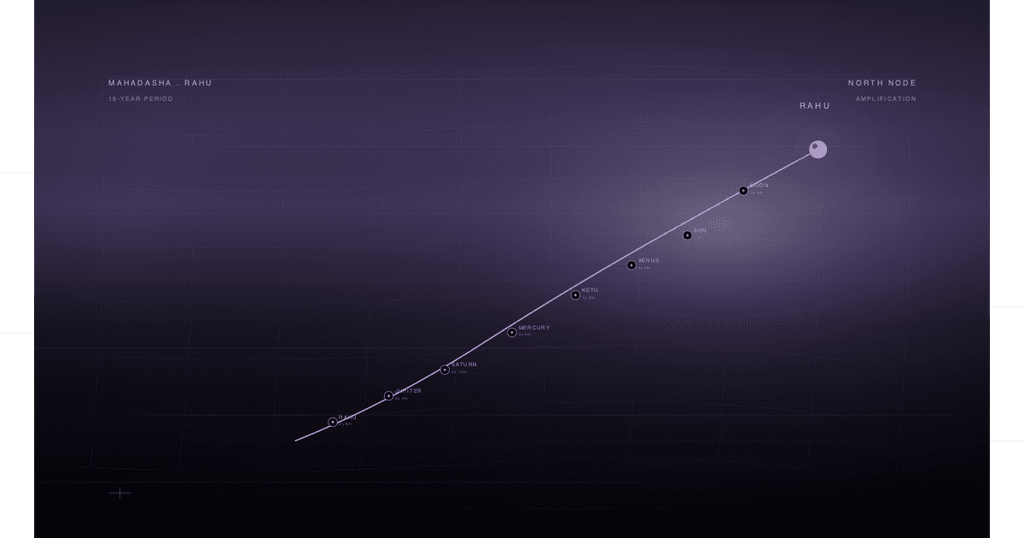
Rahu in the 6th House: Amplified Victory in Conflict. Upachaya plus Dusthana
The 6th house (Shatru Bhava, the seat of enemies, conflict, debt, daily service and chronic conditions) is the rare house in Vedic astrology that is simultaneously an upachaya (a house of growing strength through life) and a dusthana (a difficult house). The combination is what makes Rahu in the 6th one of the four placements where the lunar north node operates at its functional peak. The classical reading is straight: this is a victory placement.
Why the 6th house is structurally rare
Most houses in the Vedic chart fall cleanly into one classification or another. The 1st, 4th, 7th and 10th are kendras (angular houses of strength). The 5th and 9th are trikonas (trinal houses of merit). The 6th, 8th and 12th are dusthanas (houses of difficulty). The 3rd, 6th, 10th and 11th are upachayas (houses that grow stronger through life because they require effort to develop). The 6th house holds a position that no other house holds: it is both a dusthana and an upachaya. It is difficult and growing simultaneously.
This dual nature is the structural reason Rahu in the 6th reads as such a strong placement. Rahu is a shadow node and its mechanism is amplification through hidden routes. In a clean house (a kendra or trikona), Rahu's amplification can destabilise the house's natural smooth operation. In a pure dusthana (the 8th, the 12th), Rahu can intensify the difficulty without the compensating growth pattern. In a pure upachaya without dusthana texture (the 3rd, the 10th, the 11th), Rahu finds growth but without the friction Rahu actually needs to amplify against. Only the 6th house gives Rahu both the friction (dusthana) and the growth-arc (upachaya) in the same seat. For the foundational reading of this house across all twelve ascendants, see Tempora's 6th house reference.
The classical sources read this directly. Brihat Parashara Hora Shastra identifies Rahu in the 3rd, 6th, 10th and 11th as the four strong Rahu placements. Phaladeepika by Mantreshwara confirms the reading. Contemporary practitioners often go further and identify the 6th house specifically as the cleanest of the four because the conflict-and-growth dual texture matches Rahu's mechanism most precisely.
Victory over enemies and litigation
The 6th house is the seat of shatru (enemies), of vivada (disputes) and of all formal conflict. Rahu in the 6th delivers victory in this domain more consistently than any other placement of any planet. The pattern is recognisable across charts.
The conflicts the Rahu-in-6th native faces are typically unconventional in nature. The opponents are not the personal rivals or local enemies that an unaspected 6th house produces. They are foreign parties, anonymous adversaries, institutional or systemic opponents, regulatory bodies, intellectual property infringers, cross-border claimants or competitors operating in markets the native is entering for the first time. The conflict often looks asymmetric from the outside, with the Rahu-in-6th native appearing to be the underdog or the unconventional challenger.
The resolution pattern is also recognisable. Long-running cases that the legal system was expected to handle quickly turn into multi-year battles and the Rahu-in-6th native wins disproportionately. Regulatory matters that other parties give up on get pursued by the Rahu-in-6th native to resolution. Intellectual property disputes that look unwinnable at the outset turn the corner when the opponent's hidden weakness becomes visible. The mechanism is Rahu's hidden-amplification register: the native finds the leverage point the opponent did not anticipate.
This victory register is one of the reasons many lawyers, litigation specialists, regulatory consultants, foreign-market entry strategists and dispute-resolution practitioners carry Rahu in the 6th in their natal charts. The placement supports a career built around adversarial work in unconventional contexts.
The health register: amplification and recovery
The 6th house is also the seat of roga (disease, chronic conditions) and Rahu's amplification register applies here as well. The reading carries more nuance than the litigation reading.
The conditions the Rahu-in-6th native is prone to are typically unconventional in mechanism. Autoimmune disorders, in which the body's defence system targets its own tissues, are a textbook Rahu-in-6th signature because the mechanism itself is hidden and amplified. Chronic fatigue syndromes, allergic conditions, mystery viral illnesses, conditions that respond to alternative medicine more cleanly than to mainstream treatment, undiagnosed digestive disorders and conditions that consume substantial time inside the conventional medical system without arriving at a clean diagnosis all read as 6th-house Rahu textures.
The structural reading is not that the Rahu-in-6th native is more often sick than the population baseline. It is that the conditions the native does carry tend to be unconventional in mechanism, expensive in diagnostic energy and slow to resolve through mainstream pathways. Many of these natives find more reliable resolution through alternative medicine traditions (Ayurveda, classical Chinese medicine, functional medicine, lifestyle and dietary protocols) than through standard allopathic intervention. The 6th-house Rahu signature is part of the reason these natives often become advocates for or practitioners of alternative medicine through the run of life.
The compensating reading is recovery. The upachaya nature of the 6th house ensures that 6th-house themes strengthen through life rather than worsen. Many Rahu-in-6th charts demonstrate striking resilience: the body fights through serious illness and recovers in ways that exceed clinical expectation. The chronic conditions that destabilise other charts get integrated into the native's working life rather than ending it. The pattern is not absence of difficulty; it is repeated victory over difficulty.
Career, service and the disruptive niche
The 6th house is the seat of seva (service) and the daily work register. Rahu in the 6th amplifies the work themes into unconventional territory. The native often builds career success in fields that did not exist a generation ago or in service-delivery models that the legacy industry treats as disruptive.
Common career textures for this placement include regulatory consulting, foreign-market entry strategy, debt-recovery work, dispute-resolution practice, niche service businesses operating in regulatory gray zones, security or defence-adjacent ventures, alternative medicine practice, immigration law, cross-border tax advisory and any field that involves solving for problems the legacy market ignores. The unifying thread is that the work involves friction (a 6th-house theme) and the friction itself is the source of leverage.
Income from the 6th house tends to grow steadily through the run of life rather than arriving as a windfall. The upachaya nature ensures that early-career years are harder than late-career years; the Rahu amplification ensures that the late-career income compounds significantly above what the early-career trajectory suggested. Many Rahu-in-6th natives understate their lifetime earning potential in their 20s and surprise themselves in their 40s and 50s.
The 6th house also rules debt. Rahu in the 6th tends to deliver victory over debt rather than entrapment by it. The native may take on substantial debt at points in life (often for unconventional purposes) but the debt-resolution pattern reads consistently better than the population baseline. The classical reading on this is direct: a 6th-house Rahu native who takes a loan typically repays it; a 6th-house Rahu native who lends often recovers what is owed even when the recovery process is long.
Per-ascendant variation
Rahu in the 6th reads strongly for nearly all twelve ascendants because the structural benefit (upachaya plus dusthana) is independent of ascendant. The variation lies in which specific event-classes are most prominent. The table below captures the structural reading for each lagna.
| Ascendant | 6th sign | Dispositor | Structural reading |
|---|---|---|---|
| Aries | Virgo | Mercury | Analytical-litigation arc. Strong placement for legal practice, regulatory consulting, forensic accounting. Health register tilts toward digestive or analytical-system conditions. |
| Taurus | Libra | Venus | Partnership-mediated victory pattern. Disputes often resolved through negotiation rather than confrontation. Service business in aesthetic or luxury fields. |
| Gemini | Scorpio | Mars | One of the strongest readings. Intensity-mediated victory. Investigative, forensic, defence-adjacent careers. Health register tilts toward elimination or reproductive systems. |
| Cancer | Sagittarius | Jupiter | Strong placement. Jupiter as dispositor adds wisdom to the conflict-resolution pattern. Foreign litigation, international law, cross-border consulting. |
| Leo | Capricorn | Saturn | Disciplined-victory arc. Long-horizon dispute resolution. Government or institutional work succeeds. Late-career compounding particularly visible. |
| Virgo | Aquarius | Saturn | Unconventional-community service register. Technology-mediated conflict resolution, online dispute resolution, regulatory work in emerging markets. |
| Libra | Pisces | Jupiter | Softer reading. Jupiter as dispositor in a watery sign sometimes blunts competitive edge. Healing-service register strong. |
| Scorpio | Aries | Mars | Most outright competitive-victory arc. Mars as both lagna lord (in 6th-from-lagna calculation) and dispositor doubles the intensity. Defence, security, surgery, competitive sport. |
| Sagittarius | Taurus | Venus | Wealth-from-service arc. Service businesses in fields with material delivery. Health register tilts toward throat or thyroid conditions. |
| Capricorn | Gemini | Mercury | Communication-mediated victory. Strong for media-based dispute resolution, journalism, regulatory writing. Analytical-litigation arc. |
| Aquarius | Cancer | Moon | Empathy-mediated service. Health-care professions, social work, mental-health practice with strong recovery pattern. |
| Pisces | Leo | Sun | Authority-mediated victory. Government regulatory roles, public-facing dispute resolution, formal institutional service. |
For the ascendant-specific reading of Rahu mahadasha (the 18-year period in which 6th-house events typically activate at full register), Tempora maintains a dedicated piece for each lagna. The Scorpio ascendant reading at Rahu mahadasha for Scorpio ascendant is the place to begin for the most intense competitive-victory profile in the table.
When the moving sky touches this placement
The victory, health and service reading of a 6th-house Rahu is the standing condition; a slow transit across the 6th sign is what dates its activation. For a Virgo ascendant the 6th house is Aquarius, where transiting Rahu returns over its own natal seat from 9 June 2025 to 27 December 2026, driving the litigation and recovery register hardest through late 2026. For a Pisces ascendant the 6th house is Leo, occupied by transiting Ketu to 27 December 2026 and crossed by the solar eclipse of 12 August 2026 on the Cancer to Leo cusp, setting the south node and an eclipse on the natal Rahu. For an Aquarius ascendant the 6th house is Cancer, reached by exalted Jupiter from 27 May 2026 and by transiting Ketu from 27 December 2026 to 15 July 2028, so a benefic and a node cross the placement in sequence. Each window dates when the theme comes forward over a standing natal charge, so the transit triggers the moment and the chart owner holds the outcome. Rahu spends about eighteen months in each sign and returns to a natal sign about every eighteen years, which makes the node's own return the cleanest trigger for a 6th-house Rahu, running now for the Virgo ascendant and opening for a Leo ascendant whose 6th house is Capricorn from 27 December 2026 to 15 July 2028.
Timing: when 6th-house events activate
Events in the 6th-house domain typically activate during three timing windows. The Vimshottari dasha system is the primary timing engine.
First, Rahu mahadasha itself. The 18-year Rahu period brings the natal 6th-house placement to its full register. The Rahu-Saturn sub-period inside Rahu mahadasha is often the strongest competitive-victory window because Saturn shares the 6th-house disciplinary register. The Rahu-Mars sub-period intensifies the conflict register directly. The Rahu-Mercury sub-period activates analytical and litigation themes.
Second, mahadashas of the 6th lord, of Saturn (as karaka for service and chronic conditions), of Mars (as karaka for competition and surgery) and of Rahu's dispositor. Each activates a specific subset of the 6th-house event classes. The 6th lord's dasha is often the primary external activator. Mars and Saturn dashas activate the karaka registers directly.
Third, transit confirmation. Transit Rahu over the natal 6th house and transit Saturn over the natal 6th lord often deliver the dated event. The upachaya growth pattern means that 6th-house themes intensify through life rather than peak early; the strongest victory-in-conflict events for many charts arrive in the second half of Rahu mahadasha rather than the first. For the broader cycle context relevant to this placement's competitive register, see Tempora's Rahu mahadasha overview.
The classical context and modern updates
The classical sources unanimously praise Rahu in the 6th. The contemporary practice extends the reading by noting that the unconventional dimension of 6th-house themes has expanded dramatically. Cross-border litigation as a regular feature of life, regulatory matters spanning multiple jurisdictions, intellectual property disputes operating in technology contexts that did not exist when the BPHS was composed, autoimmune diseases that the classical Ayurvedic literature did not have terminology for and service businesses delivered through digital platforms all read cleanly as 6th-house themes in the modern chart. The Rahu-in-6th placement, which was already strong in the classical reading, reads even more clearly in the contemporary context because the unconventional dimension of 6th-house themes is now central rather than peripheral. For the structural reading of the related marriage-axis dynamics that often pair with this placement, see Tempora's marriage delay diagnosis and the Manglik Dosha piece.
What the placement does not predict
Rahu in the 6th does not predict the absence of difficulty. It predicts repeated victory over difficulty. The native still faces the conflicts, the disputes, the health challenges and the service-work friction that the 6th house carries. The placement's strength lies in the resolution pattern, not in the avoidance pattern. A reader who expects Rahu in the 6th to deliver a frictionless life is reading the placement wrong; the texture is friction with consistent positive resolution.
The placement also does not stand alone. The 6th lord's placement, the strength of Mars and Saturn as karakas, the condition of Rahu's dispositor and the running mahadasha all modulate the reading. A debilitated dispositor or a heavily afflicted 6th lord can blunt the victory pattern. A strong supporting chart amplifies it further.
Frequently asked questions
Why is Rahu in the 6th house considered one of the strongest placements?
The 6th house is both an upachaya (a house of growing strength) and a dusthana (a difficult house of enemies, debt and illness). The combination is rare in Vedic astrology. Most houses are one or the other. Rahu thrives in this dual nature because Rahu itself works through hidden amplification. The 6th house gives Rahu material to amplify (enemies, competitors, litigation, chronic conditions) and the upachaya nature ensures Rahu defeats or transforms each one over time. Classical sources from Brihat Parashara Hora Shastra to Phaladeepika treat Rahu in the 3rd, 6th, 10th and 11th as the four strongest Rahu placements and the 6th typically reads as the most outright victorious of the four.
What does Rahu in the 6th house mean for enemies and litigation?
Rahu in the 6th house signals defeat of enemies and victory in litigation, particularly in conflicts that cross conventional boundaries. The native often faces unconventional opponents (foreign parties, anonymous adversaries, institutional or systemic enemies rather than personal rivals) and tends to prevail in disputes where the opponent expected an easy win. Long-running litigation, regulatory battles, intellectual property disputes and cross-border legal matters resolve in the Rahu-in-6th native's favour more often than chance would predict. The pattern strengthens through the run of life because the 6th house is an upachaya.
Does Rahu in the 6th house cause health problems?
Rahu in the 6th house carries a health-amplification register. The native is prone to conditions that the conventional medical system has difficulty diagnosing (autoimmune disorders, chronic fatigue, allergic syndromes, mystery viral illnesses, conditions that respond to alternative medicine more cleanly than to mainstream treatment). The structural reading is not that the native is more often sick, but that the conditions the native does carry tend to be unconventional in mechanism. Many Rahu-in-6th charts also show resilience: the body fights through serious illness and recovers in ways that exceed clinical expectation. The upachaya nature of the 6th house supports the recovery pattern.
Is Rahu in the 6th house good for career and finances?
The 6th house is the house of service, employment and the daily work register. Rahu in the 6th amplifies the work themes into unconventional territory. The native often builds career success in fields that did not exist a generation ago or in service-delivery models that the legacy industry treats as disruptive. Income from the 6th house tends to grow steadily through the run of life rather than arriving in a single windfall. The placement is particularly strong for entrepreneurial paths that involve solving for problems the legacy market ignores (regulatory consulting, foreign-market entry, niche service businesses, debt-recovery work, security or defence-adjacent ventures). The 6th house also rules debt and Rahu in the 6th tends to deliver victory over debt rather than entrapment by it.
What is the timing of Rahu-in-6th-house events?
Events in the 6th-house domain typically activate during Rahu mahadasha (the 18-year period of Rahu) and during mahadashas of the 6th lord, Saturn (as karaka for service and chronic conditions), Mars (as karaka for competition and surgery) and Rahu's dispositor. Transit Rahu over the natal 6th house and transit Saturn over the natal 6th lord often deliver dated events. The upachaya growth pattern means 6th-house Rahu themes intensify through life rather than peaking early. Mid-mahadasha years inside Rahu dasha typically deliver the most significant victory-in-conflict events for charts that carry this placement.
Which ascendants are best for Rahu in the 6th house?
Rahu in the 6th house reads strongly for nearly all ascendants because the upachaya plus dusthana combination supports Rahu's amplification register universally. Aries and Scorpio ascendants often see the most outright competitive-victory arcs because Mars (the natural ruler of conflict) is the lagna lord. Cancer ascendant places Rahu in Sagittarius, where Jupiter as dispositor adds expansive support to the 6th-house themes. Capricorn ascendant places Rahu in Gemini, where Mercury as dispositor supports analytical and litigation-related victories. The weakest ascendant for this placement is Libra, where Rahu in Pisces with Jupiter as dispositor in a soft-watery sign sometimes blunts the competitive edge.
How does Rahu in the 6th house differ from Saturn in the 6th house?
Both placements support the 6th-house themes of victory in competition and growth through difficulty, but they differ in mechanism. Saturn in the 6th delivers slow, structural, grinding victory through discipline and time. The Saturn pattern is patient endurance that wears the opponent down. Rahu in the 6th delivers amplified, often sudden, unconventional victory through routes the opponent did not anticipate. The Rahu pattern is asymmetric leverage that exploits the opponent's blind spot. Both are strong placements. Saturn is preferred when the native values stability and known mechanism; Rahu is preferred when the native is comfortable with unconventional paths and tolerates higher variance in route.
When is a natal Rahu in the 6th house activated in 2026 to 2028?
The 6th-house reading is the standing condition; a slow transit across its sign dates the activation. A Virgo ascendant holds the 6th in Aquarius, where transiting Rahu returns over its own seat from 9 June 2025 to 27 December 2026. A Pisces ascendant holds it in Leo, occupied by transiting Ketu to 27 December 2026 and marked by the 12 August 2026 solar eclipse on the Cancer to Leo cusp. An Aquarius ascendant holds it in Cancer, crossed by exalted Jupiter from 27 May 2026 and by transiting Ketu from 27 December 2026 to 15 July 2028. Rahu takes about eighteen months per sign and returns to a natal sign about every eighteen years, so its return is the direct trigger, and each window dates when the health and litigation theme surfaces while the outcome stays open.
Read next
This article is a method reference for Rahu in the 6th house (Shatru Bhava), the dual upachaya plus dusthana classification and the per-ascendant variation in event-class profile. The classical framework follows Brihat Parashara Hora Shastra (BPHS) chapters on house significations and Phaladeepika by Mantreshwara on planetary placement readings. The four-strong-Rahu-placements rule (3rd, 6th, 10th, 11th) is cross-validated across the BPHS, Phaladeepika and Saravali traditions. Engine: Swiss Ephemeris with True Pushya Paksha (PVRN Rao) ayanamsa. Internal audit log maintained. This article does not constitute medical, financial, legal or professional advice. First published 2026-06-05 by Tempora Research.