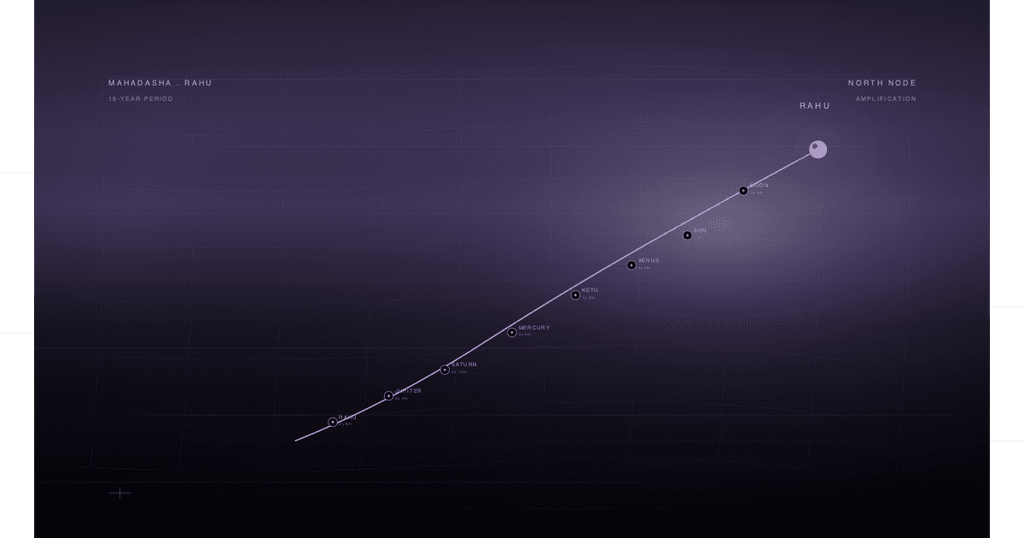
Rahu in the 7th House: Foreign Spouse and Unconventional Partnership
The 7th house (Kalatra Bhava, the seat of formal partnership, marriage, business association and the way the native is read in the public marketplace) is the partnership angle of the chart. Rahu in the 7th amplifies the partnership themes and bends them toward the boundary-crossing register. The placement does not predict the absence of marriage; it predicts that the marriage will not look like the cultural template the native was raised inside.
The 7th house and why Rahu amplifies it
The 7th house in the rashi chart sits directly opposite the 1st house (the seat of the self) and represents everything the native is not, in partnership form. The Sanskrit name Kalatra Bhava translates as the house of spouse. The practical scope is broader. The 7th house holds formal partnership, business association, the public face of the native (how the native is read in the marketplace), foreign travel and sometimes residence abroad, public-facing visibility and the kinds of recognition that come from being seen with someone else. For the foundational reading of this house across all twelve ascendants, see Tempora's 7th house reference.
Rahu is the lunar north node and its mechanism is amplification of whatever sits in the house it occupies, with a bend toward the non-classical register. In the 7th house, this produces a recognisable signature. The native is drawn to partners who are not the partners the family, the community or the cultural template would predict. The relationship itself carries a boundary-crossing dimension: the native and the partner together cover ground that neither would cover alone. The public-facing visibility of the partnership tends to be higher than it would be without Rahu in the 7th; the relationship is more often seen, read, photographed or discussed than the unaspected 7th would produce.
The classical sources treat this placement with caution. Brihat Parashara Hora Shastra notes Rahu in the 7th can produce marital instability, separation, remarriage or a partner whose conduct disturbs the household. The contemporary reading is more nuanced. The same structural amplification that the classical literature read as instability is the same structural amplification that delivers durable cross-cultural marriages in the modern context, where boundary-crossing partnerships are increasingly common and increasingly stable. The instability reading is correct for charts where additional affliction sits on the 7th house; the stable-cross-cultural reading is correct for charts where Rahu in the 7th is supported by a strong 7th lord and well-placed marriage karakas.
The foreign-spouse register
The most recognisable delivery of Rahu in the 7th is the foreign-spouse register. The native marries someone from a different country, a different cultural tradition, a different religious background, a different language family or a different social class from the family of origin. The marriage often comes about through routes the classical literature did not have words for: international education, work assignments abroad, online relationship-formation platforms, foreign residency for unrelated reasons that delivered an unexpected partner.
In contemporary Indian charts, foreign-spouse deliveries are increasingly common because globalisation has made the route easier to traverse. A Rahu-in-7th chart born in the 1990s and reaching marriage age in the 2020s is statistically more likely to deliver a literal foreign spouse than the same placement would have delivered a generation ago. The structural amplification is constant; the social conditions that allow the amplification to deliver have expanded.
In earlier generations and in charts where international travel is not part of the life pattern, the same structural amplification often delivered inter-community marriage within India, inter-faith marriage, marriage with a partner from a different linguistic region of the subcontinent or marriage with a partner from a different caste or community. The Rahu mechanism does not require crossing an international border; it requires crossing a boundary that the family of origin treats as significant. The boundary itself is what amplifies.
For the broader marriage-timing reading that often pairs with this placement, see Tempora's marriage delay diagnosis, which covers the four-layer structural reading of marriage timing across the natal chart.
Marriage timing: early or late, rarely in between
Marriage timing for Rahu-in-7th charts shows a bimodal distribution that differs from the population baseline. The conventional cultural template predicts marriage in the mid-to-late 20s for most Indian charts. Rahu in the 7th tends to push marriage either significantly earlier than this (early 20s, sometimes late teens for women in earlier generations) or significantly later (mid-30s or later, sometimes 40s for first marriage). The conventional middle window is the least common delivery for this placement.
The early-marriage pattern often correlates with charts where Rahu's dispositor is strong, where Venus or Jupiter as marriage karakas are well-placed and where the 7th lord sits in a strong house. The amplification delivers the partnership event early because the structural support is present from the beginning of adulthood. The late-marriage pattern correlates with charts where the supporting karakas need maturation time, where the dispositor is afflicted or where the lagna lord is heavily engaged with non-partnership themes (career, education, family obligations) through the early adult years. The amplification still delivers the partnership event, but only after the supporting conditions consolidate.
The timing engine for the dated event is the Vimshottari dasha system combined with transit confirmation. Rahu mahadasha (the 18-year period of Rahu) is the strongest marriage-delivery window for charts with this placement. Venus mahadasha and Jupiter mahadasha (as marriage karakas) also activate the 7th-house events strongly. The dasha of the 7th lord and the dasha of Rahu's dispositor each carry their own activation pattern. Transit Jupiter or transit Saturn over the natal 7th house, the 7th lord or the lagna delivers the dated event. The 18.6-year Rahu nodal cycle correlates with relationship pivots even outside the Rahu mahadasha proper.
Business partnership and public visibility
The 7th house also rules business partnership, public dealings and the way the native is read in the marketplace. Rahu in the 7th amplifies these themes into unconventional territory.
The native often builds business partnerships with foreign collaborators, with partners from unusual backgrounds or in fields the classical business literature did not address. Cross-border joint ventures, partnerships with parties from different commercial cultures, collaborations built on non-classical complementarity (a domain expert and a generalist, an early-stage operator and a late-stage capital allocator, a creative practitioner and a regulatory specialist) all read as natural fits for the placement. The amplification cuts both ways. A well-placed Rahu in the 7th can deliver outsized success in these unconventional partnerships. A poorly placed Rahu in the 7th can produce a sequence of unstable partnerships, betrayal patterns or partnerships that look strong externally but carry hidden agendas only the native discovers after committing.
Public-facing visibility is a recurring theme. The native with Rahu in the 7th tends to be read by the public through the partnership rather than independently. The spouse's profile, public role or visibility often complements or amplifies the native's own. Many high-visibility couples, particularly in entertainment, politics, business and creative fields, carry Rahu in the 7th in one or both charts. The placement does not produce the visibility on its own; it produces a partnership through which visibility arrives.
Per-ascendant variation
The same Rahu-in-7th placement reads differently across the twelve ascendants because the 7th house sits in a different sign for each lagna. The dispositor varies, the friend-or-enemy relationship between Rahu and the dispositor varies and the natural status of the dispositor varies. The table below captures the structural reading for each lagna.
| Ascendant | 7th sign | Dispositor | Structural reading |
|---|---|---|---|
| Aries | Libra | Venus | Strong placement. Venus as natural marriage karaka and dispositor handles the partnership directly. Foreign-spouse delivery clean. Public partnership visibility high. |
| Taurus | Scorpio | Mars | Intense partnership register. Marriages can carry transformational quality. Business partnerships in defence, security or investigative fields read well. |
| Gemini | Sagittarius | Jupiter | Cross-cultural and cross-philosophical marriages strong. Partnerships with foreign academic, publishing or teaching partners common. |
| Cancer | Capricorn | Saturn | Saturn as dispositor adds durability. Marriages tend to be late but stable. Spouse often older or in a structurally senior position. |
| Leo | Aquarius | Saturn | Unconventional-community partnerships. Technology-mediated relationships. Spouse from a non-traditional background or community. |
| Virgo | Pisces | Jupiter | Idealisation register can be strong. Partner often spiritually or artistically inclined. Read with care: idealisation can outrun reality. |
| Libra | Aries | Mars | Direct partnership register. Marriages often through bold, decisive courtship rather than slow drift. Public visibility high. |
| Scorpio | Taurus | Venus | Possessive or material-focused partnership themes. Wealth-mediated marriage register. Read with care: amplification on material themes specifically. |
| Sagittarius | Gemini | Mercury | Communication-mediated cross-cultural relationship. Strong for partnerships with media, journalism or writing partners. Multiple-language households common. |
| Capricorn | Cancer | Moon | Emotional-amplification register. Partner often from a maternal or home-oriented profession. Late marriage with strong family-formation pattern. |
| Aquarius | Leo | Sun | Authority-mediated partnership. Spouse often in a public or government-facing role. Public visibility of the couple particularly high. |
| Pisces | Virgo | Mercury | Analytical-pragmatic partnership register. Spouse from a service, medical or technical background. Practical complementarity rather than romantic idealisation. |
For the ascendant-specific reading of Rahu mahadasha (the 18-year period in which 7th-house events typically activate at full register), Tempora maintains a dedicated piece for each lagna. The Aries ascendant reading at Rahu mahadasha for Aries ascendant is the place to begin for the strongest profile in the table.
This placement under the 2026 to 2028 transits
A 7th-house Rahu keeps a standing pull on partnership and public dealings; the transiting sky decides when that pull is brought to the surface. For a Leo ascendant the 7th house is Aquarius, where transiting Rahu returns over its own natal position from 9 June 2025 to 27 December 2026, so the marriage and alliance register reads at full volume through late 2026. For an Aquarius ascendant the 7th house is Leo, held by transiting Ketu to 27 December 2026 and crossed by the 12 August 2026 solar eclipse on the Cancer to Leo cusp, which lands the south node and an eclipse point on the natal Rahu. For a Capricorn ascendant the 7th house is Cancer, where exalted Jupiter transits from 27 May 2026 and transiting Ketu arrives from 27 December 2026 to 15 July 2028, so a benefic pass and a node reach the partnership axis one after the other. These are dated activation windows above a standing natal condition, so the transit sets the timing and the placement holds the theme while the result stays with the people involved. Because Rahu walks a sign in about eighteen months and returns to a given sign about every eighteen years, its own return is the direct trigger for a 7th-house Rahu, live now for the Leo ascendant and reaching a Cancer ascendant whose 7th house is Capricorn from 27 December 2026 to 15 July 2028.
What distinguishes Rahu from Ketu on the partnership axis
The lunar north and south nodes operate as opposites on the partnership axis. Rahu in the 7th carries an outward-seeking, foreign-engagement, amplification register. The native is drawn to the unconventional partner and the boundary-crossing relationship. The 1st-house Ketu that pairs with this 7th-house Rahu places the native in the self-detaching, inward-spiritual register at the level of identity. The native may carry a strong individual self-discipline practice while the partnership delivers the boundary-crossing engagement.
Ketu in the 7th carries the opposite signature: inward-detaching, dissolution-oriented, often with a past-life or karmic-residue pattern that pulls toward solitude or toward partnerships that dissolve as the relevant lesson is integrated. Many spiritually oriented natives carry Ketu in the 7th. Rahu in the 7th delivers more partnership events with higher variance in stability; Ketu in the 7th delivers fewer partnership events but with stronger karmic resolution when they do occur. Reading the Rahu-Ketu axis as a whole rather than as two independent placements is what allows the partnership reading to settle.
Timing: when 7th-house events activate
Events in the 7th-house domain typically activate during three timing windows that the reader can compute from the chart.
First, Rahu mahadasha. The 18-year Rahu period brings the natal 7th-house placement to its full register. The Rahu-Venus sub-period inside Rahu mahadasha is often the strongest marriage-delivery window. The Rahu-Jupiter sub-period activates the formal marriage signature when Jupiter is the marriage karaka. The Rahu-Saturn sub-period tests the durability of any partnership formed earlier in the mahadasha.
Second, mahadashas of Venus, Jupiter, the 7th lord and Rahu's dispositor. Venus mahadasha activates the partnership register directly because Venus is the natural karaka for marriage in male charts. Jupiter mahadasha activates the formal-marriage register because Jupiter is the natural karaka for marriage in female charts. The 7th lord's dasha activates the partnership theme through the lord's house placement. The dispositor's dasha activates the texture of Rahu's delivery for that chart specifically.
Third, transit confirmation. Transit Jupiter or transit Saturn over the natal 7th house or the natal 7th lord delivers the dated event. The 18.6-year Rahu nodal cycle correlates with relationship pivots even when Rahu mahadasha is not running. For the broader cycle context relevant to this placement, see Tempora's Rahu mahadasha overview.
What the placement does not predict
Rahu in the 7th house does not predict divorce, instability or marital failure on its own. It predicts the unconventional register of the partnership. The reading is reliable only when read alongside the 7th lord, Venus and Jupiter as marriage karakas and Rahu's dispositor. A reader who sees Rahu in the 7th and concludes that marriage will fail has misread the placement; the failure prediction requires substantial additional affliction across the 7th-house support layers.
The placement also does not predict the partner's identity, the precise context of meeting or the durability of the eventual marriage in calendar terms. It predicts the structural signature of how the partnership theme delivers. The Mangal Dosha reading often pairs with this placement when Mars also engages the 7th house; for that overlay, see Tempora's Manglik Dosha piece.
Frequently asked questions
What does Rahu in the 7th house mean for marriage?
Rahu in the 7th house (Kalatra Bhava) does not predict the absence of marriage; it predicts the unconventional nature of it. The spouse typically comes from a different cultural background, a different religion, a different country or a different social register from the native. Marriage often happens at non-conventional ages (significantly earlier or later than the cultural norm) and through non-conventional routes (online platforms, work travel, foreign residency, introductions through unusual contexts). The relationship itself carries a boundary-crossing register: the native and the spouse together cover ground that neither would cover alone. The placement is the structural amplifier; the practical texture depends on the 7th lord's placement, Venus and Jupiter dignity and Rahu's dispositor.
Does Rahu in the 7th house cause divorce?
The classical literature treats Rahu in the 7th cautiously, noting it can produce marital instability, separation or remarriage. The contemporary reading is more nuanced. Many Rahu-in-7th charts deliver durable, unconventional marriages with no separation pattern at all; what looks unstable in the classical framework often reads as functional adaptation to a non-classical partnership structure in the modern context. The divorce probability rises specifically when the 7th lord is debilitated or in dusthana (6th, 8th, 12th), when Venus or Jupiter as marriage karakas carry heavy affliction or when the Rahu placement co-occurs with a strong Saturn aspect on the 7th. Rahu alone in the 7th, with supporting karakas, often delivers durable cross-cultural marriage.
Does Rahu in the 7th house mean a foreign spouse?
Foreign spouse is one of the most common deliveries of Rahu in the 7th, but it is not the only delivery. The structural signal is boundary-crossing in the partnership, which can manifest as a partner from a different country, a different religion, a different caste or community, a different language background, a significantly different age, a different social class or a non-classical relationship structure (inter-faith marriage, blended family, partner from a profession or background the native's family did not anticipate). In contemporary Indian charts, foreign-spouse deliveries are increasingly common because globalisation has made the boundary-crossing easier to traverse. In earlier generations the same placement often delivered inter-community or inter-regional marriage within India.
Is Rahu in the 7th house good for business partnerships?
The 7th house also rules business partnership, public dealings and the way the native is read in the marketplace. Rahu in the 7th amplifies these themes into unconventional territory. The native often builds business partnerships with foreign collaborators, with partners from unusual backgrounds or in fields the classical business literature did not address. The amplification cuts both ways. A well-placed Rahu in the 7th can deliver outsized success in cross-border ventures, joint ventures with international firms or partnerships built on non-classical complementarity. A poorly placed Rahu in the 7th can produce a sequence of unstable partnerships, betrayal patterns or partnerships that look strong externally but carry hidden agendas. The 7th lord's condition and the dispositor of Rahu determine which side the placement delivers on.
What is the timing of Rahu-in-7th-house marriage events?
Marriage timing for Rahu-in-7th charts typically activates during Rahu mahadasha (the 18-year period of Rahu), during mahadashas or antardashas of Venus or Jupiter (the marriage karakas), during the dasha of the 7th lord or during the dasha of Rahu's dispositor. Transit Jupiter or transit Saturn over the natal 7th house or the natal 7th lord delivers the dated event. The Rahu nodal cycle of 18.6 years often correlates with relationship pivots even outside Rahu mahadasha. Many Rahu-in-7th natives experience either significantly early marriage (in early-to-mid 20s) or significantly delayed marriage (in mid-30s or later); the middle window of the cultural norm is less common because Rahu's amplification register tends to push marriage either ahead of or behind the conventional schedule.
How does Rahu in the 7th differ from Ketu in the 7th?
The two nodes operate as opposites on the partnership axis. Rahu in the 7th carries an outward-seeking, foreign-engagement, amplification register. The native is drawn to the unconventional partner and the boundary-crossing relationship. Ketu in the 7th carries an inward-detaching, dissolution-oriented register. The native often carries a past-life or karmic-residue pattern that pulls toward solitude or toward partnerships that dissolve as the lesson is integrated. Many spiritually-oriented natives carry Ketu in the 7th. Rahu in the 7th delivers more partnership events but with higher variance in stability; Ketu in the 7th delivers fewer partnership events but with stronger karmic resolution when they occur. The two placements are read together when interpreting the Rahu-Ketu axis specifically.
Which ascendants are best and worst for Rahu in the 7th house?
Rahu in the 7th reads more strongly when the dispositor supports relationship stability. Aries and Libra ascendants place Rahu in Libra and Aries respectively, where Venus and Mars as dispositors handle the partnership register directly. Cancer ascendant places Rahu in Capricorn, where Saturn as dispositor adds structural durability to the unconventional marriage pattern. Sagittarius ascendant places Rahu in Gemini, where Mercury supports the communication-mediated cross-cultural relationship. The most demanding readings are typically Scorpio ascendant (Rahu in Taurus with Venus as dispositor, where the partnership themes can become possessive or material-focused) and Virgo ascendant (Rahu in Pisces with Jupiter dispositor in a soft sign, which can produce idealisation patterns that don't survive contact with the actual partner).
When is a natal Rahu in the 7th house activated in 2026 to 2028?
A 7th-house Rahu is the standing condition; a slow transit over its sign dates the activation. A Leo ascendant holds the 7th in Aquarius, where transiting Rahu returns over its own position from 9 June 2025 to 27 December 2026. An Aquarius ascendant holds it in Leo, occupied by transiting Ketu to 27 December 2026 and marked by the 12 August 2026 solar eclipse on the Cancer to Leo cusp. A Capricorn ascendant holds it in Cancer, crossed by exalted Jupiter from 27 May 2026 and by transiting Ketu from 27 December 2026 to 15 July 2028. Rahu crosses a sign in about eighteen months and returns to a natal sign about every eighteen years, so its own return is the direct trigger, and each window dates when the partnership theme comes forward without fixing what the couple does.
Read next
This article is a method reference for Rahu in the 7th house (Kalatra Bhava) and the per-ascendant variation in marriage and partnership event-class profile. The classical framework follows Brihat Parashara Hora Shastra (BPHS) chapters on house significations and Phaladeepika by Mantreshwara on planetary placement readings. The contemporary reading honours cross-cultural and inter-faith marriages as legitimate Rahu-in-7th deliveries rather than failures of the classical signature. Engine: Swiss Ephemeris with True Pushya Paksha (PVRN Rao) ayanamsa. Internal audit log maintained. This article does not constitute medical, financial, legal or professional advice. First published 2026-06-05 by Tempora Research.