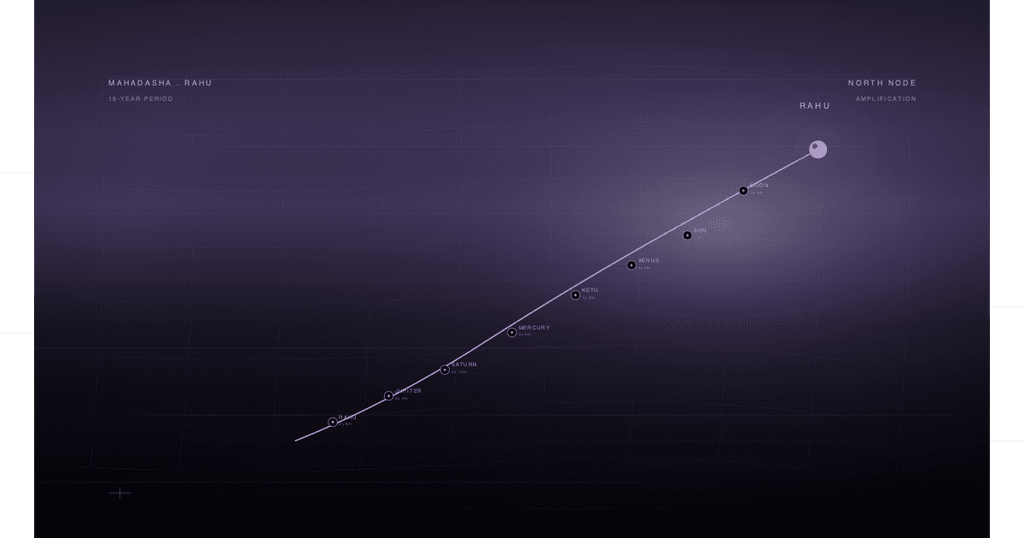
Rahu in the 8th House: Occult Research and Hidden Amplification
The 8th house (Ayur Bhava, the seat of transformation, inheritance, longevity, the occult and hidden matters) is the chart's most intense dusthana. Rahu, the lunar north node, brings its hidden-amplification register to the house that already governs hidden matters. The combination is one of the most structurally loaded placements in the natal chart. The classical literature treats it cautiously. The contemporary reading treats it as intense rather than universally negative.
The 8th house and why this placement is structurally heavy
The 8th house in the rashi chart is the deepest dusthana of the chart. The Sanskrit name Ayur Bhava translates as the house of longevity, but the practical scope is wider. The 8th house holds transformation (the kind of change that ends one phase of life and starts another), inheritance (any income that does not arrive through earned work), the partner's wealth (in the 2nd-from-7th calculation), occult and esoteric knowledge, hidden pathology in the body, sudden events of any kind, the underworld of social or institutional structures and the moment-of-death itself in the longevity reading. For the foundational reading of this house across all twelve ascendants, see Tempora's 8th house reference.
Rahu is the lunar north node and its mechanism is amplification of whatever sits in the house it occupies, with a strong bend toward the hidden and the non-classical register. Rahu's natural temperament and the 8th house's natural domain reinforce each other directly. The 8th house already holds the hidden material; Rahu amplifies the hidden material further. The result is a placement where the chart's transformation register, inheritance register, occult register and health-volatility register all operate at higher intensity than the baseline 8th-house reading would suggest.
This is why the classical literature treats the placement cautiously. Brihat Parashara Hora Shastra notes Rahu in the 8th as carrying risk of unexpected events, health-related volatility, entanglement with hidden matters and complex inheritance disputes. Phaladeepika carries similar caution. The contemporary reading does not contradict the classical caution; it adds the observation that the same intensity that produces the risks also produces the openings. The placement is structurally heavy in both directions. Whether it delivers as transformation or as overwhelm depends substantially on the support layers: Jupiter's aspect on the 8th, the 8th lord's placement and the dignity of Rahu's dispositor.
Occult research and the genuine hidden-knowledge register
The 8th house is the seat of guhya (hidden matters) and of the kind of intelligence that does not surface in everyday awareness. Rahu in the 8th amplifies access to this register. The result is a recognisable signature: the native is drawn to fields that involve uncovering, decoding or working with material that the mainstream cannot easily see.
The contemporary fields that map cleanly onto this signature include forensic investigation, journalism focused on uncovering scandal, medical research on undiagnosed conditions, archaeology, deep-history scholarship, intelligence work (in both the state and the corporate sense), cryptography, financial forensics, scientific research on phenomena the mainstream has not yet integrated (consciousness studies, parapsychology research, fringe physics) and any field that involves the systematic study of hidden mechanism. The classical occult fields (astrology, palmistry, numerology, tarot, classical Vedic ritual technology, shamanic practices, mediumship) also pair naturally with this placement; many practising astrologers and esoteric researchers carry Rahu in the 8th.
The pattern is genuine because Rahu's amplification register and the 8th house's hidden-material register reinforce each other directly. The native is not pulled into these fields by family pressure or career calculation; the pull is structural. Many natives with this placement describe an early-life fascination with secret knowledge, hidden mechanisms, mystery and the territory just beyond the mainstream consensus that they never quite shake off, regardless of what other career paths they attempt.
The reading carries one caveat. The same structural openness that delivers genuine research depth can also deliver destabilising experiences when the support framework is thin. A Rahu-in-8th native with weak Mercury, weak Jupiter and a stressed Mars may carry strong intuitive openness without the integration apparatus to do anything stable with it. Where the support layers are present, the openness consolidates into research output. Where they are absent, the openness can produce more confusion than clarity. Tempora's reading treats these themes as research subjects rather than as proof of supernatural claims; the position is that the structural openness is real and the practical effects are real, while the metaphysical interpretation is for the native to settle individually.
Inheritance: amplified, non-classical routes
The 8th house is the classical seat of inheritance. Joint resources, the partner's wealth, any income that arrives through non-earned mechanisms and the legal-financial machinery of estate settlement all live in this house. Rahu in the 8th amplifies the inheritance register through non-classical routes.
Common inheritance deliveries for this placement include unexpectedly large inheritance from non-classical sources (a distant relative, a non-family member, a legal settlement, a windfall from unanticipated quarters), inheritance through foreign or cross-border legal processes (estate proceedings in another country, settlements involving multiple jurisdictions, inheritance that requires immigration or visa-related legal work to claim), inheritance that arrives through complex or contested mechanisms (litigation between heirs, settlements that take years to resolve, inheritance that the native is initially excluded from and later included in) and significant income from the partner's wealth that exceeds the native's own earnings.
The placement does not guarantee inheritance. It amplifies whatever inheritance signature the chart carries elsewhere. A chart with no inheritance signature in the 8th lord placement, in Jupiter's condition or in the 2nd-from-7th reading will not produce inheritance out of Rahu alone. What Rahu does is bias the inheritance route, when inheritance does happen, toward the non-classical. The classical route (parent-to-child intra-family inheritance arriving on schedule) is the least common Rahu-in-8th delivery; the non-classical routes are the more common ones.
Health and longevity: high variance with strong recovery
The 8th house is also the seat of ayur (lifespan, longevity) and of unexpected health events. Rahu in the 8th amplifies the health-volatility register. The reading requires nuance.
Common patterns for this placement include unexpected health events that require sudden intervention (the medical emergency that becomes a turning point in the life pattern), chronic conditions with unconventional mechanism (autoimmune, neurological, conditions involving hidden pathology or systemic mechanisms that the conventional diagnostic process struggles to identify cleanly), strong recovery patterns after acute episodes (the native who almost did not survive an emergency and goes on to demonstrate striking resilience) and sometimes a near-death or near-fatal experience that produces personal transformation rather than physical impairment.
The placement does not predict short life. Many Rahu-in-8th natives demonstrate long lives with multiple acute episodes that they recover from. The texture is high-variance health pattern with strong resilience rather than steady-state health pattern with low resilience. Strong Jupiter aspect on the 8th and a well-placed 8th lord reduce the volatility significantly. A debilitated 8th lord or a heavy Saturn aspect on the 8th can deepen the difficulty.
The transformation that follows acute health events is part of the structural reading. The 8th house is the house of transformation; the placement does not just produce the volatility, it uses the volatility as the vehicle for the transformation. Many natives with Rahu in the 8th describe their lives as having distinct chapters separated by health events that the chart marked structurally before the events arrived.
Transformation, foreign work and the cross-border register
The 8th house in some classical readings also signals foreign residence, cross-border legal-financial work and long-distance transformation events. Rahu's foreign-engagement signature amplifies this register directly. Many Rahu-in-8th natives demonstrate one or more periods of foreign residence specifically tied to inheritance proceedings, occult or esoteric research access, medical treatment that is unavailable domestically or cross-border professional work that involves the hidden-matter or transformation themes.
For natives whose career involves the kinds of fields the 8th house naturally supports (research, investigation, occult traditions, forensic work, surgery, deep psychology, transformation-coaching, end-of-life work), the foreign-mediated dimension is often part of the career trajectory. Apprenticeship with a teacher in a different tradition, research collaboration with a foreign laboratory, professional licensure in another country that the native pursued specifically and any work that involves crossing borders to access hidden material are all natural Rahu-in-8th deliveries.
For the broader cycle context relevant to this placement's transformation register, see Tempora's Rahu mahadasha overview. The 18-year Rahu period is when the 8th-house transformation events typically cluster most densely.
Per-ascendant variation
The same Rahu-in-8th placement reads differently across the twelve ascendants. The 8th house sits in a different sign for each lagna, the dispositor varies, the supporting karaka relationships vary and the practical event-class profile differs accordingly. The table below captures the structural reading for each ascendant.
| Ascendant | 8th sign | Dispositor | Structural reading |
|---|---|---|---|
| Aries | Scorpio | Mars | Most intense reading. Mars as dispositor doubles the transformation register. Surgery, forensic work, deep investigation. Acute health events with strong recovery pattern. |
| Taurus | Sagittarius | Jupiter | Jupiter as dispositor softens the intensity. Inheritance arc strong. Foreign-academic or foreign-legal mediation common. Research depth supported. |
| Gemini | Capricorn | Saturn | One of the more workable readings. Saturn discipline structures the transformation arc. Long-horizon research and investigation supported. Inheritance through formal legal mechanisms. |
| Cancer | Aquarius | Saturn | Austere transformation register. Unconventional-community research themes. Technology-mediated occult work. Late-life inheritance more common than mid-life. |
| Leo | Pisces | Jupiter | Spiritual-transformation register strong. Genuine mystical experiences common. Inheritance through unconventional ancestral lines. |
| Virgo | Aries | Mars | Forensic-analytical register. Surgical or medical research depth. Investigation careers. Acute health events that produce diagnostic precision rather than chronic confusion. |
| Libra | Taurus | Venus | Material-resource transformation arc. Inheritance through art, luxury or aesthetic-asset registers. Hidden-resource themes that can carry possessive undertones. |
| Scorpio | Gemini | Mercury | Communication-mediated investigation. Strong for journalism focused on hidden material. Cryptography or codes. Multiple-source research synthesis. |
| Sagittarius | Cancer | Moon | Emotional-transformation register. Ancestral and family-line research. Inheritance often through maternal-line routes. |
| Capricorn | Leo | Sun | Authority-mediated transformation. Government research, institutional intelligence work, formal occult or esoteric scholarship. |
| Aquarius | Virgo | Mercury | Analytical research register. Strong for medical research on undiagnosed conditions, statistical investigation, forensic accounting. |
| Pisces | Libra | Venus | Most workable reading for Pisces. Venus softens intensity into aesthetic or relational research themes. Inheritance through partnership or aesthetic asset. |
For the ascendant-specific reading of Rahu mahadasha (the 18-year period in which 8th-house events typically activate at full register), Tempora maintains a dedicated piece for each lagna. The Aries ascendant reading at Rahu mahadasha for Aries ascendant is the place to begin for the most intense profile in the table.
Dated windows that activate a natal Rahu in the 8th
The transformation and hidden-knowledge reading of an 8th-house Rahu holds across life; a slow body crossing the 8th sign is what gives it a calendar. For a Cancer ascendant the 8th house is Aquarius, where transiting Rahu returns over its own natal seat from 9 June 2025 to 27 December 2026, pushing the occult and inheritance register hardest through late 2026. For a Capricorn ascendant the 8th house is Leo, occupied by transiting Ketu to 27 December 2026 and crossed by the solar eclipse of 12 August 2026 on the Cancer to Leo cusp, which drops the south node and an eclipse onto the natal Rahu. For a Sagittarius ascendant the 8th house is Cancer, reached by exalted Jupiter from 27 May 2026 and by transiting Ketu from 27 December 2026 to 15 July 2028, stacking a benefic transit and a node over the placement in sequence. Each of these dates when the 8th-house theme surfaces over a fixed natal charge, so the transit triggers the window and leaves what happens inside it to the chart. Rahu takes roughly eighteen months to cross a sign and comes back to any given sign about every eighteen years, so the node's own return is the direct same-planet trigger here, present now for the Cancer ascendant and arriving for a Gemini ascendant whose 8th house is Capricorn from 27 December 2026 to 15 July 2028.
Timing: when 8th-house events activate
Events in the 8th-house domain typically activate during three timing windows.
First, Rahu mahadasha. The 18-year Rahu period brings the natal 8th-house placement to its full register. The Rahu-Saturn sub-period inside Rahu mahadasha is often the most demanding window because Saturn shares the dusthana intensity register. The Rahu-Mars sub-period activates acute events (surgery, sudden change, transformation pivots). The Rahu-Jupiter sub-period often delivers the inheritance signature when the chart carries one. The Rahu-Ketu sub-period activates the deepest occult or release register.
Second, mahadashas of the 8th lord, Saturn (as karaka for longevity and chronic conditions), Mars (as karaka for acute events and surgery) and Rahu's dispositor. The 8th lord's dasha is often the strongest external activator. Mars dasha can deliver the acute event directly. The dispositor's dasha activates the specific texture of Rahu's delivery for that chart.
Third, transit confirmation. Transit Rahu or transit Saturn over the natal 8th house often delivers dated events. The 8th-house dusthana character means that events here tend to be intense and transformational rather than gradual; mahadasha pivots, antardasha boundaries and sudden transit ingresses all carry heavier weight for this placement than for upachaya-house placements. Mid-mahadasha years inside Rahu dasha typically deliver the most significant 8th-house events.
What the placement does not predict
Rahu in the 8th house does not predict death, disaster or universal misfortune. The classical caution language can read more deterministically than the actual placement justifies. What the placement predicts is intensity, high variance, transformation arcs that compress significant change into short windows and a strong pull toward hidden-knowledge fields. The outcomes of these events are not preordained by the placement; they are determined by the support layers and by how the native chooses to engage with the transformation material the chart presents.
The placement also does not stand alone. The 8th lord's placement, the strength of Jupiter and Mars as karakas, the condition of Rahu's dispositor and the aspect environment on the 8th house all modulate the reading. A debilitated 8th lord and an afflicted dispositor produce the harder texture the classical literature describes; a strong 8th lord and a well-placed dispositor produce the transformation texture the contemporary practice increasingly observes. For the broader Saturn-influence reading that often pairs with this placement, see Tempora's marriage delay diagnosis for context on how Saturn structures these intense placements.
Frequently asked questions
Is Rahu in the 8th house good or bad?
The classical reading is cautionary. The 8th house (Ayur Bhava) is a pure dusthana of transformation, inheritance, longevity, occult themes and hidden matters. Rahu in this house amplifies the hidden register, which the classical literature treats as carrying risk of unexpected events, health volatility and entanglement with hidden matters. The contemporary reading is more nuanced. The same placement that the BPHS reads cautiously delivers some of the most genuine occult-research arcs, large inheritance events and transformation-axis openings in the modern chart. The placement is structurally intense rather than universally negative. The texture depends heavily on the 8th lord's placement, Rahu's dispositor and the Saturn-Jupiter aspect environment on the 8th house.
What does Rahu in the 8th house mean for inheritance?
The 8th house is the classical seat of inheritance, joint resources, the partner's wealth and any income that arrives through non-earned mechanisms. Rahu in the 8th amplifies the inheritance register. Common deliveries include unexpectedly large inheritance from non-classical sources (a distant relative, a non-family member, a legal settlement, a windfall from unanticipated quarters), inheritance through foreign or cross-border legal processes, inheritance that arrives through complex or contested mechanisms or income from the partner's wealth that exceeds the native's own earnings significantly. The placement does not guarantee inheritance; it amplifies whatever inheritance signature the chart carries. A chart with no inheritance signature elsewhere will not produce one from Rahu in the 8th alone.
Does Rahu in the 8th house cause occult or psychic experiences?
The 8th house is the seat of guhya (hidden matters), of occult knowledge and of the kind of intelligence that does not surface in everyday awareness. Rahu in the 8th amplifies access to this register. Many natives with this placement carry genuine psychic experiences, vivid premonition patterns, strong intuitive readings of other people or interest in classical occult traditions (astrology itself, palmistry, numerology, tarot, Vedic ritual technology, shamanic practices, mediumship). The pattern is not universal; the placement creates structural openness to the register rather than guaranteed manifestation. Strong Mercury-Saturn-Jupiter support pushes the openness toward disciplined research. Weak support can produce destabilising experiences without integration framework. Tempora's reading of these themes treats them as research subjects rather than as proof of supernatural claims.
What does Rahu in the 8th house mean for longevity and health?
The 8th house is also the seat of ayur (lifespan, longevity) and of unexpected health events. Rahu in the 8th amplifies the health-volatility register. Common patterns include unexpected health events that require sudden intervention (the medical emergency that becomes a turning point), chronic conditions with unconventional mechanism (autoimmune, neurological, conditions involving hidden pathology), strong recovery after acute episodes and sometimes a near-death experience that produces personal transformation. The placement does not predict short life. Many Rahu-in-8th natives demonstrate long lives with multiple acute episodes that they recover from. The texture is high-variance health pattern with strong resilience rather than steady-state health pattern with low resilience. Strong Jupiter aspect on the 8th and a well-placed 8th lord reduce the volatility significantly.
Is Rahu in the 8th house good for research and investigation?
The 8th house is one of the strongest research houses in the chart because hidden-matter investigation is the house's natural register. Rahu in the 8th amplifies the research signature. The native often builds career or vocational depth in fields that involve uncovering hidden material: forensic investigation, journalism focused on uncovering scandal, medical research on undiagnosed conditions, archaeology, deep-history scholarship, occult traditions, intelligence work, cryptography, financial forensics, scientific research on phenomena that the mainstream has not yet integrated. The pattern is strong because Rahu's amplification register and the 8th house's hidden-matter register reinforce each other directly. Many lifelong researchers, particularly in fields involving non-obvious mechanisms, carry this placement.
What is the timing of Rahu-in-8th-house events?
Events in the 8th-house domain typically activate during Rahu mahadasha (the 18-year period of Rahu), during mahadashas of the 8th lord, Saturn (as karaka for chronic conditions and longevity), Mars (as karaka for acute events and surgery) and Rahu's dispositor. Transit Rahu or transit Saturn over the natal 8th house often delivers dated events. The 8th-house dusthana character means that events here tend to be intense and transformational rather than gradual; mahadasha pivots, antardasha boundaries and sudden transit ingresses all carry heavier weight for this placement than for upachaya-house placements. Mid-mahadasha years inside Rahu dasha typically deliver the most significant 8th-house events for charts that carry this placement.
Which ascendants are most challenging for Rahu in the 8th house?
Rahu in the 8th is structurally intense for all ascendants because the dusthana character of the house combines with Rahu's amplification register universally. The most challenging readings are typically Aries ascendant (Rahu in Scorpio, where Mars as dispositor doubles the intensity register), Cancer ascendant (Rahu in Aquarius, where Saturn as dispositor adds austere transformation register) and Libra ascendant (Rahu in Taurus, where Venus's material themes get bent into hidden-resource territory with possessive undertones). The most workable readings are typically Gemini ascendant (Rahu in Capricorn, where Saturn as dispositor adds structural discipline to the transformation arc) and Pisces ascendant (Rahu in Libra, where Venus as dispositor softens the intensity into aesthetic or relational research themes).
When is a natal Rahu in the 8th house activated in 2026 to 2028?
The 8th-house placement stands; a slow transit over its sign dates the activation. A Cancer ascendant holds the 8th in Aquarius, where transiting Rahu returns over its own seat from 9 June 2025 to 27 December 2026. A Capricorn ascendant holds it in Leo, occupied by transiting Ketu to 27 December 2026 and marked by the 12 August 2026 solar eclipse on the Cancer to Leo cusp. A Sagittarius ascendant holds it in Cancer, crossed by exalted Jupiter from 27 May 2026 and by transiting Ketu from 27 December 2026 to 15 July 2028. Rahu takes about eighteen months per sign and returns to a natal sign about every eighteen years, so its return is the direct trigger, and each window dates when the transformation and inheritance theme surfaces while leaving the result open.
Read next
This article is a method reference for Rahu in the 8th house (Ayur Bhava), the dual dusthana plus Rahu-hidden register and the per-ascendant variation in event-class profile. The classical framework follows Brihat Parashara Hora Shastra (BPHS) chapters on house significations and Phaladeepika by Mantreshwara on planetary placement readings. The contemporary reading honours occult-research arcs, large inheritance events and transformation-axis foreign work as legitimate Rahu-in-8th deliveries that the classical caution language was not designed to anticipate. Engine: Swiss Ephemeris with True Pushya Paksha (PVRN Rao) ayanamsa. Internal audit log maintained. This article does not constitute medical, financial, legal or professional advice. First published 2026-06-05 by Tempora Research.