Rahu in the 9th House: Unconventional Dharma and Foreign Father-Line
Rahu in the 9th house (Bhagya Bhava the fortune house, Dharma Bhava the principles house in Sanskrit) lands the shadow node of amplification in the strongest trikona on the chart. The pattern reads as unconventional dharma, foreign residency for higher study or scholarship and amplified father-line events. Per-ascendant variation matters: Rahu's dispositor and the Sun's natal dignity together set whether the configuration delivers cross-cultural scholarly recognition or dharmic-identity crisis.
What the 9th house contains and what Rahu amplifies
The 9th house in the rashi chart (the D-1, the natal birth chart) carries six classical significations: father (Pita), fortune and grace flowing without proportional effort (Bhagya), dharma and lived principles, higher learning beyond foundational education, the guru and teacher relationships and long-distance or pilgrimage travel. The classical karaka is Jupiter (Guru, the natural significator for wisdom and dharma). The Sun is the secondary karaka for father specifically, reading authority and lineage. Sources: Brihat Parashara Hora Shastra Chapter 11, Phaladeepika Chapter 7.
Rahu is a shadow planet (chhaya graha) without a physical body, the north node of the Moon. Its karaka register is amplification, boundary-crossing, foreign domains and the deliberate or accidental departure from inherited norms. When Rahu lands in the 9th, the partnership of the two registers is structural. The 9th asks "what principles do you live by, where does your dharma come from, who is your father, where does your scholarship take you?" Rahu answers "principles I did not inherit, dharma I assembled across borders, a father whose story does not sit cleanly inside the local register, scholarship that took me outside the home territory." The texture is rarely tidy. It is almost always biographically distinctive.
The 9th is also a trikona (trine house) and classically the strongest of the three trikonas. The trikonas are protected houses in the Parashari framework. A malefic in a trikona produces friction less than a malefic in a kendra or dusthana, because the trikona's own benefic register absorbs and redirects the shadow energy. Rahu in the 9th therefore carries less karmic friction than Rahu in the 8th or 12th and more constructive potential than Rahu in the 6th. The classical reading is mixed but tilted toward unconventional achievement rather than rupture.
The dharmic register and the foreign-principle pattern
Dharma in the Parashari framework is not religion in the western sense. It is the structural commitment to principles by which the chart owner organises the life. The 9th reads this commitment. Rahu in the 9th biases that commitment toward the unconventional, the boundary-crossing or the deliberately reconstructed.
The biographical patterns are recognisable. Natives with Rahu in the 9th often relate to inherited religion through partial rejection, deliberate reformation or substitution with a foreign tradition. They take up Buddhism in a Hindu lineage, Sufi practice in a Christian lineage, an ascetic tradition inside a householder family, a scientific rationalism inside a religious family or a religious commitment inside a secular family. The point is reversal or migration, not the specific direction. The 9th carries the dharma; Rahu insists the dharma be assembled rather than inherited.
Higher learning follows the same pattern. The 9th is the seat of scholarship beyond foundational education. Rahu in the 9th often produces cross-cultural scholarly trajectories: Indians who do their doctorates abroad and publish in English-language journals, Americans who train in Sanskrit at a traditional gurukul, Europeans who run a yoga shala in India, Indians who write physics papers from a US lab. The scholarship itself is often boundary-crossing in topic: comparative religion, area studies, translation work, immigrant literature, diaspora studies. The technical mechanism is the upachaya-amplification register meeting the dharmic register through Rahu's shadow-axis.
The teacher relationships read with Rahu's texture. Natives often find their most consequential gurus in unexpected places: a teacher from a different tradition, a non-biological mentor figure, a guru who is dead before the native is born and reaches the native only through books or recordings. The classical pattern of guru-shishya (teacher-disciple) transmission still operates, but Rahu rearranges the channel.
Father-line register and the Sun's role
The 9th house specifically reads the father (Pita), with the Sun as the secondary karaka. Rahu in the 9th amplifies the father-line. Three patterns recur in case literature.
The first is the foreign or immigrant father. The father is born outside the chart owner's place of residence, migrated for work, married outside the community or carries a biographical profile that does not fit the local register. The pattern is most visible in diaspora charts and in mixed-heritage charts.
The second is the absent or unconventional father. The father may be physically present but psychologically distant, professionally consuming, religiously dissenting or carrying a profession that takes him out of the family circle. Late reconciliation is a frequent biographical theme: the chart owner reconnects with the father in adulthood after a period of distance or estrangement. The Sun's dignity in the natal chart sharpens this reading. A combust Sun (within six degrees of itself, which is impossible) or a debilitated Sun in Libra or a Sun afflicted by Saturn intensifies the distance theme. A dignified Sun softens it.
The third is the father-line foreign-event pattern. The father's own life carries significant foreign or boundary-crossing events: emigration in his generation, a war that displaced the lineage, a religious shift inside the family line, a career move that took the family across borders. The chart owner inherits this story and often re-enacts a version of it in their own life.
The Sun and Jupiter both participate. Sun in the 9th would be the secondary karaka at its own house. Sun in another house, but well-dignified, supports the father-axis reading. Jupiter in any house with dignity supports the dharma-axis reading. When Sun and Jupiter are both well-placed and Rahu sits in the 9th, the configuration reads as constructive: unconventional dharma plus a distinctive but functional father-line. When Sun or Jupiter is afflicted, the unconventional register tips toward dharmic-identity crisis or father-line rupture.
Dispositor analysis: the sign matters more than the house
Rahu has no own sign in the classical Parashari tradition. The reading therefore depends heavily on the dispositor (the planet ruling the sign Rahu occupies in the 9th house). Each ascendant places Rahu in a different sign in the 9th, so the dispositor varies. The dispositor's house placement, sign dignity and aspect picture together set the texture of Rahu in the 9th for that specific chart.
| 9th house sign | Dispositor | Reading texture |
|---|---|---|
| Aries | Mars | Action-axis dharma. Pioneer-register scholarship. Father carries warrior or competition signature. |
| Taurus | Venus | Aesthetic or pleasure-axis dharma. Foreign-arts scholarship. Father in commerce, music or material-comfort lineage. |
| Gemini | Mercury | Communication-axis dharma. Foreign-language scholarship. Father as writer, teacher or commercial communicator. |
| Cancer | Moon | Emotional or maternal-axis dharma. Devotional or therapeutic scholarship. Father carries a sensitive or emotional register. |
| Leo | Sun | Authority-axis dharma. Cross-cultural authority work. Father carries leadership or political register. Sun is also the secondary father karaka, so the reading concentrates. |
| Virgo | Mercury | Analytical-axis dharma. Translation or technical-scholarship work. Father in service or analytical profession. |
| Libra | Venus | Aesthetic or partnership-axis dharma. Diplomatic or relational scholarship. Father in arts or partnership-dependent profession. |
| Scorpio | Mars | Classical Rahu debilitation by some schools. Most volatile. Transformative or occult scholarship. Father carries a hidden or transformative biography. |
| Sagittarius | Jupiter | Direct dharmic register. Foreign-philosophical scholarship. Father as teacher or religious figure. Jupiter is also the dharma karaka, so the reading concentrates. |
| Capricorn | Saturn | Institutional-axis dharma. Bureaucratic or structural scholarship. Father as institutional figure, late reconciliation pattern common. |
| Aquarius | Saturn | Network or technology-axis dharma. Computer-mediated scholarship. Father in technology or network-axis profession. |
| Pisces | Jupiter | Devotional or contemplative dharma. Religious or mystical scholarship. Father carries spiritual or dissolving-axis biography. |
The dispositor's house placement modulates further. Rahu in the 9th with the dispositor in a kendra (1st, 4th, 7th, 10th) or trikona (1st, 5th, 9th) produces constructive results. Rahu in the 9th with the dispositor in a dusthana (6th, 8th, 12th) produces friction. Rahu in the 9th with the dispositor combust or debilitated weakens the configuration substantially.
Per-ascendant variation
The functional reading of Rahu in the 9th depends on which sign the 9th is for that ascendant. The pattern of what Rahu can deliver shifts substantially. Tempora's calibration treats the ascendant as the highest-weight variable in any planet-in-house reading. The Swiss Ephemeris with True Pushya Paksha ayanamsa by PVRN Rao is used for sign-house calculations.
Aries ascendant: Rahu in Sagittarius, Jupiter dispositor. Direct dharmic amplification. Strong placement for foreign teaching, philosophical work or cross-cultural religious scholarship. The father often carries a foreign-or-teacher biography. Jupiter's natal placement is the quality dial.
Taurus ascendant: Rahu in Capricorn, Saturn dispositor. Institutional or bureaucratic dharmic register. Late-flowering father reconciliation common. Saturn's natal placement determines whether the institutional register is supportive or restrictive.
Gemini ascendant: Rahu in Aquarius, Saturn dispositor (with classical Saturn ownership). Technology-axis or network-axis dharma. The 9th lord Saturn often carries friction for Gemini lagna. Reading texture depends heavily on Saturn's house position.
Cancer ascendant: Rahu in Pisces, Jupiter dispositor. One of the most constructive Rahu-in-9th configurations. Devotional or contemplative scholarship, foreign religious work. Jupiter is also yogakaraka-equivalent for Cancer lagna by some classical readings; the configuration concentrates dharmic-amplification energy.
Leo ascendant: Rahu in Aries, Mars dispositor. Action-axis dharma. Pioneer-register scholarship. The 9th lord Mars carries the dharma-action signature; Mars's natal dignity determines the texture. Often produces foreign-action careers (foreign correspondents, foreign military, foreign-trade pioneers).
Virgo ascendant: Rahu in Taurus, Venus dispositor. Aesthetic or commercial dharmic register. Foreign-arts or foreign-commerce scholarship. Venus's natal dignity is the variable; Venus combust or debilitated weakens the configuration.
Libra ascendant: Rahu in Gemini, Mercury dispositor. Communication-axis dharma. Foreign-language scholarship, translation work, cross-cultural publishing. Mercury's natal dignity sets the quality.
Scorpio ascendant: Rahu in Cancer, Moon dispositor. Emotional or devotional dharmic register. The 9th lord Moon's dignity is critical; waxing Moon supports, waning Moon under affliction weakens.
Sagittarius ascendant: Rahu in Leo, Sun dispositor. Authority-axis dharma. The Sun is also the secondary father karaka, so the configuration concentrates. Sun's natal dignity is the variable; a strong Sun produces cross-cultural authority work, a weak Sun produces dharmic-identity friction.
Capricorn ascendant: Rahu in Virgo, Mercury dispositor. Analytical-axis dharma. Technical-translation or structural-scholarship work. Mercury's natal placement determines texture.
Aquarius ascendant: Rahu in Libra, Venus dispositor. Partnership-axis or diplomatic dharma. Cross-cultural diplomatic work, foreign-relational scholarship. Venus's natal placement sets the quality.
Pisces ascendant: Rahu in Scorpio, Mars dispositor. Classical Rahu debilitation reading by most modern schools. Most volatile configuration. Transformative or occult scholarship, intense father-line rupture or reconciliation pattern. The dispositor Mars in a dusthana sharpens the friction.
When the current sky brings this placement forward
A 9th-house Rahu sets a standing charge on dharma, higher learning and the father-line; the transiting sky is what dates each activation. For a Gemini ascendant the 9th house is Aquarius, where transiting Rahu returns over its own position from 9 June 2025 to 27 December 2026, lifting the cross-cultural and philosophical register to full strength through late 2026. For a Sagittarius ascendant the 9th house is Leo, held by transiting Ketu to 27 December 2026 and marked by the 12 August 2026 solar eclipse on the Cancer to Leo cusp, which sets the south node and an eclipse point on the natal Rahu. For a Scorpio ascendant the 9th house is Cancer, where exalted Jupiter, the dharma karaka, transits from 27 May 2026 and transiting Ketu follows from 27 December 2026 to 15 July 2028, laying a benefic pass and a node over the placement in turn. These windows date when the theme is drawn forward above a standing natal condition, so the transit sets the timing while the natal Rahu keeps the signature and the outcome stays open. Since Rahu crosses a sign in about eighteen months and returns to a given sign about every eighteen years, its own return is the direct trigger for a 9th-house Rahu, running now for the Gemini ascendant and reaching a Taurus ascendant whose 9th house is Capricorn from 27 December 2026 to 15 July 2028.
Conjunctions, aspects and combinations
Rahu in the 9th rarely sits alone. Conjunctions and aspects modulate the reading. Rahu conjunct the 9th lord intensifies the dharmic-amplification register; the lord's dignity becomes the quality dial. Rahu conjunct Jupiter in the 9th is the Guru-Chandala yoga in its most direct form: amplified dharmic register with deliberate boundary-crossing. The pattern often produces visible teachers who carry unconventional credentials or controversial reformist agendas. Rahu conjunct the Sun in the 9th amplifies the father-axis: a foreign-or-immigrant father, an absent father or a father with a dramatic biographical event. Rahu conjunct Saturn in the 9th produces austere unconventional dharma, sometimes with late-life reconciliation arcs and an institutional teaching career. Rahu conjunct Mars in the 9th produces an action-axis dharmic signature, often with risk-taking foreign work.
Aspects from Jupiter to the 9th soften Rahu's friction; Jupiter's aspect on Rahu in any house is classically protective and the protection is intensified when Rahu sits in Jupiter's natural trinal seat. Aspects from Saturn add structure and slowness. Aspects from Mars introduce conflict and decisive movement. Aspects from the Sun strengthen the father-axis register. Ketu (180 degrees from Rahu) sits in the 3rd house when Rahu is in the 9th. The 3rd-9th Rahu-Ketu axis activates the courage-and-dharma polarity: the chart owner may carry inherited courage (from the 3rd) which then drives unconventional dharmic work (the 9th).
The Rahu mahadasha activation window
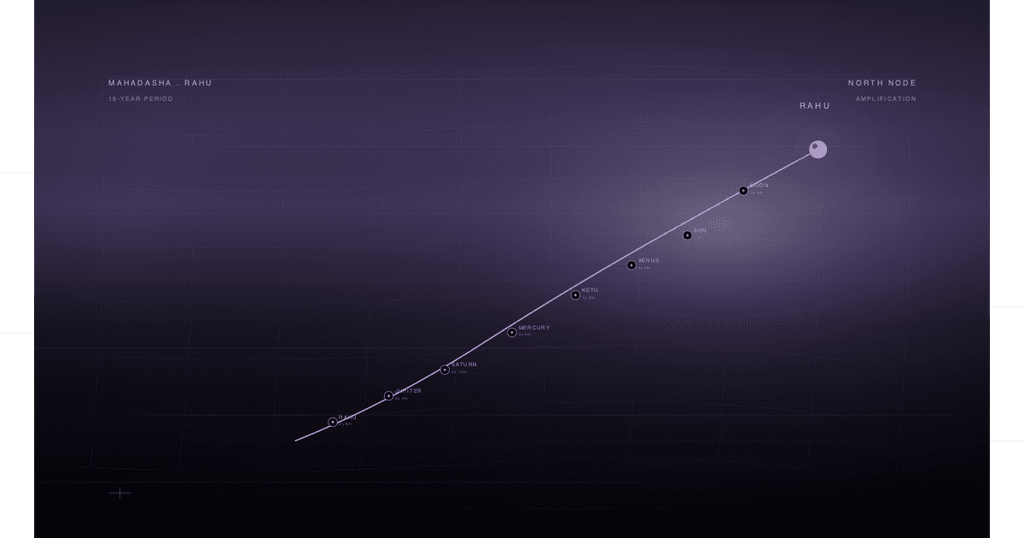
The Rahu mahadasha is the 18-year period when Rahu's karaka register sits in the foreground of the life. For natives with Rahu in the 9th, this period is the primary activation window. The defining biographical event of the 9th-house Rahu reading typically anchors inside this 18 years.
The pattern from the case literature is consistent. Foreign residency for higher study often begins in the early Rahu mahadasha. Cross-cultural scholarly recognition often arrives in the mid-mahadasha. Father-line events (the foreign-father biographical revelation, the immigration story unfolding, the late reconciliation) often cluster in the Rahu-Jupiter or Rahu-Sun antardashas. The 18-year amplification window is documented in detail at the Rahu mahadasha overview.
Secondary activation windows include the mahadasha of the 9th lord (the dispositor of the sign on the 9th cusp), the mahadasha of Jupiter (the dharma karaka), the mahadasha of the Sun (the secondary father karaka) and the mahadasha of any planet conjunct Rahu in the 9th. Inside any of these, the Rahu antardasha provides the precise sub-window.
Transit confirmation is the timing layer. The Jupiter transit through the 9th house or in conjunction with natal Rahu often delivers the dharmic event. The Saturn transit through the 9th delivers the structural event (late-stage scholarship completion, institutional appointment, inheritance event). Eclipse activations on the natal Rahu position concentrate father-line events.
Reading sequence in practice
- Identify the sign on the 9th house for the natal ascendant. This is the dispositor of Rahu in the 9th.
- Trace the dispositor to its house placement and check dignity (exalted, own sign, neutral, debilitated, combust).
- Check the Sun's natal position and dignity. The Sun is the secondary father karaka and shapes the father-axis register.
- Check Jupiter's natal position and dignity. Jupiter is the dharma karaka and shapes the principles register.
- Identify conjunctions and aspects to natal Rahu in the 9th. Note the Ketu placement in the 3rd (always the polar opposite).
- Locate the running mahadasha. If Rahu mahadasha is running, the 9th-house activation window is open. If the dasha of the 9th lord, Jupiter or the Sun is running, secondary activation is in play.
- Cross-confirm with the Navamsa (D-9). The D-9 reads marriage and dharma at higher resolution; Rahu's Navamsa house placement adds the second-pass reading.
What this reading does not predict
The structural reading is precise about register and disposition but explicitly limited on three fronts. It does not predict a specific scholarship admission, a specific foreign residency event or a specific father-line biographical revelation. It predicts the structural conditions under which those events become likely and the windows in which they tend to concentrate. It does not predict the direction of the dharmic shift (whether the chart owner moves toward orthodoxy or away from it). It does not predict the father's specific biography, only the texture of the father-line story. Personal-chart outcomes always depend on the running dasha, the simultaneous transit picture, the strength of the dispositor and the resolution of the Navamsa. Tempora's framework is structural; the dated-call discipline lives at the tracker.
Frequently asked questions
What does Rahu in the 9th house mean?
Rahu in the 9th house (Bhagya Bhava the fortune house, Dharma Bhava the principles house) reads as unconventional dharma, foreign-axis principles, boundary-crossing fortune and significant father-line foreign events. The native often relates to philosophy, religion and higher learning through non-traditional channels: cross-cultural study, immigrant scholarship, technology-mediated teaching or the deliberate adoption of a tradition outside the family register. Foreign residency for study or scholarship is a recurring biographical pattern. The father-line carries Rahu's amplification register: a foreign father, an absent or unconventional father or a father whose life carries significant foreign-axis events.
Is Rahu in the 9th house good or bad?
Rahu in the 9th house is classically mixed. The 9th is the strongest trikona on the chart and a benefic placement house by classical definition. Rahu as a shadow node in a trikona produces fortune-axis amplification but through unconventional means rather than the smooth Jupiter-style flow. Outcomes depend on Rahu's dispositor (the planet ruling the sign on the 9th), the natal position of Jupiter (the natural dharma karaka), the natal position of the Sun (the secondary father karaka) and the running mahadasha. A well-dispositioned Rahu in the 9th produces cross-cultural scholarly recognition, foreign-residency-driven dharmic expansion and a distinctive father-line story. A poorly dispositioned Rahu in the 9th can produce dharmic-identity crisis, father-line rupture or the deliberate rejection of inherited principles.
Does Rahu in the 9th house indicate foreign travel or residency?
Yes. The 9th house is the classical seat of long-distance and pilgrimage travel, the karaka domain for foreign religious or scholarly residence. Rahu's natural register is the boundary-crossing axis. The two stack: Rahu in the 9th biases the chart toward extended foreign residency for higher education, scholarly research, religious study or the cultivation of a teaching credential outside the home country. The pattern often shows up as a graduate or post-graduate move abroad, a Fulbright-style scholarly grant or a guru-following journey across borders. The timing concentrates inside the Rahu mahadasha (the 18-year amplification period) or during the Rahu antardasha within the mahadasha of the 9th lord or a benefic in the 9th.
How does Rahu in the 9th house affect the father?
Rahu in the 9th house specifically amplifies the father-line register, since the 9th is the primary significator for father in the Parashari tradition (with the Sun as secondary karaka). Three patterns repeat in the case literature. First, the father carries an unconventional biographical profile: a foreign birthplace, an immigrant story, a career outside the family tradition or a religious shift. Second, the father-line itself carries foreign or boundary-crossing events: emigration, dispersal of the lineage, a marriage outside the community. Third, the chart owner's relationship with the father takes an unconventional register: distance, late reconciliation, mentorship from a non-biological father figure. The reading sharpens with the Sun's dignity and the dispositor of the 9th.
What are the best and worst ascendants for Rahu in the 9th house?
The reading shifts substantially with ascendant. Most constructive: Cancer ascendant (Rahu in Pisces, Jupiter dispositor, dharmic register intact) and Leo ascendant (Rahu in Aries, Mars dispositor, action-axis dharma). Strong but volatile: Aries ascendant (Rahu in Sagittarius, Jupiter dispositor, often foreign teaching) and Sagittarius ascendant (Rahu in Leo, Sun dispositor, complicated authority register). Mixed: Taurus, Virgo and Capricorn ascendants where Rahu's dispositor falls in a difficult position. Most challenging: Pisces ascendant (Rahu in Scorpio, Mars dispositor, classical debilitation reading) and Gemini ascendant (Rahu in Aquarius with the 9th lord Saturn carrying friction). The dispositor's house placement and dignity is the key variable in every case.
When does Rahu in the 9th house deliver its major events?
Event timing concentrates at three overlapping points. First, the Rahu mahadasha (the 18-year amplification period) activates the natal placement as the headline window: defining cross-cultural philosophical work, the foreign-residency arc or the father-line event tends to anchor here. Second, the dasha of the 9th lord, Jupiter (the dharma karaka), the Sun (the secondary father karaka) or any planet conjunct Rahu in the 9th produces secondary activation windows. Third, the Jupiter or Saturn transit through the 9th house or over natal Rahu provides the timing confirmation that turns disposition into event. Tempora's calibration uses the Swiss Ephemeris with the True Pushya Paksha ayanamsa by PVRN Rao for both natal and transit reads.
When is a natal Rahu in the 9th house activated in 2026 to 2028?
A 9th-house Rahu is the standing charge; a slow transit over its sign dates each activation. A Gemini ascendant holds the 9th in Aquarius, where transiting Rahu returns over its own position from 9 June 2025 to 27 December 2026. A Sagittarius ascendant holds it in Leo, occupied by transiting Ketu to 27 December 2026 and marked by the 12 August 2026 solar eclipse on the Cancer to Leo cusp. A Scorpio ascendant holds it in Cancer, crossed by exalted Jupiter from 27 May 2026 and by transiting Ketu from 27 December 2026 to 15 July 2028. Rahu spends about eighteen months in each sign and returns to a natal sign about every eighteen years, so its own return is the direct trigger, and each window dates when the dharma and father-line theme comes forward without settling the outcome.
- Rahu Mahadasha: the 18-year period of amplification and unconventional rise
- The 9th house: father, dharma, higher learning, guru and long-distance travel
- Rahu in the 10th house: career summit through unconventional channels
- Will I settle abroad? the 12th-house reading for foreign residency
- Will I migrate abroad permanently? the dasha-and-transit method
This article was prepared by Tempora Research as an informational piece in the Houses cluster. Methodology, calibrated lift figures and reconciliation entries are documented in Tempora's research-publishing standards and reproducible against the public engine. Internal audit log maintained. This article does not constitute medical, financial, legal or professional advice. First published 2026-06-05 by Tempora Research.