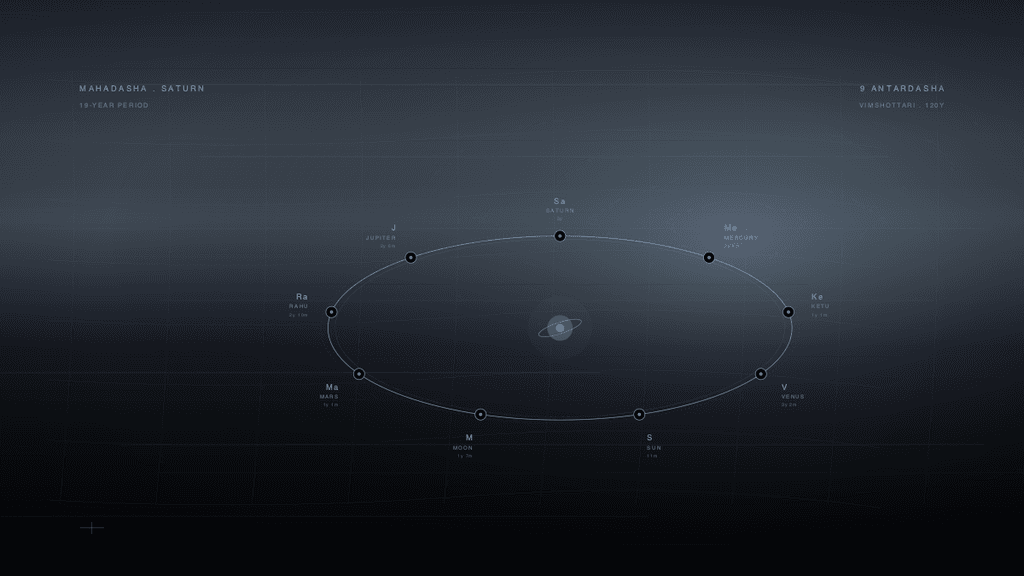
Saturn in the 1st House: disciplined self and the late-bloomer arc.
Saturn sitting on the lagna (the ascendant, the exact zodiacal degree rising at birth) sets the lifelong tone of the chart. The native presents serious, looks older than chronological age, carries the body and self-image under structural pressure from the early years and tends to grow into authority across decades rather than arriving in it at the start. Classical Parashari practice treats Saturn in the 1st house (Tanu Bhava in Sanskrit, the house of the body and self) as the prototypical late-bloomer signature: restricted youth, sustained-effort midlife, recognised second half. Computed with Swiss Ephemeris and True Pushya Paksha ayanamsa (Vedic reference frame for sidereal positions). Sources: Brihat Parashara Hora Shastra Chapter 27 (planets in houses), Phaladeepika Chapter 15, Sarvartha Chintamani.
What the 1st house carries
The 1st house in Vedic astrology (Tanu Bhava, the body house) begins at the lagna (the ascendant, the precise zodiacal degree rising on the eastern horizon at the moment of birth). The house carries the body, the physical constitution, the head and brain, the complexion, the personality, the early-life self-image and the direction the life takes. Classical sources read the 1st house as the most personal point on the chart: the place where the native and the world meet. The Sun is the karaka (significator) for the 1st house, signifying vitality and the core sense of self.
A planet sitting in the 1st house imprints its signature on every aspect the house carries. The body takes the planet's register; the personality takes the planet's tone; the early-life narrative takes the planet's pattern; the life direction takes the planet's pull. Among the seven classical planets and the two nodes, Saturn sitting in the 1st produces the most structural reading because Saturn's nature is structure, restriction and the slow build of time.
For the full 1st-house reading independent of any single planet, see Tempora's 1st house piece. For the full Saturn karaka portfolio across the Vimshottari sequence, see Saturn Mahadasha. This article walks the specific signature Saturn produces when it sits in the Tanu Bhava.
The serious-presented native and the mature-acting personality
The most visible surface marker of Saturn in the 1st is the personality presentation. The native reads serious from early youth. Classical Parashari texts use phrases that translate to grave bearing, sober conduct and weighty presence. The native does not present as light, playful or instantly warm; the native presents as composed, measured and slow to enthusiasm. The body language is contained. The face often carries a quiet gravity. Strangers sometimes read the native as older than the chronological age suggests.
The behavioural register matches the presentation. The native is patient, deliberate and structurally honest. The native takes responsibility young, often before peers do. School-age friends read the native as the serious one, the one who carries weight, the one others turn to when something difficult needs handling. The native develops a stoic relationship to hardship: classical sources note that Saturn-in-lagna natives accept difficulty without complaint and process it through sustained work rather than emotional discharge.
The native is slow to commit and slow to abandon. Where a Mars-in-lagna native bursts into action and a Jupiter-in-lagna native expands generously, the Saturn-in-lagna native builds slowly, holds long and works through resistance. Friends and partners that survive the slow-commit phase find the relationship durable across decades. The native does not warm to people on first meeting and the people who matter to the native are usually people who stayed through that first phase.
The body register: bone, joint and structural frame
Saturn is the karaka of bone, joint, ageing and the structural frame of the body. Saturn sitting in the 1st house (the body house) imprints those registers on the native's physical constitution. The native often has a strong skeletal frame and a body that ages well in the structural sense, but the same configuration produces specific vulnerabilities. The classical body-zone reading lists knees, joints, spine, teeth, calcium and the lower back as the load-bearing areas where Saturn-in-1st natives carry stress.
The complexion register is dry and weathered. Saturn's nature is dryness and the lagna-Saturn native often has skin that runs dry, hair that runs coarse and a body that holds little excess moisture. Classical sources describe the build as lean, tall or angular more often than soft or rounded. The body is built for endurance rather than for speed: the native often discovers in midlife that they can sustain physical work or walking distances that exhaust friends with different placements.
Health pattern across the life arc follows Saturn's nature. Early life often carries minor chronic conditions that the native learns to manage rather than to cure. Midlife (around the late thirties and forties) often carries joint, back or dental work, particularly during Saturn mahadasha or antardasha or during Sade Sati (Saturn's seven-and-a-half-year transit across the natal Moon's sign and the two adjacent signs). Late life often shows surprising durability because the Saturn body was built for the long arc. Tempora's Sade Sati piece walks the seven-and-a-half-year Saturn transit framework in detail.
The early-life restriction pattern
The classical Saturn-in-1st reading carries a specific early-life pattern. The native takes on responsibility earlier than peers, often through parental absence, financial hardship or a family configuration that requires the native to grow up quickly. Some charts show a parent's death, illness or extended absence during the formative years; others show a family economy that placed work on the native young; others show no event but a tone of seriousness from infancy that other children did not carry.
The schooling years often carry friction. Classical sources note that Saturn-in-lagna natives are not the brilliant-quick-start students. The native often struggles in early grades, then catches up through sustained effort, then outperforms peers in later grades through accumulated discipline. The pattern shows up most clearly in subjects that reward consistent work over inspiration: mathematics, language acquisition, technical fields. The native is the slow-build student who, by college or the first job, has compounded the early effort into structural competence.
Social life in early years often runs narrow. The native has few close friends rather than wide circles. The friendships that form in school and early adulthood are often the friendships that last decades. The native is uncomfortable with crowd dynamics, group enthusiasm and the social acceleration that more solar or Jupiterian charts find natural. Classical commentaries treat this not as a deficit but as a structural feature: the native is built for depth rather than breadth across all life domains, including the social one.
The midlife crystallisation and late-bloomer arc
The signature Saturn-in-1st life arc is the late-bloomer pattern. The early decades run under restriction; the middle decades crystallise through sustained-effort work; the late decades deliver the authority the chart was building toward. Classical Parashari practice describes this as Saturn delivering its rewards on Saturn's own timeline, which is the slowest among the classical planets.
The crystallisation point typically falls between the 32nd and 42nd years, with the exact timing modulated by Saturn's natal dignity and the running dasha. Saturn's first major return (Shani Punaravriti, around the 29th to 30th year) is often the inflection point: the native passes through Saturn's first full cycle and emerges into a different register of life. The work the native had been building for a decade or two begins to compound. Professional recognition arrives later than it does for peers, but when it arrives it tends to be structural rather than transient. The native becomes the person others turn to when something serious needs handling.
The second-half-of-life peak is the classical promise of Saturn-in-1st. Late forties through sixties is the register where the native is most fully themselves. The body has aged into its frame; the personality has settled into its weight; the work has compounded into authority. Classical commentaries note that Saturn-in-lagna natives often achieve their most visible accomplishments after the 45th year and that their fame, when it arrives, is durable rather than fashionable.
The pattern inverts the conventional narrative of fast-start, plateau, decline. Saturn-in-1st natives run slow-start, sustained-effort, late-peak. The arc is structurally different and the framework for evaluating it must be different. A Saturn-in-1st native at twenty-five who has not yet achieved much by the standard markers is not behind; the chart is on its own schedule.
Per-ascendant variation
The general Saturn-in-1st reading modulates by which sign sits on the lagna. The configuration carries a different load when Saturn is well-placed by sign versus poorly placed and the ascendant determines which.
| Ascendant | Saturn sign in 1H | Reading |
|---|---|---|
| Aries | Aries (debilitated) | The harshest version. Saturn in its sign of debilitation in the lagna produces the most restricted early life and the longest path to the late-bloomer arc. Neecha-bhanga (debilitation cancellation) by an exalted dispositor improves the reading materially. |
| Taurus | Taurus (neutral) | Moderate reading. Venus as ascendant lord supports Saturn structurally. The native carries Saturn registers but the body and resources are stabilised by Taurus's earthy ground. |
| Gemini | Gemini (friend) | Saturn in Mercury's sign reads workable. The intellectual register softens the Saturn weight; the native often becomes a writer, analyst or technical specialist whose late-bloomer arc plays out in cognitive work. |
| Cancer | Cancer (enemy) | Difficult reading. Saturn in Moon's sign creates Saturn-Moon enemy friction in the body house, with emotional and physical fatigue registers. Sade Sati intensifies significantly when natal Moon is in 1H, 12H or 2H. |
| Leo | Leo (enemy) | Difficult reading. Sun (lagna lord) and Saturn are classical enemies. The native often carries vitality friction and a sense of authority being earned rather than inherited. |
| Virgo | Virgo (friend) | Workable reading. Mercury supports Saturn; the native often does well in technical, analytical or service-oriented work that rewards sustained precision. |
| Libra | Libra (exalted) | The strongest single configuration. Saturn exalted in the lagna produces a structurally exceptional native: serious presentation, but with the dignity, authority and structural weight Saturn carries at exaltation. Often produces a major late-life public figure. |
| Scorpio | Scorpio (enemy) | Difficult reading. Saturn-Mars enemy friction in the body house produces structural intensity that the native must learn to channel. Often produces a deeply private but powerful late-life arc. |
| Sagittarius | Sagittarius (neutral) | Moderate reading. Jupiter as ascendant lord softens Saturn's restriction with a dharmic register. The native often becomes a teacher or institutional figure in the late-bloomer phase. |
| Capricorn | Capricorn (own sign) | Exceptional reading. Saturn in own sign in the lagna is one of the strongest planetary configurations in the chart. The native reads as Saturn personified: structurally authoritative, weighty, durable. Often produces a major institutional or public figure across decades. |
| Aquarius | Aquarius (own sign) | Exceptional reading. Saturn in own sign in the lagna in Aquarius produces a more progressive, system-thinking variant of the Capricorn reading. The native often becomes a structural innovator or institution-builder in the late-bloomer phase. |
| Pisces | Pisces (neutral) | Moderate reading. Jupiter as ascendant lord softens Saturn's restriction. The native often carries a quiet spiritual register alongside the structural seriousness. |
The own-sign exception is the key per-ascendant variation. For Capricorn and Aquarius ascendants, Saturn in the 1st house is not the restrictive reading it produces for most other ascendants. The native carries Saturn's structural authority from the start, the body is built for endurance rather than restriction and the late-bloomer arc plays out as a steady compounding rather than as a long climb from hardship. Capricorn-rising natives with Saturn in the 1st are among the most structurally durable charts in the classical literature.
Saturn dasha activation and Sade Sati overlay
The natal Saturn-in-1st configuration runs as a permanent structural feature of the chart, but the dasha cycle activates it at specific windows. The Saturn mahadasha (the nineteen-year Vimshottari period of Saturn) brings the lagna-Saturn signature into the foreground. During Saturn mahadasha for a Saturn-in-1st native, the body, the personality and the life direction all come under direct Saturn pressure for the full nineteen years. The Tempora Saturn Mahadasha piece walks the nineteen-year period in detail; the additional consideration for Saturn-in-1st natives is that the period activates the body house directly.
Sade Sati (the seven-and-a-half-year transit of Saturn across the 12th, 1st and 2nd houses from the natal Moon) intersects the Saturn-in-1st reading in a specific way. When the natal Moon is in the 1st house, the 2nd house or the 12th house, Sade Sati transit brings Saturn back through the body house and intensifies the lagna-Saturn signature. For Saturn-in-1st natives with natal Moon in 1H, 2H or 12H, Sade Sati is one of the most structurally demanding transits of the life arc and the events of those seven and a half years often define the late-bloomer pivot.
Saturn return (the 29th-to-30th-year transit when Saturn returns to its natal position) is the inflection point classical commentaries highlight for Saturn-in-1st natives. The return brings Saturn back to the lagna and the native passes through a structural-renewal window that often delivers the first major late-bloomer milestone: a career consolidation, a relationship commitment, a body re-organisation or a relocation. Tempora's Saturn return at 29 piece walks this transit in detail.
What the framework does not predict
The Saturn-in-1st reading is structural. It describes the texture of the body, the personality and the life arc, but it does not predict specific events. The framework does not predict the exact age at which the late-bloomer arc crystallises (it indicates the window, not the date), the specific profession the native will land in, the identity of relationships or the specific health events the body will encounter. The reading describes the structural register; the dasha and transit overlays activate it at specific times; the lived life fills in the content.
The framework also does not pass moral judgment. Classical commentaries sometimes describe Saturn-in-1st as a difficult placement, but the reading is more accurately understood as a structurally different placement. The early decades carry restriction; the late decades carry authority. Whether the native experiences this as hardship-followed-by-reward or as a coherent long arc depends on the framing the native brings to it. The chart describes the structure; the relationship to the structure is the native's own.
This placement in the 2026 to 2028 sky
The natal Saturn-in-1st sits in the chart as a standing condition, and the moving sky of 2026 to 2028 brings it forward on datable windows that vary by ascendant. A Pisces ascendant carries the 1st-house Saturn in Pisces, and transit Saturn has held Pisces since 20 March 2025 and stays there until 23 May 2027, so this native is inside a Saturn return over the lagna across the whole window, with the exact contact fixed by the natal degree. An Aries ascendant carries the placement in Aries, where transit Saturn arrives on 23 May 2027, retreats to Pisces on 4 November 2027 and settles back into Aries from 11 February 2028, so the return over the body house perfects across that retrograde double pass into early 2028. A Cancer ascendant has the 1st house in Cancer, which exalted Jupiter crosses on its full stay from 27 May 2026 to 19 June 2027, reading as a lift over the self rather than a same-planet contact. Underneath these dates runs the return cadence itself: Saturn takes about 29.5 years to circle the zodiac back to a given sign, and when transit Saturn re-enters the sign of the natal Saturn it forms the same-planet contact that classical practice treats as the trigger for the placement's signature. Read each date as an activation window laid over a fixed natal condition, where the placement is the standing fact and the transit only times when it surfaces. No window here forces an event; each marks when the theme is most workable.
Frequently asked questions
What does Saturn in the 1st house mean in Vedic astrology?
Saturn in the 1st house (Tanu Bhava, the body house) produces a serious-presented, mature-acting native whose life arc peaks in the second half. The body carries Saturn registers (bone, joint, knee, structural frame, dry complexion, lean or angular build). The personality reads weighty, patient, slow to enthusiasm and structurally honest. Early life often runs under restriction (responsibility taken young, parental absence or financial hardship). Midlife crystallises through sustained-effort work that compounds across decades. Late life delivers the authority the chart was building toward. The reading inverts for Capricorn and Aquarius ascendants where Saturn is in its own sign in the lagna and reads as exceptional rather than restrictive.
Is Saturn in the 1st house good or bad?
Neither in absolute terms; the reading is structural rather than valenced. For most ascendants, Saturn in the 1st produces a difficult early life and a strong second half. The native often experiences the early decades as restriction and the late decades as authority. For Capricorn and Aquarius ascendants, Saturn in the 1st is own-sign and the configuration is one of the strongest in the chart, producing structural authority from the start rather than restriction. For Libra ascendant, Saturn is exalted in the 1st and the configuration is exceptional. The framework reads Saturn in the 1st as a slow-arc placement that rewards patience and sustained effort rather than as a uniformly negative configuration.
Why do people with Saturn in the 1st house look older than their age?
Saturn is the karaka of ageing, bone structure and the structural frame of the body. When Saturn sits in the 1st house (the body house), it imprints its registers on the native's physical appearance. The face often carries a quiet gravity from early youth. The skin runs dry and weathered rather than soft. The body build is lean, tall or angular more often than rounded. The bearing is composed and contained rather than energetic and expansive. Strangers therefore often read the native as older than the chronological age suggests. The same configuration that produces the early-aged look produces the durable body register: Saturn-in-1st natives often age structurally well into late life because the body was built for endurance from the start.
What is the late-bloomer arc of Saturn in the 1st house?
Saturn-in-1st natives follow a structurally different life arc than the conventional fast-start narrative. Early life (school years through twenties) often runs under restriction with sustained effort building slowly. Midlife (thirties and forties) crystallises through compounded work. Late life (late forties through sixties and beyond) delivers the authority the chart was building toward. Classical sources describe this as Saturn delivering its rewards on Saturn's own timeline. The inflection point typically falls around Saturn's first major return (the 29th-to-30th year) and the most visible accomplishments often arrive after the 45th year. The framework treats this not as delay but as a structurally different life timeline that rewards patience and compounds across decades.
Which body parts does Saturn in the 1st house affect?
Saturn in the 1st house (the body house) imprints Saturn registers on the load-bearing structural zones of the body. Classical sources list knees, joints, spine, teeth, calcium metabolism and the lower back as the primary affected zones. The skeletal frame is generally strong but the joints and bones carry stress, particularly during Saturn mahadasha, Saturn antardasha or Sade Sati transit. The complexion runs dry. The body build is typically lean or angular. The pattern is not uniformly negative: the same Saturn registers that produce joint and bone vulnerability also produce a body built for endurance, walking distances and physical sustainability into late life. The framework reads the body as structurally Saturn-marked rather than as structurally weak.
Why is Saturn in the 1st house exceptional for Capricorn and Aquarius ascendants?
Saturn rules both Capricorn (its day-house) and Aquarius (its night-house). When the ascendant is Capricorn or Aquarius and Saturn sits in the 1st house, Saturn is in its own sign in the lagna. The own-sign placement removes the friction that Saturn produces in other ascendants and lets Saturn deliver its structural authority directly. Capricorn ascendants with Saturn in the 1st are read as Saturn personified: structurally authoritative, weighty, durable, often producing major institutional or public figures across decades. Aquarius ascendants with Saturn in the 1st carry a more progressive and system-thinking variant, often producing structural innovators or institution builders. Both configurations are among the strongest planetary placements in classical Vedic astrology and they invert the conventional reading of Saturn in the 1st as restrictive.
How does Sade Sati interact with Saturn in the 1st house?
Sade Sati is Saturn's seven-and-a-half-year transit across the 12th, 1st and 2nd houses from the natal Moon. When the natal Moon sits in the 1st house, the 2nd house or the 12th house, Sade Sati transit brings Saturn back through the body house and intensifies the natal Saturn-in-1st signature. For these natal-Moon positions, Sade Sati is one of the most structurally demanding transit windows of the life arc, often coinciding with the late-bloomer pivot (relocation, career consolidation, body re-organisation, relationship commitment). When the natal Moon is in a sign that does not place Sade Sati on the body house, the transit still activates Saturn registers but does not double-stack with the natal Saturn-in-1st position. Tempora's Sade Sati piece walks the transit framework in detail by Moon sign.
When is a natal Saturn in the 1st house activated in 2026 to 2028?
The activation is ascendant-specific. A Pisces ascendant holds the 1st-house Saturn in Pisces and is inside a Saturn return over the lagna now, since transit Saturn sits in Pisces from 20 March 2025 until 23 May 2027. An Aries ascendant carries it in Aries, where transit Saturn arrives on 23 May 2027, steps back to Pisces on 4 November 2027 and returns to Aries from 11 February 2028, completing the return across that double pass. A Cancer ascendant sees exalted Jupiter cross the 1st house from 27 May 2026 to 19 June 2027 as a lighter benefic pass. Saturn returns to any given sign about every 29.5 years, so the same-planet contact is the deeper trigger. Each date is an activation window over a standing natal placement rather than a fixed event.
- 1st house · the full reading of the body and self house
- Saturn Mahadasha · the nineteen-year Saturn period karaka portfolio
- Sade Sati · the seven-and-a-half-year Saturn transit framework
- Saturn return at 29 · the first Saturn return inflection point
- Saturn · the planet portrait and karaka register
This article was prepared by Tempora Research as a planet-in-house reading. The framework is descriptive of structural chart layers and does not predict specific events. Internal audit log maintained. This article does not constitute medical, financial, legal or professional advice. First published 2026-06-05 by Tempora Research.