Why Tempora Won't Read Your Chart Over WhatsApp
Tempora is a research firm. The framework operates on dated public forward calls, calibrated computation against the Swiss Ephemeris and the True Pushya Paksha ayanamsa and methodology files that any reader can audit. WhatsApp consultations and phone-app shortcuts cannot deliver this. The position is anti-imprecision. The tradition itself is the standard the framework is trying to meet.
The question the brand keeps getting asked
The Tempora site publishes long-form research on national charts, dated forward calls for India, Russia, the United States and other entities and methodology articles on the calibrated lift framework. Readers find the work credible. A predictable subset of them then asks the same question: can you read my personal chart, can we do a WhatsApp call, can you take birth details over message and send back a reading.
The answer is no and this article documents why. The reason is not commercial reluctance and not a posture against personal-chart work. The reason is that a calibrated chart reading requires a specific operational discipline that a WhatsApp exchange cannot reproduce. The discipline is what makes the framework's published forward calls credible in the first place. Skipping the discipline for a private read would erase the thing that distinguishes the work.
What a chart actually requires
A Vedic birth chart computed to research standards requires four inputs and four methodological commitments.
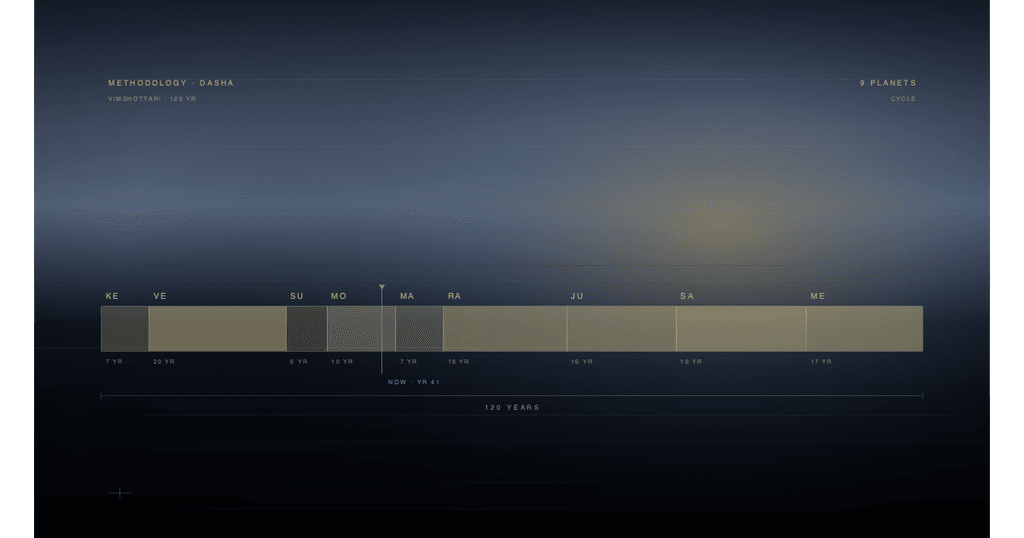
Birth time accurate to the minute. The ascendant (lagna, the rising sign) shifts by approximately 1 degree every 4 minutes. A 4-minute error in recorded birth time moves the ascendant by 1 degree of sidereal longitude. That shift can carry the ascendant across a sign boundary, which changes every house assignment in the chart. The natal Moon shifts by approximately 1 degree of sidereal longitude every 2 hours. A 2-hour error can move the Moon across a nakshatra boundary, which changes the Vimshottari opening dasha lord and produces a different 120-year dasha sequence. Birth times recorded to within 10 minutes are common in Indian birth records. Birth times recorded to within an hour are common. Birth times recorded "around dawn" or "in the evening" are useless for calibrated work.
Birth place precise to the city or town. Birth place determines the local sidereal time and the geographic latitude, both of which enter the ascendant computation. A 1-degree error in latitude or longitude is small for most purposes but for high-latitude births or charts where the ascendant sits close to a sign cusp the precision matters. A city-level birth place is sufficient. A "we were travelling in the north" or "somewhere near Mumbai" is not.
Date in an unambiguous calendar. Dates from older Indian birth records sometimes use the Vikram Samvat, Shaka Samvat or other regional calendars. These convert cleanly to Gregorian dates but the conversion needs to be done explicitly. A date stated only in a regional calendar without conversion can be off by a year or two.
The four methodological commitments. Ayanamsa (Tempora uses True Pushya Paksha, the sibling article documents the choice), house system (Whole Sign), dasha system (Vimshottari for the primary timing layer) and divisional chart conventions (D-1 main, D-9 navamsa for the relationship overlay, D-10 dasamsa for career, others as required). Each of these commitments has alternatives. A calibrated reading requires the commitments to be fixed in advance and stated.
Why phone-app shortcuts are not equivalent
Most commercial phone-app astrology software runs on simplified computation. Three structural problems.
Hidden defaults. Phone apps typically default to Lahiri Chitrapaksha ayanamsa without making the choice visible. The user sees a chart. The user does not see the ayanamsa or the house system or the precession-approximation method. The output cannot be audited because the assumptions are not stated.
Mean-precession approximations. The simpler implementations use a long-term average precession rate rather than date-accurate computation. The Swiss Ephemeris computes the actual position of the precession-corrected zodiac for each date. Phone apps that approximate produce slightly different positions, particularly for high-precision applications like nakshatra-boundary cases.
Composite-feature output without methodology trail. A phone app might output "Saturn in 7th house, dasha period Mars-Rahu" without specifying the house-system convention, the ayanamsa or the divisional chart math. A user reading the output cannot reproduce the computation from the inputs because the inputs do not specify the methodology.
The Tempora framework uses the Swiss Ephemeris (the same computation library that professional astrology software uses) with the True Pushya Paksha ayanamsa fixed, Whole Sign houses, the Vimshottari dasha system and the documented divisional chart conventions. The methodology is published at Swiss Ephemeris and Vedic accuracy and the ayanamsa article. A reader can verify any Tempora chart computation against the published methodology.
Why public dated calls beat private readings
The deepest reason Tempora does not deliver WhatsApp readings is the reconciliation discipline that the public forward calls operate under. A public dated forward call carries four elements: a named entity, a dated window, an observable signal and an explicit reconciliation condition condition. The call is timestamped before the window opens. When the window closes, the outcome is reconciled on the same public surface regardless of whether the call met.
The discipline is documented in reproducible astrology and the reconciliation log lives at the forward-call tracker. The misses are on the same page as the hits. The framework owns its misses.
A private reading delivered over WhatsApp cannot operate under the same discipline. The reading exists only in the private chat. The terms can be retroactively narrated. The reconciliation condition condition can be reframed after the event. There is no public record of whether the prediction met or missed. The reading is unreproducible by construction.
The asymmetry is not abstract. A WhatsApp practitioner who delivers ten readings and gets two right can claim the two as evidence and silently retire the eight that missed. A public tracker that publishes ten dated calls and reconciles all ten in public cannot. The discipline is what produces the credibility. Stripping the discipline for a private read would erase the thing that makes Tempora's other work trustworthy.
What reproducibility means in practice
A Tempora forward call is published on the public site before the window opens. The article documents the entity (which national chart, which natal point), the dated window (specific months), the signal (which calibrated signature is active, what observable would count as the prediction occurring) and the reconciliation condition (what would have to happen or not happen for the call to fail).
A reader who wants to verify the call can read the source article, check the underlying signature against Tempora's published calibration ledger in the repository, cross-reference the methodology files at Calibrated lift astrology and run the test condition during the live window. The reconciliation note appears at the tracker within a defined lag after window close. The reader can audit the entire chain.
A WhatsApp reading has no comparable verification path. The practitioner sends a message. The recipient receives the message. The practitioner's source data, methodology and assumptions are not stated. The prediction cannot be reproduced by a third party because there is no published methodology to reproduce against. The reading is practitioner-dependent in the sense that only the practitioner who delivered it can speak to its terms.
The framework's published methodology is the opposite of practitioner-dependent. The methodology files exist independently of any individual reader. Anyone who runs the Swiss Ephemeris with the documented ayanamsa and the documented calibration produces the same numerical output. The framework can be verified by any party with the computational tools and the public files.
This is not anti-tradition
The Tempora framework is built entirely on classical Vedic astrology: Vimshottari dasha (Sanskrit for "twentieth", the 120-year-cycle dasha system), the 27 nakshatras (the lunar mansions), divisional charts (the vargas, with D-9 and D-10 as the standard overlays), Whole Sign houses (the classical Indian house system) and the sidereal zodiac. The calibration corpus uses classical authority-figure birth charts as ground-truth event datasets. The framework's methodological choices are choices about computation rigour and publication discipline within the tradition, not departures from it.
The position is not against the practitioners doing careful work in private practice. Several traditions of classical Vedic astrology operate at high standards inside their teaching lineages, with careful chart rectification, documented methodology and intellectual honesty. The framework's posture is against the broad informal commercial layer that has developed alongside the genuine tradition: WhatsApp consultations with vague terms, phone-app readings with hidden assumptions, paid calls with no documented methodology and no public reconciliation.
The classical tradition itself implies a higher standard than the informal commercial layer delivers. The classical texts emphasise birth time accuracy, careful chart computation and methodological commitment. A WhatsApp reading delivered in a few minutes from a verbal birth date does not meet the standard the classical texts themselves describe. The framework's position is that the tradition deserves the rigour it asks for.
How the framework delivers individual reads
Kaal Imprint at /kaal is the consumer surface for individual chart computation under the Tempora framework. Kaal Imprint takes birth date, birth time and birth place, runs the calibrated computation against the Swiss Ephemeris and the True Pushya Paksha ayanamsa, then returns three dated moments from the user's own past as a proof-of-method before any forward read. The same birth data run through the same framework produces the same dates.
The output is not a chat message from a practitioner. It is a computation against a documented framework, with the methodology trail visible at the published findings articles. A user who wants to verify what the framework did with their data can read the methodology files and follow the chain.
This is the right surface for individual chart work. The Imprint computation is reproducible. The framework's assumptions are stated. The result can be audited against the published methodology. The discipline that makes the public forward calls credible is the same discipline that makes the individual reads credible.
The structural reason this matters for the brand
A research firm and a private practice are different operational structures. A research firm publishes work on a public surface, owns its misses, runs methodology files that any reader can audit and operates under a reconciliation discipline. A private practice delivers practitioner-dependent readings, accepts the asymmetric incentives of private commercial work and operates on relational trust rather than published methodology.
Both can be done with integrity. Several private practices in the classical Vedic tradition operate at high standards. The two structures cannot be combined into a single offering, however. A firm that delivers public forward calls and also runs private WhatsApp readings produces two different products under one name and the credibility of the public work depends on not blurring into the private work.
The Tempora brand is the research-firm structure. The framework's commitment is to the public surface, the reconciliation discipline and the methodology audit. The Kaal product is the consumer-facing surface that delivers individual chart computation under the same discipline. WhatsApp readings are not on the menu because they would change what the brand is.
What to do instead
For a reader who wants to engage with the framework on their own birth data, the path is Kaal Imprint at /kaal. The Imprint computation takes birth details, runs the calibrated framework against the user's chart and returns three dated moments from the user's past as proof-of-method. The methodology trail is visible at the published findings articles.
For a reader who wants to understand the framework's methodology, the starting points are reproducible astrology (the discipline), Calibrated lift astrology (the calibration framework), True Pushya Paksha vs Lahiri (the ayanamsa commitment) and Swiss Ephemeris and Vedic accuracy (the computation layer). The methodology files are public and the calibration weights are stored in the repository.
For a reader who wants to see whether the framework's forward calls are meeting their windows, the surface is the forward-call tracker. The tracker shows active windows, closed windows with reconciled outcomes and the framework's running hit rate. The misses are on the same page as the hits.
What is not on the menu is a private chat reading. The framework's discipline does not support it and offering it would erase the discipline.
Two hours of sky against 0.05 degrees of orb: the argument in dates
The refusal reads less like principle and more like arithmetic once the current window is laid out in numbers. On the transit side the engine works at exactness: the corpus example is transit Jupiter crossing the India 1947 chart's natal Mercury on 5 August 2026 at an orb of 0.05 degrees, with the natal Sun contact following on 16 October 2026. Aspect strength peaks at exact degree contact and falls away with orb, which is the whole reason degree-level aspect strength is computed to fractions of a degree rather than eyeballed by sign. Precision like that on the transit side is purchased entirely in advance and wasted instantly if the natal side of the contact is a guess.
The natal side degrades fast without real birth data. The ascendant changes sign roughly every two hours, so all twelve signs rise over any day and a remembered "sometime in the morning" spans two or three different lagnas, which means two or three different whole-sign house structures. The dated sky then tells each of those lagnas a different story. Saturn's Aries years from 23 May 2027 sit in the 10th house for Cancer rising and in the 9th for Leo rising, two hours later on the same birthday, in the same city. A chat reading that never resolves which lagna is yours is assigning dated chapters to houses it has not identified.
The Moon is the second casualty. It completes the 27-nakshatra circuit in 27.3 days, about one mansion per day, and the birth nakshatra plus the elapsed fraction within it selects the first Vimshottari mahadasha and its remaining balance. Hours of birth-time error therefore bend every dasha boundary for the rest of the life, quietly and proportionally. Dated boundaries sharpen the stakes: with the Sade Sati wheel stepping forward at Saturn's Aries entry on 23 May 2027, retreat window of 4 November 2027 to 11 February 2028 noted, a natal Moon in late Pisces and one in early Aries stand in different phases of that cycle. A reading that never verified the Moon's degree can place a person on the wrong side of a dated line and sound equally confident doing it.
This is the case in its entirety: a reading is downstream of a computation, and a computation is downstream of data. A WhatsApp thread can carry birth data perfectly well; what it cannot carry is the verification discipline, the stated ayanamsa, the reproducible ephemeris run and the willingness to be graded afterwards. Precision is what makes a claim falsifiable, and falsifiability is what the public record buys: 9 graded flagship calls, a 50 percent hit rate, misses published beside the hits. A reading built on unverified birth data can never be wrong in a checkable way, which is precisely what is wrong with it.
Frequently asked questions
Does Tempora do private chart readings on WhatsApp?
No. Tempora is a research firm that publishes dated forward calls on a public surface and ships calibrated chart computations through the Kaal product. The framework does not deliver private practitioner-dependent readings over WhatsApp or any other private messaging channel. A reader who wants a chart computed under the Tempora framework can use Kaal Imprint to generate a calibrated read against their own birth data.
Why is birth time precision necessary for an accurate Vedic chart?
Birth time determines the ascendant (lagna), the houses and the natal Moon's position in its nakshatra. A 4-minute error in birth time shifts the ascendant by approximately 1 degree, which can move the ascendant across a sign boundary and change the entire house structure of the chart. A 2-hour error shifts the natal Moon by approximately 1 degree of sidereal longitude, which can move the Moon across a nakshatra boundary and change the Vimshottari opening dasha lord. Without recorded birth time accurate to the minute, the chart computation contains structural uncertainties that propagate into every subsequent reading.
Why are phone-app astrology shortcuts inadequate for a calibrated read?
Most commercial phone-app astrology uses simplified planetary position computations and built-in default ayanamsa choices without making the assumptions visible. Phone apps typically default to Lahiri Chitrapaksha ayanamsa, sometimes use mean-precession approximations rather than date-accurate values and rarely document the house-system convention being used. Tempora's framework uses the Swiss Ephemeris (the standard astronomical computation library used across professional astrology software) with the True Pushya Paksha ayanamsa fixed and the methodological choices documented. Phone-app readings cannot be reproduced against a published reference because the assumptions are not stated.
What is the difference between a public dated forward call and a private reading?
A public dated forward call is published on the open Tempora site with a named entity, a specific date window, an observable signal and a stated reconciliation condition condition. The call is timestamped before the window opens. When the window closes, the outcome is reconciled in public regardless of whether the call met. A private reading delivered over WhatsApp cannot be checked against these standards. The reading exists only in private communication, the prediction's terms can be retroactively narrated and there is no public record of whether the prediction met or missed. Tempora's framework operates on the public-dated standard.
Is Tempora anti-tradition?
No. The Tempora framework is built on classical Vedic astrology techniques: Vimshottari dasha, the 27 nakshatras, divisional charts, Whole Sign houses and the sidereal zodiac. The framework's calibration corpus uses classical authority-figure birth charts as ground-truth event datasets. The methodological choices the framework makes are choices about computation rigour and publication discipline, not departures from the tradition. The position is anti-imprecision, not anti-tradition. Informal commercial astrology that delivers vague, untested readings without documented assumptions falls below the standard the tradition itself implies.
How does someone get a chart computed under the Tempora framework?
Through Kaal Imprint at /kaal, the framework's Path A consumer product. Kaal Imprint takes birth date, birth time and birth place, runs the calibrated computation against the Swiss Ephemeris and the True Pushya Paksha ayanamsa, then returns three dated moments from the user's own past as a proof-of-method before any forward read. The reading is reproducible: the same birth data run through the same framework produces the same dates. The output is not a WhatsApp message from a practitioner. It is a calibrated computation against a documented framework that any reader can verify against public methodology files.
Why does Tempora publish methodology files publicly?
Because reproducibility is the test that distinguishes calibrated work from practitioner-dependent reading. The Tempora methodology files at /findings document the ayanamsa choice, the calibration framework, the reconciliation condition discipline and the calibrated lift figures. The calibration weights are stored at Tempora's published calibration ledger in the repository and the calibration engine regenerates them from the historical event corpus. A reader who wants to verify a Tempora forward call can read the source article, check the calibration weights and cross-reference the framework against the published methodology. A WhatsApp reading from a private practitioner has no comparable verification path.
What does a rough birth time actually cost in the 2026 to 2028 window?
Two concrete losses. First, the ascendant changes sign roughly every two hours, so an uncertain morning birth spans two or three lagnas and each lagna assigns the dated transits to different houses: Saturn's Aries years from 23 May 2027 sit in the 10th house for Cancer rising and in the 9th for Leo rising, two hours apart on the same day. Second, the Moon crosses one nakshatra roughly per day, and the birth nakshatra with its elapsed fraction sets the first Vimshottari mahadasha and its balance, so hours of error bend every dasha boundary that follows. Meanwhile the engine's transit side runs at exactness, the corpus example being the 5 August 2026 Jupiter contact on India's natal Mercury at 0.05 degrees orb. Precision on one side of a contact is wasted when the other side is a guess, which is why the framework computes charts from verified birth data instead of reading them over chat.
Read next
- reproducible astrology: the discipline the framework operates under
- Calibrated lift astrology: the methodology behind the forward calls
- Swiss Ephemeris and Vedic accuracy: the computation layer
- True Pushya Paksha vs Lahiri: the ayanamsa commitment
- How to verify a Tempora forward call: the audit path for sceptical readers
- Kaal Imprint: the consumer surface for individual chart computation
This article represents Tempora Research method documentation and brand position. It does not constitute financial, legal or professional advice. Internal audit log maintained.