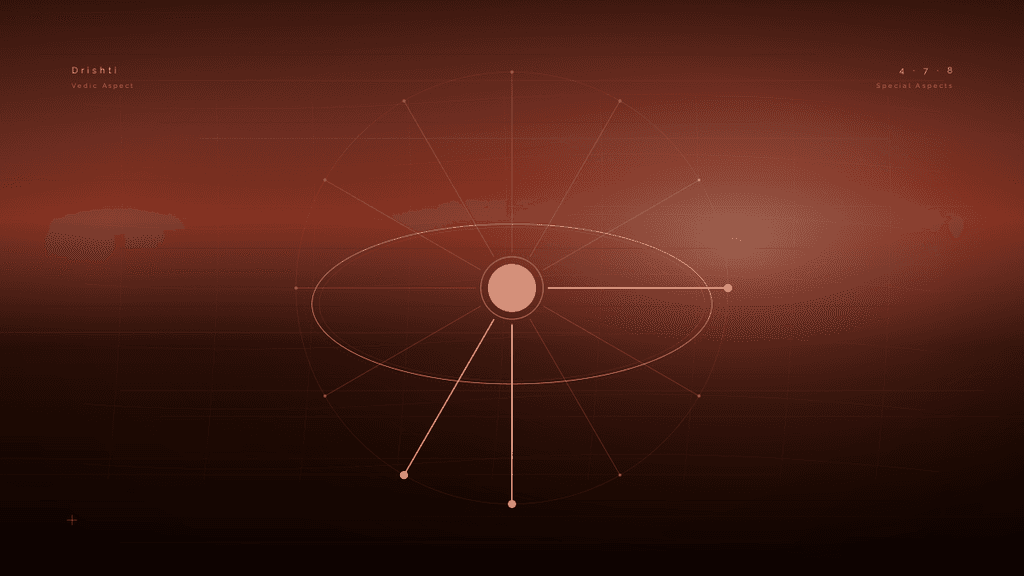
Aspect Strength by Degree: How Drishti Intensity Is Computed
Not every drishti (aspect) carries the same weight. Classical Vedic astrology recognises a hierarchy of aspect strengths and modern computation refines that hierarchy by measuring the precise degree separation between aspecting and aspected points. This piece walks through the four classical strength values, the rashi drishti (sign aspect) versus graha drishti (planet aspect) distinction, the degree-based refinement and how the composite strength reading feeds into forward-call timing.
Why aspect strength is a real thing in the framework
Drishti is the Sanskrit word for sight. In classical Vedic astrology the term refers to the angular reach of a graha (planet) across the chart. A planet does not only act on the bhava (house) it occupies. It also throws a glance to specific other houses and the planets sitting in those houses. The framework treats this distance reach as functionally equivalent to placement, scaled by an aspect-strength factor that classical texts assign to each glance. The aspect-strength factor is what this article is about.
The strength factor is not a vague intensity rating. The classical Parashari teaching assigns four discrete strength values and a series of conditional modifiers. The strength reading matters because two aspects of the same nominal type (both 7th aspects, both Jupiter 5th aspects, both Saturn 10th aspects) can produce very different outcomes depending on the precise angular separation, the dignity of the aspecting planet and the presence of other aspects on the receiving point. A practitioner reading aspect strength as binary (present or absent) misses most of the nuance the framework actually carries.
The strength reading also matters because it interacts with dasha-bhukti timing in a load-bearing way. A natal aspect that is structurally weak (light intensity at peak, dignified aspecting planet projecting at less than full force) produces mild effects during the running dasha of either planet involved. A natal aspect that is structurally strong (high intensity at peak, undignified aspecting planet projecting raw force, no benefic mitigation) produces concentrated effects during the same dasha. The aspect strength is the multiplier on the dasha activation, not an independent signal.
The four classical strength values
Classical Parashari teaching assigns four strength values for aspect glances. The full glance (purna drishti) carries 100 percent strength and is reserved for the 7th aspect (the standard opposition that every planet shares) and for the special aspects each planet carries with full strength in most lineages. The three-quarter glance (called paada-3 or paada-4 in some texts) carries 75 percent strength and is assigned to mid-distance aspects in some lineages. The half glance (ardha drishti) carries 50 percent strength and applies to certain aspects in conditional configurations. The quarter glance (paada drishti) carries 25 percent strength and is the lightest reading.
The strength values are set out below for each planet's aspect set. The table follows the most widely-followed Parashari teaching. Some lineages assign slightly different fractional values for the special aspects; the variation is most pronounced for Jupiter (where some teachers treat the 5th aspect as three-quarter and the 9th aspect as full) and for Saturn (where some teachers treat the 3rd aspect as three-quarter and the 10th aspect as full). Tempora's reading follows the standard teaching where all named special aspects are treated as full strength for the sign-level computation and the degree-based refinement provides the fine-grained scaling.
| Planet | Standard 7th aspect | Special aspects (strength) | Conditional |
|---|---|---|---|
| Sun | Full (100%) | None in standard teaching | Combust planets within ~9 degrees lose distinct identity |
| Moon | Full (100%) | None in standard teaching | Strength varies with paksha (waxing or waning) |
| Mars | Full (100%) | 4th aspect: Full; 8th aspect: Full | Mars retrograde intensifies aspect |
| Mercury | Full (100%) | None in standard teaching | Combust frequently due to proximity to Sun |
| Jupiter | Full (100%) | 5th aspect: Full; 9th aspect: Full | Jupiter retrograde reads as deeper internal aspect |
| Venus | Full (100%) | None in standard teaching | Strength interacts with dignity (exaltation in Pisces, debilitation in Virgo) |
| Saturn | Full (100%) | 3rd aspect: Full; 10th aspect: Full | Saturn retrograde intensifies karma reading |
| Rahu | Full (100%) | 5th aspect: Full; 9th aspect: Full (Jaimini schools) | True Node vs Mean Node choice affects ~2 degree precision |
| Ketu | Full (100%) | 5th aspect: Full; 9th aspect: Full (Jaimini schools) | Ketu's aspects read with detachment signature |
The table treats all named aspects as full strength at the sign level. The fractional values (75, 50, 25 percent) appear in the framework primarily through the Ashtakavarga and Shadbala computation systems, which are detailed scoring frameworks that use the fractional strengths for precise planetary strength assessment across multiple parameters. For the routine aspect-reading flow, the framework simplifies to two questions: does the aspect reach the receiving point and what is the degree-based intensity within the orb.
Rashi drishti versus graha drishti
Two distinct aspect frameworks operate in parallel in classical Vedic astrology. The first is rashi drishti (sign aspect) and the second is graha drishti (planetary aspect). The distinction is load-bearing because the two frameworks produce different aspect maps for the same chart.
Rashi drishti is the aspect framework where a sign (and everything in it) is read as aspecting another sign based purely on sign position. The classical Jaimini system uses rashi drishti extensively. The Jaimini rashi drishti rule is precise: a movable sign (Aries, Cancer, Libra, Capricorn) aspects all fixed signs (Taurus, Leo, Scorpio, Aquarius) except the adjacent one; fixed signs aspect all movable signs except the adjacent one; and dual signs (Gemini, Virgo, Sagittarius, Pisces) aspect each other. The Jaimini framework reads the chart through these sign-level aspects and many Jaimini-specific timing techniques rely on rashi drishti rather than graha drishti.
Graha drishti is the aspect framework where a planet (and only the planet, not the whole sign) is read as aspecting a specific house or planet through the special-aspect rules. The Parashari teaching uses graha drishti for the special aspect framework (Mars's 4th and 8th, Jupiter's 5th and 9th, Saturn's 3rd and 10th). The Parashari graha drishti is more granular than Jaimini rashi drishti and produces a different aspect map. Modern computation runs both frameworks in parallel and reads them together: rashi drishti gives the sign-level aspect picture, graha drishti gives the planet-level refinement.
The degree-based intensity refinement (the third layer this article is about) is a refinement of graha drishti specifically. It measures the precise angular separation between the aspecting planet and the receiving point and scales the graha drishti strength by how close the separation comes to the exact aspect angle. The rashi drishti framework does not use degree-based refinement because it operates at the whole-sign level.
How degree-based aspect strength is actually computed
The degree-based refinement starts from a simple geometric principle: the exact aspect angle is the angular separation that produces the strongest aspect. For the 7th aspect, the exact angle is 180 degrees of separation. For Mars's 4th aspect, the exact angle is 90 degrees of separation (since the 4th house from any point is 90 degrees away). For Jupiter's 5th aspect, the exact angle is 120 degrees. For Jupiter's 9th aspect, the exact angle is 240 degrees (or equivalently 120 degrees behind). For Saturn's 3rd aspect, the exact angle is 60 degrees. For Saturn's 10th aspect, the exact angle is 270 degrees (or equivalently 90 degrees behind).
The aspect strength scales by proximity to the exact angle within an orb. The conventional orb (the allowable deviation from exact angle) is read as roughly plus or minus 5 degrees for the 7th aspect, with strength scaling roughly linearly from peak at exact angle down to roughly half strength at the orb boundary. The special aspects use similar orbs, sometimes tightened for the more granular Saturn and Mars aspects and loosened for Jupiter's wide benefic projection. The orb teaching varies by lineage and the conservative reading uses tighter orbs across the board (3 degrees instead of 5 for the special aspects).
The computation is straightforward. Step one: compute the angular separation between the aspecting planet and the receiving point in zodiacal degrees. Step two: compute the deviation from the exact aspect angle. Step three: if the deviation is within the orb, scale the aspect strength by the proportion (deviation / orb). Step four: combine the scaled strength with the sign-level Parashari strength and the conditional modifiers to produce the composite reading. The arithmetic is precise and the output is a single number that represents the aspect's effective strength as a percentage of full classical strength.
Applying versus separating aspects
The degree-based refinement produces a second important distinction that the sign-level framework cannot capture: the difference between applying and separating aspects. An applying aspect is one where the aspecting planet is moving toward the exact aspect angle. The angular separation is changing in a way that brings the aspect toward peak. A separating aspect is one where the aspecting planet has just crossed the exact aspect angle and is moving away. The angular separation is changing in a way that takes the aspect away from peak.
The applying versus separating distinction matters because the two states read differently for forward-call timing. An applying aspect carries upcoming event-potential: the peak has not yet arrived and the event the aspect signifies is in the future. A separating aspect carries just-completed event-residue: the peak has passed and the event the aspect signifies has already occurred. For natal chart reading the distinction is less consequential because the aspect is fixed at the moment of birth, but for transit reading and for progressed chart reading the distinction is load-bearing.
For dasha-bhukti reading specifically, the applying versus separating distinction interacts with the running dasha period. A Jupiter dasha running while transit Jupiter is applying to natal Saturn through Jupiter's 9th aspect carries upcoming benefic event-potential. The same Jupiter dasha running while transit Jupiter is separating from natal Saturn through the same aspect carries just-completed event-residue. The distinction often shows up as the difference between a positive event arriving at the expected timing window versus one that arrived in the previous window and is winding down.
The aspect strength computation walk-through
Worked example for clarity. Take a chart with natal Jupiter at 12 degrees 30 minutes Aries and natal Saturn at 14 degrees 45 minutes Sagittarius. Jupiter's 9th aspect from Aries lands on Sagittarius (the 9th sign from Aries is Sagittarius). The exact angular separation for the 9th aspect is 240 degrees forward (or equivalently 120 degrees backward). Jupiter at 12 degrees 30 minutes Aries projects its 9th aspect to the point 240 degrees forward, which is 12 degrees 30 minutes Sagittarius. Natal Saturn is at 14 degrees 45 minutes Sagittarius, so the receiving point is 2 degrees 15 minutes past the exact aspect point. The aspect is applying (Jupiter moving forward will close the gap with Saturn in the natural zodiacal sequence on next return). Within a 5-degree orb the deviation of 2.25 degrees scales the aspect strength to roughly 55 percent of peak (using linear scaling: 100 percent at 0 degrees, 50 percent at 5 degrees). The composite reading is Jupiter's 9th aspect on natal Saturn at moderate-to-strong intensity, applying, with the natal aspect always active and the transit weather adding or subtracting from the activation depending on the running dasha.
What the degree-based reading does not do
The degree-based aspect strength framework is precise about angular intensity but explicitly limited on three fronts. It does not override the dignity of the aspecting planet. A debilitated planet projecting a high-intensity aspect through tight angular separation still projects weakened force because the planet itself is structurally compromised. The dignity modifier comes before the degree-based modifier in the composite reading. The 5-degree orb produces a precise intensity number but the precise intensity is multiplied by the dignity factor, not added independently.
It does not capture the karaka logic. The framework reads the geometry of the aspect but the meaning of the aspect comes from what the aspecting planet signifies and what the receiving planet or house signifies. A precisely-computed Jupiter aspect on the 7th house reads completely differently from a precisely-computed Mars aspect on the same house even at identical angular precision. The degree-based reading is one input to the meaning-reading; it does not produce meaning by itself. Tempora's coverage of the specific aspect readings (the Mars-7th, Saturn-Moon, Jupiter-5th, Rahu-natal-planets readings) carries the meaning layer that the strength computation feeds into.
It does not replace the broader chart reading. A precisely-strong aspect in a chart with weak overall structural support (debilitated lagna lord, malefic-loaded kendras, damaged trikonas) still projects within the limits of the broader structure. The aspect intensity is a multiplier on what the chart can produce; it is not an independent producer of outcomes. The framework reads the aspect strength as one signal in a multi-layer reading; it does not negate other layers when they project difficulty.
How aspect strength feeds into Tempora's forward-call reading
Tempora's aspect computation runs on the Swiss Ephemeris with the True Pushya Paksha ayanamsa by PVRN Rao. The Swiss Ephemeris returns planetary longitudes to arc-second precision (1/3600 of a degree), which is far more precision than the aspect strength framework actually requires. The conventional orb (5 degrees) is generous compared to the precision of the underlying ephemeris and the strength computation operates well within the precision the Swiss Ephemeris provides.
The computation runs three stages of strength assessment. Stage one applies the sign-level Parashari framework: identify each planet's house position and compute its standard 7th aspect plus any special aspects (Mars 4th 8th, Jupiter 5th 9th, Saturn 3rd 10th, Rahu and Ketu specials in the Jaimini-aligned configuration). Stage two applies the degree-based refinement: measure the precise angular separation between the aspecting planet and the receiving point and scale the aspect strength by proximity to the exact angle within the 5-degree orb. Stage three applies the conditional modifiers: dignity of the aspecting planet (exaltation, debilitation, own sign, combustion, retrogression), aspect from other planets on the aspecting or receiving point (benefics strengthen, malefics dampen or harden) and the active dasha-bhukti period.
The composite reading produces an aspect strength score that feeds into the forward-call timing reading. The score is used in two ways. First, it determines whether an aspect rises to the threshold of significance for the timing reading: a score below roughly 30 percent of peak is treated as background noise rather than active aspect. Second, it determines the intensity of the aspect's contribution to the composite signal during dasha-bhukti activation: a higher score produces a heavier weight in the multi-signal stack that the timing reading uses to produce a forward-call window. The framework is not a guess; it is a sequence of well-specified arithmetic operations that takes planetary positions as input and produces aspect strength as output.
Conclusion
Aspect strength in classical Vedic astrology is a precise three-layer computation, not a generic intensity rating. The first layer is the sign-level Parashari framework that assigns full strength to the 7th aspect and to each planet's special aspects (Mars 4th 8th, Jupiter 5th 9th, Saturn 3rd 10th). The second layer is the degree-based refinement that scales aspect intensity by proximity to the exact aspect angle within a 5-degree orb. The third layer is the conditional modifier that adjusts intensity by the aspecting planet's dignity, by benefic or malefic aspect on the aspecting planet and by the active dasha-bhukti. The composite reading produces a single aspect strength score that feeds into the forward-call timing reading. The framework is testable: it takes Swiss Ephemeris output as input and produces aspect strength as output through a sequence of well-specified arithmetic operations. The strength reading matters because two aspects of the same nominal type can produce very different outcomes depending on precise angular separation, dignity and benefic or malefic support. A clean aspect-strength reading is one layer in the timing stack, not the whole stack.
Degree exactness under the 2026 to 2028 sky
The dated sky gives the strength framework live material to work on. The sign-level layer comes first. Transit Jupiter, exalted in Cancer from 27 May 2026 to 19 June 2027, casts its 5th aspect into Scorpio, its 7th into Capricorn and its 9th into Pisces; from Leo, held from 19 June 2027, the destinations step to Sagittarius, Aquarius and Aries. Transit Saturn in Pisces until 23 May 2027 casts its 3rd into Taurus, its 7th into Virgo and its 10th into Sagittarius, and from Aries, entered 23 May 2027 with a retreat into Pisces from 4 November 2027 to 11 February 2028, the glances move to Gemini, Libra and Capricorn. In stage-one terms every natal point in an aspected sign counts as aspected for the whole window.
The degree layer decides when inside the window the aspect actually peaks. The corpus example of exactness comes from the India 1947 chart: transit Jupiter crossed natal Mercury on 5 August 2026 at an orb of 0.05 degrees, then reached natal Sun on 16 October 2026. The sign-level statement is that Jupiter sits in Cancer for roughly thirteen months; the degree scan names the single day each natal contact goes exact. That is the resolution gap this whole piece is about, and it is why the engine computes orbs to fractions of a degree rather than stopping at the sign boundary.
Exactness dates an intensity peak. It does not guarantee the event, and the corpus carries the receipt for that limit. The June 2026 monsoon call ran through an exact transit Jupiter contact on India's natal Moon in Pushya on 21 June, orb under 0.1 degrees, with the signature calibrated at 1.41x on fifteen prior instances. Rainfall printed roughly 40 percent below the normal band the call named and the entry is graded FAILED at the monsoon print note, which stays on the record. A maximally tight orb fed a wrong call; the strength score is one multiplier in the stack, sitting under the dignity, karaka and dasha layers.
The applying and separating distinction also becomes concrete once dates are attached. Ahead of 5 August 2026 the Jupiter-Mercury contact on that chart was applying, carrying upcoming event-potential in the framework's terms; from 6 August it was separating residue. Any natal chart can be scanned the same way against the dated windows above. Tempora's scoreboard context for all of this: nine graded flagship calls to date, hit rate 50 percent, misses published.
Frequently asked questions
What is aspect strength in Vedic astrology?
Aspect strength refers to the intensity with which a planet's drishti (aspect) affects the house or planet it glances at. Classical Vedic astrology recognises that not all aspects carry the same weight. The standard 7th house opposition glance shared by all planets carries the highest classical strength. The special aspects each planet carries (Mars's 4th and 8th, Jupiter's 5th and 9th, Saturn's 3rd and 10th, Rahu and Ketu's contested specials) carry scaled-down strengths in the conventional teaching. Beyond the sign-based aspect (rashi drishti) framework, modern Vedic computation also applies a degree-based refinement (graha drishti) where the angular distance between the aspecting planet and the aspected point is measured precisely and the aspect strength is scaled by how close that distance comes to the exact aspect angle. The two frameworks operate together in contemporary practice.
What are the classical aspect strength values?
The classical Parashari teaching assigns four strength values for aspect glances. The full glance (purna drishti) carries 100 percent strength and is reserved for the 7th aspect (the standard opposition that every planet shares) and for the special aspects that each planet carries with full strength: Jupiter's 5th and 9th, Mars's 4th and 8th, Saturn's 3rd and 10th. The three-quarter glance (paada-3 or paada-4 depending on the lineage) carries 75 percent strength and is assigned to certain mid-distance aspects in some lineages. The half glance (ardha drishti) carries 50 percent strength and applies to certain aspects in conditional configurations. The quarter glance (paada drishti) carries 25 percent strength and is the lightest reading. In practice the most-used framework treats the standard 7th aspect as full strength, the special aspects as full strength when teaching the special-aspect rule and reserves the fractional values for fine-grained Ashtakavarga and Shadbala computation.
What is the difference between rashi drishti and graha drishti?
Rashi drishti (sign aspect) is the aspect framework where a sign (and everything in it) is read as aspecting another sign based purely on sign position. The classical Jaimini system uses rashi drishti extensively: a movable sign aspects all fixed signs except the adjacent one, fixed signs aspect all movable signs except the adjacent one and dual signs aspect each other. Graha drishti (planetary aspect) is the aspect framework where a planet (and only the planet, not the whole sign) is read as aspecting a specific house or planet through the special-aspect rules. The Parashari teaching uses graha drishti for the special aspect framework (Mars's 4th and 8th, Jupiter's 5th and 9th, Saturn's 3rd and 10th). The two frameworks operate in parallel: rashi drishti gives the sign-level aspect picture, graha drishti gives the planet-level refinement and degree-based intensity scales graha drishti by how close the planets are to exact aspect angles.
How is degree-based aspect strength computed?
Degree-based aspect strength refines the sign-level aspect framework by measuring how close the aspecting planet comes to the exact aspect angle. For the 7th aspect specifically, the exact aspect angle is 180 degrees of separation. A planet at 15 degrees Aries aspecting a point at 15 degrees Libra is at exactly 180 degrees separation and the aspect strength is at its peak. A planet at 15 degrees Aries aspecting a point at 5 degrees Libra is at 170 degrees separation and the aspect strength is slightly reduced. The conventional orb (the allowable deviation from exact angle) is read as roughly plus or minus 5 degrees for the 7th aspect, with strength scaling linearly from peak at exact angle down to roughly half strength at the orb boundary. The same principle applies to the special aspects: the closer the aspect comes to exact angle, the higher the intensity. Degree-based refinement matters most for fine-grained timing readings and for assessing whether an aspect is approaching or separating.
Do all aspects carry the same strength?
No. The conventional teaching is consistent that aspects do not carry equal strength. The standard 7th aspect carries the highest classical strength because the diametric opposition is the natural full-distance glance and all planets share it. Each planet's special aspects carry scaled strengths: Mars's 7th aspect is full strength, Mars's 4th and 8th aspects carry reduced strengths in some lineages. Jupiter's 7th is full strength and Jupiter's 5th and 9th aspects are also treated as full strength in most schools because Jupiter is the strongest benefic. Saturn's 7th is full strength and Saturn's 3rd and 10th are also treated as full strength in most schools because of their structural importance in karma readings. Rahu and Ketu's special aspects (where taught) carry strengths comparable to their respective benefic counterparts (Jupiter for Rahu, Ketu's specials are less standardised). The differential strength reading matters because a planet aspecting three houses simultaneously through three special aspects projects at different intensities into each receiving house.
Does aspect strength matter for forward-call timing?
Yes. Aspect strength is one of the most consequential refinements for forward-call timing because two aspects of the same nominal type (both 7th aspects) can produce very different outcomes depending on the precise degree separation, the dignity of the aspecting planet and the presence of other aspects on the receiving point. A separating aspect (where the aspecting planet has just crossed exact angle and is moving away) reads differently from an applying aspect (where the planet is approaching exact angle). Applying aspects are conventionally read as carrying upcoming event-potential and separating aspects as carrying just-completed event-residue. The distinction matters most for transit readings (where Jupiter, Saturn or Rahu may aspect a natal point through one of their special aspects during transit) and for dasha-bhukti reading where the running planet is aspecting other natal points. Tempora's reading uses degree-based aspect strength for transit and dasha refinement after the sign-level aspect framework establishes the baseline.
How does Tempora compute aspect strength?
Tempora's aspect computation runs on the Swiss Ephemeris with the True Pushya Paksha ayanamsa by PVRN Rao. The Swiss Ephemeris returns planetary longitudes to arc-second precision and the computation runs three stages of strength assessment. Stage one applies the sign-level Parashari framework: identify each planet's house position and compute its standard 7th aspect plus any special aspects (Mars 4th 8th, Jupiter 5th 9th, Saturn 3rd 10th, Rahu and Ketu specials). Stage two applies the degree-based refinement: measure the precise angular separation between the aspecting planet and the receiving point and scale the aspect strength by proximity to exact angle within a 5-degree orb. Stage three applies the conditional modifiers: dignity of the aspecting planet (exaltation, debilitation, own sign, combustion, retrogression), aspect from other planets (benefics on the aspecting planet strengthen its projection, malefics on the receiving planet harden the impact) and the active dasha-bhukti period. The composite reading produces an aspect strength score that feeds into the forward-call timing reading.
How exact do the 2026 to 2028 transit contacts get?
The engine computes transit orbs to fractions of a degree, and the corpus example is the India 1947 chart: transit Jupiter crossed natal Mercury on 5 August 2026 at an orb of 0.05 degrees and reached natal Sun on 16 October 2026. The sign-level windows are broad, with Jupiter in Cancer from 27 May 2026 to 19 June 2027 aspecting Scorpio, Capricorn and Pisces, and Saturn in Pisces until 23 May 2027 aspecting Taurus, Virgo and Sagittarius before the Aries maps take over. The degree scan names the day a given natal contact peaks inside those windows. Exactness dates intensity and settles nothing by itself: the June 2026 monsoon call ran through a contact at under 0.1 degrees of orb and still graded FAILED. The strength score stays one multiplier in a multi-layer reading.
Read next
This article was first published on 06 June 2026. It documents conventional Vedic teaching on aspect strength computation and Tempora Research's drishti intensity method. Internal audit log maintained for methodology revisions; any subsequent material change to the framework above will be appended here with a dated note. This article represents conventional Vedic teaching and Tempora Research method documentation. It does not constitute medical, financial, legal or professional advice.