Saturn Aspect on the Moon: Mental Pressure, Melancholy and the Cooling Reading
Saturn throws three special drishti (aspects) in classical Vedic astrology. When any of those three glances lands on the natal Moon, the mind picks up Saturn-flavoured signatures. This piece walks through how the aspect is computed, what the mental-pressure reading is actually saying, the cancellation conditions that soften it and what the framework explicitly does not predict.
What Saturn's drishti is doing in the natal chart
Drishti is the Sanskrit word for sight. In classical Vedic astrology the term refers to the angular reach of a graha (planet) across the chart. A planet does not only act on the bhava (house) it occupies. It also throws a glance to specific other houses and the planets sitting in those houses. The houses and planets receiving that glance carry the projecting planet's signature even when it is not physically present in the receiving location. The framework treats this distance reach as functionally equivalent to placement, scaled by an aspect-strength factor that classical texts assign to each glance.
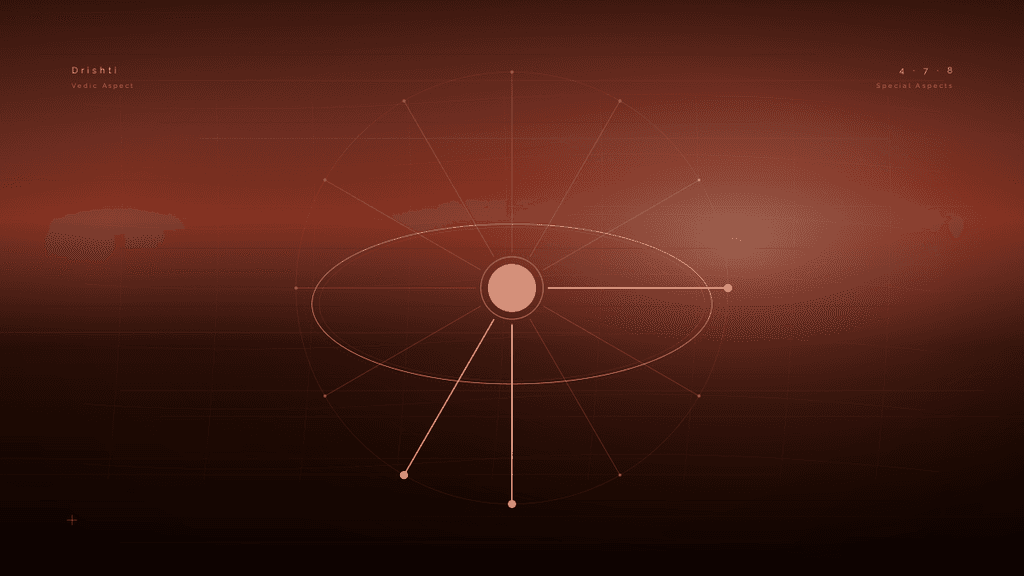
Every planet aspects the seventh house from its own position. The seventh aspect is the natural opposition glance and carries full strength. This is the standard drishti shared across all nine grahas. Beyond the standard seventh, three planets carry additional special aspects in the classical framework. Saturn carries the third aspect and the tenth aspect (counted from Saturn itself, moving zodiacally forward). Jupiter carries the fifth aspect and the ninth aspect. Mars carries the fourth aspect and the eighth aspect. Rahu and Ketu carry contested special aspects in different schools.
The classical reason for Saturn's special aspects is symbolic. Saturn rules the third and tenth signs counted from its own placement in many lineages of the teaching. The third and tenth glances therefore reflect Saturn's structural domain across the zodiacal arc. The practical effect is that Saturn from a single placement can affect three other houses through aspect, plus the planets sitting in those houses. When one of those receiving planets is the Moon, the framework names the contact as the canonical mental-pressure reading.
Why Saturn-Moon specifically carries the mental-pressure weight
The Moon in Vedic astrology is the karaka (significator) of the mind (manas), the mother, the emotional layer, the inner peace of the chart-holder and the lunar reflection of solar light into the field of feeling. The Moon governs how the native experiences emotion, how the inner field responds to outer events and how rest, comfort, mother-care and emotional safety register in the psyche. The Moon is also the fastest-moving graha and the most reactive to transit weather.
Saturn is the karaka of time, structure, restriction, delay, discipline, sustained effort, hardship and the slow grinding maturation of life. Saturn rules the years that pile up, the responsibilities that compound, the shoulders that bear weight and the patience that outlasts impatience. Saturn is the slowest of the visible grahas and the most consequential through cumulative effect rather than fast trigger.
When Saturn aspects the Moon, the karaka of weight meets the karaka of mental ease. The reading is that the mind sits under continuous structural load. The native carries responsibilities heavier than peers of the same age. The native processes feelings through a filter of seriousness and slow consideration rather than fast reaction. The native experiences periodic compressions of mood under Saturn transit triggers. The reading is not depression as a clinical diagnosis and it is not a guarantee of poor mental health. It is a temperament signature that runs through the life and intensifies during specific dasha and transit windows.
The three Saturn-to-Moon aspect routes
Reading Saturn's drishti onto the natal Moon strictly through the three special aspects produces three routes by which Saturn touches the Moon. The aspect routes are set out below. The strength column reflects classical aspect-strength teaching scaled to the seventh glance as the unit. The seventh aspect is the canonical opposition glance and is treated as full strength.
| Saturn position relative to Moon | Aspect type | Strength | Reading |
|---|---|---|---|
| 3 houses behind the Moon | 3rd aspect | ~75% | Saturn from behind pressures the mind with the past. The signature is rumination, lingering responsibility from earlier years and a feeling of incomplete obligation. |
| Opposite the Moon (7th) | 7th aspect | Full | Saturn directly opposes the Moon. The signature is the heaviest mental-pressure reading: chronic seriousness, slow emotional processing and the canonical sade sati feeling running through the natal baseline. |
| 10 houses behind the Moon | 10th aspect | ~50% | Saturn from below pressures the mind with future weight. The signature is anticipatory burden, premature concern about ageing and a feeling of obligations not yet faced. |
The three routes are not equally weighted. The seventh aspect is the heaviest and produces the most concentrated mental-pressure reading because the diametric opposition is the strongest natural glance. The third aspect carries roughly three-quarter strength and the tenth aspect carries roughly half strength. All three are read as Saturn-Moon contacts and all three trigger the same canonical reading at scaled intensity.
The mental-pressure framework in practice
Classical texts describe the Saturn-Moon contact through several recurring themes. The first theme is seriousness from a young age. The native who carries a natal Saturn-Moon aspect tends to read as older than peers, takes life weight earlier and finds it harder to access childlike lightness. The second theme is slow emotional processing. The Saturn-Moon native does not feel emotions less; the native processes them more slowly, holds them longer and arrives at emotional resolution after extended consideration rather than fast release. The third theme is responsibility heavier than the age would suggest. The Saturn-Moon native often takes on the role of caretaker, family pillar or premature breadwinner because the mental field is structurally tuned to carry weight.
The fourth theme is periodic compression of mood. The aspect produces predictable low windows that intensify during Saturn or Moon dasha periods, during sade sati transits and during specific Saturn-related planetary returns. The compressions are not random; they correlate with measurable astrological triggers and they release when the triggers pass. The fifth theme is a melancholy aesthetic. The Saturn-Moon native often finds resonance in serious art, contemplative music, monastic teaching, long-form writing and disciplines that honour weight. The temperament is not pathological. It has its own beauty and its own contribution.
The sixth theme is the maturation signal. The aspect is read as a karmic teaching about emotional discipline and structural endurance. The native learns through the aspect to hold feeling without collapse, to distinguish mood from circumstance and to develop the inner steadiness that comes from sustained pressure. This is the gift that Saturn-Moon natives often recognise in mid-life looking back at the cost of the journey.
What Saturn-Moon does not mean
The Saturn-Moon framework is precise about the temperament signature but explicitly limited on three fronts. It does not predict clinical depression or major depressive disorder as a medical diagnosis. The aspect is a temperament reading, not a diagnostic instrument. A native with a natal Saturn-Moon may live a full and emotionally stable life with mild seriousness as the only signature. A native without the aspect may experience clinical depression for reasons the framework does not address. The aspect speaks to the structure of the mental field, not the medical state of the brain.
It does not predict the absence of joy, love, family connection or emotional richness. Saturn-Moon natives often have deep love lives, close family bonds and rich inner experience. The Saturn signature filters how that experience is processed; it does not negate the experience. Many Saturn-Moon natives describe their emotional lives as quietly intense rather than absent.
It does not override the broader chart. A Saturn-Moon aspect with a strong, well-placed 4th lord, a strong lagna lord and benefic support from Jupiter often produces a mature, resilient native who reads as serious but not heavy. A Saturn-Moon aspect with no benefic support, a weak 4th lord and additional malefic pressure on the Moon produces the heavier reading. Tempora's coverage of aspect strength by degree sets out how the aspect intensity is computed in detail.
The cancellation and softening conditions
Classical teaching lists several softening conditions for the Saturn-Moon contact. The cancellation conditions are conventionally called bhanga (breaking or cancellation). The bhanga rules are read as full or partial softening depending on the configuration. A full softening removes the harsh edge of the mental-pressure reading and leaves a workable maturity signal. A partial softening reduces the intensity but the temperament signature remains.
The first softening is Saturn's own dignity. Saturn in its own signs (Capricorn or Aquarius) or exaltation sign (Libra) carries less harsh pressure because the planet sits in a structurally stable energetic state and its glance projects organised weight rather than raw restriction. The second softening is the Moon's own dignity. Moon in its own sign (Cancer) or exaltation sign (Taurus) carries more stability and absorbs Saturn pressure better than a debilitated or weak Moon. The third softening is the Moon's paksha (waxing or waning phase). A waxing Moon in shukla paksha (the bright half) carries more inner light and more resilience to Saturn pressure than a waning Moon in krishna paksha (the dark half).
The fourth softening is benefic support. Jupiter aspect on Saturn softens the projection significantly because Jupiter brings wisdom, faith and emotional buoyancy that counteract Saturn's heaviness. Jupiter aspect on the Moon directly is even more softening because Jupiter then supports the receiving karaka. Venus aspect on the Moon brings emotional ease and aesthetic resonance that take the edge off Saturn's seriousness. The fifth softening is a strong 4th lord. The 4th house is the seat of mental peace and a strong, well-placed 4th lord acts as a shock-absorber for the Saturn-Moon contact. The sixth softening is a strong lagna lord. A well-placed lagna lord gives the native the personal vitality to carry the Saturn weight without collapse. Tempora's reading on benefic aspect cancellation of dosha covers the broader cancellation lattice across aspect dosha types.
The Saturn-Moon reading test
A Saturn-Moon aspect reading runs through six layers. Layer one: identify Saturn's house position and which of the three special aspects lands on the natal Moon (or whether Saturn occupies the Moon's house in conjunction, which is treated as the strongest contact). Layer two: read Saturn's sign dignity and the Moon's sign dignity. Layer three: read the Moon's paksha (waxing or waning). Layer four: identify any benefic aspect on Saturn or on the Moon (Jupiter, Venus). Layer five: read the 4th house, the 4th lord and the lagna lord's condition. Layer six: check the active dasha-bhukti for Saturn or Moon involvement and the current transit pattern for sade sati activation. The composite reading determines whether the contact projects as heavy raw pressure, workable maturity signal or fully softened temperament colour.
When the Saturn-Moon aspect intensifies in the life
The natal Saturn-Moon aspect is a baseline temperament that runs through the entire life. The aspect intensifies in three specific windows that classical texts identify as the canonical heavy periods. The first is the Vimshottari (the 120-year planetary period sequence) mahadasha or bhukti of either Saturn or the Moon. The 19-year Saturn mahadasha is the longest of the Vimshottari mahadashas and during the Saturn mahadasha of a native who carries a natal Saturn-Moon aspect the temperament signature runs at full intensity for nearly two decades. The Moon mahadasha of 10 years activates the Moon side of the contact and pulls Saturn-Moon themes to the surface through emotional triggers.
The second window is sade sati. Sade sati is the seven-and-a-half-year transit of Saturn through the 12th house, the 1st house and the 2nd house from the natal Moon. The transit is the canonical heavy window for any Saturn-Moon native because Saturn physically moves into close angular relationship with the natal Moon during the middle phase of the transit. The sade sati teaching is one of the most widely-followed transit frameworks in Vedic astrology and Tempora's coverage of sade sati as a spiritual lesson reads the transit through the maturation lens rather than the doom lens.
The third window is the combination of the first two. When the Saturn mahadasha or Saturn bhukti coincides with sade sati transit, the Saturn-Moon native experiences the heaviest possible activation of the natal aspect. The combined window can last several years and is the period when the mental-pressure reading runs at maximum intensity. The classical teaching is that this window is also when the maturation signal runs at maximum intensity. The cost is highest and the spiritual return is highest.
How Tempora computes the Saturn-Moon aspect
Tempora's aspect reading runs on the Swiss Ephemeris with the True Pushya Paksha ayanamsa by PVRN Rao. The Swiss Ephemeris returns sidereal longitudes to arc-second precision. The True Pushya Paksha ayanamsa fixes the sidereal zero point at Pushya nakshatra's start, which differs from the more common Lahiri ayanamsa by a small but consequential amount. The computation runs in five stages.
Stage one locates Saturn and the Moon in the natal chart and computes Saturn's three special drishti (third, seventh and tenth from Saturn). Stage two checks whether any of the three glances land on the natal Moon and whether Saturn itself occupies the Moon's sign in conjunction. Stage three reads both planets' dignity layers: sign placement, exaltation or debilitation, own-sign or enemy-sign, combustion (Saturn rarely combusts but the Moon can be close to the Sun in new-moon births), retrogression state and the Moon's paksha. Stage four identifies any benefic aspect on Saturn or the Moon and reads the 4th house and 4th lord condition. Stage five applies the cancellation lattice (Saturn dignity, Moon dignity, Moon paksha, Jupiter or Venus support, strong 4th lord, strong lagna lord) and reports the bhanga status.
The output feeds into the wider mental-state reading along with the natal 4th house, the lord of the 4th, the lagna lord's condition, the Moon's nakshatra and the active Vimshottari dasha-bhukti scan. The Saturn-Moon reading does not stand alone in any Tempora output. It is presented as one layer among the temperament-reading stack along with the lagna analysis, the Moon's nakshatra reading, transit windows and the active dasha period.
Conclusion
Saturn's aspect on the natal Moon is the canonical mental-pressure reading in classical Vedic astrology because it puts the karaka of the mind under the karaka of weight and time. The three special drishti of Saturn (third, seventh and tenth from its own position) give Saturn three ways to project onto the Moon. The reading is seriousness, slower emotional processing, periodic compressions of mood and a maturation signal that builds through repeated contact. The aspect also carries real gifts: realism, patience, sustained concentration and the discipline that produces deep expertise. The contact is softened by Saturn or Moon dignity, by Jupiter or Venus support, by a waxing Moon, by a strong 4th lord and by a strong lagna lord. The aspect intensifies during Saturn or Moon dasha periods and during sade sati. The framework reads the structure of the mental field, not a clinical diagnosis; the broader temperament reading runs the natal 4th house, the Moon's nakshatra and the dasha scan alongside the aspect. A clean Saturn-Moon reading is one layer in the temperament stack, not the whole stack.
Transit Saturn on the natal Moon, 2026 to 2028
The natal Saturn-Moon aspect is fixed at birth, and transit Saturn recreates the same contact on a published schedule. Saturn has occupied Pisces since 20 March 2025 and holds it until 23 May 2027. Through that date the strongest transit form, the conjunction that layer one of the reading treats as heaviest, falls on natal Moons in Pisces. The three glances follow the whole-sign count: the 3rd reaches natal Moons in Taurus, the 7th reaches Virgo Moons and the 10th reaches Sagittarius Moons, continuously for the length of the stay.
The conjunction case is where this page meets sade sati. Sade sati is Saturn's transit through the 12th, 1st and 2nd signs from the natal Moon, roughly seven and a half years in three phases of about two and a half years each. Dated from the current calendar: a natal Moon in Pisces is in the core second phase, the stretch where Saturn sits on the Moon's own sign, a natal Moon in Aries is in the first phase and a natal Moon in Aquarius is in the closing phase. For a chart that also carries the natal Saturn-Moon aspect, the core phase is the canonical heavy window the timing section above describes.
The wheel steps forward on 23 May 2027, when Saturn enters Aries. Moon-in-Aries moves to the core phase, Moon-in-Taurus enters the first phase and Moon-in-Pisces passes into the closing phase. The calendar itself supplies the caveat: Saturn retreats into Pisces from 4 November 2027 to 11 February 2028, briefly restoring the earlier map before the Aries stay resumes and holds until 2030. From Aries the glances also step, reaching natal Moons in Gemini by the 3rd, Libra by the 7th and Capricorn by the 10th. Every phase statement in this window needs the retreat attached.
Degree strength orders the whole picture. The sign-level chapters above date the years; within them the contact peaks when transit Saturn crosses the natal Moon's exact degree, and the engine computes such orbs to fractions of a degree, the corpus standard of exactness being the 0.05 degree Jupiter-Mercury contact of 5 August 2026 on the India 1947 chart. The limits carry over unchanged: this is a temperament and maturation reading with no clinical claim attached, the natal aspect keeps the structural signature, the running dasha keeps timing priority and no graded call on a sade sati population sits on the public scoreboard. The full dated wheel by Moon sign is mapped in the sade sati by rashi note.
Frequently asked questions
What does Saturn's aspect on the Moon mean in Vedic astrology?
Saturn's drishti (aspect) on the natal Moon is read in classical Vedic astrology as a mental-pressure signature. Saturn carries three special aspects (3rd, 7th and 10th from its own position) and any of these glances landing on the Moon produces a Saturn-Moon contact. The conventional reading is that the mind carries a Saturn flavour: seriousness, restraint, slower emotional processing, a tendency toward responsibility heavier than the age, melancholy under transit triggers and a maturation signal that builds through repeated contact. The framework is read most carefully for the natal Moon because the Moon is the karaka of the mind (manas) and Saturn is the karaka of weight, time and structure. The two energies are tonally opposite and their contact produces a measurable cooling and slowing of the mental field.
Which Saturn placements aspect the natal Moon?
Saturn aspects the Moon from three positions through its special drishti. Saturn 3 houses behind the Moon throws its 3rd aspect onto the Moon. Saturn opposite the Moon (7 houses away) throws the standard 7th aspect onto the Moon. Saturn 10 houses behind the Moon (or 3 houses ahead, since the 10th aspect counted forward is the 3rd aspect counted backward in the zodiacal cycle) throws its 10th aspect onto the Moon. The 7th aspect is the standard opposition glance that all planets share and is the heaviest. The 3rd and 10th aspects are Saturn's special drishti and carry roughly three-quarter and half strength respectively in classical teaching.
Why is Saturn-Moon read as mental pressure specifically?
The Moon in Vedic astrology is the karaka (significator) of the mind (manas), the mother, the emotional layer, the inner peace of the chart-holder and the lunar reflection of solar light. Saturn is the karaka of time, structure, restriction, delay and the slow grinding maturation of life. When Saturn aspects the Moon, the karaka of weight meets the karaka of mental ease. The reading is that the mind sits under continuous structural load. The native carries responsibilities heavier than peers, feels emotions through a filter of seriousness, processes feeling more slowly than is comfortable and experiences periodic compressions of mood under Saturn transit triggers. The reading is not depression as a clinical diagnosis. It is a temperament signature that runs through the life and intensifies during specific dasha and transit windows.
Is Saturn aspect on the Moon always negative?
No. The Saturn-Moon contact carries weight but it also carries gifts that the framework explicitly names. Saturn brings the mind toward realism. The Saturn-Moon native is rarely deluded about life, sees difficulties clearly from a young age and develops a maturity of judgement that peers without the aspect take decades to reach. Saturn also brings the mind toward sustained effort. The aspect supports patience, long-arc concentration, the capacity to sit with hard problems and the discipline that produces deep expertise. Many serious researchers, writers, monastics and long-form artists carry Saturn-Moon contacts in their natal charts. The mental-pressure reading is real but it is the cost of a real gift, not a defect.
What softens or cancels a Saturn-Moon aspect?
Classical teaching lists several softening conditions for the Saturn-Moon contact. Saturn in its own sign (Capricorn or Aquarius) or exaltation (Libra) carries less harsh pressure because the planet sits in a structurally stable state. Saturn aspected by Jupiter is significantly softened because Jupiter brings wisdom, faith and emotional buoyancy that counteract Saturn's heaviness. Jupiter aspect on the Moon directly is even more softening because Jupiter then supports the receiving karaka rather than just the projecting one. The Moon in waxing phase (shukla paksha) carries more inner light and absorbs Saturn pressure better than the waning Moon (krishna paksha). The Moon in own sign (Cancer) or exaltation (Taurus) carries more stability. A strong, well-placed lord of the 4th house (the house of mental peace) also acts as a shock-absorber. Tempora's reading on benefic aspect cancellation of dosha covers the broader cancellation framework across aspect dosha types.
When does the Saturn-Moon aspect intensify in the life?
The natal Saturn-Moon aspect is a baseline temperament that runs through the entire life. The aspect intensifies in three specific windows. First, during Saturn's mahadasha or bhukti in the Vimshottari (120-year planetary period) sequence: the 19-year Saturn mahadasha and the smaller Saturn bhuktis under other dashas activate the aspect strongly. Second, during the Moon's mahadasha or bhukti: the 10-year Moon mahadasha and Moon bhuktis can pull Saturn-Moon themes to the surface. Third, during sade sati: the seven-and-a-half-year Saturn transit through the 12th, 1st and 2nd houses from the natal Moon is the canonical heavy window for Saturn-Moon natives and produces the most concentrated mental-pressure reading of the life. The combination of natal Saturn-Moon aspect plus active Saturn dasha plus sade sati transit is read as the heaviest possible window for the temperament signature.
How does Tempora compute the Saturn-Moon aspect?
Tempora's aspect reading runs on the Swiss Ephemeris with the True Pushya Paksha ayanamsa by PVRN Rao. The Swiss Ephemeris returns sidereal longitudes to arc-second precision. For the Saturn-Moon aspect specifically, the computation locates Saturn and the Moon in the natal chart, computes Saturn's three special drishti (3rd, 7th and 10th from Saturn), checks whether the natal Moon receives any of them, computes both planets' dignity (sign placement, exaltation, debilitation, own-sign, combustion, retrogression), reads the Moon's paksha (waxing or waning phase), checks for the cancellation conditions (Jupiter aspect on Saturn or Moon, Saturn or Moon in own or exalted sign, strong 4th lord) and reports the aspect strength plus the cancellation status. The output feeds into the wider mental-state reading along with the natal 4th house, the lord of the 4th, the lagna lord's condition and the active dasha-bhukti scan.
When does transit Saturn aspect my natal Moon between 2026 and 2028?
It depends on the Moon's sign. With Saturn in Pisces until 23 May 2027, natal Moons in Pisces carry the conjunction, the core second phase of sade sati, while the glances reach Moons in Taurus by the 3rd, Virgo by the 7th and Sagittarius by the 10th. Moons in Aries are in the first sade sati phase and Moons in Aquarius in the closing phase. When Saturn enters Aries on 23 May 2027 the wheel steps forward: Aries Moons move to the core phase, Taurus Moons enter the first phase, Pisces Moons pass to the closing phase and the glances reach Gemini, Libra and Capricorn. Saturn retreats into Pisces from 4 November 2027 to 11 February 2028, briefly restoring the earlier map. The contact peaks at exact degree crossing, computed to fractions of a degree, and the reading stays a temperament layer with no clinical claim attached.
Read next
This article was first published on 06 June 2026. It documents conventional Vedic teaching on Saturn's drishti onto the natal Moon and Tempora Research's aspect reading method. Internal audit log maintained for methodology revisions; any subsequent material change to the framework above will be appended here with a dated note. This article represents conventional Vedic teaching and Tempora Research method documentation. It does not constitute medical, financial, legal or professional advice.