Benefic Aspect Cancellation of Dosha: The Bhanga Reading
A benefic drishti (aspect) from Jupiter, Venus or the waxing Moon onto an afflicted planet or house cancels or softens the dosha (affliction) signature in classical Vedic astrology. The framework is sometimes called bhanga (breaking or cancellation) and it is one of the most consequential correction rules in chart reading. This piece walks through which planets cancel which kinds of affliction, the strength conditions and what the framework explicitly does not undo.
The benefic-malefic classification in classical Vedic astrology
The classical benefic-malefic classification has a permanent layer and a contextual layer. The permanent benefics are Jupiter (the great benefic, Guru), Venus (the lesser benefic, Shukra) and the waxing Moon (Chandra in the bright fortnight). The permanent malefics are Saturn (Shani), Mars (Mangal), Rahu (the north node) and Ketu (the south node). The contextual planets are Mercury (Budha, which becomes benefic when conjunct another benefic and malefic when conjunct a malefic) and the Sun (Surya, mildly malefic by intrinsic nature but functionally benefic when ruling a kendra or trikona).
The classification interacts with the planet's house rulership in the natal chart. A planet that rules a kendra (the angular 1/4/7/10) carries functional benefic capacity even when it is a natural malefic. A planet that rules a trikona (the trine 1/5/9) is functionally benefic in classical reading because the trikonas are the most auspicious houses. A planet that rules a dusthana (the difficult triad 6/8/12) loses some of its benefic capacity even when it is a natural benefic. The composite functional reading is the product of the intrinsic benefic-malefic classification and the natal house rulership; a Jupiter ruling the 6th house (which happens for Cancer ascendant) is a partially functional malefic in classical opinion even though Jupiter is the great benefic intrinsically.
For the cancellation framework the intrinsic benefic classification is the primary filter. A Jupiter aspect cancels dosha in the conventional reading regardless of whether Jupiter happens to rule a dusthana for a particular ascendant. The functional classification is a secondary modifier that fine-tunes the cancellation strength. The Tempora reading runs both layers but presents the intrinsic classification as the headline because it is the more direct teaching from Brihat Parashara Hora Shastra (the foundational classical text) and the major commentary lineages.
Jupiter's cancellation: the strongest single source
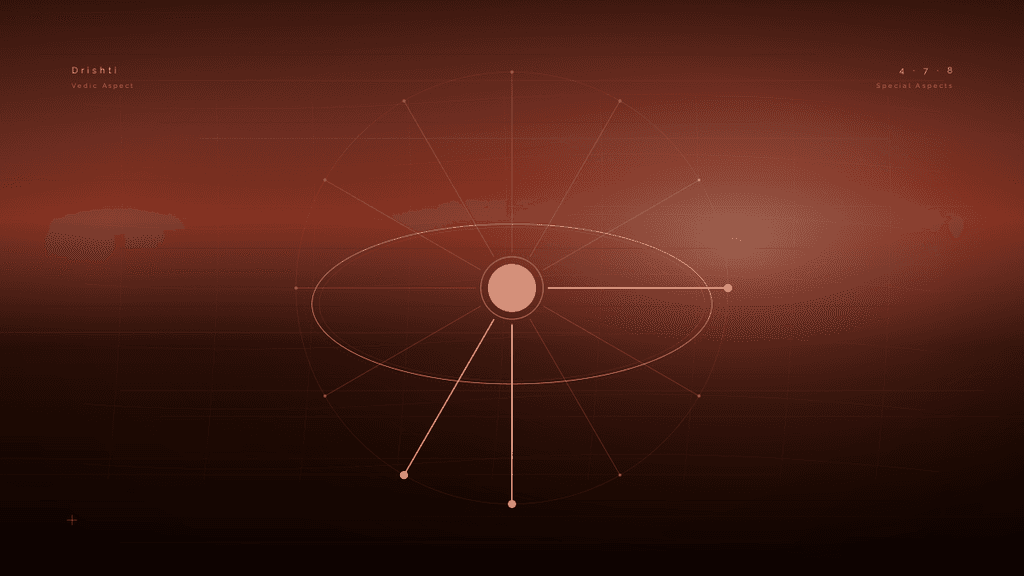
Jupiter is the strongest single source of benefic cancellation in the classical reading. Jupiter carries three drishti (aspects): the standard 7th aspect shared by all planets and Jupiter's two special aspects (the 5th and the 9th from Jupiter's own position). The 5th and 9th aspects land on the trikona (trine 1/5/9) positions which are the most auspicious houses in any natal chart and Jupiter's 9th aspect specifically is read as the grace aspect because the 9th house is the seat of dharma (right action), fortune and the father karaka. Tempora's detailed reading on Jupiter's 9th house aspect covers the grace projection in full.
When Jupiter's drishti lands on an afflicted planet (a malefic, a planet in debilitation, a planet in a dusthana, a planet in combustion) or an afflicted house (a dusthana, a house with multiple malefics, a house with a debilitated lord), Jupiter projects wisdom, restraint and structural support onto the affliction. The conventional reading is that Jupiter's aspect can cancel up to roughly three-quarters of the dosha signature even when Jupiter itself is moderately placed. A strong Jupiter (own sign Sagittarius or Pisces, exalted in Cancer, in a kendra or trikona, in retrograde with classical lineage support) cancels closer to full strength.
Jupiter's cancellation is particularly relevant to four classical dosha contexts. First the Manglik dosha (Mars affliction on the 7th house and the marriage axis), where Jupiter's aspect on Mars or on the 7th house is one of the standard cancellation conditions. Second the Saturn-Moon affliction (the mental-pressure reading), where Jupiter's aspect on the Moon or on Saturn softens the mental-axis projection significantly. Third the Kala Sarpa Yoga (the Rahu-Ketu axis condition), where Jupiter's aspect on Rahu or Ketu is a partial mitigation. Fourth the dusthana placements (6/8/12 occupation), where Jupiter's aspect provides structural support to the planet sitting in the difficult house.
Venus's cancellation: the marriage-affliction specialist
Venus is the second-strongest source of benefic cancellation in the classical reading. Venus carries only the standard 7th aspect shared by all planets and does not have the special drishti pair that Jupiter and Saturn carry. The 7th aspect from Venus is conventionally read as projecting beauty, harmony, marital support, artistic expression and the softening influence of Shukra (the planet's Sanskrit name).
When Venus's drishti lands on an afflicted planet or house, Venus projects its softening influence onto the affliction. Venus is particularly relevant to marriage and partnership readings because Venus is the karaka of marriage in the natural zodiac. A Venus aspect onto an afflicted 7th house or onto a Manglik Mars is one of the standard cancellation conditions for the Manglik dosha. A Venus aspect onto a debilitated 7th lord softens the marriage-house weakness. A Venus aspect onto Saturn (the other primary malefic for marriage timing) softens Saturn's delay signature on the 7th.
The strength of the Venus cancellation depends on Venus's own dignity. Venus in own sign (Taurus or Libra) or exaltation (Pisces) projects strong cancellation, sometimes approaching Jupiter's cancellation strength for marriage-axis afflictions. Venus in friendly sign or in a kendra projects moderate cancellation. Venus in debilitation (Virgo), combustion (within roughly ten degrees of the Sun, with the exact orb varying by lineage) or retrogression projects weak cancellation. The Venus cancellation is also diluted by malefic conjunction; a Venus conjunct Saturn, Mars or Rahu projects modified signatures that classical opinion treats with caution.
The Moon's cancellation: conditional on waxing or waning state
The Moon's aspect can cancel dosha but the cancellation is conditional on the Moon's waxing or waning state and on the Moon's intrinsic dignity. The waxing Moon (Shukla Paksha, from the new moon to the full moon) is classified as benefic and projects emotional support, mental stability and the softening of mental-axis afflictions. The waning Moon (Krishna Paksha, from the full moon to the new moon) is classified as neutral to mildly malefic in stricter readings and projects weaker or no cancellation. The Moon carries only the standard 7th aspect; the Moon does not have special drishti beyond the opposition glance.
The Moon's cancellation is particularly relevant to two classical contexts. First the Saturn-Moon affliction (the mental-pressure reading covered in Tempora's piece on Saturn's aspect on the Moon), where a strong waxing Moon under Saturn's pressure carries internal resilience that the dosha reading does not predict. Second the Manglik dosha context, where the Moon's aspect on Mars is one of the conventional Manglik cancellation conditions because the Moon binds Mars into the emotional layer of the chart rather than letting it project outward as raw friction.
A strong Moon (own sign Cancer, exalted in Taurus, in a kendra, waxing in Shukla Paksha and aspected by Jupiter or Venus) cancels strongly across the mental and marriage contexts. A weak Moon (debilitated in Scorpio, combust, waning in Krishna Paksha, aspected by Saturn or Rahu) cancels weakly or not at all. The conventional reading is that a Moon below 72 degrees from the Sun (combustion threshold) and in the dark fortnight does not provide cancellation; the planet itself is afflicted and cannot project benefic support.
The strength conditions that make cancellation count
A benefic aspect counts as cancellation only when several conditions hold together. The bhanga lattice is precise about when a benefic projection actually neutralises the affliction and when it merely modifies the surface reading without removing the structural signature. Five conditions run in the conventional reading.
First the benefic itself must be reasonably well-placed. A Jupiter in own sign or exaltation cancels strongly. A Jupiter debilitated in Capricorn or combust cancels weakly or not at all. A Venus in own sign or exaltation cancels strongly. A Venus debilitated in Virgo or combust cancels weakly. The cancellation strength is a product of the benefic's intrinsic capacity, not just the fact of the aspect. Second the benefic must not be retrograde when classical strictness applies. A retrograde benefic projects modified signatures that some lineages count as cancellation and some do not. Tempora's reading counts retrograde benefics as partial cancellation sources, scaled by the planet's other dignity layers.
Third the benefic must not be conjunct a malefic or aspected by a stronger malefic. A benefic under malefic pressure carries diluted cancellation strength because the benefic's own state is compromised before it projects outward. A Jupiter conjunct Rahu (the Guru Chandala Yoga) projects modified signatures that classical opinion treats as compromised; the cancellation power is reduced. Fourth the benefic aspect must land directly on the afflicted planet or afflicted house. An aspect that grazes the house cusp but lands on a non-afflicted occupant does not cancel. The orb-precise reading covered in Tempora's piece on aspect strength by degree applies here. Fifth the affliction itself must be in the range where benefic cancellation applies. Some afflictions (a heavy classical planetary-war signature, a planetary war between two grahas competing for the same degree) require structural cancellation conditions beyond benefic aspect alone.
The bhanga lattice across classical dosha contexts
The bhanga lattice runs across the major classical dosha contexts with cancellation conditions that vary by dosha. The table below sets out the four most consequential dosha contexts and the standard cancellation conditions for each.
| Dosha context | Primary cancellation | Secondary cancellation | Notes |
|---|---|---|---|
| Manglik (Kuja) dosha | Jupiter or Venus aspect on Mars | Moon aspect on Mars; Mars in own sign or exaltation; dual-Manglik partner matching | Tempora's reading on Manglik cancellation rules covers the full lattice |
| Saturn-Moon affliction | Jupiter aspect on Moon or on Saturn | Strong waxing Moon in own sign or exaltation; Venus aspect on Moon | Cancellation softens the mental-pressure reading but does not erase the introspective signature |
| Kala Sarpa Yoga (Rahu-Ketu axis) | Jupiter aspect on Rahu or Ketu | Strong benefic in the central trapped-planet area; benefic exchange with the nodes | Partial mitigation; structural axis remains active across the dasha periods |
| Dusthana (6/8/12) placement | Jupiter aspect on the dusthana occupant | Dusthana lord in own sign or exaltation; benefic conjunction with the dusthana occupant | Cancellation supports the planet sitting in the difficult house but does not relocate the house |
The lattice is read as a probability gradient, not a binary on or off. A Manglik dosha with Jupiter aspect on Mars from own sign carries roughly 75% cancellation in the conventional reading. The same Manglik dosha with Jupiter debilitated and combust aspecting Mars carries roughly 20% cancellation. The same Manglik dosha with no benefic aspect carries 0% cancellation and projects the full friction signature. The composite cancellation score combines all relevant benefic aspects (Jupiter, Venus, Moon) weighted by their individual cancellation capacities.
The bhanga reading test
A bhanga reading runs through five layers. Layer one: identify the dosha (Manglik, Saturn-Moon, Kala Sarpa, dusthana placement, debilitation, combustion). Layer two: identify the candidate benefic aspects (Jupiter's three drishti, Venus's 7th aspect, Moon's 7th aspect when waxing). Layer three: read each candidate benefic's own dignity (sign placement, kendra-trikona position, retrogression, combustion, conjunction with malefics). Layer four: check whether the benefic aspect lands directly on the afflicted planet or house. Layer five: compute the composite cancellation score as the sum of individual benefic capacities scaled by aspect-orb precision. The result determines whether the dosha projects as full friction (no cancellation), modified friction (partial cancellation) or workable neutrality (high cancellation).
What benefic cancellation does not undo
The benefic cancellation framework has clear limits in classical practice. It does not cancel structural longevity conditions. The maraka (death-inflicting) framework and the Balarishta (early-childhood death indicators) run on their own rules. A benefic aspect modifies the surface signature but does not erase the structural maraka calculation; a chart with heavy maraka indicators and benefic aspects on the maraka planets carries reduced friction in the maraka domain but the structural reading remains active.
It does not cancel the karaka damage from a planet in its own karaka house in stricter classical opinions. The Sun in the 9th damages the father karaka in some lineages; a benefic aspect modifies but does not undo the damage signature. Venus in the 7th in some lineages damages the marriage karaka; a benefic aspect modifies but does not undo the karaka damage. The conservative reading of karaka damage applies in subsets of the classical tradition; the more liberal reading does not treat karaka-in-own-house as automatically damaging. Tempora runs the conservative reading as the headline.
It does not override the active dasha-bhukti at the time of event. A Mars Mahadasha running across a cancelled Manglik dosha still activates the Mars signature during the period even when the natal dosha is structurally cancelled. The cancellation softens the natal-chart projection but the dasha-period activation runs on the Vimshottari (the 120-year planetary period sequence) timing layer which is independent of the natal cancellation. The composite reading at any time is the product of the natal signature, the dasha-period activation and the transit conditions; benefic cancellation operates only on the natal signature.
How Tempora computes the bhanga reading
Tempora's bhanga computation runs on the Swiss Ephemeris with the True Pushya Paksha ayanamsa by PVRN Rao. The Swiss Ephemeris returns each planet's sidereal longitude to arc-second precision and the True Pushya Paksha ayanamsa fixes the sidereal zero point at Pushya nakshatra's start. The cancellation reading runs in four stages.
Stage one identifies the natal dosha set by scanning the chart for the standard dosha conditions: Manglik (Mars in or aspecting the marriage-relevant houses), Saturn-Moon affliction (Saturn aspect on the Moon by conjunction or drishti), Kala Sarpa Yoga (all seven traditional grahas trapped between Rahu and Ketu), dusthana placements (planets in the 6/8/12), debilitation, combustion and weak placement. Stage two identifies the candidate benefic aspects onto each dosha by projecting Jupiter's three drishti, Venus's 7th aspect and the Moon's 7th aspect when waxing.
Stage three reads each candidate benefic's own dignity. Sign placement (exaltation, debilitation, own sign, friend's sign, neutral, enemy sign). Combustion state. Retrogression state. Aspect from stronger malefics back onto the benefic. Conjunction with malefics. The dignity reading produces a cancellation capacity score for each benefic aspect. Stage four computes the composite cancellation score for each dosha by summing the benefic capacities scaled by aspect-orb precision and reports the dosha as fully cancelled, partially cancelled or uncancelled. The output feeds into the wider chart reading along with the dasha-bhukti scan and is never read as a single-layer prediction.
Conclusion
Benefic aspect cancellation of dosha is one of the most consequential correction rules in classical Vedic chart reading. The bhanga lattice runs across the major dosha contexts (Manglik, Saturn-Moon, Kala Sarpa, dusthana placements) and determines whether the natal dosha projects as full friction or workable neutrality. Jupiter is the strongest single cancellation source because of its three drishti and the wisdom-grace projection. Venus is the second-strongest source and is the marriage-affliction specialist. The waxing Moon cancels mental-axis afflictions when in dignity. The cancellation depends on the benefic's own strength and is diluted by retrograde state, combustion, malefic conjunction or weak placement. The framework does not undo structural longevity, karaka damage or dasha-period activation; it softens the natal signature only. The bhanga reading is one layer in the wider chart-reading stack and is never presented as a single-layer prediction.
Benefic cancellation under the 2026 to 2028 sky
The benefic aspect that cancels a dosha in the natal chart is a standing drishti fixed at birth. The dated sky adds a transit version of the same mechanism. When a benefic transits into aspect of a natal dosha, it lends the softening drishti for the length of its stay, a time-boxed relief that echoes the classical cancellation while the standing chart holds.
Jupiter is the strongest cancellation source in the tradition because of its three drishti, and it is exalted in Cancer from 27 May 2026 to 19 June 2027, the most benefic form the transit can take. From Cancer its aspects reach the 5th sign Scorpio, the 7th sign Capricorn and the 9th sign Pisces. A natal dosha seated in Scorpio, Capricorn or Pisces, whether a Manglik Mars, a Saturn-Moon affliction or a dusthana placement in one of those signs, receives exalted transit Jupiter's drishti across the window and reads a dated softening. When Jupiter moves to Leo from 19 June 2027 the aspected signs step to Sagittarius, Aquarius and Aries. Venus and Mercury, the lighter cancellation sources, pass into aspect of any given sign several times a year in brief spells.
Pair the signal with its limit. A transit aspect is a dated relief window that opens on the ingress and closes on the exit. The classical cancellation is the standing natal benefic drishti, present across a life and read at full weight when the benefic is dignified. The transit relief carries the same boundaries the framework already sets. It softens the natal dosha signature for its window and leaves structural longevity, karaka damage and dasha-period activation to their own rules.
A chart whose natal cancellation is already strong reads the exalted-Jupiter window as the sky seconding a correction it owns. A chart leaning on the transit alone reads a relief that ends when Jupiter leaves the sign. Tempora grades dated forward calls on the public scoreboard, and no dosha-cancellation population signature is posted there, so the transit windows are computable while the calibrated lift stays open. The Jupiter mahadasha note sets out how a Jupiter period and this Jupiter transit read as one overlay.
Frequently asked questions
What is benefic aspect cancellation of dosha in Vedic astrology?
Benefic aspect cancellation is the classical Vedic rule that a drishti (aspect) from a benefic graha (planet) onto an afflicted planet or house can soften or fully cancel the dosha (affliction) signature on that planet or house. The benefic planets in the conventional reading are Jupiter, Venus, the waxing Moon and well-placed Mercury (when not conjunct a malefic). The cancellation reading is one of the most consequential corrections in classical chart reading because it determines whether a Mars-Manglik, a Rahu-Ketu axis, a Saturn-Moon affliction or a 6/8/12 dusthana placement actually projects as friction or whether the benefic support neutralises the signature. The rule is sometimes called bhanga (cancellation or breaking) in the conventional vocabulary.
Which planets are benefics and which are malefics?
The classical benefic-malefic classification has a permanent layer and a contextual layer. The permanent benefics are Jupiter (the great benefic, Guru), Venus (the lesser benefic, Shukra) and the waxing Moon (Chandra in the bright fortnight). The permanent malefics are Saturn (Shani), Mars (Mangal), Rahu (the north node) and Ketu (the south node). The contextual planets are Mercury (Budha, which becomes benefic when conjunct another benefic and malefic when conjunct a malefic) and the Sun (Surya, which is mildly malefic by intrinsic nature but becomes functionally benefic when it rules a kendra or trikona). The benefic-malefic classification interacts with the planet's house rulership in the natal chart; a benefic ruling a dusthana (6/8/12) loses some of its benefic capacity and a malefic ruling a kendra or trikona gains some functional benefic capacity.
How does Jupiter's aspect cancel dosha?
Jupiter is the strongest single source of benefic cancellation in the classical reading. Jupiter's drishti carries three glances: the standard 7th aspect shared by all planets and Jupiter's two special aspects (the 5th and the 9th from Jupiter's own position). The 5th and 9th aspects land on the trikona (trine 1/5/9) positions which are the most auspicious houses and Jupiter's 9th aspect is particularly read as the grace aspect because the 9th house is the seat of dharma (right action) and fortune. When Jupiter's drishti lands on an afflicted planet (a malefic, a planet in debilitation, a planet in a dusthana) or an afflicted house, Jupiter projects wisdom, restraint and structural support onto the affliction. The conventional reading is that Jupiter's aspect can cancel up to 75% of the dosha signature even when Jupiter itself is moderately placed. A strong Jupiter (own sign Sagittarius or Pisces, exalted in Cancer, in a kendra or trikona) cancels closer to full strength.
How does Venus's aspect cancel dosha?
Venus is the second-strongest source of benefic cancellation in the classical reading. Venus carries only the standard 7th aspect shared by all planets and does not have the special drishti pair that Jupiter and Saturn carry. The 7th aspect from Venus is conventionally read as projecting beauty, harmony, marital support, artistic expression and the softening influence of Shukra. When Venus's drishti lands on an afflicted planet or house, Venus projects its softening influence onto the affliction. Venus is particularly relevant to marriage and partnership readings because Venus is the karaka (significator) of marriage in the natural zodiac; a Venus aspect onto an afflicted 7th house or onto a Manglik Mars is one of the standard cancellation conditions. The strength of the Venus cancellation depends on Venus's own dignity: Venus in own sign (Taurus or Libra) or exaltation (Pisces) projects strong cancellation, Venus in debilitation (Virgo) or combustion projects weak cancellation.
Does the Moon's aspect cancel dosha?
The Moon's aspect can cancel dosha but the cancellation is conditional on the Moon's waxing or waning state and on the Moon's intrinsic dignity. The waxing Moon (Shukla Paksha, from the new moon to the full moon) is classified as benefic and projects emotional support, mental stability and the softening of mental-axis afflictions. The waning Moon (Krishna Paksha, from the full moon to the new moon) is classified as neutral to mildly malefic in stricter readings and projects weaker or no cancellation. The Moon carries only the standard 7th aspect. The Moon's cancellation is particularly relevant to Saturn-Moon afflictions (the mental-pressure reading) and to Mars-affliction readings because a Moon aspect on Mars is one of the conventional Manglik cancellation conditions. A strong Moon (own sign Cancer, exalted in Taurus, in a kendra, waxing in Shukla Paksha) cancels strongly; a weak Moon (debilitated in Scorpio, combust, waning in Krishna Paksha) cancels weakly.
What conditions does a benefic aspect need to count as cancellation?
A benefic aspect counts as cancellation only when several conditions hold together. First the benefic itself must be reasonably well-placed: a Jupiter in own sign or exaltation cancels strongly, a Jupiter debilitated in Capricorn or combust cancels weakly or not at all. Second the benefic must not be retrograde when classical strictness applies (a retrograde benefic projects modified signatures that some lineages count as cancellation and some do not). Third the benefic must not be conjunct a malefic or aspected by a stronger malefic; a benefic under malefic pressure carries diluted cancellation strength. Fourth the benefic aspect must land directly on the afflicted planet or afflicted house; an aspect that grazes the house cusp but lands on a non-afflicted occupant does not cancel. Fifth the affliction itself must be in the range where benefic cancellation applies; some afflictions (a heavy classical planetary-war signature or planetary war) require structural cancellation conditions beyond benefic aspect alone.
What does benefic cancellation explicitly not undo?
The benefic cancellation framework has clear limits in classical practice. It does not cancel structural longevity conditions; the maraka (death-inflicting) framework and Balarishta (early-childhood death indicators) run on their own rules and a benefic aspect modifies but does not erase those signatures. It does not cancel the karaka damage from a planet in its own karaka house in classical opinions; the Sun in the 9th damages the father karaka and a benefic aspect modifies but does not undo the damage signature. It does not override the active dasha-bhukti at the time of event; a Mars Mahadasha running across a cancelled Manglik dosha still activates the Mars signature during the period even when the natal dosha is structurally cancelled. The framework is precise on what cancellation softens (the natal dosha signature) and explicit on what it does not erase (structural longevity, karaka damage, dasha-period activation).
Can Jupiter's 2026 to 2028 transit cancel a dosha?
It lends a dated softening rather than a permanent cancellation. Jupiter is the strongest benefic aspect source in the tradition, and it is exalted in Cancer from 27 May 2026 to 19 June 2027. From Cancer its three drishti reach the 5th sign Scorpio, the 7th sign Capricorn and the 9th sign Pisces, so a natal dosha seated in one of those signs receives exalted transit Jupiter's aspect and reads a softening for the window. When Jupiter moves to Leo from 19 June 2027 the aspected signs step to Sagittarius, Aquarius and Aries. The relief opens on the ingress and closes on the exit, and it keeps the framework's limits: it softens the natal dosha signature and leaves structural longevity, karaka damage and dasha-period activation to their own rules. The standing natal benefic drishti is the permanent form. Tempora grades dated calls on the public scoreboard and no dosha-cancellation population signature is posted there.
Read next
This article was first published on 06 June 2026. It documents conventional Vedic teaching on benefic aspect cancellation of dosha and Tempora Research's bhanga reading method. Internal audit log maintained for methodology revisions; any subsequent material change to the framework above will be appended here with a dated note. This article represents conventional Vedic teaching and Tempora Research method documentation. It does not constitute medical, financial, legal or professional advice.