Mars Aspect on the 7th House: Marriage, Manglik and the Friction Reading
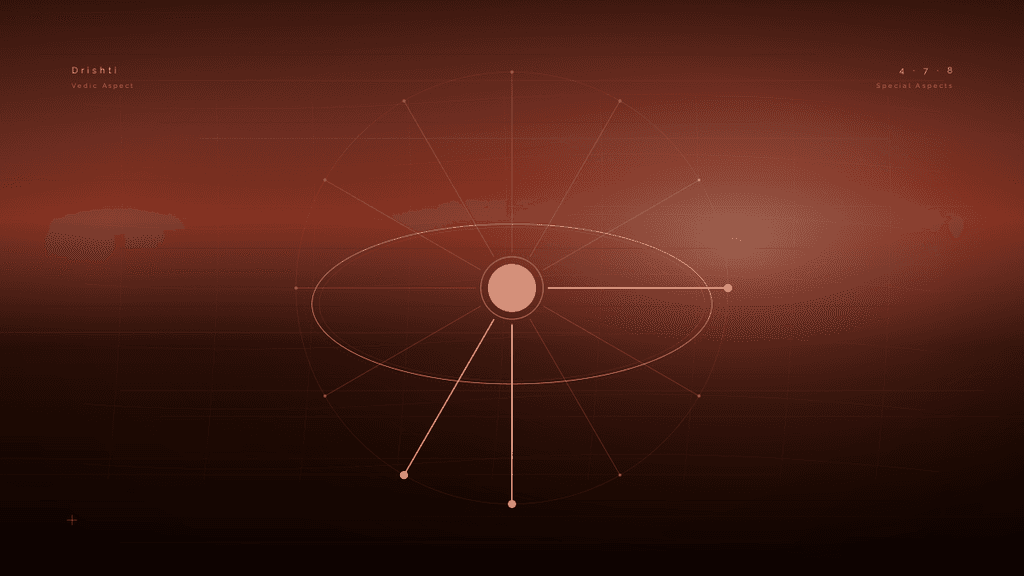
Mars throws three special drishti (aspects) in classical Vedic astrology. When any of those three glances lands on the 7th house of marriage, the partnership chart picks up Mars-flavoured signatures. This piece walks through how the aspect is computed, what the Manglik framework is reading, the cancellation rules that soften the friction and what the framework explicitly does not predict.
What drishti is doing in classical Vedic astrology
Drishti is the Sanskrit word for sight. In classical Vedic astrology the term refers to the angular reach of a graha (planet) across the chart. A planet does not only act on the bhava (house) it occupies. It also throws a glance to specific other houses and the houses receiving that glance carry the planet's signature even when the planet is not physically present. The framework treats this distance reach as functionally equivalent to placement, scaled by an aspect-strength factor that classical texts assign to each glance.
Every planet aspects the seventh house from its own position. The seventh aspect is the natural opposition glance and carries full strength. This is the standard drishti shared across all nine grahas. Beyond the standard seventh, three planets carry additional special aspects in the classical framework. Mars carries the fourth aspect and the eighth aspect (counted from Mars itself). Jupiter carries the fifth aspect and the ninth aspect. Saturn carries the third aspect and the tenth aspect. Rahu and Ketu carry contested special aspects in different schools; the conservative reading restricts them to the seventh glance plus the trikona (trine 1/5/9) glance in some lineages.
The classical reason for Mars's special aspects is symbolic. Mars rules the fourth sign Cancer (where Mars sits in debilitation) and the eighth sign Scorpio (Mars's own sign). The fourth and eighth glances reflect Mars's nodal energy points across the zodiac. The practical effect is that Mars in a single placement can disturb three or four houses simultaneously through aspect. This is why classical texts treat Mars positions with extra care for marriage: a Mars that sits in a relatively quiet house can still aspect three other houses including the seventh.
The Mars-7th house specifically
The seventh house in any natal chart is the seat of marriage, partnership and one-to-one engagement. It is the house of the spouse, the business partner, the open enemy in litigation and the public face of the chart-holder in negotiation. The seventh is a kendra (angular house 1/4/7/10) and shares the structural prominence of all four kendras. Anything that activates the seventh activates the partnership domain.
Mars's three special aspects plus its physical placement give Mars five ways to touch the seventh house. Mars in the first house aspects the seventh house through its seventh glance. This is the strongest of the aspect routes because the seventh glance carries full classical strength. Mars in the fourth house aspects the seventh house through its fourth glance. The fourth glance carries roughly three-quarters strength. Mars in the twelfth house aspects the seventh house through its eighth glance. The eighth glance carries roughly half strength. Mars in the seventh house is the direct placement and carries the highest signature of all. Mars in the tenth house does not aspect the natal seventh through any of its three special drishti (the tenth glance is not part of Mars's aspect set).
The signatures Mars carries into the seventh house are conventionally read as energy, assertion, quick reactivity, courage in confrontation, sometimes outright aggression and a tendency to physical or emotional friction in close partnership. The Mars-marked seventh does not predict a violent marriage. It predicts a partnership domain that operates on Mars's frequency: high activation, low patience, fast escalation, fast resolution.
The Manglik (Kuja) dosha framework
Manglik dosha (also called Kuja dosha) is the conventional name for Mars occupying or aspecting houses that classical texts read as central to marriage. The standard Manglik list is the first, second, fourth, seventh, eighth and twelfth houses from the ascendant, the Moon or Venus. Each of these positions either places Mars in the seventh house, aspects the seventh house through one of Mars's three special drishti or touches a house that classical texts read as marriage-supporting (the second house of family, the twelfth house of bed pleasures and pleasures of the marital bed).
The Manglik framework reads the dosha as a friction signature for marriage. The conventional reading covers four possible signatures: delayed marriage timing, partner conflict, broken engagements before marriage and separation risk after marriage. Stricter classical texts add a fifth signature of widowhood when the Mars touch on the seventh is particularly heavy and unmitigated. The fifth signature is the source of much of the cultural anxiety around Manglik dosha in contemporary Indian matchmaking.
The Manglik check is run from three reference points in modern practice: from the ascendant (lagna), from the Moon's position and from Venus's position. A chart is considered fully Manglik when Mars sits in or aspects the marriage-relevant houses from all three references. A chart is partially Manglik when only one or two references show the dosha. The strictness of the reading varies regionally: north Indian matchmakers tend to apply all three references, south Indian practice often uses ascendant plus Moon and conservative south Indian Brahmin tradition has its own variation that treats Mars in the second house from Venus as the most consequential.
The four full-aspect positions onto the natal seventh
Reading Mars's drishti onto the natal seventh strictly through the three special aspects produces four positions where Mars touches the seventh house. The full-aspect table is set out below. The strength column reflects classical aspect-strength teaching scaled to the seventh glance as the unit.
| Mars position | Aspect type | Strength | Reading |
|---|---|---|---|
| 1st house | 7th aspect | Full | Mars on the lagna throws full-strength glance at the spouse. The partnership signature is energetic confrontation and quick partner-engagement. |
| 4th house | 4th aspect | ~75% | Mars from the home throws three-quarter glance at the spouse. The partnership signature is home-life friction spilling into marriage. |
| 7th house | Direct placement | Highest | Mars literally sits in the marriage house. The signature is most intense and is read as the heaviest Manglik position. |
| 12th house | 8th aspect | ~50% | Mars from the bedroom throws half-strength glance at the spouse. The partnership signature is intimate-domain friction and energy expenditure in marriage. |
The four positions are not equally weighted in the Manglik reading. Mars in the seventh is the heaviest and carries the most cancellation requirements. Mars in the first is the second-heaviest because the full-strength glance lands on the marriage house. Mars in the fourth is the third-heaviest because the home-and-marriage axis overlaps in classical reading. Mars in the twelfth is the lightest of the four full-aspect positions but still counted as Manglik because of the seventh-house touch through the eighth glance.
Mars's dignity and the aspect signature
Mars's intrinsic state at the time of aspect matters as much as the aspect itself. A Mars in own sign (Aries or Scorpio) or in exaltation (Capricorn) throws a glance that is less disruptive because the planet sits in a structurally stable state. A Mars in debilitation (Cancer) or combust (within nine degrees of the Sun) throws a glance that is more disruptive because the planet is structurally weakened and projects its weakness onto the receiving house.
The classical reading runs Mars's dignity check across six layers. Sign placement (exaltation, debilitation, own sign, friend's sign, neutral, enemy sign). House placement (kendra, trikona, dusthana 6/8/12, upachaya). Combustion state (distance from the Sun). Retrogression state (Mars retrograde for roughly two months every two years). Aspect from benefics (Jupiter or strong Venus toward Mars softens the projection). Aspect from malefics (Saturn or Rahu toward Mars hardens the projection).
The composite dignity reading determines whether the Mars-7th aspect projects raw friction or workable assertion. A Mars exalted in Capricorn aspecting the seventh through its seventh glance projects assertion onto the marriage but assertion that has structural backbone and stable direction. A Mars debilitated in Cancer aspecting the seventh through the same glance projects raw emotional reactivity onto the marriage with no structural support. Both are Manglik but they read very differently.
The cancellation rules (Manglik mitigation)
Classical texts list several cancellation conditions for the Mars-7th friction reading. The cancellation rules are conventionally called Manglik dosha bhanga or Kuja dosha bhanga (bhanga meaning breaking or cancellation). The bhanga rules are read as full or partial cancellation depending on the configuration. A full cancellation removes the friction reading entirely. A partial cancellation reduces the friction to a workable level.
The first cancellation is Mars's own dignity. Mars in Aries, Scorpio or Capricorn carries a structurally cancelled dosha because the planet's strength prevents the friction from manifesting. The second cancellation is benefic support: Jupiter conjunct or aspecting Mars softens the projection significantly because Jupiter brings wisdom and restraint. A well-placed Venus conjunct or aspecting Mars softens the projection because Venus is the karaka of marriage and tempers Mars's edge. The third cancellation is Moon support: the Moon conjunct or aspecting Mars softens the dosha by binding Mars into the emotional layer of the chart rather than letting it project outward.
The fourth cancellation is dual-Manglik partner matching. The classical and now widely-followed rule is that a Manglik native marrying another Manglik native cancels the dosha for both. The reasoning is that two Mars-projections on the seventh meet symmetrically and neutralise each other. The matching rule has practical consequences in Indian matchmaking because Manglik-to-Manglik pairings are actively sought when one partner carries the dosha. Tempora's reading on Manglik cancellation rules covers the full cancellation lattice including the regional variations.
The fifth cancellation is a structurally strong seventh lord. When the lord of the seventh house is exalted, in own sign or in a kendra or trikona with benefic support, the seventh house can absorb the Mars projection without structural damage. The strong seventh lord acts as a shock-absorber for the Mars aspect. The sixth cancellation is Mars in the seventh in its own sign (Aries or Scorpio) or exaltation (Capricorn); this is treated as both a Mars dignity cancellation and a Mars-in-seventh special case in some lineages.
The Mars-7th reading test
A Mars-7th aspect reading runs through six layers. Layer one: identify Mars's house position and which of the three special aspects lands on the natal seventh. Layer two: read Mars's sign dignity (exaltation, debilitation, own sign or neutral). Layer three: check Mars's combustion and retrogression state. Layer four: identify any benefic aspect on Mars (Jupiter, Venus or Moon). Layer five: check Manglik status from the ascendant, the Moon and Venus separately. Layer six: read the seventh lord's strength and placement. The composite reading determines whether the friction projects as raw Manglik conflict, softened workable assertion or fully cancelled neutrality.
What the Mars-7th reading does not predict
The Mars-7th aspect framework is precise about the friction signature but explicitly limited on three fronts. It does not predict the partnership's emotional quality or the couple's compatibility. Those are read from the bride's and groom's full natal charts and from the synastry overlay between the two charts (covered in Tempora's reading on Atmakaraka pair compatibility and navamsa overlay compatibility). The Mars aspect speaks to the structure of friction in the marriage house, not the content of the relationship.
It does not predict divorce or partner harm. The stricter classical reading of widowhood from an unmitigated Manglik dosha is one of the conventional teachings that modern practice treats with caution; the structural reading does not extend to forecasting partner mortality and Tempora's framework explicitly excludes that prediction. The Mars aspect is a friction reading, not a harm reading.
It does not override the natal seventh lord's placement or the active dasha-bhukti. A Manglik chart with a strong, well-placed seventh lord and a benefic-running marriage dasha can produce a smooth marriage with internal Mars friction that the couple work through. A non-Manglik chart with a structurally weak seventh lord can produce a difficult marriage with no Mars trigger. The Mars-7th aspect is one signal among several; the marriage reading runs the full lattice. Tempora's coverage of why marriage is delayed sets out the broader timing reading.
How Tempora computes the Mars-7th aspect
Tempora's aspect reading runs on the Swiss Ephemeris with the True Pushya Paksha ayanamsa by PVRN Rao. The Swiss Ephemeris returns Mars's sidereal longitude to arc-second precision; the True Pushya Paksha ayanamsa fixes the sidereal zero point at Pushya nakshatra's start, which differs from the more common Lahiri ayanamsa by a small but consequential amount. The computation runs in five stages.
Stage one identifies Mars's natal house position and computes the three special drishti (fourth, seventh and eighth from Mars). Stage two checks whether any of the three glances land on the natal seventh or whether Mars itself occupies the seventh. Stage three reads Mars's dignity layers: sign placement, combustion state, retrogression state and aspect from benefics or malefics. Stage four runs the Manglik check from the ascendant, the Moon and Venus separately and reports the three-point Manglik score. Stage five applies the cancellation lattice (Mars dignity, benefic support, Moon aspect, dual-Manglik matching, strong seventh lord) and reports the bhanga status.
The output feeds into the wider marriage timing reading along with the seventh lord placement, Venus condition and the active dasha-bhukti scan. The Mars-7th reading does not stand alone in any Tempora output; it is presented as one layer among the marriage-reading stack along with synastry, Vimshottari dasha (the 120-year planetary period sequence) and transit windows.
Conclusion
Mars's aspect on the seventh house is the single most consequential aspect reading in classical Vedic compatibility. The three special drishti of Mars (fourth, seventh and eighth from its own position) plus the direct placement give Mars five ways to touch the marriage house. The Manglik or Kuja dosha framework reads this Mars-7th touch as a friction signature for marriage timing, partner conflict or delayed unions. The dosha is cancelled by Mars in own sign or exaltation, by Jupiter or strong Venus aspect, by Moon support, by dual-Manglik matching and by a structurally strong seventh lord. The framework reads the friction structure, not the relationship content; the broader marriage reading runs synastry, dasha timing and transit windows alongside the Mars aspect. A clean Manglik reading is one layer in the marriage stack, not the whole stack.
Mars and the 7th house in the 2026 to 2028 sky
The natal reading above fixes where Mars aspects the 7th. The transiting sky cannot move that natal aspect, but it can light the same 7th house on dated boundaries, and the interaction of a benefic or a node with a Mars-aspected 7th is the piece worth dating across 2026 to 2028.
Exalted Jupiter is the softening body. It occupies Cancer from 27 May 2026 to 19 June 2027, which is the 7th house for a Capricorn ascendant, then Leo from the 23 October 2026 taste and the settled stay from 19 June 2027, the 7th for an Aquarius ascendant. For a Manglik chart on either ascendant, transit Jupiter crossing the 7th is the classical benefic overlay that eases a Mars-aspected partnership house for the duration, a dated window of relief rather than a permanent change to the natal aspect.
Saturn works the other way, adding weight. It sits in Pisces, the 7th for a Virgo ascendant, until 23 May 2027, then Aries, the 7th for a Libra ascendant, through the rest of the window. Saturn joining a Mars-aspected 7th by transit compounds the pressure classically, so a Manglik Virgo or Libra ascendant reads these as the firmer, slower seasons.
The nodes sharpen the theme. Rahu with Ketu holds the Leo-Aquarius axis until 27 December 2026, then the Cancer-Capricorn axis to 15 July 2028. A node on the 7th alongside a natal Mars aspect raises the intensity of the partnership axis, and the solar eclipse of 12 August 2026 on the Cancer-Leo cusp is the sharpest single moment in the window, a classically shadowed date to elect around.
Transit Mars itself moves fast, roughly a sign every six weeks, so transit Mars crossing the natal 7th or throwing its 4th, 7th or 8th aspect onto it recurs several times a year. These are short, frequent windows read per chart, and they matter most when they coincide with the slow overlays above. Whether a Mars aspect needs weighing at all depends on cancellation, which the Manglik cancellation rules piece sets out.
The limitation holds throughout. A transit over a Mars-aspected 7th is a dated window that eases or intensifies the natal signature, not a rewrite of it; the aspect stays where the birth chart put it. Tempora has graded no Manglik or marriage call on its public scoreboard, which stands at nine flagship calls, half met, the misses left up. A dated partnership window here will carry a falsifier before it is called, and this section stops at the sky.
Frequently asked questions
What does Mars's aspect on the 7th house mean in Vedic astrology?
Mars in classical Vedic astrology carries three special drishti (aspects) beyond the seventh-house glance that all planets share. Mars throws a full-strength aspect to the fourth house, the seventh house and the eighth house from its own position. When Mars occupies the first, fourth, seventh, eighth or twelfth house, the 7th house of marriage receives a Mars drishti or holds Mars itself. The reading is that the partnership space carries Mars-flavoured signatures: assertion, energy, friction, quick reactivity, courage in confrontation and sometimes outright aggression. The framework is conventionally summarised as Manglik dosha or Kuja dosha. The 7th house aspect specifically is the most consequential of the five positions because the 7th is the seat of marriage and the partner.
What is Manglik or Kuja dosha?
Manglik dosha (also called Kuja dosha) is the conventional name for Mars occupying or aspecting the 1st, 2nd, 4th, 7th, 8th or 12th house from the ascendant, the Moon or Venus in a natal chart. Each of these positions either places Mars in the 7th house, aspects the 7th house through Mars's 4th, 7th or 8th drishti or touches a house that classical texts read as marriage-supporting (the 2nd house of family, the 12th house of bed pleasures). The dosha is read as carrying friction signatures for marriage: delayed timing, partner conflict, broken engagements, separation risk or, in stricter texts, widowhood. Modern matchmakers treat Manglik as a marriage-compatibility filter and the dosha cancellation rules (Manglik mitigation) form a standard layer of synastry reading.
Why does Mars have three special aspects instead of one?
All planets in Vedic astrology aspect the seventh house from their own position (the planet's full opposition glance). Three planets carry additional special aspects in classical texts. Mars carries the 4th and 8th aspects beyond the standard 7th. Jupiter carries the 5th and 9th aspects beyond the 7th. Saturn carries the 3rd and 10th aspects beyond the 7th. Rahu and Ketu carry contested special aspects in some schools. The reason the classical framework gives Mars these particular aspects is symbolic: Mars rules the 4th sign Cancer (debilitation) and the 8th sign Scorpio (own sign), so the 4th and 8th house glances reflect Mars's nodal energy points. The practical effect is that a single Mars placement can disturb three or four houses simultaneously through aspect, which is why Mars positions are read with extra care for marriage and partnership.
Which Mars placements aspect the 7th house?
Mars aspects the 7th house from four positions through its special drishti. Mars in the 1st house throws its 7th aspect onto the 7th house. Mars in the 4th house throws its 4th aspect onto the 7th house. Mars in the 10th house throws its 10th-from-itself which is the 7th from the lagna's perspective only when reading from the 4th aspect of Mars in the 10th, so the literal four full-aspect positions onto the natal 7th are Mars in the 1st (7th aspect), Mars in the 4th (4th aspect), Mars in the 12th (8th aspect) and Mars actually sitting in the 7th. The complete Manglik list adds the 2nd, 4th, 8th and 12th positions from the ascendant because of partnership and family-life implications even when Mars does not literally aspect the 7th.
What is the strength of Mars's aspect in friction terms?
Mars's full aspect (drishti) carries the same notional strength as a planet's actual placement in the aspected house. Classical texts assign the 7th aspect (the standard opposition glance) the highest strength because it is the natural diametric line. The 4th aspect carries roughly three-quarter strength and the 8th aspect carries roughly half strength. The practical reading is that Mars in the 1st aspecting the 7th carries the strongest Manglik signature, Mars in the 4th aspecting the 7th carries the second-strongest signature and Mars in the 12th aspecting the 7th carries the third-strongest. Mars actually sitting in the 7th house carries the strongest signature of all because the planet is physically in the marriage seat. The strength reading interacts with Mars's sign placement, dignity (exaltation, debilitation, combustion) and the aspect of benefics back onto Mars.
What cancels or softens a Mars aspect on the 7th house?
Classical texts list several cancellation conditions for the Mars-7th friction reading. Mars in its own sign (Aries or Scorpio) or exaltation sign (Capricorn) carries less disruptive friction because the planet sits in a stable energetic state. Mars conjunct or aspected by Jupiter is significantly softened because Jupiter brings wisdom and restraint to Mars's reactivity. Mars conjunct or aspected by a strong, well-placed Venus is softened because Venus is the karaka of marriage and tempers Mars's edge. The Manglik dosha is treated as cancelled when both partners carry the dosha (the matching theory) or when the dosha appears from one reference (ascendant) but not from the others (Moon, Venus). The dosha is also treated as cancelled when Mars is aspected by the Moon, when Mars is in the 7th house of own or exalted sign or when the 7th lord is exceptionally strong. Tempora's reading on Manglik cancellation rules covers the full cancellation lattice.
How does Tempora compute the Mars-7th aspect?
Tempora's aspect reading runs on the Swiss Ephemeris with the True Pushya Paksha ayanamsa by PVRN Rao. The Swiss Ephemeris returns Mars's sidereal longitude to arc-second precision and the True Pushya Paksha ayanamsa fixes the sidereal zero point at Pushya nakshatra's start, which differs from the more common Lahiri ayanamsa by a small but consequential amount. For the Mars-7th aspect specifically, the computation identifies Mars's house position, computes Mars's three special aspects (4th, 7th, 8th from Mars), checks whether the natal 7th house receives any of them, computes Mars's dignity (exaltation, debilitation, own-sign, combustion, retrogression), checks for the cancellation conditions (Jupiter or Venus support, dual-Manglik matching, Moon aspect on Mars) and reports the aspect strength plus the cancellation status. The output feeds into the wider marriage timing reading along with the 7th lord placement, Venus condition and dasha-bhukti scan.
How does the 2026 to 2028 sky touch a Mars-aspected 7th house?
The transiting sky cannot move a natal Mars aspect, but it lights the same 7th house on dated boundaries. Exalted Jupiter occupies Cancer, the 7th for a Capricorn ascendant, from 27 May 2026 to 19 June 2027, then Leo, the 7th for Aquarius, easing a Mars-aspected partnership house for the duration. Saturn sits in Pisces, the 7th for Virgo, until 23 May 2027, then Aries, the 7th for Libra, adding weight. The Rahu-Ketu axis holds Leo-Aquarius until 27 December 2026 and Cancer-Capricorn after, and the 12 August 2026 eclipse falls on the Cancer-Leo cusp. Transit Mars itself returns to the 7th several times a year. Each is a dated window that eases or intensifies the natal aspect rather than rewriting it, and Tempora has graded no Manglik call on its public scoreboard.
Read next
This article was first published on 05 June 2026. It documents conventional Vedic teaching on Mars's drishti onto the 7th house and Tempora Research's aspect reading method. Internal audit log maintained for methodology revisions; any subsequent material change to the framework above will be appended here with a dated note. This article represents conventional Vedic teaching and Tempora Research method documentation. It does not constitute medical, financial, legal or professional advice.