Saturn in the 4th House: home structural stress and real-estate consolidation.
Saturn sitting in the 4th house (Sukha Bhava in Sanskrit, the house of home, mother, comfort, vehicles and inner happiness) is classically among the most demanding Saturn placements in Vedic astrology. The 4th house karaka is the Moon and Saturn and Moon are classical enemies; the fixed-house karaka friction of the 4th (a kendra house with the Moon as karaka but fixed-house duties) compounds the Saturn restriction register. The configuration produces home structural stress (delayed home-buying, restricted home environments, structural family hardship), real-estate consolidation through institutional or large-scale work (the wealth-from-property pattern when it arrives, arrives durably), mother-line structural events (parental hardship, mother-line longevity stress, eldest-child responsibility) and intensified Sade Sati when the natal Moon is also affected. Computed with Swiss Ephemeris and True Pushya Paksha ayanamsa. Sources: Brihat Parashara Hora Shastra Chapter 27, Phaladeepika Chapter 15, Saravali, Sarvartha Chintamani.
What the 4th house carries
The 4th house in Vedic astrology (Sukha Bhava, the happiness house) carries the home, the mother, comfort (sukha in Sanskrit), real estate, vehicles, the chest and lungs, primary schooling, the inner sense of well-being, the foundation of life and the patrimony (family-line property and accumulated comfort). The classical karaka (significator) is the Moon, signifying emotional comfort, mother-figure presence and the inner experience of home. The Moon is the primary karaka because the 4th house and the Moon both carry the comfort-and-home register; classical sources read this as the deepest karaka pairing in the chart.
The 4th house is also a kendra (angular house) in the classical four-fold classification of houses (kendras: 1, 4, 7, 10; trikonas: 1, 5, 9; dusthanas: 6, 8, 12; upachayas: 3, 6, 10, 11). Kendras carry structural authority in the chart and planets in kendras are classically strong because the angular houses are load-bearing for the chart's structure. The fixed-karaka and kendra-house combination in the 4th creates a specific structural tension when a planet that does not naturally fit the comfort register sits there.
Saturn sitting in the 4th house places a planet whose nature is restriction, structure, slow build and the long arc of time in a house whose karaka is the Moon (emotional comfort, mother, inner happiness). The Saturn-Moon enemy register is one of the most direct planetary frictions in classical Vedic astrology and placing Saturn in the Moon's own house compounds the friction. Classical commentaries describe this as one of the more demanding placements Saturn can occupy. For the full 4th-house reading independent of any single planet, see Tempora's 4th house piece. For the broader Sade Sati framework that often intensifies for Saturn-in-4H natives, see Sade Sati.
Why this is classically challenging
The structural challenge has three distinct sources. First, Saturn and Moon are classical enemies in the Parashari friendship table. The friendship table reads each planet's relationship to every other planet as friend, neutral or enemy; Saturn-Moon is enemy in both directions. When Saturn sits in a house whose karaka is the Moon, the enemy-on-karaka-house friction imprints on every aspect of the house. The Moon's significations (emotional comfort, mother, inner happiness, the feeling of home) come under Saturn's restrictive register and the native experiences the comfort domain as structurally limited.
Second, the 4th is a kendra house (angular) and the kendra position adds structural weight to Saturn's placement. Classical doctrine reads malefics in kendras as auspicious for material outcomes (kendra strength) but inauspicious for comfort outcomes (the karaka-friction limits inner happiness). The configuration is therefore productive for the structural domain of the 4th (real estate, property, institutional consolidation) but restrictive for the personal-comfort domain. The native often builds material foundation through the 4th but does not enjoy the inner comfort the foundation might suggest.
Third, the 4th carries the deepest emotional and inner-life register in the chart. Saturn's nature does not natively fit the inner-comfort domain and the structural mismatch shows up across decades as a low-grade sense of difficulty in finding home, comfort or settled inner experience. Classical commentaries describe Saturn-in-4H natives as carrying a structural inner restlessness even when the outer life looks settled. The native often does not feel at home in their home, does not feel comfortable in their comfort, does not feel happy in what would conventionally count as happiness. The inner register runs serious and weighted across the life arc.
Home structural stress in early life
The early-life pattern of Saturn-in-4H is structural home stress. The exact form varies by chart and family circumstance but the classical reading lists several recurring patterns. Restricted home environment in childhood (the family of origin lives in modest or constrained quarters), home relocation under hardship (the family moves due to economic or other pressures during the native's formative years), parental hardship (one or both parents carry structural difficulty during the native's childhood) or family structural events (separation, death of a family member, family financial restructuring during the native's young years).
The native often grows up with a sense that home is not the safe-and-warm-and-stable register that peers experience. The childhood home carries Saturn's seriousness, weight and structural duties rather than the warmth and ease the 4th house can produce when other planets occupy it. The native often takes on responsibility for the home environment earlier than peers (running errands, managing household tasks, supporting parents in practical matters) and the early responsibility shapes the structurally serious personality the native carries forward.
Home-buying timeline runs delayed structurally. Saturn-in-4H natives often buy their first home later than the demographic average for their cohort and the home-buying process often involves more structural complexity than peers encounter. The first home is rarely the dream home; it is often a structurally modest acquisition that the native then builds on across decades. Classical commentaries note that Saturn-in-4H natives often live in rented accommodation for longer than peers and that the eventual home-buying coincides with major Saturn dasha or transit windows.
Real-estate consolidation in the second half of life
The compensating pattern for Saturn-in-4H is real-estate consolidation in the second half of life. The configuration delays the home and comfort register but, when wealth arrives, the wealth often lands durably in property. Classical reading is that Saturn-in-4H natives become the structural property-builders of their family lines: the native is the one who consolidates the family real-estate base, buys the substantial primary home in midlife, accumulates additional property as savings vehicle and passes property to the next generation.
The real-estate pattern shows up most clearly between the 36th and 55th years. The first home-purchase often falls between the 32nd and 38th years (often during Saturn antardasha or after Saturn's first return at age 29). The home-upgrade or second-property purchase often falls between the 42nd and 50th years (often during Saturn mahadasha or in conjunction with major dasha transitions). By the late fifties, Saturn-in-4H natives often have the most structurally consolidated property base among peers, even if the trajectory looked slow for decades.
The real-estate work often runs through institutional or large-scale registers. The native often builds wealth through real estate as a structural activity rather than through small transactions: institutional property development, large-scale acquisition, structural property work in their profession or real-estate consolidation as part of a broader institutional career. Classical commentaries note that Saturn-in-4H produces strong institutional real-estate work registers, particularly when combined with Saturn placements in the 10th house cycle (career) or with strong 11H configurations (gains).
Mother-line structural events
The 4th house carries the mother. Saturn-Moon enemy register imprints on the mother-line specifically because Moon is the karaka of mother and Saturn restricts the karaka register. The classical reading lists several recurring patterns: parental hardship in the mother (the mother carries health, financial or emotional difficulty during the native's formative years), mother-line longevity stress (the mother may face longevity events during the native's young adulthood, often during Saturn dasha periods), eldest-child responsibility for the mother (the native carries weight for the mother's welfare across decades) or structural distance from the mother (geographic, emotional or both).
The relationship between the native and the mother is often loyal but heavy. The native takes responsibility for the mother seriously and often becomes the primary support for the mother in her late years. The relationship rarely carries the easy warmth that other 4H configurations produce; it carries duty, structural weight and durable obligation. Classical commentaries describe this as Saturn's mother-line register: not warmth but weight, not ease but commitment.
Mother-line longevity stress windows often fall during Saturn dasha periods, particularly the Saturn-Moon and Saturn-Sun antardasha. The framework reads these as stress windows that require attention rather than as fatal predictions; the actual outcome depends on the broader chart, the Moon's natal strength and the running transit context. The native often becomes aware of mother-longevity questions earlier than peers, sometimes through specific events during the formative years or young adulthood.
Sade Sati intensification
Sade Sati is Saturn's seven-and-a-half-year transit across the 12th, 1st and 2nd houses from the natal Moon. The transit is structurally demanding for all natives but it carries specific intensification for Saturn-in-4H natives because the natal Saturn-Moon enemy register is already foregrounded in the chart.
The intensification is most direct when the natal Moon sits in the 3rd, 4th or 5th house. When natal Moon is in 4H (same house as Saturn), the natal Saturn-Moon enemy conjunction is one of the most demanding configurations in the chart and Sade Sati transit across 3H-4H-5H overlays the conjunction with prolonged transit pressure across seven and a half years. When natal Moon is in 3H, Sade Sati starts with Saturn transit through 2H (12th from Moon) and proceeds through 3H (Moon's house) and 4H (2nd from Moon, the natal Saturn position); the middle and late phases overlay the natal Saturn-in-4H configuration directly. When natal Moon is in 5H, Sade Sati transit through 4H-5H-6H overlays the early and middle phases on the natal Saturn-in-4H position.
For these three natal Moon positions, Sade Sati for Saturn-in-4H natives often coincides with the most structurally demanding period of the life arc. Home stress, mother-line events, inner-comfort restriction and real-estate consolidation pressures all concentrate in the seven-and-a-half-year window. The transit also often delivers the major real-estate consolidation events of the life arc, because the same Saturn pressure that produces stress also produces the structural building work that Saturn-in-4H is disposed toward.
For natal Moon positions outside the 3H-4H-5H band, Sade Sati still activates the Saturn-in-4H register but with less intensification. The framework reads Sade Sati for Saturn-in-4H natives as a structurally significant transit that requires attention regardless of natal Moon position.
The inner-comfort register
The 4th house carries the deepest inner-life register in the chart. Saturn imprints on this register a structural seriousness that the native carries across the life arc. The native often experiences inner life as weighted, serious and structurally demanding rather than as light, easy or carefree. The configuration is not depression in the clinical sense (the framework does not predict clinical states) but a structural tone of inner weight.
The pattern shows up across registers. The native rarely feels at home in their home environment even when the home is structurally comfortable. The native often carries low-grade dissatisfaction with comfort itself, finding ease less satisfying than effort. The native often does better in periods of structured work than in periods of leisure: leisure runs strange to the Saturn-in-4H register and the native often feels more grounded when working than when resting.
Classical commentaries note that Saturn-in-4H natives often become structurally engaged with practices that address the inner register through discipline: meditation, structured spiritual practice, long-form yoga, contemplative reading or religious observance in a structured form. The configuration does not produce easy spirituality but it produces sustained spiritual work across decades that often delivers structural inner depth in the late-bloomer phase.
Per-ascendant variation
The general Saturn-in-4H reading modulates by which sign sits on the 4th-house cusp. Even within the structurally demanding classical reading, per-ascendant variation is material.
| Ascendant | Saturn sign in 4H | Reading |
|---|---|---|
| Aries | Cancer (enemy) | One of the harsher variants. Saturn in Moon's own sign in Moon's own house compounds Saturn-Moon enemy friction maximally. Home and mother-line carry significant structural stress. |
| Taurus | Leo (enemy) | Difficult reading. Saturn-Sun enemy friction in 4H creates authority-and-comfort tension. Mother-line may carry paternal-figure register. |
| Gemini | Virgo (friend) | Workable reading. Saturn in Mercury's sign softens the Moon-friction with analytical or technical register. Home environment often carries communication or service orientation. |
| Cancer | Libra (exalted) | The strongest single variant. Saturn exalted in 4H in kendra produces structural authority in home and real-estate domains. Often produces major real-estate or institutional figures. |
| Leo | Scorpio (enemy) | Difficult reading. Saturn-Mars enemy friction in 4H produces transformation and intensity in home and mother-line. Real-estate work often involves transformation registers. |
| Virgo | Sagittarius (neutral) | Workable reading. Saturn in Jupiter's sign softens the friction with dharmic register. Home often becomes a teaching or institutional space in midlife. |
| Libra | Capricorn (own sign) | Exceptional reading. Saturn in own sign in kendra in 4H produces structural home authority and durable real-estate consolidation. One of the strongest variants across ascendants. |
| Scorpio | Aquarius (own sign) | Exceptional reading. Saturn in own sign Aquarius in 4H produces home and real-estate work through system-thinking or progressive registers. Strong real-estate consolidation late. |
| Sagittarius | Pisces (neutral) | Moderate reading. Saturn in Jupiter's water sign softens the friction with compassionate register. Home often carries spiritual or service orientation. |
| Capricorn | Aries (debilitated) | The harshest variant overall. Saturn debilitated in 4H in kendra produces maximum friction. Neecha-bhanga (debilitation cancellation by exalted dispositor) improves the reading materially. |
| Aquarius | Taurus (neutral) | Workable reading. Saturn in Venus's earth sign in 4H gives stable real-estate build. Home environment often carries aesthetic or partnership orientation. |
| Pisces | Gemini (friend) | Moderate reading. Saturn in Mercury's air sign softens the friction with communication or technical register. Home often runs with mental-activity orientation. |
The two strongest variants are Cancer ascendant (Saturn exalted in Libra in 4H) and Libra ascendant (Saturn own-sign in Capricorn in 4H). The harshest variants are Capricorn ascendant (Saturn debilitated in Aries in 4H) and Aries ascendant (Saturn in Cancer in 4H, enemy-on-karaka-house compounded). For all other ascendants, the reading falls in the workable-to-difficult band where the Saturn-in-4H structural stress operates but variation by sign provides some support or further friction.
Saturn dasha activation
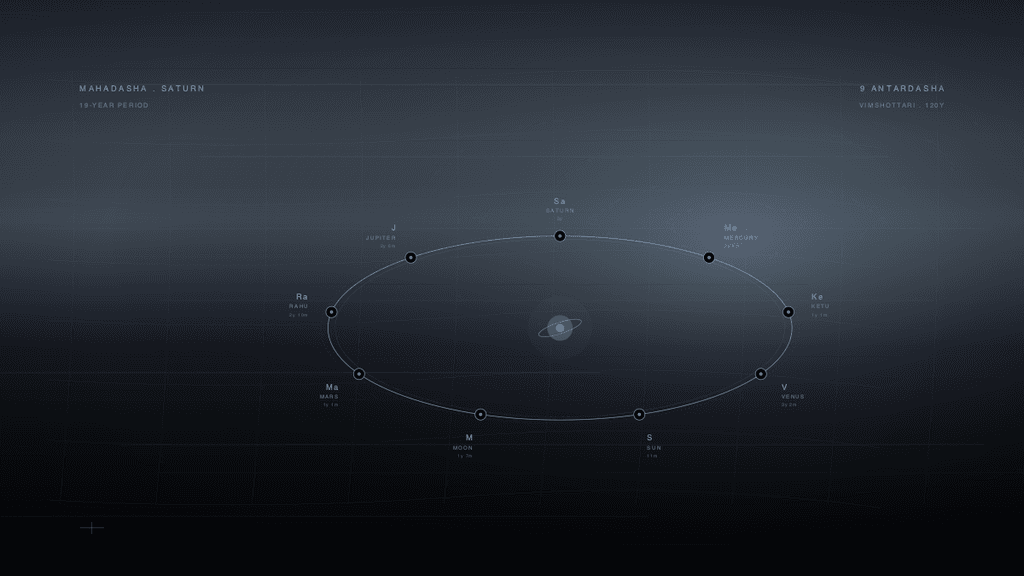
The natal Saturn-in-4H configuration runs as a permanent structural feature but the dasha cycle activates the home and real-estate register at specific windows. The Saturn mahadasha (the nineteen-year period) is the major activation window. During the nineteen years, the 4H signature comes into the foreground and the native often executes the major real-estate consolidation of the life arc, faces the most direct mother-line longevity events and works through the most concentrated home structural stress. The Tempora Saturn Mahadasha piece walks the period in detail.
The Saturn-Venus, Saturn-Mercury and Saturn-Jupiter antardasha sub-periods typically deliver the favourable real-estate events within Saturn mahadasha. The Saturn-Moon antardasha is the most demanding sub-period because it activates the Saturn-Moon enemy register directly; many Saturn-in-4H natives face their most direct mother-line events during this antardasha. The Saturn-Sun antardasha activates authority and home-stability registers; the Saturn-Mars antardasha activates property-acquisition and transformation events.
What the framework does not predict
The Saturn-in-4H reading is structural. It describes the texture of the home register, the mother-line, the inner-comfort domain and the real-estate consolidation pattern, but it does not predict specific events. The framework does not predict the exact home or properties the native will buy (it describes the structural disposition, not the addresses), the specific mother-line events the native will encounter, the exact age at which real-estate consolidation crystallises (it indicates the window, not the date) or the specific inner-experience register the native will carry (the framework reads structural tone, not clinical state).
The framework also does not pass moral judgment on the structural stress register. The classical reading is sometimes described in heavy terms because the comfort domain carries restriction; the more accurate reading is that the comfort domain is structurally different rather than uniformly worse. The native who works the long arc rather than fighting it often arrives at a real-estate consolidation and inner-depth register in the second half of life that exceeds what the early-life difficulty had suggested possible. The chart describes a structurally demanding placement; the relationship to the structure is the native's own.
Saturn in the 4th under the 2026 to 2028 transits
A 4th-house Saturn holds the home, mother and inner-ground axis as a standing condition, and the 2026 to 2028 sky times when that axis is activated. A Sagittarius ascendant carries the 4th house in Pisces, where transit Saturn has sat since 20 March 2025 and stays until 23 May 2027, so this native runs a Saturn return over the home house across the whole window with the contact fixed by the natal degree. A Capricorn ascendant places the 4th house in Aries, reached by transit Saturn on 23 May 2027, released back to Pisces on 4 November 2027 and re-entered from 11 February 2028, so the return over the Sukha Bhava perfects across that retrograde double pass. An Aries ascendant has the 4th house in Cancer, which exalted Jupiter crosses on its full stay from 27 May 2026 to 19 June 2027, a benefic pass over home and heart in Jupiter's own exaltation that reads as ease rather than a Saturn trigger. The cadence sits beneath: Saturn takes about 29.5 years to circle back to a sign, and its re-entry into the natal Saturn's sign forms the same-planet contact that classical practice treats as the placement coming forward. Each window is timing laid over a fixed natal fact, where the placement is the standing condition and the transit is only the trigger. These dates mark when the theme is live rather than any settled event.
Frequently asked questions
Is Saturn in the 4th house bad?
Saturn in the 4th house is classically among the more demanding Saturn placements but the reading is structural rather than uniformly bad. The challenge has three sources: Saturn and Moon are classical enemies and Moon is the 4H karaka, the 4th is a kendra house adding structural weight to the friction and the 4th carries the deepest inner-comfort register in the chart which Saturn's nature does not natively fit. The native often experiences home structural stress in early life (restricted home environment, parental hardship, family-line restriction), mother-line structural events and inner-comfort restriction across the life arc. The configuration compensates through real-estate consolidation in the second half of life: when wealth arrives, it lands durably in property. The framework reads the placement as structurally demanding rather than as uniformly negative. Per-ascendant variation is material: Cancer ascendant places Saturn exalted in 4H (strongest variant), Libra places Saturn own-sign in 4H (also exceptional), Capricorn places debilitation (harshest variant).
Why does Saturn in the 4th house affect the mother?
The 4th house karaka is the Moon and the Moon is also the karaka of the mother. Saturn and Moon are classical enemies in the Parashari friendship table. When Saturn sits in the 4th house, the Saturn-Moon enemy friction imprints on the mother-line specifically. The classical reading lists parental hardship in the mother during the native's formative years (the mother carries health, financial or emotional difficulty), mother-line longevity stress (the mother may face longevity events during the native's young adulthood, often during Saturn dasha periods), eldest-child responsibility for the mother (the native carries weight for the mother's welfare across decades) and structural distance from the mother (geographic, emotional or both). The relationship between the native and the mother is often loyal but heavy: duty, structural weight and durable obligation rather than easy warmth. Mother-line longevity stress windows often fall during Saturn dasha periods, particularly Saturn-Moon and Saturn-Sun antardasha sub-periods. The framework reads these as stress windows requiring attention rather than as fatal predictions.
Why does Sade Sati intensify with Saturn in the 4th house?
Sade Sati is Saturn's seven-and-a-half-year transit across the 12th, 1st and 2nd houses from the natal Moon. The transit is demanding for all natives but it carries specific intensification for Saturn-in-4H natives because the natal Saturn-Moon enemy register is already foregrounded in the chart. The intensification is most direct when the natal Moon sits in the 3rd, 4th or 5th house. When natal Moon is in 4H (same house as Saturn), the natal Saturn-Moon enemy conjunction is one of the most demanding configurations in the chart and Sade Sati transit across 3H-4H-5H overlays the conjunction with prolonged transit pressure. When natal Moon is in 3H or 5H, the Sade Sati transit also overlays the natal Saturn-in-4H position during one of the three phases. For these three natal Moon positions, Sade Sati for Saturn-in-4H natives often coincides with the most structurally demanding period of the life arc. The transit also often delivers the major real-estate consolidation events because the same Saturn pressure that produces stress also produces structural building work.
Does Saturn in the 4th house mean no home or property?
No. Saturn in the 4th house delays and structures the home-and-property register but does not eliminate it. The classical reading is that home-buying runs structurally delayed: the first home-purchase often falls later than the demographic average for the cohort and the first home is rarely the dream home but is often a structurally modest acquisition that the native builds on across decades. The compensating pattern is real-estate consolidation in the second half of life: when wealth arrives, it lands durably in property. Saturn-in-4H natives often become the structural property-builders of their family lines, consolidating the family real-estate base, buying the substantial primary home in midlife, accumulating additional property as savings vehicle and passing property to the next generation. The major real-estate consolidation typically falls between the 36th and 55th years. By the late fifties, Saturn-in-4H natives often have the most structurally consolidated property base among peers, even if the trajectory looked slow for decades. The configuration produces property through patience and institutional or large-scale work rather than through early or easy acquisition.
How does Saturn in the 4th house affect mental peace?
The 4th house carries the deepest inner-life register in the chart and Saturn imprints structural seriousness on this register. The native often experiences inner life as weighted, serious and structurally demanding rather than as light, easy or carefree. The configuration is not depression in the clinical sense (the framework does not predict clinical states) but a structural tone of inner weight. The native rarely feels at home in their home environment even when the home is structurally comfortable, often carries low-grade dissatisfaction with comfort itself and often does better in periods of structured work than in periods of leisure. Classical commentaries note that Saturn-in-4H natives often become structurally engaged with practices that address the inner register through discipline: meditation, structured spiritual practice, long-form yoga, contemplative reading or religious observance. The configuration does not produce easy spirituality but it produces sustained spiritual work across decades that often delivers structural inner depth in the late-bloomer phase. The mental-peace register is therefore structurally demanding but capable of late-life depth through disciplined practice.
Which ascendants have the strongest Saturn in the 4th house?
Two ascendants place Saturn most favourably in the 4th house. Cancer ascendant places Saturn in Libra in the 4th, which is Saturn's sign of exaltation. The exalted-in-kendra configuration is one of the strongest Saturn placements across all twelve houses, producing structural authority in home and real-estate domains and often producing major real-estate or institutional figures across decades. Libra ascendant places Saturn in Capricorn in the 4th, which is Saturn's own sign. The own-sign-in-kendra configuration produces structural home authority and durable real-estate consolidation; the native often builds significant institutional wealth through property registers across decades. Scorpio ascendant places Saturn in Aquarius in the 4th (Saturn's other own sign) and produces a system-thinking variant of the strong-Saturn reading. For all three of these ascendants, the Saturn-in-4H configuration delivers the structurally productive register without the maximum-friction reading of Saturn-Moon enemy-on-karaka-house compounding. The harshest variant is Capricorn ascendant (Saturn debilitated in Aries in 4H) followed by Aries ascendant (Saturn in Cancer in 4H, enemy-on-karaka-house compounded).
When does Saturn in the 4th house deliver real estate?
The major real-estate consolidation window typically falls between the 36th and 55th years for Saturn-in-4H natives. The first home-purchase often falls between the 32nd and 38th years, frequently during a Saturn antardasha sub-period or shortly after Saturn's first return at the 29th-to-30th year. The home-upgrade or second-property acquisition often falls between the 42nd and 50th years, frequently during Saturn mahadasha (when Saturn becomes the running nineteen-year period lord) or in conjunction with major dasha transitions. By the late fifties, Saturn-in-4H natives often have the most structurally consolidated property base among peers. The real-estate work often runs through institutional or large-scale registers rather than through small individual transactions: institutional property development, large-scale acquisition, structural property work as part of a broader career. Within Saturn mahadasha, the Saturn-Venus, Saturn-Mercury and Saturn-Jupiter antardasha sub-periods typically deliver the favourable real-estate events. The pattern compounds across decades and the late-fifties property base often exceeds what the early-career trajectory had suggested possible.
When is a natal Saturn in the 4th house activated in 2026 to 2028?
The window varies by ascendant. A Sagittarius ascendant carries the 4th-house Saturn in Pisces and is in a Saturn return over the home house now, since transit Saturn holds Pisces from 20 March 2025 to 23 May 2027. A Capricorn ascendant holds it in Aries, activated when transit Saturn enters on 23 May 2027, steps back on 4 November 2027 and returns from 11 February 2028. An Aries ascendant sees exalted Jupiter cross the 4th house from 27 May 2026 to 19 June 2027. Saturn returns to any sign about every 29.5 years, the deeper same-planet trigger. Each date is an activation window over the standing placement rather than a guaranteed event.
- 4th house · the full reading of the home and mother house
- Saturn Mahadasha · the nineteen-year Saturn period karaka portfolio
- Sade Sati · the seven-and-a-half-year Saturn transit framework
- Saturn in the 3rd house · the upachaya placement comparison
- When will I buy a house · the home-buying timing framework
This article was prepared by Tempora Research as a planet-in-house reading. The framework is descriptive of structural chart layers and does not predict specific events. Internal audit log maintained. This article does not constitute medical, financial, legal or professional advice. First published 2026-06-05 by Tempora Research.