Saturn in the 3rd House: sustained-effort openings and upachaya strength.
Saturn sitting in the 3rd house (Sahaja Bhava in Sanskrit, the house of siblings, courage, effort and the upachaya growing register) is among the most structurally favourable Saturn placements in classical Vedic astrology. The 3rd is an upachaya house (one of the four houses that grow stronger over time, the others being 6, 10 and 11) and malefics like Saturn perform well in upachayas because the houses absorb the malefic register and convert it into sustained-effort productivity. The native often produces openings through long, patient, structurally disciplined work, carries structurally defining sibling-line events, develops writing and communication that gathers weight across decades and grows physical and mental stamina that compounds with age. Computed with Swiss Ephemeris and True Pushya Paksha ayanamsa. Sources: Brihat Parashara Hora Shastra Chapter 27, Phaladeepika Chapter 15, Sarvartha Chintamani, classical upachaya doctrine in Jataka Parijata.
What the 3rd house carries
The 3rd house in Vedic astrology (Sahaja Bhava, the sibling house) carries siblings (particularly younger siblings), courage and initiative (parakrama in classical Sanskrit), self-effort, short journeys, the immediate neighbourhood, hands and arms, writing, communication, primary skill development and the lower-level intelligence (the practical-effort register as distinct from the higher dharmic intelligence of the 9th). The classical karaka (significator) is Mars, signifying courage and the energy of effort. Mercury is the secondary karaka through the communication register.
The 3rd house carries a specific classical classification that materially changes the Saturn-in-3H reading: it is one of the four upachaya houses. The upachaya group (houses 3, 6, 10 and 11) are the growing houses; classical sources read planets in upachayas as gaining strength over time rather than starting strong. Malefics like Saturn, Mars and Rahu perform structurally well in upachayas because the houses absorb the malefic register and convert it into sustained productivity, effort and structural growth. The classical doctrine, documented in Jataka Parijata and elaborated in Phaladeepika, is direct: malefics in upachayas are auspicious; benefics in upachayas are less auspicious. Saturn in the 3rd house is therefore among the most favourable Saturn placements across the twelve houses, second only perhaps to Saturn in the 11th (another upachaya). For the full 3rd-house reading independent of any single planet, see Tempora's 3rd house piece.
Why this is one of the strongest Saturn placements
The upachaya classification inverts the conventional Saturn-as-restriction reading. Saturn's nature is the slow build, structural discipline and the long arc of time. In an upachaya house, those qualities become a productive engine rather than a restrictive load. The 3rd house is the house of self-effort, courage and skill development; Saturn imprints on these registers the structural discipline that lets effort compound across decades into structural mastery.
The classical reading is that Saturn in the 3rd produces a native who breaks through where others give up. The first decade of effort in any chosen domain runs slow and unrewarding; the second decade compounds; the third decade delivers structural mastery that peers who started faster but did not sustain have not reached. The pattern shows up across professional, creative and physical domains. Writers with Saturn in 3H produce body of work across decades that compounds into structural authority. Athletes with the configuration are the endurance specialists who outlast peers. Professionals with the configuration become the senior structural figures in their domain across thirty or forty year careers.
Courage (parakrama) under Saturn-in-3H reads structural rather than impulsive. The native does not act on impulse and does not court risk for its own sake; the native takes the long, slow, sustained risk and holds the position through difficulty until the structural reward arrives. Classical commentaries describe this as Saturn courage: not the flash of bravery but the steady refusal to abandon a project under pressure. The native is the one who does not quit.
Sustained-effort openings
The signature productivity pattern of Saturn-in-3H is the sustained-effort transformation. The native works long, patient, structurally disciplined cycles in their chosen domain and breaks through to structural recognition or mastery at the point where most peers have either quit or plateaued. The pattern shows up in three specific timing windows.
First, the first major transformation often arrives around Saturn's first return (the 29th-to-30th year). The native has been building for a decade by that point and the Saturn return delivers the first structural consolidation of the work. Second, the major mid-career transformation often falls in the late thirties or forties during Saturn mahadasha (when Saturn becomes the running mahadasha lord) or during the Saturn antardasha of another mahadasha. The transformation is rarely sudden; it is the visible consolidation of a decade of slow build. Third, the late-career structural authority often crystallises in the late fifties or sixties during Saturn's second return (around the 58th to 59th year). The native by that point carries the accumulated weight of forty years of sustained work and the late return delivers the most structurally durable recognition of the life arc.
The domains in which Saturn-in-3H natives produce openings are typically the long-arc work domains: writing, technical mastery, institutional building, research, teaching, structural professions. The configuration is less common in fast-cycle domains (entertainment, fashion, short-cycle business) and when it appears there the native often produces the unusual long-arc career within a fast-cycle field (the writer-comedian who builds across decades rather than burning out in years, the long-career fashion designer rather than the trend-driven one).
Sibling-line structural events
The 3rd house carries siblings (particularly younger siblings, the parashari reading places elder siblings in the 11th). Saturn sitting in the 3rd imprints structural events on the sibling line. The exact form varies by chart and culture, but the classical reading lists several recurring patterns: eldest-child responsibility for younger siblings (the native carries weight for sibling welfare), sibling distance (the native is geographically or emotionally distant from siblings across long periods), sibling structural events (a sibling's serious illness, career struggle, geographic relocation under hardship) or one-child outcomes (the native has fewer siblings than the family average or is an only child).
The classical Saturn-in-3H reading often pairs with the native taking on a quasi-parental role for a younger sibling. The native is the responsible elder; the younger sibling looks to the native for structural support across decades. The relationship is often less warm than ideal but durably loyal. Classical commentaries note that the Saturn-in-3H native often supports a sibling financially or structurally in adult life, sometimes carrying the support for many years.
The maraka layer does not apply directly to siblings in classical reading (the 3rd is not a maraka house) but the Saturn placement carries longevity-stress windows that can activate for siblings during Saturn dasha periods. The framework reads these as stress windows rather than as fatal predictions. The chart owner often becomes aware of sibling longevity questions earlier than peers, sometimes through specific events during the formative years.
Writing and communication with accumulated weight
The 3rd house carries writing and communication. Saturn imprints structural discipline on the writing register. The native often becomes a structural writer or communicator whose body of work gathers weight across decades. The pattern is direct: each piece of work carries Saturn's seriousness, careful construction and weighted content; the accumulated body of work compounds into structural authority that flash-in-the-pan writers cannot match.
Specific writing registers Saturn-in-3H natives often inhabit include long-form non-fiction, technical documentation, structural commentary, institutional analysis, research writing, biography, history and the slow-build essay. The native is less often the fast-cycle journalist, the trend commentator or the entertainment writer; the native is more often the careful long-form author who publishes a major work every several years rather than weekly columns. By midlife the native often has produced enough body of work to carry authority in their domain.
Speaking and short-cycle communication run less natively for Saturn-in-3H. The native is often a better writer than speaker. Public speaking, when the native does it, carries weight precisely because the native speaks rarely; the audience reads the careful construction and measured delivery as authority. Classical commentaries describe Saturn-in-3H as the placement that produces the rare-but-weighty public statement rather than the constant-but-light social presence.
Stamina and physical effort that compounds with age
The 3rd house carries hands and arms specifically (in the body-zone mapping of the twelve houses) and the broader physical-effort register more generally. Saturn imprints structural discipline on the physical body in a specific way: the body grows stamina across decades rather than starting fast and burning out.
The classical reading is that Saturn-in-3H natives are not the natively athletic types in youth. The body in adolescence and early twenties often runs slow, the native does not enjoy short-burst exertion and high-intensity competition does not feel native. The pattern inverts across decades: by the thirties and forties the native is often the endurance specialist among peers, the long-distance walker, the patient sustained-work practitioner who outlasts faster-starting peers. By the fifties and sixties the native is often physically stronger than peers who started fitter because the Saturn body was built for the long arc.
The configuration shows up classically in martial arts, endurance sports, long-form physical practice (yoga at structural depth), trekking, walking and any physical domain that rewards sustained discipline over flash intensity. Saturn-in-3H natives who take up such practices in their twenties or thirties often become the most accomplished practitioners in their cohort by the late forties or fifties.
Short journeys and the immediate environment
The 3rd house carries short journeys (as distinct from long journeys, which are read from the 9th house and the 12th). Saturn imprints structural discipline on the short-journey register. The native often travels frequently within their region or country (commute, work travel, family-visit travel, neighbourhood-based travel) but does so in a structured rather than impulsive way. The native is the one who plans the trip, holds the schedule and runs the journey on time.
The immediate neighbourhood and local environment carry the same register. The native is often well-known and structurally engaged in their immediate locality across decades. The pattern shows up most clearly in long residence in one place: the Saturn-in-3H native often lives in the same neighbourhood for many years and develops structural ties to it through the slow-build mechanism Saturn produces in upachaya houses.
Per-ascendant variation
The general Saturn-in-3H reading modulates by which sign sits on the 3rd-house cusp. Even within the favourable upachaya reading, per-ascendant variation is material.
| Ascendant | Saturn sign in 3H | Reading |
|---|---|---|
| Aries | Gemini (friend) | Workable reading. Saturn in Mercury's sign in the communication house produces writing and technical work as the transformation domain. Sibling line carries communication-related register. |
| Taurus | Cancer (enemy) | Moderate reading. Saturn-Moon enemy friction in the effort house produces some emotional friction with sibling line and effort domain, but upachaya support remains. Writing carries emotional weight. |
| Gemini | Leo (enemy) | Moderate reading. Saturn-Sun enemy friction in the effort house. The native often works through authority register in the transformation domain; sibling line may carry paternal-figure register. |
| Cancer | Virgo (friend) | Strong reading. Saturn in Mercury's earth sign in upachaya produces precise technical or analytical transformation work. Writing register is exceptionally strong. |
| Leo | Libra (exalted) | The strongest single variant. Saturn exalted in upachaya produces structurally exceptional transformation work. Writing, communication and sustained effort all carry maximum weight. |
| Virgo | Scorpio (enemy) | Difficult reading among Saturn-in-3H variants. Saturn-Mars enemy friction in the effort house produces intense and transformative transformation work but with emotional cost. Sibling line may carry transformation register. |
| Libra | Sagittarius (neutral) | Workable reading. Saturn in Jupiter's sign in upachaya softens the slow-build with dharmic register. Transformation work often involves teaching or expansive structures. |
| Scorpio | Capricorn (own sign) | Exceptional reading. Saturn in own sign in upachaya is one of the most structurally productive variants across all twelve ascendants. The native produces durable institutional or structural transformation work across decades. |
| Sagittarius | Aquarius (own sign) | Exceptional reading. Saturn in own sign Aquarius in upachaya produces system-thinking, technological or progressive transformation work. The pattern compounds significantly across decades. |
| Capricorn | Pisces (neutral) | Moderate reading. Saturn in Jupiter's water sign in upachaya softens the structural register with compassionate or spiritual content. Writing often carries philosophical depth. |
| Aquarius | Aries (debilitated) | The most difficult variant among Saturn-in-3H readings. Saturn debilitated in upachaya creates friction between the upachaya support and the debilitation register. Neecha-bhanga (debilitation cancellation by exalted dispositor) improves the reading materially. |
| Pisces | Taurus (neutral) | Workable reading. Saturn in Venus's earth sign in upachaya produces stable, slow-build transformation work often through aesthetic or partnership-oriented domains. |
The classical favourites are Leo ascendant (Saturn exalted in Libra in 3H), Scorpio ascendant (Saturn own-sign in Capricorn in 3H) and Sagittarius ascendant (Saturn own-sign in Aquarius in 3H). The most difficult variant is Aquarius ascendant (Saturn debilitated in Aries in 3H), though even this carries upachaya support that softens the debilitation register. For all twelve ascendants, the Saturn-in-3H reading is fundamentally more favourable than Saturn in most other houses because the upachaya support is structural.
Saturn dasha activation
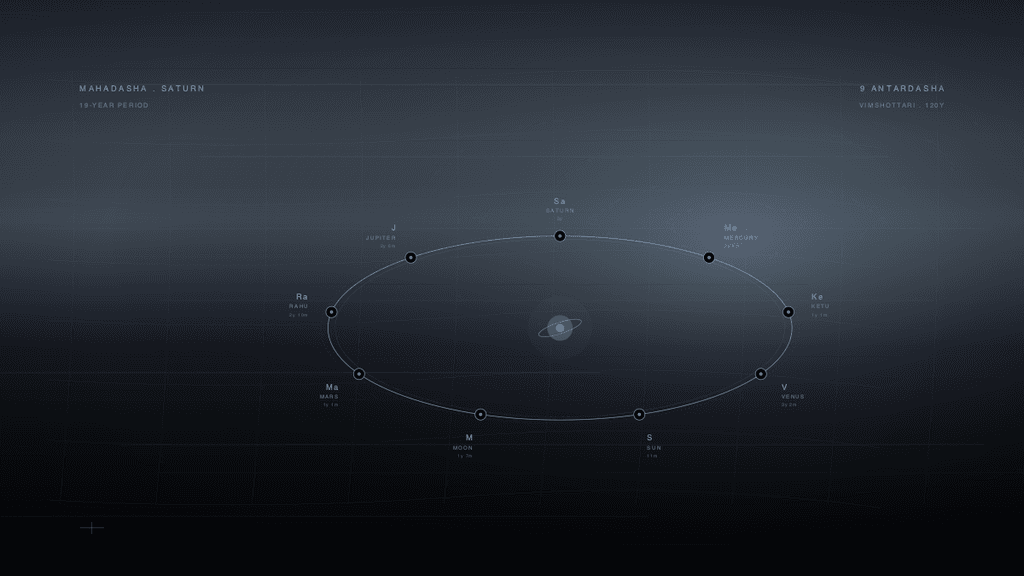
The natal Saturn-in-3H configuration runs as a permanent structural feature but the dasha cycle activates the transformation pattern at specific windows. The Saturn mahadasha (the nineteen-year period) is the major transformation-activation window. During the nineteen years, the upachaya productivity register comes into the foreground and the native often produces the most structurally significant work of the life arc. The Tempora Saturn Mahadasha piece walks the period in detail.
The Saturn-Mercury, Saturn-Venus and Saturn-Jupiter antardasha sub-periods within Saturn mahadasha typically deliver the transformation events. Saturn-Sun and Saturn-Mars antardasha sub-periods often produce the intense effort cycles that precede openings. For Saturn-in-3H natives in other mahadashas (Jupiter, Mercury, Venus etc.), the Saturn antardasha within those mahadashas activates the 3H configuration in shorter form, often producing meaningful but smaller transformation events.
Sade Sati overlay is significant when the natal Moon sits in the 2nd, 3rd or 4th house. When natal Moon is in 3H, Sade Sati transit centres on the 3rd house for two and a half years and the natal Saturn-in-3H configuration is foregrounded. The transit often coincides with major transformation events because the upachaya support amplifies the Sade Sati pressure into structural productivity rather than into the restriction register Sade Sati produces in non-upachaya houses.
What the framework does not predict
The Saturn-in-3H reading is structural. It describes the transformation pattern, the sibling-line register, the writing and communication domain and the stamina arc, but it does not predict specific events. The framework does not predict the specific domain the native will produce openings in (it describes the structural disposition, not the field), the exact age at which the major transformation crystallises (it indicates the window, not the date), the number of siblings or specific sibling events the native will encounter or the specific writing or communication outputs the native will produce.
The framework also does not guarantee transformation outcomes. Saturn-in-3H produces a structural disposition toward sustained-effort productivity; the native must do the work for the disposition to manifest. The chart describes a favourable structure; the lived life fills in the content. A Saturn-in-3H native who does not engage with sustained-effort work will not produce the openings the configuration disposes them toward. The framework reads disposition rather than predicting destiny.
Dated activations of this placement
Saturn in the 3rd sets a standing register on effort, siblings and communication, and the moving sky of 2026 to 2028 gives it datable trigger points by ascendant. A Capricorn ascendant carries the 3rd house in Pisces, where transit Saturn has held since 20 March 2025 and remains until 23 May 2027, so this native is inside a Saturn return over the effort house right now, timed exactly by the natal degree. An Aquarius ascendant places the 3rd house in Aries, and transit Saturn arrives on 23 May 2027, draws back to Pisces on 4 November 2027 and re-enters Aries to stay from 11 February 2028, completing the return over that double pass into early 2028. A Taurus ascendant has the 3rd house in Cancer, crossed by exalted Jupiter on its full stay from 27 May 2026 to 19 June 2027, which reads as a benefic lift on initiative rather than a Saturn contact. Beneath the dates runs the cadence: Saturn takes about 29.5 years to return to a sign, and that re-entry over the natal position is the same-planet contact classical practice names as the trigger for the placement. Each window times a condition that is already fixed in the chart, where the natal Saturn is the standing fact and the transit only sets the clock. None of these dates compels a specific outcome.
Frequently asked questions
Why is Saturn in the 3rd house considered one of the strongest Saturn placements?
The 3rd house is one of the four upachaya (growing) houses in classical Vedic astrology (along with houses 6, 10 and 11). Classical doctrine documented in Jataka Parijata and Phaladeepika reads malefics like Saturn, Mars and Rahu as performing structurally well in upachayas because the houses absorb the malefic register and convert it into sustained productivity, effort and structural growth. Saturn's nature (slow build, structural discipline, long arc of time) becomes a productive engine in the upachaya rather than a restrictive load. The 3rd house specifically carries self-effort, courage and skill development; Saturn imprints structural discipline on these registers and lets effort compound across decades into structural mastery. Among the twelve houses, the 3rd is one of the two most favourable Saturn placements (the other being the 11th, also an upachaya). The reading inverts the conventional Saturn-as-restriction frame.
What kind of openings does Saturn in the 3rd house produce?
Saturn-in-3H produces sustained-effort openings: the native works long, patient, structurally disciplined cycles in their chosen domain and breaks through to structural recognition or mastery at the point where most peers have quit or plateaued. Timing typically follows three windows. The first major transformation often arrives around Saturn's first return (the 29th-to-30th year) after a decade of building. The major mid-career transformation often falls in the late thirties or forties during Saturn mahadasha or Saturn antardasha. The late-career structural authority crystallises in the late fifties or sixties during Saturn's second return (around the 58th to 59th year). Domains favoured: writing, technical mastery, institutional building, research, teaching, structural professions. The transformation is rarely sudden; it is the visible consolidation of a decade of slow build. The native is the one who does not quit.
How does Saturn in the 3rd house affect siblings?
Saturn in the 3rd house (the sibling house, particularly for younger siblings) imprints structural events on the sibling line. The classical reading lists eldest-child responsibility for younger siblings, sibling distance (geographic or emotional distance across long periods), structurally defining sibling events (a sibling's serious illness, career struggle, geographic relocation under hardship) and one-child or few-sibling outcomes. The native often takes a quasi-parental role for a younger sibling and becomes the responsible elder the sibling looks to for structural support across decades. The relationship is often less warm than ideal but durably loyal. The native often supports a sibling financially or structurally in adult life. The 3rd is not a maraka house, but Saturn dasha periods carry longevity-stress windows that can activate for siblings. The framework reads these as stress windows requiring attention rather than as fatal predictions.
Why does Saturn in the 3rd house favour writing?
The 3rd house carries writing and communication; Saturn imprints structural discipline on the writing register. The native often becomes a structural writer whose body of work gathers weight across decades. Each piece of work carries Saturn's seriousness, careful construction and weighted content; the accumulated body of work compounds into structural authority. Writing registers Saturn-in-3H natives often inhabit: long-form non-fiction, technical documentation, structural commentary, institutional analysis, research writing, biography, history and the slow-build essay. The native is less often the fast-cycle journalist or trend commentator and more often the careful long-form author publishing major works every several years. The upachaya support amplifies the writing register specifically because writing rewards the long-arc sustained work pattern Saturn produces. By midlife the native often has produced enough body of work to carry authority in their domain.
Does Saturn in the 3rd house increase stamina?
Yes, structurally and with a specific timing pattern. Saturn imprints discipline on the body's physical-effort register in the 3rd house. The native is not the natively athletic type in youth: in adolescence and early twenties the body often runs slow and short-burst exertion does not feel native. The pattern inverts across decades. By the thirties and forties the native is often the endurance specialist among peers, the long-distance walker, the patient sustained-work practitioner who outlasts faster-starting peers. By the fifties and sixties the native is often physically stronger than peers who started fitter because the Saturn body was built for the long arc. The configuration shows up classically in martial arts, endurance sports, long-form yoga, trekking and any physical domain that rewards sustained discipline over flash intensity. Saturn-in-3H natives who take up such practices in their twenties or thirties often become the most accomplished practitioners in their cohort by the late forties or fifties.
What does Saturn in the 3rd house mean for courage?
The 3rd house carries courage (parakrama) and self-effort. Saturn imprints structural discipline on the courage register. Saturn-in-3H courage reads structural rather than impulsive: the native does not act on impulse and does not court risk for its own sake; the native takes the long, slow, sustained risk and holds the position through difficulty until the structural reward arrives. Classical commentaries describe this as Saturn courage: not the flash of bravery but the steady refusal to abandon a project under pressure. The native is the one who continues when peers give up. The pattern differs structurally from Mars-in-3H courage (impulsive, fast-burst, competitive) and Sun-in-3H courage (authoritative, declarative). Saturn-in-3H courage is the courage of compounding presence: the native who is still working on the difficult problem after everyone else has moved on. The configuration produces structural rather than dramatic accomplishments.
How does Saturn in the 3rd house compare to Saturn in other upachaya houses?
Saturn performs structurally well in all four upachaya houses (3, 6, 10 and 11) but each placement produces a different transformation pattern. Saturn in the 3rd produces sustained-effort openings through writing, communication, sibling-line responsibility and personal courage and skill development. Saturn in the 6th produces openings through service, debt-management, conflict-resolution and overcoming enemies; the configuration is classically called Vipreet Raja Yoga when 6L sits in 6H or 8H or 12H and produces unexpected rises through adversity. Saturn in the 10th (Karma Bhava, the career house) produces openings through institutional career-building, public authority and structural professions; this is among the highest classical placements for Saturn as it carries digbala (directional strength) in the 10th. Saturn in the 11th (Labha Bhava, the gains house) produces openings through large networks, gains, group affiliations and the structured reward register. All four upachaya placements compound across decades. Saturn-in-3H is the most personal-effort and writing-favoured of the four.
When is a natal Saturn in the 3rd house activated in 2026 to 2028?
It is ascendant-specific. A Capricorn ascendant carries the 3rd-house Saturn in Pisces and is in a Saturn return over the effort house now, with transit Saturn in Pisces from 20 March 2025 to 23 May 2027. An Aquarius ascendant holds it in Aries, triggered as transit Saturn enters on 23 May 2027, retreats on 4 November 2027 and returns from 11 February 2028. A Taurus ascendant sees exalted Jupiter cross the 3rd house from 27 May 2026 to 19 June 2027. Saturn returns to a given sign about every 29.5 years, which is the deeper same-planet trigger. Each date is an activation window over the standing placement rather than a fixed event.
- 3rd house · the full reading of the sibling and effort house
- Saturn Mahadasha · the nineteen-year Saturn period karaka portfolio
- Sade Sati · the seven-and-a-half-year Saturn transit framework
- Saturn in the 2nd house · the wealth-house comparison
- Growing houses · the upachaya classification framework
This article was prepared by Tempora Research as a planet-in-house reading. The framework is descriptive of structural chart layers and does not predict specific events. Internal audit log maintained. This article does not constitute medical, financial, legal or professional advice. First published 2026-06-05 by Tempora Research.