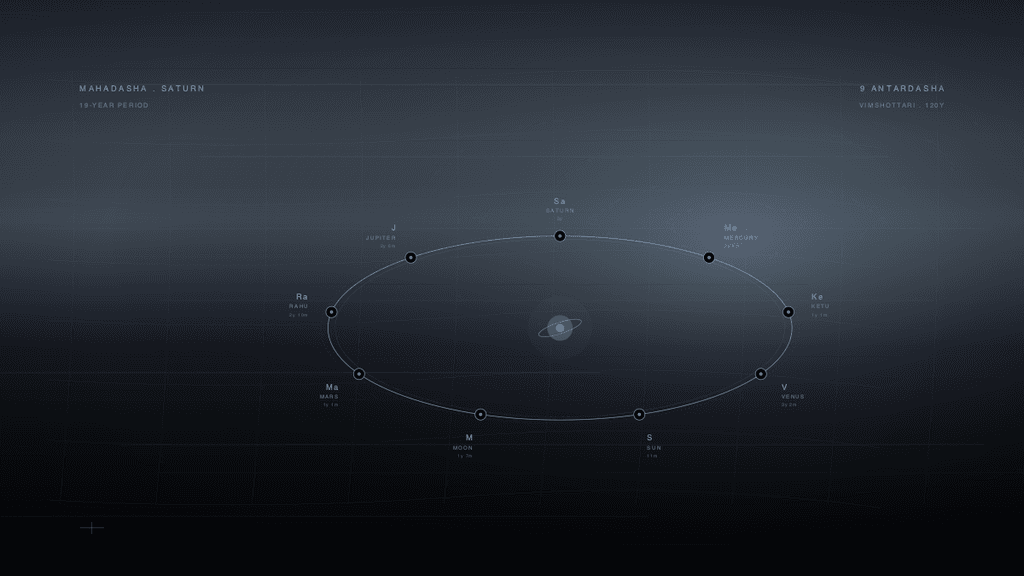
Saturn in the 2nd House: late wealth and family discipline.
Saturn sitting in the 2nd house (Dhana Bhava in Sanskrit, the wealth and family house) places Saturn's structural register on the resources, speech, family and the values the native carries. The reading is the long-arc wealth pattern: money does not arrive early or easily, but compounds through sustained effort and lands durably in the second half of life. Family-of-origin often carries structural changes the native must process. Speech runs measured, delayed or weighted. The 2nd house carries the maraka (death-causing) classification in Parashari practice, which adds a specific layer to the reading. Computed with Swiss Ephemeris and True Pushya Paksha ayanamsa. Sources: Brihat Parashara Hora Shastra Chapter 27 and Chapter 44 (maraka houses), Phaladeepika Chapter 15, Sarvartha Chintamani.
What the 2nd house carries
The 2nd house in Vedic astrology (Dhana Bhava, the wealth house) carries accumulated resources, family of origin, speech, food, the right eye, primary education, the close family unit and the value system the native inherits and develops. The classical karaka (significator) is Jupiter, signifying expansion of resources and the family-line transmission of wealth and values. Classical sources read the 2nd house as the second-most-personal point on the chart after the 1st: the resources and family register attached to the body and self.
A planet sitting in the 2nd imprints its signature on every register the house carries. Wealth takes the planet's pattern; family-of-origin takes the planet's tone; speech takes the planet's register; values take the planet's pull. Saturn sitting in the 2nd produces a slow, structural and durable reading across all those domains because Saturn's nature is the slow build, the structural frame and the long arc of time.
The 2nd house also carries the maraka (death-causing) classification in Parashari practice. The 2nd and 7th houses are classified as maraka in the conventional reading because they bracket the longevity register: the 8th house (next from 7th) and the 3rd house (next from 2nd) are the houses of longevity and the houses immediately preceding them carry the activation register. A planet in 2H or 7H reads with a maraka overlay that does not predict death but adds a longevity-stress register to the dasha and antardasha of the planet in question. For the full 2nd-house reading independent of any single planet, see Tempora's 2nd house piece.
The long-arc wealth pattern
The most defining feature of Saturn-in-2H is the wealth-from-long-arc-work signature. Money does not arrive early and does not arrive easily. The native often starts adult life with less material support than peers and builds resources slowly across decades through sustained effort. Classical Parashari sources describe this as Saturn's nature in the wealth house: structure, restriction and the slow compounding of effort over time.
The pattern shows up in three specific ways. First, early career wages run modest. The native often takes the slow-build job rather than the high-glamour job and the income register stays under demographic peers for the first decade of work. Second, savings compound slowly but durably. The Saturn-in-2H native is structurally disposed to save what they earn rather than spend and the savings habit compounded over twenty or thirty years produces a wealth register that exceeds what the income alone would predict. Third, the wealth that lands is durable. Saturn-in-2H natives are rarely the lottery-win or windfall-inheritance pattern; they are the build-it-over-decades-and-it-stays pattern.
The crystallisation point for the wealth register typically falls between the 36th and 45th years, with timing modulated by Saturn's natal dignity and the running dasha. Saturn's first major return (around the 29th-to-30th year) often coincides with the inflection: the slow build begins to compound visibly. By the late forties, the Saturn-in-2H native often has the most stable resource base among peers, even if the trajectory had looked slow for decades.
For the broader Vimshottari-period activation of Saturn's karaka register, see Tempora's Saturn Mahadasha piece. For Saturn-in-2H natives, the Saturn mahadasha is the most direct wealth-activation window: the nineteen-year period brings the natal configuration into the foreground and often delivers the major wealth consolidation of the life arc.
Family-line structural changes
The 2nd house carries the family-of-origin register. Saturn sitting in the 2nd imprints structural changes on the family the native is born into. The exact form varies by chart and culture, but the classical reading lists several recurring patterns: parental hardship during the native's formative years, eldest-child responsibility for younger siblings or for elders, family-line restriction (limited resources, restricted social mobility, parental occupations that constrained options) or structural events (parental separation, death of a family member, family relocation under hardship).
The native often takes on family responsibility earlier than peers. A common configuration: the Saturn-in-2H native becomes the financially responsible member of the family of origin, supporting parents in their late years or siblings through difficult periods. The native does not resent the responsibility (Saturn is structurally disposed to accept duty) but the responsibility is structural rather than chosen.
The values the native develops from the family-of-origin register are classically Saturnian: thrift, discipline, structural honesty, slow trust, weighted obligation. The native carries these values across life and often passes them to their own children. Family wealth transmission, when it occurs, runs slow: the native rarely inherits a windfall but often inherits a structural foundation (property, savings, a family business) that the native then builds on across decades. The maraka classification of the 2nd house adds a specific layer to family longevity: classical sources note that Saturn's dasha or antardasha during the chart owner's adult years can coincide with longevity events for elder family members. The reading is structural rather than predictive: it indicates a window where family longevity registers concentrate.
Speech: delayed, measured or weighted
The 2nd house carries speech (the vak register in classical Sanskrit terminology). Saturn sitting in the 2nd imprints structural changes on the speech pattern. The classical reading lists three recurring forms: speech that develops late (the native is a slow-talking child or carries a childhood speech impediment that the native works through), speech that runs measured and slow as an adult (the native speaks less than peers, chooses words carefully, pauses between sentences) or speech that carries weight and gravity (the native is the person whose statements are taken seriously when they do speak).
The pattern is often a mixture. A Saturn-in-2H native might have struggled with speech in childhood, developed careful adult speech patterns and become a person whose words carry weight in professional settings. The native is rarely a chatty extrovert and rarely the dominant voice in social gatherings. The native is more often the person who speaks late in a discussion, says less than peers but says it precisely and is heard because of the precision.
Writing often becomes a primary expressive register. Many Saturn-in-2H natives find writing easier than speaking: the writing process accommodates Saturn's preference for slow construction, careful structure and weighty content. Classical commentaries note that Saturn-in-2H produces writers, structural commentators, technical communicators and people whose published or written word carries authority across decades.
Languages are a specific domain where the slow-build register pays off. The Saturn-in-2H native often becomes structurally competent in languages they study, even if the initial learning runs slow. The pattern shows up most clearly in second-language acquisition: the native starts behind peers, builds through sustained effort and ends ahead by the structural compounding over years.
The maraka classification and what it means
The 2nd house carries the maraka (death-causing) classification in classical Parashari practice. The classification does not mean a planet in 2H predicts death; it means the dasha or antardasha of a planet sitting in 2H, ruling 2H or aspecting 2H carries a longevity-stress register that can activate longevity events for the native or for close family members.
The classical reading distinguishes between maraka tendency (the chart structure) and maraka event (the lived outcome). Saturn-in-2H gives the chart a maraka layer that activates during Saturn dasha or antardasha; whether the activation produces a longevity event depends on the broader chart, the strength of the Sun and the lagna and the running transit context. The framework reads maraka as a stress register rather than as a fatal prediction.
The reading is structural across two practical layers. First, the native often becomes aware of longevity questions earlier than peers, sometimes through family events (a parent's illness or death during the native's young adulthood). The early exposure shapes the native's relationship to mortality and contributes to the structurally serious personality register Saturn-in-1st and Saturn-in-2H both produce. Second, the native's own longevity stress windows often fall during Saturn dasha periods, particularly the Saturn-Sun and Saturn-Mars antardasha (Sun and Mars are the planets most directly tied to vitality and longevity). The framework reads these windows as periods that require health attention rather than as periods of inevitable hardship.
For the broader maraka framework, see Tempora's reading at 2nd house and 7th house pieces, which walk the maraka classification in the context of each house.
Per-ascendant variation
The general Saturn-in-2H reading modulates by which sign sits on the 2nd-house cusp. The configuration carries a different load when Saturn is well-placed by sign versus poorly placed and the ascendant determines which.
| Ascendant | Saturn sign in 2H | Reading |
|---|---|---|
| Aries | Taurus (neutral) | Moderate reading. Saturn in Venus's earth sign in the wealth house gives stable but slow material build. Wealth compounds through real-estate or land-based registers. |
| Taurus | Gemini (friend) | Workable reading. Saturn in Mercury's sign in the wealth house often produces wealth from communication, writing or technical work. Speech may be measured but the native often does well with structured communication. |
| Gemini | Cancer (enemy) | Difficult reading. Saturn-Moon enemy friction in the wealth house produces emotional and material fatigue around family-of-origin and resource accumulation. Family register often carries restriction. |
| Cancer | Leo (enemy) | Difficult reading. Saturn-Sun enemy friction in the wealth house creates authority-and-resource tension. Family-of-origin often carries paternal restriction. |
| Leo | Virgo (friend) | Workable reading. Saturn in Mercury's sign supports structured wealth-building through technical or analytical work. The wealth register compounds steadily. |
| Virgo | Libra (exalted) | One of the strongest configurations. Saturn exalted in the wealth house produces structural wealth durability, often through partnership-based or aesthetic-domain work. Speech is measured but authoritative. |
| Libra | Scorpio (enemy) | Difficult reading. Saturn-Mars enemy friction in the wealth house produces wealth-through-intense-effort and family-of-origin transformation registers. The maraka layer is more pronounced. |
| Scorpio | Sagittarius (neutral) | Workable reading. Saturn in Jupiter's sign in the wealth house softens the slow-build with a dharmic register. Wealth often arrives through teaching, institutional or expansive work in the late-bloomer phase. |
| Sagittarius | Capricorn (own sign) | Exceptional reading. Saturn in own sign in the wealth house gives structural wealth authority. The native often builds significant resources through institutional work and the late-bloomer wealth peak is durable. |
| Capricorn | Aquarius (own sign) | Exceptional reading. Saturn in own sign Aquarius in the wealth house produces wealth through system-thinking work, technology, networks or progressive structures. The pattern compounds across decades. |
| Aquarius | Pisces (neutral) | Moderate reading. Saturn in Jupiter's water sign in the wealth house gives a softer, more spiritually framed wealth register. Family-of-origin may carry compassionate or service-oriented patterns. |
| Pisces | Aries (debilitated) | The harshest variant. Saturn debilitated in the wealth house produces the slowest and most structurally restricted wealth register among ascendants. Neecha-bhanga by an exalted dispositor improves the reading materially. |
The two most favourable variants are Virgo (Saturn exalted in Libra in 2H) and Sagittarius and Capricorn (Saturn own-sign in Capricorn or Aquarius in 2H). The harshest variant is Pisces ascendant (Saturn debilitated in Aries in 2H). For all other ascendants, the reading falls in the workable-to-moderate band where Saturn's slow-build wealth pattern operates but the structural friction is not extreme.
Saturn dasha activation and Sade Sati overlay
The natal Saturn-in-2H configuration runs as a permanent structural feature, but the dasha cycle activates it at specific windows. The Saturn mahadasha (the nineteen-year Vimshottari period) brings the 2H signature into the foreground for the full nineteen years. During Saturn mahadasha for a Saturn-in-2H native, the wealth register, the family-of-origin context and the speech and writing domains all come under direct Saturn pressure and direct Saturn-style productivity. Major wealth consolidation often falls in the Saturn-Mercury, Saturn-Venus or Saturn-Jupiter antardasha sub-periods within the nineteen-year window. The Tempora Saturn Mahadasha piece walks the nineteen-year period in detail.
Sade Sati overlay is significant for Saturn-in-2H natives whose natal Moon sits in the 1st, 2nd or 3rd house. When natal Moon is in 1H, Sade Sati transit through 12H-1H-2H brings Saturn back to the 2nd house during the last phase, intensifying the natal Saturn-in-2H signature for two and a half years. When natal Moon is in 2H, the entire Sade Sati transit centres on the wealth house and the natal Saturn-in-2H configuration is foregrounded across all seven and a half years. When natal Moon is in 3H, Sade Sati starts with Saturn in 2H (the 12th from natal Moon) and the first two-and-a-half-year phase intensifies the configuration.
For each of these natal Moon positions, Sade Sati often coincides with the wealth-pivot inflection: the slow-build phase compounds visibly into the consolidation phase. The Tempora Sade Sati piece walks the transit framework by natal Moon sign.
What the framework does not predict
The Saturn-in-2H reading is structural. It describes the texture of the wealth register, the family-of-origin pattern and the speech and writing domains, but it does not predict specific events. The framework does not predict the exact wealth figure the native will accumulate (it describes the slow-build pattern, not the absolute amount), the specific family-of-origin events the native will encounter, the exact age at which the wealth peak crystallises (it indicates the window, not the date) or the longevity events of the maraka register (the framework reads maraka as stress, not as fatality).
The framework also does not pass moral judgment on the slow-build wealth pattern. Classical commentaries sometimes describe Saturn-in-2H as a difficult placement because the early decades carry restriction; the more accurate reading is that the early decades require patience and the late decades deliver structural durability. The native who works the long arc rather than fighting it often arrives at a structurally stable wealth register that exceeds what the early career trajectory had suggested possible.
When the current sky activates a natal Saturn here
A 2nd-house Saturn holds the wealth and speech axis as a standing feature of the chart, and the 2026 to 2028 transits time when that axis is stirred. An Aquarius ascendant places the 2nd house in Pisces, where transit Saturn has sat since 20 March 2025 and holds until 23 May 2027, so this native runs a Saturn return across the wealth house through the whole window with the exact hit set by the natal degree. A Pisces ascendant carries the 2nd house in Aries, and transit Saturn reaches it on 23 May 2027, retreats to Pisces on 4 November 2027 and re-enters Aries to stay from 11 February 2028, so the wealth-house return completes over that retrograde double pass. A Gemini ascendant has the 2nd house in Cancer, which exalted Jupiter crosses on its full stay from 27 May 2026 to 19 June 2027, a benefic pass over the Dhana Bhava that reads as resource attention rather than a Saturn trigger. The return cadence sits under all of this: Saturn needs about 29.5 years to circle back to a sign, and its re-entry into the natal Saturn's sign is the same-planet contact classical practice reads as the wealth signature coming due. Treat each window as timing over a placement already written into the chart, where the natal Saturn is the standing condition and the transit is the trigger. These dates mark availability rather than any guaranteed sum.
Frequently asked questions
What does Saturn in the 2nd house mean for wealth?
Saturn in the 2nd house (Dhana Bhava, the wealth house) produces wealth that arrives through long-arc sustained work rather than early inheritance or quick gain. Money compounds slowly across decades and lands durably in the second half of life. Early career wages typically run modest, savings compound through Saturn's structural discipline and the wealth peak often crystallises between the 36th and 45th years (timed by Saturn's natal dignity and dasha cycle). The configuration is structurally disposed to long-term resource building rather than to windfall or inheritance. The wealth that the native builds is durable and rarely lost once consolidated. Per-ascendant variation modulates the reading significantly: Sagittarius and Capricorn ascendants place Saturn as own-sign in the 2nd, Virgo places exaltation and Pisces places debilitation.
Is Saturn in the 2nd house a maraka?
Saturn in the 2nd house carries the maraka (death-causing) classification in classical Parashari practice because the 2nd house is one of the two maraka houses (the other is the 7th). The classification does not predict death; it adds a longevity-stress register to the dasha and antardasha of any planet sitting in 2H, ruling 2H or aspecting 2H. For a Saturn-in-2H native, the Saturn mahadasha and the Saturn antardasha within other mahadashas carry a maraka layer that often manifests as health attention windows for the native, longevity events for elder family members or structural stress around resource and family registers. The framework reads maraka as a stress indicator that requires attention rather than as a fatal prediction. The actual outcome depends on the broader chart strength, the running transit context and the strength of the Sun and the lagna lord.
Why does Saturn in the 2nd house affect speech?
The 2nd house in Vedic astrology carries speech (vak in Sanskrit). When Saturn sits in the 2nd, it imprints its structural register on the speech pattern in three common forms. First, speech can develop late: the native may have been a slow-talking child or had a childhood speech impediment that they worked through. Second, adult speech runs measured and slow: the native speaks less than peers, chooses words carefully and pauses between sentences. Third, speech carries weight and gravity: the native is often the person whose statements are taken seriously when they do speak, even though they speak rarely. Writing often becomes a primary expressive register because the writing process accommodates Saturn's preference for slow construction and structural precision. Many Saturn-in-2H natives become writers, structural commentators or technical communicators.
Does Saturn in the 2nd house cause family problems?
Saturn in the 2nd house often produces family-of-origin structural changes during the native's formative years. The classical reading lists parental hardship, eldest-child responsibility for younger siblings or for elders, family-line restriction (limited resources or restricted mobility) and structural events (parental separation, family relocation under hardship, death of a family member). The native typically takes on family responsibility earlier than peers and becomes the financially responsible member of the family of origin in adult life. The framework does not read this as uniformly negative: the early responsibility shapes the structurally serious personality and produces the discipline that drives the long-arc wealth build. The values the native develops (thrift, structural honesty, slow trust, weighted obligation) are classically Saturnian and the native often passes them to their own children. Family longevity events sometimes activate during Saturn dasha periods, particularly in the maraka register.
How does Saturn in the 2nd house affect different ascendants?
The reading modulates significantly by ascendant. For Virgo ascendant, Saturn is exalted in Libra in the 2nd house and produces the strongest single variant: structural wealth durability often through partnership-based or aesthetic-domain work. For Sagittarius ascendant, Saturn is own-sign in Capricorn in the 2nd, producing structural wealth authority and durable late-bloomer wealth peak. For Capricorn ascendant, Saturn is own-sign in Aquarius in the 2nd, producing wealth through system-thinking work, technology or progressive structures. For Pisces ascendant, Saturn is debilitated in Aries in the 2nd, producing the harshest variant: the slowest and most restricted wealth register among all ascendants. For the remaining ascendants, the reading falls in the workable-to-moderate band where the slow-build wealth pattern operates but the structural friction is not extreme. The framework reads Saturn-in-2H as fundamentally a slow-arc placement that rewards patience across decades regardless of ascendant.
When does Saturn in the 2nd house deliver wealth?
The wealth-crystallisation window typically falls between the 36th and 45th years for Saturn-in-2H natives, with exact timing modulated by Saturn's natal dignity and the running Vimshottari dasha. Saturn's first major return (around the 29th-to-30th year) is often the inflection point: the slow-build phase begins to compound visibly. The Saturn mahadasha (the nineteen-year period when Saturn becomes the running mahadasha lord) is the most direct wealth-activation window for Saturn-in-2H natives. Within the Saturn mahadasha, the Saturn-Mercury, Saturn-Venus and Saturn-Jupiter antardasha sub-periods often deliver major wealth consolidation. Sade Sati (Saturn's seven-and-a-half-year transit across the 12th, 1st and 2nd from natal Moon) often coincides with the wealth-pivot inflection when natal Moon sits in the 1st, 2nd or 3rd house. By the late forties, the Saturn-in-2H native often has the most stable resource base among peers.
What is the difference between Saturn in the 2nd house and Saturn in the 11th house for wealth?
Both placements produce wealth registers but the pattern is structurally different. Saturn in the 2nd house (Dhana Bhava) produces wealth through long-arc sustained work, family-line transmission of resources, savings discipline and durable accumulation. The native builds resources slowly across decades and the wealth lands in the second half of life. The configuration carries the maraka classification of the 2nd house. Saturn in the 11th house (Labha Bhava, the gains house) produces wealth through structured gains, large networks, institutional positions and the slow-built reward register. The 11th is an upachaya house (one of the four growing houses) and Saturn is classically strong in upachaya houses. Saturn-in-11H natives typically build wealth through large-scale work, group affiliations or institutional positions rather than through direct personal savings and family transmission. The Saturn-in-2H pattern is more personal and family-centred; the Saturn-in-11H pattern is more network and institution-centred. Both compound across decades, but through different mechanisms.
When is a natal Saturn in the 2nd house activated in 2026 to 2028?
The window depends on the ascendant. An Aquarius ascendant carries the 2nd-house Saturn in Pisces and is in a Saturn return over the wealth house now, since transit Saturn holds Pisces from 20 March 2025 to 23 May 2027. A Pisces ascendant holds it in Aries, activated when transit Saturn enters on 23 May 2027, steps back on 4 November 2027 and returns from 11 February 2028. A Gemini ascendant sees exalted Jupiter cross the 2nd house from 27 May 2026 to 19 June 2027. Saturn returns to a given sign about every 29.5 years, which sets the deeper same-planet trigger. Each is a dated activation window over the standing placement rather than a promised financial event.
- 2nd house · the full reading of the wealth and family house
- Saturn Mahadasha · the nineteen-year Saturn period karaka portfolio
- Sade Sati · the seven-and-a-half-year Saturn transit framework
- Saturn in the 1st house · the body-and-self placement comparison
- Dhana yoga · the wealth-combination framework
This article was prepared by Tempora Research as a planet-in-house reading. The framework is descriptive of structural chart layers and does not predict specific events. Internal audit log maintained. This article does not constitute medical, financial, legal or professional advice. First published 2026-06-05 by Tempora Research.