Rahu Aspect on Natal Planets: The Obsession and Amplification Reading
Rahu is the shadow graha (planet) and one of the two lunar nodes. Its drishti (aspect) on natal planets is contested across schools but consistently read as the most consequential amplification signature in classical Vedic astrology. This piece walks through the contested aspect framework, the planet-by-planet contamination signatures, the conditions that turn Rahu from derailment risk into productive amplification and what the framework explicitly does not predict.
The contested aspect framework for Rahu
Rahu is one of the two lunar nodes along with Ketu (the south node) and is treated as a shadow graha (planet) in classical Vedic astrology rather than a physical body. Rahu has no luminance of its own; it is a mathematical point where the Moon's orbit crosses the ecliptic and its astrological effect comes through the influence it exerts on the planets and houses it touches. The aspect framework for Rahu is the most contested area of the entire drishti teaching because different lineages assign Rahu different aspect sets.
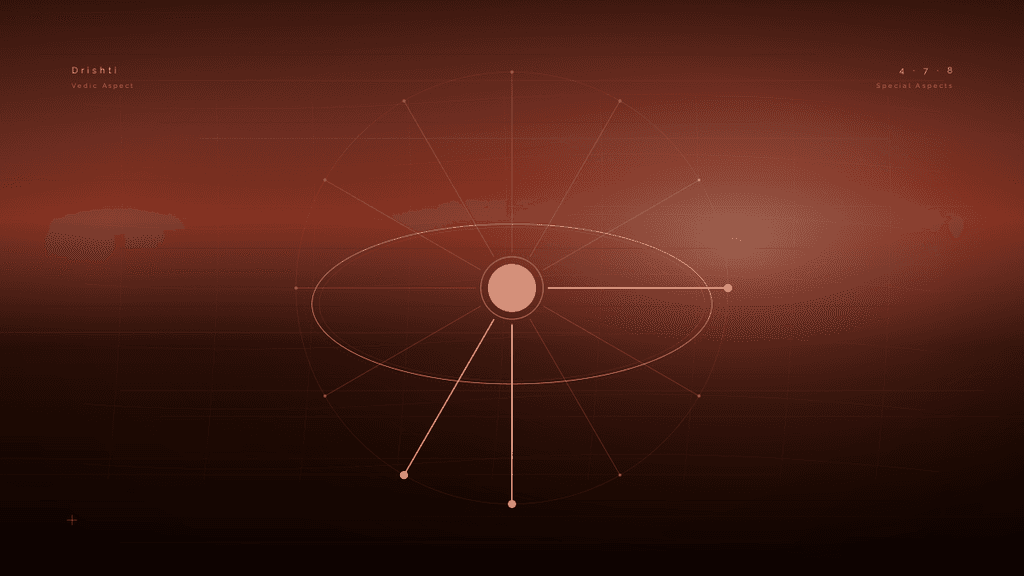
The standard 7th house aspect that every graha shares is accepted across all schools. Rahu aspects the 7th house from its own position and any natal planet sitting in the 7th from Rahu receives the standard opposition glance. Beyond the 7th aspect, the major teaching divisions are these. The Jaimini lineage and many Parashari schools teach Rahu's special aspects as the 5th and 9th aspects, mirroring Jupiter's special aspects. The conservative Parashari teaching restricts Rahu to only the 7th aspect. Some lineages add the 12th aspect for Rahu specifically. A small group of teachers treat Rahu as aspecting all twelve houses with diminishing strength, which is a minority view.
Tempora's reading uses the 5th, 7th and 9th aspect framework consistent with Jaimini and many Parashari traditions, which is the most widely-followed configuration in contemporary Vedic practice. The reasoning is that the Jaimini framework has been validated across the largest corpus of timing readings and it produces the most internally consistent results when read against forward-call data. The conservative 7th-only framework is also supported in Tempora's reading as a configurable alternative for users who prefer that lineage.
What Rahu actually does to a planet it aspects
Rahu's effect on a natal planet is amplification with obsession. The framework is consistent across lineages on this point even where the lineages disagree on which planets Rahu aspects. Rahu is the karaka (significator) of foreign influence, sudden expansion, illusion (maya), obsessive desire, addictions of all forms and what the classical framework calls karmic hunger (the restless wanting that drives the soul to incarnate and to chase). When Rahu aspects a planet, that planet's natural significations get amplified and pushed into an obsessive register.
The amplification is real and can produce extraordinary outcomes when channelled. Many of the most extraordinary worldly achievers in any field carry strong Rahu aspects in their natal charts because Rahu provides the karmic hunger that drives the long climb. The native does not just work hard; the native cannot stop working because the hunger that Rahu activates does not subside through ordinary satisfaction. The obsession produces depth of focus that ordinary motivation cannot match.
The same hunger that drives extraordinary achievement can also derail the native into the canonical Rahu pathologies: addiction (the receiving planet's significations consumed compulsively rather than skilfully), overreach (the target keeps moving and the native chases past the point of sustainability), restless dissatisfaction (no amount of the receiving planet's significations satisfies because Rahu's hunger is structurally infinite) and the chasing of expanded targets that never deliver the satisfaction the chase promises. The framework is consistent that Rahu does not create the obsession from nothing; it amplifies whatever the receiving planet is already significating.
Planet-by-planet Rahu aspect signatures
Rahu aspects on each natal planet produce distinct signatures because the amplification activates the receiving planet's specific significations. The table below sets out the conventional reading for each receiving planet. The reading is the same whether Rahu reaches the planet through the 5th, 7th or 9th aspect; the route only modifies the intensity, not the character.
| Receiving planet | Productive expression | Pathological expression |
|---|---|---|
| Sun | Extraordinary ambition; high-stakes career drive; visionary leadership; political or executive achievement | Ego inflation; authority hunger; pathological self-importance; the need for external validation as a structural addiction |
| Moon | Visionary creativity; deep imagination; access to non-ordinary mental states; powerful intuition | Anxiety; mood swings; substance use; emotional instability; restless inner field; difficulty with sleep and rest |
| Mars | Extreme physical achievement; sustained athletic or martial drive; courage under pressure; sharp tactical thinking | Violence; reckless risk-taking; chronic anger; accidents; aggression that the native cannot fully control |
| Mercury | Brilliant strategy; deep analytical capacity; mastery of communication; trade-craft and negotiation excellence | Manipulation; lies; obsessive analysis; conspiracy thinking; the use of intellect for harm |
| Jupiter | Charismatic teaching; spiritual leadership; capacity to hold and transmit wisdom at scale | Guru-syndrome; false expertise; the projection of certainty without underlying mastery; cult-leader pathologies |
| Venus | Extraordinary artistic output; sustained creative drive; refined aesthetic intelligence; capacity for deep romantic devotion | Addiction (substance, sex, food); serial unfaithfulness; the chasing of pleasure as a structural compulsion |
| Saturn | Extreme worldly achievement; sustained discipline across decades; the capacity to build very large structures | Workaholism; burnout; rigid achievement-orientation; the inability to rest; chronic stress signatures |
The table is read as a spectrum rather than a binary. Most natives who carry a Rahu aspect on a particular planet experience some mix of productive and pathological expression across the life. The mix depends on the structural support the native receives (benefic aspects, strong dispositor, strong lagna lord), the dasha-bhukti the native is running and the native's conscious engagement with the obsession the aspect produces. Tempora's reading on Rahu-Ketu axis and past-life karma covers the deeper karmic framing of the obsession the aspect activates.
The amplification reading versus the contamination reading
Two distinct readings circulate in classical and modern Vedic literature for Rahu's contact with a natal planet. The amplification reading (which Tempora follows as the primary framework) treats Rahu's effect as a scaling of the receiving planet's natural significations toward obsession. The contamination reading treats Rahu's effect as a corruption of the receiving planet's natural significations toward pathology. The distinction matters because the two readings produce different counsel.
The amplification framework reads a Rahu-Jupiter contact as Jupiter's wisdom amplified into either charismatic teaching or false expertise depending on structural support. The contamination framework reads the same contact as Jupiter's wisdom contaminated by Rahu's illusion and therefore producing false certainty. Both readings produce some correct predictions but the amplification framework is more accurate over forward-call data because it correctly identifies the productive expression as a real possibility rather than treating Rahu's effect as uniformly negative.
Tempora's framework reads Rahu through the amplification lens with the contamination expression as the pathological tail of the same amplification curve. This treats the aspect as morally neutral and consequential rather than morally negative and feared. The contamination framework, used historically to dissuade native engagement with the receiving planet's significations, is read in Tempora's framework as the failure mode of unsupported or unconscious engagement rather than the default outcome.
The Rahu-aspect reading test
A Rahu-aspect reading on a natal planet runs through six layers. Layer one: identify Rahu's house position and which of the three special aspects (5th, 7th, 9th in the Jaimini-aligned framework) lands on the receiving planet. Layer two: read the receiving planet's dignity (sign placement, exaltation or debilitation, own-sign or enemy-sign, combustion, retrogression). Layer three: identify the dispositor of Rahu (the lord of the sign Rahu occupies) and read its strength and placement. Layer four: identify any benefic aspect on Rahu or the receiving planet (particularly Jupiter, which is the strongest softening influence). Layer five: read the lagna lord's condition. Layer six: read the active Vimshottari dasha-bhukti for Rahu or the receiving planet's involvement and the current Rahu transit pattern. The composite reading determines whether the aspect projects as productive amplification, neutral baseline or pathological contamination.
What works with a Rahu aspect (the channelling framework)
Classical teaching is consistent that Rahu does not respond to suppression. The native who tries to deny the obsession the aspect activates ends up with the obsession leaking out through the back door, often in worse form than if it had been engaged consciously. The framework recommends channelling rather than suppression. The aspect is best worked with rather than against. Classical teaching lists several conditions that turn a Rahu aspect from derailment risk into productive amplification.
The first condition is Jupiter support. Jupiter aspect on the receiving planet or on Rahu itself is the most consistent softening because Jupiter brings wisdom and discrimination that channel Rahu's hunger toward useful outcomes. The Jupiter-supported Rahu-Mars chart can produce a sustained athletic or military career rather than recurrent injury and chronic anger. The Jupiter-supported Rahu-Venus chart can produce a long artistic career rather than addiction. Tempora's coverage of benefic aspect cancellation of dosha sets out the broader cancellation lattice.
The second condition is a strong dispositor of Rahu. The lord of the sign Rahu occupies (Rahu has no rulership of its own in the classical framework) determines whether Rahu has structural support. A Rahu in Taurus with a strong Venus (the dispositor) is much more workable than a Rahu in Taurus with a debilitated combust Venus. The third condition is a strong lagna lord. The lagna lord governs the native's personal vitality and capacity to hold strong configurations. A strong lagna lord gives the native the personal vitality to hold the amplification without losing self.
The fourth condition is conscious sadhana directed at Rahu and at the receiving planet. The classical recommendations include chanting Rahu mantras during the Rahu mahadasha or bhukti, gemstone use if recommended by an astrologer (hessonite garnet for Rahu, with caveats about combining with other gemstones), specific charity directed at Rahu and working with the receiving planet's significations through disciplined practice. The Rahu-Mercury native who studies disciplines like cryptography, languages or strategic analysis under a teacher channels the hunger productively. The Rahu-Mercury native who lets the hunger run without discipline becomes the canonical conspiracy-theorist. The framework is consistent that engagement plus structure is the only stable path with a strong Rahu aspect.
What the Rahu-aspect reading does not predict
The Rahu-aspect framework is precise about the amplification signature but explicitly limited on three fronts. It does not predict the moral character of the native. The amplification is morally neutral; the native's character determines whether the obsession is channelled productively or destructively. A strong moral framework, sustained ethical practice and a healthy support network turn even the heaviest Rahu aspects into productive drivers. A weak moral framework lets the same aspect derail into the canonical pathologies. The aspect is consequential but it does not determine ethics.
It does not predict addiction deterministically. The framework reads addiction as a risk that Rahu aspects on the Moon, Venus or Jupiter amplify but it does not read addiction as inevitable. Medical, social and circumstantial factors interact with the natal aspect in ways that the framework treats with humility. Tempora's coverage of Mars aspect on the 7th house shows the parallel structure where aspect dosha frameworks raise risk without producing deterministic forecasts.
It does not override the broader chart. A Rahu aspect on a natal planet with strong benefic support, a strong dispositor, a strong lagna lord and conscious engagement produces the productive expression. The same aspect without structural support produces the pathological expression. The aspect is one signal in a multi-layer reading; it does not negate other layers when they project support or difficulty. The reading is paired with the receiving planet's dignity, the active dasha and the transit weather.
When the Rahu aspect activates in the life
The natal Rahu aspect is a baseline that runs through the entire life but it activates strongly in two windows. The first window is Rahu's mahadasha or bhukti in the Vimshottari (the 120-year planetary period sequence). The 18-year Rahu mahadasha is one of the most consequential mahadashas in the entire sequence because Rahu's natal aspects run at full amplification for nearly two decades. The bhuktis of Rahu within other mahadashas provide shorter activation windows of 6 to 30 months depending on the host mahadasha.
The second window is the mahadasha or bhukti of the receiving planet. When the receiving planet runs, its themes activate and the natal Rahu aspect runs alongside the activation. The Rahu-Venus native experiences the heaviest Rahu-Venus reading during the Venus mahadasha and during the Rahu mahadasha. The Rahu-Mars native experiences the heaviest Rahu-Mars reading during the Mars mahadasha and the Rahu mahadasha. The combination of Rahu mahadasha with the receiving planet's bhukti or the receiving planet's mahadasha with Rahu's bhukti produces the most concentrated obsession or amplification window of the life and is the period when natives most often experience the canonical Rahu story-lines.
The transit weather also matters. Rahu's transit through the natal house of the receiving planet intensifies the aspect for approximately 18 months (Rahu moves backward through the zodiac at roughly the same speed Saturn moves forward, completing the zodiac in about 18 years). Rahu's transit over the receiving planet itself is the most intense single transit trigger and is often the period when natives experience the most concentrated Rahu manifestation.
How Tempora computes the Rahu aspect on a natal planet
Tempora's aspect reading runs on the Swiss Ephemeris with the True Pushya Paksha ayanamsa by PVRN Rao. The Swiss Ephemeris returns Rahu's sidereal longitude to arc-second precision. Rahu's position is computed using the True Node by default (the mean node teaching is also supported as a configurable alternative; the difference between True Node and Mean Node is typically less than 2 degrees and most aspect readings produce the same result under both).
The computation runs in five stages. Stage one locates Rahu and the natal planets in the chart and computes Rahu's three special drishti (fifth, seventh and ninth from Rahu in the Jaimini-aligned framework). Stage two checks which natal planets receive any of the glances and reports the aspect routes. Stage three reads the dignity of each receiving planet (sign placement, exaltation or debilitation, own-sign, combustion, retrogression). Stage four reads the dispositor of Rahu (the lord of the sign Rahu occupies) and its placement and dignity. Stage five identifies any benefic aspect on Rahu or the receiving planets (particularly Jupiter, the strongest softening influence) and applies the channelling lattice.
The output feeds into the wider dasha-bhukti reading because Rahu's effects manifest most concentratedly during dasha activations. The Rahu-aspect reading does not stand alone in any Tempora output. It is presented as one layer among the karmic-amplification stack along with the receiving planet's natal house, the Rahu-Ketu axis reading, the natal dispositor analysis, the Vimshottari dasha scan and the current Rahu transit pattern.
Conclusion
Rahu's aspect on a natal planet is the canonical amplification signature in classical Vedic astrology. The aspect framework is contested across schools but the consistent teaching is that Rahu does not create signatures from nothing. It amplifies whatever the receiving planet is already significating and pushes the amplification into an obsessive register. The reading is morally neutral and consequential: the amplification can serve the native through extraordinary worldly achievement or it can derail the native into the canonical Rahu pathologies. The outcome depends on structural support and conscious engagement, not on the aspect itself. Jupiter support, a strong dispositor of Rahu, a strong lagna lord and conscious sadhana directed at the receiving planet's significations are the classical conditions that turn Rahu from derailment risk into productive amplification. The aspect activates strongly during Rahu's 18-year mahadasha and during the receiving planet's mahadasha and bhukti periods. The framework reads the structure of the karmic hunger; it does not predict outcomes deterministically and it does not determine the native's moral character. A clean Rahu-aspect reading is one layer in the karmic-amplification stack, not the whole stack.
Transit Rahu across the natal planets, 2026 to 2028
The timing section above names Rahu's transit over a receiving planet as the most intense single trigger, and the current calendar dates the sign-level version of that trigger. Rahu occupies Aquarius until 27 December 2026, then Capricorn until 15 July 2028. Any natal planet placed in Aquarius carries the transit conjunction through late 2026; any natal planet in Capricorn carries it from 27 December 2026. At sign level the conjunction is an eighteen-month co-residence, and the degree pass within it, computable to fractions of a degree, marks the concentrated stretch.
The glances follow the same chapters. Reading the nodes with the fifth, seventh and ninth drishti the corpus follows, Rahu in Aquarius reaches natal planets in Gemini, Leo and Libra, and Rahu in Capricorn reaches natal planets in Taurus, Cancer and Virgo. The second chapter carries a notable exchange: from 27 December 2026 until 19 June 2027 transit Jupiter sits exalted in Cancer, the sign Rahu's seventh glance lands on, while Jupiter's own seventh aspect from Cancer falls back onto Capricorn. The strongest classical softening influence and the amplifier hold each other in opposition for roughly six months, which the channelling framework above reads as a dated version of Jupiter support arriving by transit.
The eclipse layer belongs to the same axis. The solar eclipse of 12 August 2026 falls on the Cancer-Leo cusp while the nodes still run the Aquarius-Leo line, so charts with natal planets near that boundary get the eclipse contact and, from late December, the shifted nodal axis across the adjacent signs. The eclipse axis note carries the collective-chart side of that geometry.
The boundaries of the claim stay narrow. A transit contact is dated weather over the natal amplification structure: the standing Rahu-aspect reading belongs to the birth chart, the dasha hierarchy keeps priority and a sign-level map says which charts are in the traffic without saying what any one chart experiences. Tempora's scoreboard holds no graded call on a nodal-transit population; its headline, nine graded flagship calls at a 50 percent hit rate with misses published, is the calibration context these windows sit inside.
Frequently asked questions
Does Rahu have aspects in Vedic astrology?
Yes but the question is contested across schools. Rahu is one of the two lunar nodes (along with Ketu) and the classical aspect framework for Rahu varies by lineage. The standard 7th house aspect that every planet shares is accepted across all schools: Rahu aspects the 7th house from its own position. Beyond the standard 7th aspect, three positions are taught as Rahu's special aspects in some lineages: the 5th aspect, the 9th aspect and (in some schools) the 12th aspect. The 5th and 9th aspect teaching mirrors Jupiter's special aspects and is used in many North Indian and Parashari lineages. The conservative teaching restricts Rahu to only the 7th aspect. Tempora's reading uses the 5th, 7th and 9th aspect framework consistent with Jaimini and many Parashari traditions, which is the most widely-followed configuration in contemporary Vedic practice.
What does Rahu's aspect on a natal planet mean?
Rahu's drishti on a natal planet is read as amplification with obsession. Rahu is the karaka of foreign influence, sudden expansion, illusion (maya), obsessive desire and what the classical framework calls karmic hunger. When Rahu aspects a planet, that planet's natural significations get amplified and pushed into an obsessive register. The amplification is real and can produce extraordinary outcomes when channelled. The obsession signature is also real and can produce overreach, addiction, restless dissatisfaction and the chasing of expanded targets that never deliver the expected satisfaction. The framework is consistent that Rahu does not create the obsession from nothing; it amplifies whatever the receiving planet is already significating and pushes the native to want more of it than is healthy.
How does Rahu aspect on different planets read differently?
Rahu aspects on each natal planet produce distinct signatures because the amplification activates the receiving planet's specific significations. Rahu on the Sun amplifies ego, ambition and authority hunger; it can produce extraordinary career drive or pathological self-importance. Rahu on the Moon amplifies emotion, imagination and inner restlessness; it can produce visionary creativity or anxiety, mood swings and substance use. Rahu on Mars amplifies courage, energy and aggression; it can produce extreme physical achievement or violence and reckless risk-taking. Rahu on Mercury amplifies intellect, communication and trade-craft; it can produce brilliant strategy or manipulation, lies and obsessive analysis. Rahu on Jupiter amplifies belief, teaching and wisdom; it can produce charismatic spiritual leadership or guru-syndrome and false expertise. Rahu on Venus amplifies romance, art and sensory desire; it can produce great artistic output or addiction and serial unfaithfulness. Rahu on Saturn amplifies discipline, weight and ambition; it can produce extreme worldly achievement or workaholism and burnout.
Is Rahu's aspect always negative?
No. The Rahu reading is morally neutral in the classical framework even though it is one of the most consequential aspect readings. Rahu amplifies what it touches and the amplification can serve the native or it can derail the native, depending on what the receiving planet signifies, on the native's structural support (benefic aspects from Jupiter, strong lagna lord, well-placed dispositor) and on the native's conscious relationship with the obsession the aspect produces. Many of the most extraordinary worldly achievers carry strong Rahu aspects in their natal charts because Rahu provides the karmic hunger that drives the long climb. The same aspect in a chart without structural support or conscious engagement produces the canonical Rahu pathologies. The aspect is consequential but not deterministic.
What softens or works with a Rahu aspect on a natal planet?
Classical teaching lists several conditions that turn a Rahu aspect from a derailment risk into a productive amplification. Jupiter aspect on the receiving planet or on Rahu itself is the most consistent softening because Jupiter brings wisdom and discrimination that channel Rahu's hunger toward useful outcomes. A strong dispositor of Rahu (the lord of the sign Rahu occupies) provides structural support for the obsession. A strong lagna lord gives the native the personal vitality to hold the amplification without losing self. Conscious sadhana directed at Rahu (chanting Rahu mantras during the Rahu mahadasha or bhukti, gemstone use if recommended, working with the receiving planet's significations through disciplined practice) is a major part of the classical mitigation framework. The conventional teaching is that Rahu does not respond to suppression but it does respond to channelling. The aspect is best worked with rather than against.
When does the Rahu aspect activate in the life?
The natal Rahu aspect is a baseline that runs through the entire life but it activates strongly in two windows. The first is Rahu's mahadasha or bhukti in the Vimshottari (120-year planetary period) sequence. The 18-year Rahu mahadasha is the canonical heaviest window for any chart that carries a strong natal Rahu aspect because the receiving planet's themes run at full amplification for nearly two decades. The bhuktis of Rahu within other mahadashas provide shorter activation windows of 6 to 30 months depending on the host mahadasha. The second window is the mahadasha or bhukti of the receiving planet (the planet that Rahu aspects). When the receiving planet runs, its themes activate and the natal Rahu aspect runs alongside the activation, often producing the most concentrated obsession or amplification window of the life. Transits of Rahu also matter, particularly Rahu's transit through the natal house of the receiving planet, which intensifies the aspect for approximately 18 months.
How does Tempora compute the Rahu aspect on a natal planet?
Tempora's aspect reading runs on the Swiss Ephemeris with the True Pushya Paksha ayanamsa by PVRN Rao. The Swiss Ephemeris returns Rahu's sidereal longitude to arc-second precision. Rahu's position is computed using the True Node (mean node teaching is also supported but True Node is the Tempora default). For the Rahu aspect specifically, the computation locates Rahu and the natal planets, computes Rahu's three special drishti (5th, 7th and 9th from Rahu in the Jaimini-aligned teaching), checks which natal planets receive any of the glances, reads the dignity of the receiving planet (sign, house, combustion, retrogression), checks for the softening conditions (Jupiter aspect on Rahu or the receiving planet, strong dispositor of Rahu, strong lagna lord) and reports the aspect strength alongside the obsession or amplification signature. The output feeds into the wider dasha-bhukti reading because Rahu's effects manifest most concentratedly during dasha activations.
Which natal planets does transit Rahu contact between 2026 and 2028?
Rahu occupies Aquarius until 27 December 2026 and Capricorn from that date until 15 July 2028, so natal planets in those signs carry the transit conjunction in sequence. Reading the nodes with the fifth, seventh and ninth drishti, Rahu in Aquarius also glances natal planets in Gemini, Leo and Libra, and Rahu in Capricorn glances Taurus, Cancer and Virgo. From 27 December 2026 to 19 June 2027 exalted transit Jupiter in Cancer and transit Rahu in Capricorn hold each other in opposition, a dated instance of the Jupiter softening the channelling framework describes. The solar eclipse of 12 August 2026 lands on the Cancer-Leo cusp during the first chapter. These are sign-level windows: the degree pass marks the concentrated stretch, the natal chart holds the standing amplification reading and the running dasha keeps timing priority.
Read next
This article was first published on 06 June 2026. It documents conventional Vedic teaching on Rahu's drishti onto natal planets and Tempora Research's aspect reading method. Internal audit log maintained for methodology revisions; any subsequent material change to the framework above will be appended here with a dated note. This article represents conventional Vedic teaching and Tempora Research method documentation. It does not constitute medical, financial, legal or professional advice.