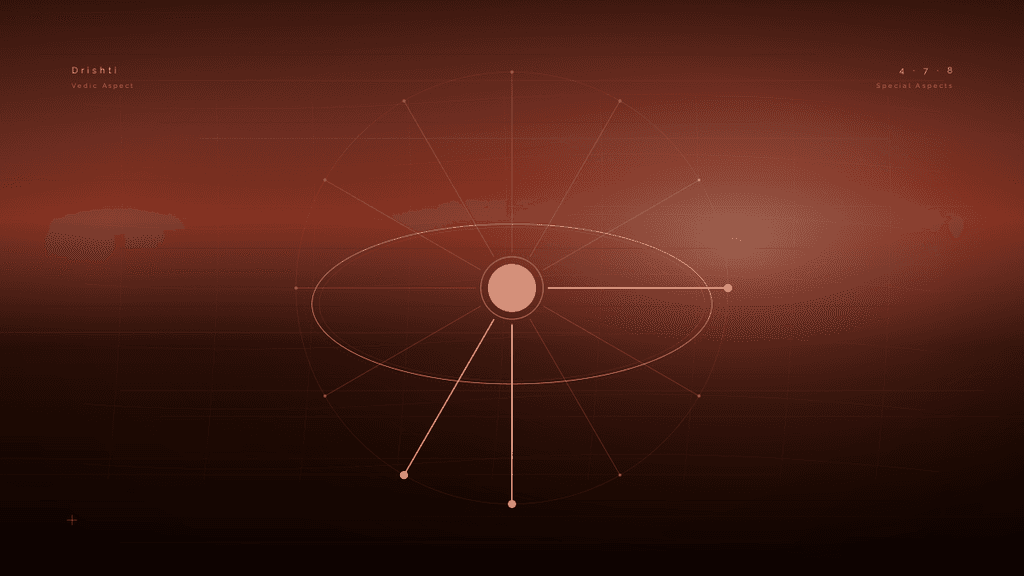
Jupiter aspect on natal planets: the benefic 5th, 7th and 9th drishti
Every planet aspects the 7th house from itself. Jupiter, Mars and Saturn also cast special aspects to specific additional houses. Jupiter's special aspect reaches the 5th and 9th houses on top of the 7th, and because Jupiter is the great benefic, its aspect blesses, expands and dignifies whatever planet it touches. This page covers the Jupiter aspect planet by planet, what it protects, what it does not predict, and where transit Jupiter aspects natal planets from 2026 to 2028.
The aspect framework for Jupiter
In classical Vedic astrology a planet influences not only the house it sits in but also the houses it aspects (drishti, meaning gaze). The universal rule is that every planet aspects the 7th house from itself, the full-opposition sight-line. Three planets have additional special aspects: Mars to the 4th and 8th, Saturn to the 3rd and 10th, and Jupiter to the 5th and 9th.
The 5th and 9th are the two trine houses (trikona), the most auspicious houses in the chart, associated with intelligence, children and creativity (5th) and fortune, dharma, teachers and the father-principle (9th). That Jupiter, the natural significator of wisdom and dharma, casts its special aspect precisely onto the two trine houses is not a coincidence in the classical scheme: the great benefic reinforces the fortune-and-wisdom axis wherever it looks.
So a planet receiving Jupiter's aspect is receiving a sight-line from the significator of expansion, protection, wisdom and grace. Whatever that planet governs gets a benefic cushion.
What Jupiter actually does to a planet it aspects
Jupiter's aspect is the gentlest and most protective of the special aspects. Where Saturn's aspect disciplines and Mars's aspect forces, Jupiter's aspect blesses. The classical reading has four consistent effects:
1. Protection. Jupiter's aspect on a planet shields the house that planet governs from the worst of any affliction. A malefic in a difficult house, when aspected by Jupiter, delivers a softened version of its difficulty. This is the single most-relied-upon rescue signature in chart reading.
2. Expansion. Whatever the aspected planet signifies grows. Jupiter aspecting the 2nd-house lord expands wealth capacity; aspecting the 5th-house lord expands children and creativity; aspecting Venus expands relationship and aesthetic life. The growth is qualitative (more meaning, more scope) as much as quantitative.
3. Dignification. Jupiter's aspect adds an ethical and wisdom register to the aspected planet. A Mars aspected by Jupiter acts with more restraint and principle; a Mercury aspected by Jupiter reasons with more depth and honesty. The planet behaves more like its higher self.
4. Faith and optimism. Jupiter's aspect adds a forward-looking, hopeful quality. The domains the aspected planet governs carry a sense of possibility and belief rather than constriction.
The one caution: an unmitigated Jupiter aspect can also over-expand. Jupiter aspecting a planet already prone to excess (a strong Venus toward indulgence, a Mars toward over-confidence) can amplify the excess as readily as the virtue. Benefic does not mean without cost; it means the register is growth, and growth can overshoot.
Planet-by-planet Jupiter aspect signatures
The Jupiter aspect reads differently depending on which planet receives it, because Jupiter dignifies whatever the aspected planet already governs.
Jupiter aspect on the Sun
Dignifies authority. The native's self-expression and leadership carry an ethical, teacherly, principled quality. Classical texts read this as a strong signature for advisory, judicial, academic or dharmic-authority roles. The father-relationship is generally protected. The caution is self-righteousness if the aspect is very tight.
Jupiter aspect on the Moon
The Gajakesari signature. When Jupiter aspects (or conjoins, or sits in mutual kendra with) the Moon, the classical Gajakesari yoga is in play. It reads as a protected, hopeful, wisdom-oriented emotional life, good judgement, respected public standing and mental resilience. One of the most benefic Moon configurations available.
Jupiter aspect on Mars
Restrains and principles the force. Mars aspected by Jupiter acts with strategy and ethics rather than raw aggression. Strong signature for principled leadership, surgery-with-judgement, ethical competition, teaching of martial or technical skills. Softens the injury and conflict potential of a difficult Mars.
Jupiter aspect on Mercury
Deepens the intellect. Mercury aspected by Jupiter reasons with wisdom and honesty rather than mere cleverness. Classical signature for teachers, writers, lawyers, scholars, advisors. The combination of Mercury's analytical speed with Jupiter's depth is one of the strongest learning-and-communication signatures in the toolkit.
Jupiter aspect on Venus
Elevates relationship and aesthetics. Venus aspected by Jupiter reads as refined taste, ethical relationships, generosity in love, and often a protected marriage. The caution is over-indulgence, since two benefics amplifying pleasure can tip toward excess. Generally a fortunate signature for partnership and the arts.
Jupiter aspect on Saturn
Softens the structural weight. Saturn aspected by Jupiter carries its discipline with more faith and less bleakness. The delay-and-restriction register of Saturn is cushioned by Jupiter's optimism. Strong signature for patient, principled long-term building: institutions, law, sustained ethical work. One of the better Saturn-mitigation configurations.
Jupiter aspect on Rahu
Channels the amplifier toward dharma. Rahu aspected by Jupiter has its boundary-pushing ambition given an ethical container. Reads as expansive worldly ambition that stays within principle, foreign-connected wisdom traditions, or unconventional teaching. The classical texts note this is the difference between a Rahu that overreaches destructively and one that expands constructively.
Jupiter aspect on Ketu
Dignifies the detachment. Ketu aspected by Jupiter reads as spiritual wisdom, moksha-oriented intelligence, and a refined rather than merely absent relationship to the Ketu-house domains. Strong signature for genuine spiritual scholarship rather than escapism.
The trine-reinforcement reading
Because Jupiter aspects the 5th and 9th (the two trikonas) plus the 7th, a well-placed Jupiter tends to reinforce the fortune axis of the chart from wherever it sits. When Jupiter sits in a kendra (1st, 4th, 7th, 10th) its 5th and 9th aspects reach trikona-adjacent houses, producing the classical Dharma-Karmadhipati support pattern. When Jupiter sits in a trikona its aspects reach other trikonas and the 7th.
This is why the position of Jupiter is one of the first things a classical reader checks: its aspect alone can lift the fortune-and-wisdom houses of an otherwise-difficult chart. A single well-placed Jupiter casting its benefic aspect onto the right houses is a genuine rescue in the classical scheme.
What amplifies (and what to watch) with a Jupiter aspect
The Jupiter aspect strengthens when: Jupiter is in its own sign (Sagittarius, Pisces) or exaltation (Cancer); Jupiter is unretrograde and uncombust; and the aspected planet is itself reasonably placed (Jupiter magnifies what is there, so it magnifies strength more cleanly than it rescues weakness).
The Jupiter aspect weakens or complicates when: Jupiter is debilitated (Virgo) or combust; Jupiter is the functional malefic for that ascendant (Jupiter owns dusthana houses for some risings, e.g. for Taurus and Libra lagnas Jupiter is a less-friendly functional lord); or the aspect over-expands an already-excessive planet. Read Jupiter's own dignity before reading what its aspect does.
What the Jupiter-aspect reading does not predict
- Not a guarantee of good outcomes. Jupiter's aspect improves the odds and softens the difficulty; it does not remove free choice or guarantee success. It is a supportive signature, not a deterministic one.
- Not a substitute for the aspected planet's own condition. A severely afflicted planet aspected by Jupiter is a softened affliction, not a strength. Jupiter cushions; it does not transform a weak planet into a strong one.
- Not a timing signal by itself. The aspect is a standing feature of the birth chart. When its benefit shows up in life is a dasha-and-transit question, not an aspect question.
- Not always benefic in effect. For ascendants where Jupiter is a functional malefic, or when Jupiter over-expands an excessive planet, the aspect can complicate. Read Jupiter's functional role for the specific ascendant first.
When the Jupiter aspect activates in the life
A natal Jupiter aspect is always present, but its effect is foregrounded in specific windows: during the mahadasha or antardasha of Jupiter; during the mahadasha or antardasha of the aspected planet; and when transit Jupiter or transit slow planets activate the natal Jupiter or the aspected planet. The benefic cushion is strongest when Jupiter's own planetary period runs, which is when the chart's protective and expansive themes tend to surface most clearly.
How Tempora computes the Jupiter aspect
Tempora's engine computes Jupiter's special aspect by sign-count under whole-sign drishti: Jupiter aspects the 5th, 7th and 9th signs from the sign it occupies. Degree-based aspect strength (Jupiter's aspect is strongest when the aspected planet is near the same degree Jupiter would reach in the aspected sign) is available as a secondary refinement. The engine cross-references Jupiter's own dignity (own-sign, exalted, debilitated, combust, retrograde) so the aspect reading is weighted by the aspecting Jupiter's condition, not read as a flat benefic regardless of state.
The whole-sign method is the Parashari default and the one Tempora reports. Degree-based Tajika aspect strength is used only where a specific reading calls for it, and is flagged when it is.
Transit Jupiter across the natal planets, 2026 to 2028
Transit Jupiter carries the same 5th, 7th and 9th benefic aspect. As Jupiter moves, its aspect sweeps across natal planets, delivering the benefic cushion to different chart houses in sequence. The 2026 to 2028 walk (engine-computed under True Pushya Paksha):
| Period | Transit Jupiter sign | Aspects (5th/7th/9th from it) |
|---|---|---|
| Through 18 Jun 2027 | Cancer (exalted) | Scorpio, Capricorn, Pisces |
| 19 Jun to 18 Nov 2027 | Leo | Sagittarius, Aquarius, Aries |
| From 18 Nov 2027 | Virgo (debilitated) | Capricorn, Pisces, Taurus |
Natives with natal planets in the aspected signs receive a transit-Jupiter benefic cushion for the duration of that leg. The cushion is strongest while Jupiter is exalted in Cancer (through mid-2027) and weakest once Jupiter reaches debilitation in Virgo (year-end 2027). The full walk is detailed in Jupiter transit 2027 and the multi-year Jupiter transit 2025 to 2028 calendar.
Conclusion
The Jupiter aspect is the classical toolkit's most reliable protective and expansive signature. It blesses the planet it touches, cushions affliction, deepens intelligence, principles force and grows whatever the aspected planet governs, all subject to Jupiter's own dignity and functional role for the ascendant. Read it as the benefic counterweight to the pressure aspects of Saturn and Mars, and check Jupiter's condition before reading how much cushion it can actually deliver.
Frequently asked questions
Which houses does Jupiter aspect?
Jupiter aspects the 5th, 7th and 9th houses (or signs, under whole-sign drishti) counted from its own position. Every planet aspects the 7th; Jupiter's special additional aspects are the 5th and 9th, the two trine houses. This places Jupiter's benefic gaze precisely on the fortune-and-wisdom axis of the chart.
Is a Jupiter aspect always good?
Mostly, but not unconditionally. Jupiter's aspect is benefic: it protects, expands and dignifies the aspected planet. But it can over-expand a planet already prone to excess, and for ascendants where Jupiter is a functional malefic (Taurus and Libra risings, for example) the aspect is less purely favourable. Jupiter's own dignity matters too: a debilitated or combust Jupiter delivers a weaker cushion. Read Jupiter's condition and functional role first.
What is the Jupiter aspect on the Moon?
Jupiter aspecting the Moon is the Gajakesari signature, one of the most benefic Moon configurations. It reads as a protected, hopeful, wisdom-oriented emotional life, sound judgement, respected public standing and mental resilience. The classical Gajakesari yoga is formed by Jupiter aspecting, conjoining or sitting in mutual kendra with the Moon.
Can a Jupiter aspect rescue a difficult planet?
It softens rather than transforms. A malefic in a difficult house aspected by Jupiter delivers a milder version of its difficulty, and this is the most-relied-upon rescue signature in classical reading. But Jupiter cushions the affliction; it does not turn a weak or afflicted planet into a strong one. The aspected planet's own condition still governs; Jupiter improves the odds and reduces the damage.
How is the Jupiter aspect different from the Saturn and Mars aspects?
All three cast special aspects but in opposite registers. Jupiter aspects the 5th, 7th and 9th and its register is benefic: it blesses, expands and protects. Saturn aspects the 3rd, 7th and 10th and its register is structural pressure: it disciplines, delays and matures. Mars aspects the 4th, 7th and 8th and its register is force: it energises, agitates and pushes to action. Jupiter cushions where Saturn and Mars press.
Where does transit Jupiter aspect in 2027?
Transit Jupiter carries the same 5th, 7th and 9th aspect as it walks. Through 18 June 2027 (exalted in Cancer) it aspects Scorpio, Capricorn and Pisces. From 19 June in Leo it aspects Sagittarius, Aquarius and Aries. From 18 November in Virgo (debilitated) it aspects Capricorn, Pisces and Taurus. Natives with natal planets in those signs get the transit-Jupiter benefic cushion for that leg, strongest while Jupiter is exalted in the first half of 2027.
Read next
- Saturn aspect on natal planets · the structural 3rd, 7th and 10th drishti
- Mars aspect on natal planets · the force 4th, 7th and 8th drishti
- Rahu aspect on natal planets · the amplifier aspect
- Aspect strength by degree · how orb changes the reading
- Jupiter transit 2027 · where transit Jupiter aspects across the year
- Aspects · the full drishti framework
This article was first published on 30 July 2026. It documents conventional Vedic teaching on Jupiter's benefic drishti onto natal planets (5th, 7th and 9th aspects) and Tempora Research's aspect reading method. Internal audit log maintained for methodology revisions; any subsequent material change to the framework above will be appended here with a dated note. This article represents conventional Vedic teaching and Tempora Research method documentation. It does not constitute medical, financial, legal or professional advice.