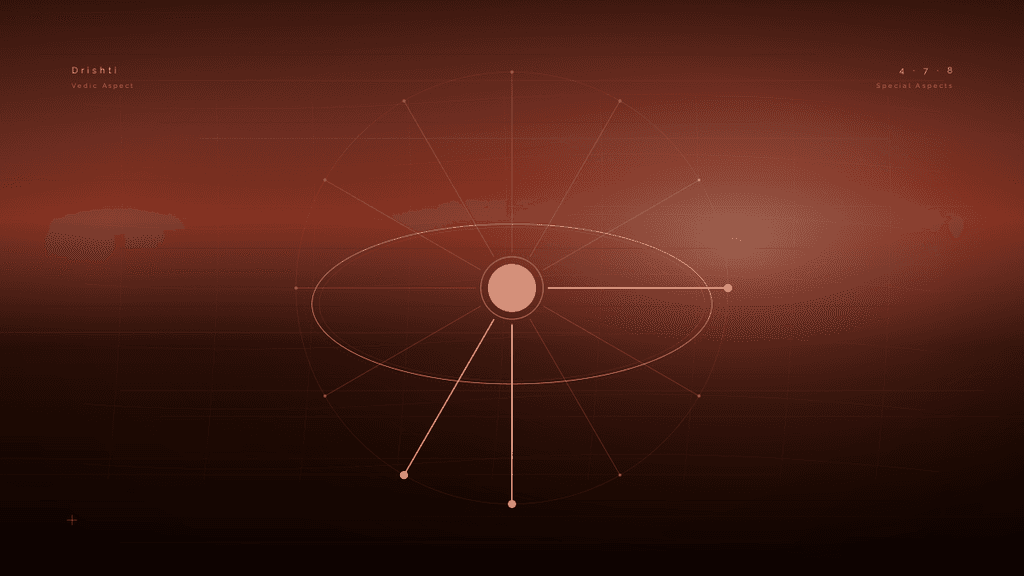
Mars aspect on natal planets: the force 4th, 7th and 8th drishti
Every planet aspects the 7th house from itself. Mars, Jupiter and Saturn also cast special aspects to specific additional houses. Mars's special aspect reaches the 4th and 8th houses on top of the 7th, and because Mars is the significator of energy, courage and force, its aspect drives, agitates and pushes to action whatever planet it touches. This page covers the Mars aspect planet by planet, what it energises, what it does not predict, and where transit Mars aspects natal planets.
The aspect framework for Mars
A planet in classical Vedic astrology influences the house it occupies and the houses it aspects (drishti). All planets aspect the 7th from themselves. Three planets have additional special aspects: Jupiter to the 5th and 9th, Saturn to the 3rd and 10th, and Mars to the 4th and 8th.
The 4th is the house of home, emotional foundation, mother and inner security; the 8th is the house of transformation, crisis, shared resources, longevity and sudden events. Mars, the significator of energy, conflict and decisive force, casting its special aspect onto the security-and-transformation axis is the source of two of its most-watched signatures: Mars aspecting the 4th is a classical marker for a contested or unsettled home life, and Mars aspecting the 8th is a marker for sudden, forceful transformative events. Mars's aspect brings heat and motion to whatever it touches.
What Mars actually does to a planet it aspects
Mars's aspect is the most activating of the special aspects. Where Jupiter blesses and Saturn tests, Mars drives. The classical reading has four consistent effects:
1. Energy and drive. Whatever the aspected planet signifies is pushed into action. Mars's aspect on the 10th lord drives career ambition; on Mercury it drives quick decisive communication; on the Moon it drives an active, restless emotional life. The domains the aspected planet governs get initiative and force.
2. Agitation and heat. Mars's aspect adds friction, urgency and sometimes conflict. The aspected planet's domain can carry irritation, impatience, argument or a fight-quality. This is the disruptive face of the same energy that drives.
3. Courage and decisiveness. Mars's aspect adds the capacity to act, to take risks and to push through resistance. The aspected planet can operate boldly where it might otherwise hesitate. This is Mars's constructive gift: force in service of getting things done.
4. Injury and sudden-event potential. In its difficult expression, particularly the aspect on the 8th, Mars's force can manifest as accidents, surgery, sudden crises or abrupt reversals. The 8th-house aspect specifically is a classical marker to read carefully for the sudden-event register.
The whole reading of a Mars aspect turns on channelling. Channelled, it is courage, drive, decisive competence and the capacity to build and defend. Unchannelled, it is conflict, accident, anger and disruption. The same force, two directions.
Planet-by-planet Mars aspect signatures
The Mars aspect reads differently depending on which planet receives it, because Mars energises whatever the aspected planet governs.
Mars aspect on the Sun
Drives authority. The native's leadership and self-expression carry force, courage and a willingness to fight for position. Strong signature for command roles, military, sport, surgery, entrepreneurship and any field rewarding decisive authority. The caution is ego-conflict, a domineering streak, or friction with the father and other authority figures.
Mars aspect on the Moon
Energises and agitates the emotional life. Mars aspecting the Moon reads as an active, passionate, quick-reacting emotional nature with a short fuse. It gives emotional courage and drive but also irritability, impatience and a tendency to act on feeling. Chandra-Mangala combinations are strong wealth-through-effort signatures but carry the emotional-heat caution. Read the mother-and-home theme as active and sometimes contested.
Mars aspect on Mercury
Sharpens and quickens the intellect. Mercury aspected by Mars thinks fast, argues well and makes decisions quickly. Strong signature for debate, engineering, surgery, competitive analysis and sharp technical work. The caution is a cutting or combative communication style, impatience with slower thinkers, and decisions made too fast.
Mars aspect on Venus
Intensifies passion and desire. Venus aspected by Mars reads as strong physical passion, intensity in relationship, and a drive in the pleasure-and-desire register. It gives magnetism and courage in love but also the potential for conflict, jealousy or impulsiveness in relationships. The artistic register gains force and boldness. The caution is relationship friction and impulsive attraction.
Mars aspect on Jupiter
Energises the expansion. Jupiter aspected by Mars reads as active, courageous pursuit of growth, principled ambition, and the drive to act on wisdom rather than merely hold it. Strong signature for leaders who combine vision with the force to execute. The caution is over-confidence, dogmatic force, or expansion pursued too aggressively.
Mars aspect on Saturn
The friction of accelerator and brake. Mars aspecting Saturn (or the reverse) is the classical Mars-Saturn tension: drive meeting restriction. Channelled, it produces disciplined power, sustained hard effort, engineers and builders who combine force with structure. Unchannelled, it produces frustration, stop-start action, suppressed anger or accident-through-haste. This aspect specifically rewards deliberate channelling.
Mars aspect on Rahu
Inflames the amplifier. Rahu aspected by Mars (the classical Angarak-yoga register when they conjoin) reads as intense, forceful, boundary-pushing ambition, sometimes explosive. It gives enormous drive and the capacity for dramatic rise, but carries the strongest conflict-and-sudden-event caution of the Mars-aspect signatures. Channelling is critical; unchannelled it is the marker for volatile, high-risk action.
Mars aspect on Ketu
Sharpens the detachment into force. Ketu aspected by Mars reads as sudden, sharp, sometimes severing action in the Ketu-house domains, or as a forceful, cutting spiritual intensity. It can mark abrupt endings and decisive breaks. Strong signature for surgical precision and decisive renunciation; caution for the sudden-severance register.
The security-and-transformation reading
Because Mars aspects the 4th and 8th (home-security and transformation-crisis) plus the 7th, a difficult Mars can unsettle the two most vulnerable emotional axes of the chart. Mars aspecting the 4th is the classical Bhauma or Kuja marker for a contested home, restlessness in the domestic domain, or property-and-mother themes carrying conflict. Mars aspecting the 8th is the marker for sudden transformative events, surgery, accident-proneness or abrupt reversals in shared resources and longevity matters.
This is why Mars placement and its aspects are checked carefully in matching and in home-and-longevity reading. But the same force, when Mars is dignified and the chart channels it, is exactly what defends the home, drives transformation constructively and provides the courage to rebuild after crisis. Mars's aspect is defensive and regenerative as readily as it is disruptive, depending on dignity and channelling.
What channels (and what to watch) with a Mars aspect
The Mars aspect channels constructively when: Mars is in its own sign (Aries, Scorpio) or exaltation (Capricorn); Mars is unretrograde and uncombust; the chart provides an outlet for the drive (physical work, competition, decisive career, building); and the aspected planet has the strength to carry the added force. A dignified, channelled Mars aspect is a courage-and-capability signature.
The Mars aspect disrupts when: Mars is debilitated (Cancer) or combust; Mars is the functional malefic for that ascendant; there is no constructive outlet for the drive, so it turns to conflict or accident; or the aspect on the 4th or 8th falls on already-vulnerable placements. Read Mars's dignity, functional role and the chart's outlets before deciding whether the aspect empowers or disrupts.
What the Mars-aspect reading does not predict
- Not guaranteed conflict or injury. Mars's aspect adds force and sudden-event potential; a channelled Mars is courage and capability, not calamity. The injury register is a risk to manage, not a certainty.
- Not a substitute for the aspected planet's own condition. A strong planet under a Mars aspect gains drive; a weak or afflicted one can be pushed into instability. The aspect adds force; the planet's own strength decides whether the force builds or breaks.
- Not a timing signal by itself. The aspect is a standing birth-chart feature. When the drive or the sudden-event potential activates is a dasha-and-transit question.
- Not uniformly difficult. For ascendants where Mars is a yogakaraka or functional benefic (Cancer and Leo risings), the Mars aspect is a strong, favourable drive-and-courage signature. Read Mars's functional role first.
When the Mars aspect activates in the life
A natal Mars aspect is always present, but its effect is foregrounded during the mahadasha or antardasha of Mars; during the period of the aspected planet; and when transit Mars (fast) or the transit slow planets activate the natal Mars or the aspected planet. Mars's own periods and its transit conjunctions are when the drive-and-agitation register tends to surface most sharply, including the sudden-event windows the 8th-house aspect flags.
How Tempora computes the Mars aspect
Tempora's engine computes Mars's special aspect by sign-count under whole-sign drishti: Mars aspects the 4th, 7th and 8th signs from the sign it occupies. Mars's own dignity (own-sign, exalted, debilitated, combust, retrograde) weights the reading, so a debilitated or combust Mars aspect is read as more disruptive and less constructively channelled than a dignified Mars aspect. The engine flags the 8th-house aspect specifically for the sudden-event register, since that is the placement most classically associated with the difficult expression of Mars's force.
Transit Mars across the natal planets
Transit Mars carries the same 4th, 7th and 8th aspect, and because Mars is medium-speed (1.5 to 6 months per sign, longer when retrograde), its aspect sweeps across natal planets faster than the slow planets but slower than the inner ones. When transit Mars aspects a natal planet, it delivers a burst of the force register to that planet's house: energy, urgency and, in difficult configurations, the accident-and-conflict caution for the duration of the aspect.
Transit Mars is most watched when it aspects natal Mars, natal Saturn (activating the Mars-Saturn friction), or when it aspects the natal ascendant or Moon during a stressful period. The Mars transit calendar sits inside the broader outer-planet picture in Mundane astrology 2027.
Conclusion
The Mars aspect is the classical toolkit's force signature. It energises, drives and sharpens the planet it touches, adding courage and decisive capability when channelled and conflict, agitation or sudden-event potential when not, all subject to Mars's own dignity and functional role for the ascendant. Read it as the active counterweight to Jupiter's blessing and Saturn's discipline, and remember that the whole reading turns on whether the chart gives the force somewhere constructive to go.
Frequently asked questions
Which houses does Mars aspect?
Mars aspects the 4th, 7th and 8th houses (or signs, under whole-sign drishti) counted from its own position. Every planet aspects the 7th; Mars's special additional aspects are the 4th and 8th, the security-and-transformation axis. The 4th aspect is the classical marker for a contested home, and the 8th aspect for sudden transformative or accident-related events.
Is a Mars aspect always bad?
No. Mars's aspect adds force, drive and courage, which is constructive when the chart channels it into physical work, competition, decisive career or building. For ascendants where Mars is a yogakaraka or functional benefic (Cancer and Leo risings), the Mars aspect is a strong favourable signature. The aspect disrupts only when Mars is debilitated or combust, when there is no outlet for the drive, or when it falls on already-vulnerable placements.
What does Mars aspecting the Moon mean?
Mars aspecting the Moon energises and agitates the emotional life. It reads as an active, passionate, quick-reacting emotional nature with emotional courage and drive, but also irritability, impatience and a short fuse. Chandra-Mangala combinations are strong wealth-through-effort signatures, but carry the emotional-heat caution and an active, sometimes contested home-and-mother theme.
Why is the Mars aspect on the 8th house watched carefully?
Because the 8th house governs sudden events, crisis, transformation, surgery and longevity, and Mars's force applied there is the classical marker for abrupt, forceful events: accidents, surgery, sudden reversals in shared resources. It is a risk register to read carefully and manage, not a certainty. The same 8th-house Mars, when dignified and channelled, also provides the courage to transform and rebuild after crisis.
How is the Mars aspect different from the Jupiter and Saturn aspects?
All three cast special aspects but in opposite registers. Mars aspects the 4th, 7th and 8th and its register is force: it energises, agitates and pushes to action. Jupiter aspects the 5th, 7th and 9th and its register is benefic: it blesses, expands and protects. Saturn aspects the 3rd, 7th and 10th and its register is structural pressure: it disciplines, delays and matures. Mars drives where Jupiter cushions and Saturn tests.
What is the Mars-Saturn aspect friction?
When Mars aspects Saturn (or Saturn aspects Mars), the classical reading is the tension between drive and restriction, accelerator and brake. Channelled deliberately, it produces disciplined power and sustained hard effort: engineers, builders and operators who combine force with structure. Unchannelled, it produces frustration, stop-start action, suppressed anger or accident-through-haste. This specific aspect rewards conscious channelling more than any other.
Read next
- Jupiter aspect on natal planets · the benefic 5th, 7th and 9th drishti
- Saturn aspect on natal planets · the structural 3rd, 7th and 10th drishti
- Rahu aspect on natal planets · the amplifier aspect
- Mars special aspects · the 4th, 7th and 8th in more detail
- Aspect strength by degree · how orb changes the reading
- Aspects · the full drishti framework
This article was first published on 30 July 2026. It documents conventional Vedic teaching on Mars's force drishti onto natal planets (4th, 7th and 8th aspects) and Tempora Research's aspect reading method. Internal audit log maintained for methodology revisions; any subsequent material change to the framework above will be appended here with a dated note. This article represents conventional Vedic teaching and Tempora Research method documentation. It does not constitute medical, financial, legal or professional advice.