Mars Special Aspects: The 4th, 7th and 8th Drishti Explained
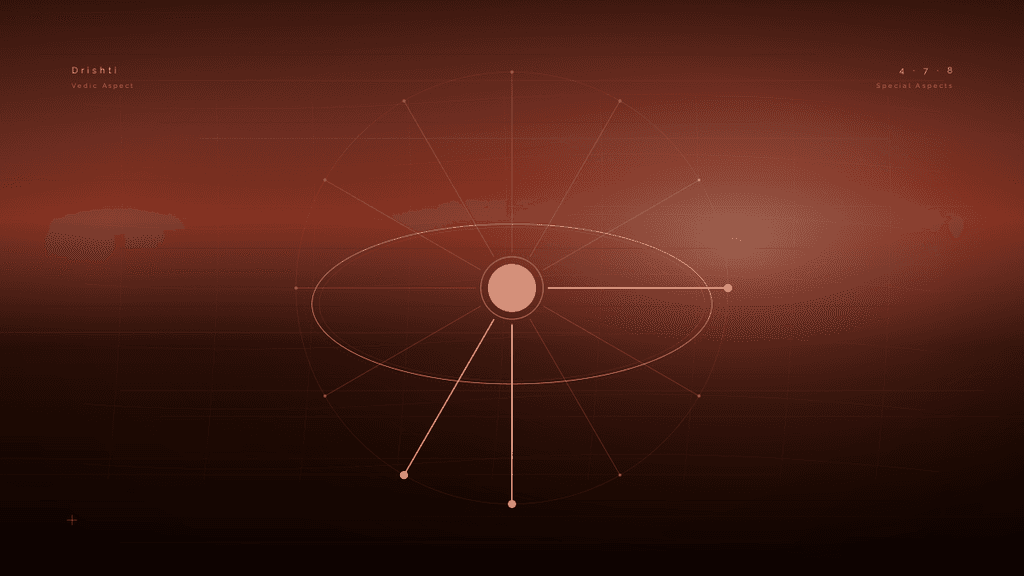
Mars carries three special drishti (aspects) in classical Vedic astrology. Where Saturn and Jupiter each get their own pair of additional glances, Mars gets a 4th aspect and an 8th aspect on top of the standard 7th. This piece walks through why those particular three, what each glance projects, how the strength scales and how the framework is computed in Tempora's reading stack.
The drishti framework in classical Vedic astrology
Drishti is the Sanskrit word for sight. In classical Vedic astrology the term refers to the angular reach of a graha (planet) across the chart beyond the bhava (house) it occupies. A planet does not only act on the house it sits in. It throws a glance to specific other houses and the houses receiving that glance carry the planet's signature even when the planet is not physically present. The framework treats the distance reach as functionally equivalent to placement, scaled by an aspect-strength factor that classical texts assign to each glance.
Every planet aspects the seventh house from its own position. The seventh aspect is the natural opposition glance and carries full classical strength. This is the standard drishti shared across all nine grahas. Beyond the standard seventh, three planets carry additional special aspects in the classical framework. Mars carries the fourth aspect and the eighth aspect counted from Mars itself. Jupiter carries the fifth aspect and the ninth aspect. Saturn carries the third aspect and the tenth aspect. The remaining grahas (Sun, Moon, Mercury, Venus) carry only the standard seventh aspect. Rahu and Ketu carry contested special aspects in different schools; the conservative reading restricts them to the seventh glance plus the trikona (trine 1/5/9) glance in some lineages.
The Mars special aspects are the focus of this reading. Of the three planets that carry additional drishti, Mars has the most distinctive set because the 4th and 8th glances pull Mars into the kendra-trikona-dusthana lattice in a specific way that the Jupiter and Saturn glances do not replicate. A Mars in any single house projects onto three other houses at once and the houses receiving the projection are spread across the three structural groups of the chart.
Why Mars gets the 4th and 8th aspects specifically
The classical reason given for Mars's three special aspects is symbolic and rooted in the planet's sign rulership. Mars rules two signs in the zodiac. Aries is the 1st sign of the zodiac and is Mars's own sign of activation, raw energy and combat. Scorpio is the 8th sign from Aries and is Mars's second own sign of depth, transformation and concentrated force. Cancer is the 4th sign from Aries and is Mars's sign of debilitation, the sign where Mars is structurally weakened because Cancer's watery emotional nature does not host Mars's fiery activation comfortably.
The 4th and 8th glances from Mars therefore reflect Mars's nodal energy points across the zodiac. The 8th glance reaches the sign Mars rules in its mature, concentrated form. The 4th glance reaches the sign Mars is debilitated in. The 7th glance is the natural opposition shared by all planets. The three special drishti together mark out the axis along which Mars projects its force: the sign of own activation (1st aspect implicit in placement), the sign of debilitation (4th aspect, the challenged projection), the sign of opposition (7th aspect, the standard relational projection) and the sign of concentrated mature force (8th aspect, the transformative projection).
The practical effect of this symbolic structure is that Mars in a single placement can disturb three houses at once through aspect. The reading is more consequential than for any planet that carries only the seventh glance because a single Mars position activates multiple chart sectors simultaneously. This is the reason Mars placements are read with extra care across the kendra (angular 1/4/7/10) and dusthana (6/8/12, the difficult-house triad) framework and the reason Mars-related yogas (combinations) and doshas (afflictions) play such a prominent role in classical compatibility and timing reading.
The 4th aspect: home, mother, emotional substrate
The 4th aspect of Mars is the glance Mars throws to the 4th house from its own position. The 4th house in any chart is the seat of home, mother, immovable property, vehicles, the inner emotional substrate, the heart space and what classical texts call the foundation of the chart. The 4th is the bhava that holds the chart-holder's emotional and physical resting point. It is one of the four kendras (angular houses 1/4/7/10) and carries the structural prominence of all kendras.
When Mars aspects the 4th house through its 4th glance, the home and emotional domain picks up Mars-flavoured signatures. The conventional reading covers four possible signatures: activation and energy in the home (the home as a place of doing rather than resting), conflict with the mother or maternal figures, frequent residential moves and a tendency toward physical disruption in the property (renovations, fires, accidents) or emotional volatility in the inner space. The signatures are not predictions of disaster. They are reading of the frequency the 4th house operates on when Mars's glance lands there.
A Mars in the 1st house aspects the 4th house through its 4th glance. A Mars in the 5th house aspects the 8th house through its 4th glance. A Mars in the 9th house aspects the 12th house through its 4th glance. The reading scales with Mars's dignity at the time of aspect. A Mars in own sign or exaltation aspecting the 4th projects disciplined activation; the home becomes a place of organised doing. A Mars in debilitation or combustion aspecting the 4th projects raw emotional volatility; the home becomes a place of friction. The aspect is also conventionally read for the mother's wellbeing, particularly when Mars is debilitated or afflicted at the time of aspect.
The 7th aspect: the standard opposition and Manglik gravity
The 7th aspect of Mars is the standard opposition glance shared by all planets. It carries the highest notional strength in classical aspect-strength teaching because the seventh is the natural diametric line and the planet's force is projected along the chart's longest internal axis. The 7th house is the seat of marriage, partnership, one-to-one engagement, the open enemy in litigation and the public face of the chart-holder in negotiation.
When Mars aspects the 7th house through this glance, the partnership domain picks up Mars signatures: assertion, fast escalation, fast resolution, courage in confrontation and the friction structure conventionally summarised as Manglik dosha (Mars affliction) or Kuja dosha. The Mars-7th aspect is the most consequential of the three Mars glances for natal-chart marriage reading because it lands on the marriage seat with full classical strength. The conventional reading from Mars in the 1st (where the 7th glance lands on the 7th house) is the canonical Manglik position; from Mars in the 4th (where the 4th glance lands on the 7th house) is the second-heaviest; from Mars in the 12th (where the 8th glance lands on the 7th house) is the third.
Tempora's detailed reading on Mars aspect on the 7th house covers the Manglik framework in full including the conditions under which the dosha is cancelled. The relevant point for the general Mars special-aspect reading is that the 7th glance is the structural reason the Manglik framework exists at all. Without Mars's three special aspects there would be no consistent five-position list of Manglik placements; the framework derives directly from the drishti structure.
The 8th aspect: transformation, longevity, occult
The 8th aspect of Mars is the glance Mars throws to the 8th house from its own position. The 8th house is one of the three dusthana houses (6/8/12, the difficult-house triad) and is the seat of transformation, longevity, occult knowledge, inheritance, in-law family, sudden events and the maraka (death-inflicting) functions in classical longevity reading. The 8th is the house of hidden things, sudden ruptures and the parts of life that operate outside ordinary structures.
When Mars aspects the 8th house, the transformation domain picks up Mars signatures: sudden disruptive events, surgical or accidental injuries (Mars rules the surgeon's knife and the accident in classical reading), occult investigation, fast inheritance shifts and a tendency toward research or investigative work that requires breaking into hidden structures. The Mars-8th aspect is also a longevity-reading factor in classical texts because Mars on the 8th interacts with the maraka framework in specific ways. The aspect strength is conventionally read as scaled slightly lower than the 7th aspect in some lineages and as full strength in others; Tempora follows the Parashari reading of full strength for the headline computation.
A Mars in the 1st house aspects the 8th house through its 8th glance. A Mars in the 5th house aspects the 12th house through its 8th glance. A Mars in the 7th house aspects the 2nd house through its 8th glance, which is the route through which Mars in the 7th becomes part of the Manglik list even from the 2nd-house reference. The composite reading depends heavily on Mars's intrinsic dignity. A Mars in own sign or exaltation aspecting the 8th projects concentrated investigative force and is one of the classical signatures for surgeons, researchers and occultists. A Mars debilitated or afflicted aspecting the 8th projects raw rupture and is read as a longevity-stress factor that interacts with the wider maraka calculation.
Aspect-strength scaling across the three glances
Two conventional teachings exist on the strength scaling across Mars's three special drishti. The conservative Parashari reading treats all three glances as full strength. Each aspect projects Mars's full signature onto the aspected house without the strength decay that some texts apply to other planets's aspects. This is the conventional reading that Tempora's headline computation follows because it is the teaching directly attributable to the Brihat Parashara Hora Shastra (the foundational classical text) and to the major commentary lineages.
The alternative scaled reading appears in Krishnamurti Paddhati (KP, a 20th century reformist tradition) and in some south Indian schools. The scaled teaching is that the 7th aspect carries full strength (the standard opposition), the 4th aspect carries roughly three-quarter strength and the 8th aspect carries roughly half strength. The scaled reading is consistent with the broader Tajika (Persian-influenced) aspect framework that some lineages absorb into the Vedic reading. Tempora notes the scaled alternative as a secondary computation but does not run it as the headline.
The strength scaling interacts with Mars's intrinsic dignity in both teachings. A Mars in own sign, exaltation or a strong house projects stronger signatures across all three aspects regardless of the scaling scheme. A Mars in debilitation, combustion or weak placement projects weaker but still classified-as-full glances under the Parashari reading. The composite signature on any receiving house is read as the product of the aspect strength and Mars's intrinsic dignity. A weak Mars aspecting at full strength is not the same as a strong Mars aspecting at half strength; the dignity layer is the multiplier that shapes the actual reading.
The three-glance projection table
A Mars in any house projects to three houses simultaneously through its special drishti. From the 1st house Mars aspects the 4th, the 7th and the 8th. From the 2nd house Mars aspects the 5th, the 8th and the 9th. From the 3rd house Mars aspects the 6th, the 9th and the 10th. From the 4th house Mars aspects the 7th, the 10th and the 11th. From the 5th house Mars aspects the 8th, the 11th and the 12th. From the 6th house Mars aspects the 9th, the 12th and the 1st. From the 7th house Mars aspects the 10th, the 1st and the 2nd. From the 8th house Mars aspects the 11th, the 2nd and the 3rd. From the 9th house Mars aspects the 12th, the 3rd and the 4th. From the 10th house Mars aspects the 1st, the 4th and the 5th. From the 11th house Mars aspects the 2nd, the 5th and the 6th. From the 12th house Mars aspects the 3rd, the 6th and the 7th. The reading runs all three glances together as a single composite signature on the chart.
How Mars's three aspects show up in the strength table
The strength table below sets out the conventional Parashari reading and the alternative scaled reading side by side. The Parashari column is the Tempora headline. The scaled column is presented for readers who want to apply the KP or south Indian alternative.
| Aspect | Houses reached | Parashari strength | Scaled strength |
|---|---|---|---|
| 4th aspect | 4th house from Mars | Full | ~75% |
| 7th aspect | 7th house from Mars | Full (highest) | Full (highest) |
| 8th aspect | 8th house from Mars | Full | ~50% |
The conventional reading is that the 7th aspect is the most consequential because it is the standard opposition and the natural diametric line. The 4th and 8th aspects expand Mars's reach but the 7th remains the structural backbone of any Mars reading. The scaled reading explicitly downgrades the 4th and 8th to reflect the same intuition; the Parashari reading treats them as fully equivalent but in practice the 7th still carries the strongest reading because the opposition axis is the most consequential structural relationship in any chart.
How Tempora computes Mars's three aspects
Tempora's aspect reading runs on the Swiss Ephemeris with the True Pushya Paksha ayanamsa by PVRN Rao. The Swiss Ephemeris returns Mars's sidereal longitude to arc-second precision; the True Pushya Paksha ayanamsa fixes the sidereal zero point at Pushya nakshatra's start, which differs from the more common Lahiri ayanamsa by a small but consequential amount. The Mars special-aspect computation runs in four stages.
Stage one identifies Mars's natal house position and projects the three special drishti forward in the zodiacal direction (the 4th house from Mars, the 7th house from Mars and the 8th house from Mars). Stage two reads Mars's intrinsic dignity layers: sign placement (exaltation in Capricorn, debilitation in Cancer, own sign in Aries or Scorpio, friend's sign, neutral, enemy sign), combustion state (distance from the Sun in degrees), retrogression state and aspect from benefics (Jupiter, Venus, Moon) or malefics (Saturn, Rahu). Stage three computes the composite aspect signature on each of the three receiving houses by combining the aspect strength (Parashari full strength as headline) with Mars's intrinsic dignity. Stage four reports the three composite signatures and links them to the wider chart reading.
The output feeds into the dasha-bhukti scan, the transit timeline and the relevant cluster reading (Manglik for the 7th aspect, the 4th-house life-axis reading for the 4th aspect, the longevity and 8th-house occult reading for the 8th aspect). Tempora's reading on aspect strength by degree covers the fine-grained scoring system used when aspects interact across degree-precise orbs rather than house-precise ones. The Mars special-aspect reading does not stand alone in any output; it is presented as one layer in the wider chart-reading stack.
What the framework does not predict
The Mars three-aspect framework is precise about the projection structure but explicitly limited on three fronts. It does not predict outcomes in isolation. A Mars aspecting the 4th, 7th and 8th simultaneously is a structural fact about the chart; whether the projections manifest depends on Mars's dignity, the receiving houses's lords, the active Vimshottari (the 120-year planetary period sequence) dasha-bhukti and the transit conditions over time. The aspect is a probability gradient, not a forecast.
It does not override the natal house lord's placement or strength. A Mars aspecting the 4th house does not predict the home structure in isolation; the 4th lord's placement is the primary 4th-house reading and the Mars aspect is a modifier. A Mars aspecting the 7th house does not predict marriage outcome in isolation; the 7th lord's condition and Venus's state run the marriage reading. A Mars aspecting the 8th house does not predict longevity outcome in isolation; the maraka calculation runs the longevity reading. The Mars aspects are signal layers, not the full reading.
It does not extend to forecasting catastrophic events. The classical reading of accidental injury from Mars's 4th glance on the 4th, sudden marital rupture from Mars's 7th glance on the 7th or sudden death from Mars's 8th glance on the 8th is one of the stricter teachings that modern practice treats with caution. Tempora's framework explicitly excludes catastrophe forecasting and presents the aspect signatures as probability gradients to be read against the broader chart and timing.
Conclusion
Mars's three special drishti (the 4th, the 7th and the 8th from Mars's own position) are the structural backbone of any Mars reading in classical Vedic astrology. The three glances together let a single Mars placement project signatures onto three houses simultaneously, which is why Mars positions carry extra weight in compatibility, timing and event reading. The 7th aspect is the standard opposition shared by all planets and the most consequential of the three because it lands on the natural diametric line. The 4th and 8th aspects are Mars-specific and derive symbolically from Mars's rulership of Scorpio (the 8th sign) and debilitation in Cancer (the 4th sign). The Parashari reading treats all three at full classical strength; alternative lineages scale the 4th and 8th lower. Tempora runs the Parashari reading as the headline and the dignity layer as the modifier, never reading any single aspect in isolation from Mars's intrinsic state and the wider chart.
Mars's three glances against the 2026 to 2028 slow sky
Mars itself moves too quickly for a dated transit chapter: it crosses signs in weeks, and the corpus dates only the slow bodies. The dated application of this framework therefore runs in the other direction. Natal Mars's three glances are fixed at birth, and the 2026 to 2028 slow transits move through the signs those glances already cover, activating each destination on a published timetable.
A worked example shows the arithmetic. Take a natal Mars exalted in Capricorn. Its 4th glance falls in Aries, its 7th in Cancer and its 8th in Leo, and every one of those destinations carries dated traffic in this window. Cancer hosts Jupiter in exaltation from 27 May 2026 to 19 June 2027 and Ketu from 27 December 2026 to 15 July 2028. Leo hosts Ketu until 27 December 2026 and Jupiter from 19 June 2027. Aries receives Saturn on 23 May 2027, with the retreat into Pisces from 4 November 2027 to 11 February 2028 before the re-entry that holds into 2030. The same chart also takes transit Rahu across natal Mars's own sign from 27 December 2026. Each slow body arriving in a glance destination reads as that house's Mars projection gaining a dated co-tenant: Jupiter steadies, Saturn weights, the nodes polarise. Any other natal Mars sign yields its own triple by the same whole-sign count.
Mars does have one entry on the public record in this window, and honesty requires naming its mechanism. The 2026 British Grand Prix call, graded MET at the race note, ran on the UK 1801 chart through Mercury mahadasha with Jupiter antardasha and Mars pratyantardasha on race day, Mars as the competition karaka at the deepest sub-tier. That is a dasha mechanism rather than a drishti one: no graded call has yet tested a Mars-aspect population, and the scoreboard's headline, nine graded flagship calls at a 50 percent hit rate with misses published, is the honest context for every unmeasured layer.
The limits from the section above carry straight over. These are sign-level activations, intensity follows degree contact, the receiving house's lord keeps the primary reading and the framework's exclusion of catastrophe forecasting applies to transit overlays exactly as it applies to the natal map.
Frequently asked questions
What are Mars's three special aspects in Vedic astrology?
Mars in classical Vedic astrology carries three full-strength drishti (aspects) beyond the seventh-house glance shared by all planets. Mars throws a full-strength aspect to the 4th house from its position, a full-strength aspect to the 7th house from its position and a full-strength aspect to the 8th house from its position. The 7th aspect is the standard glance every planet shares. The 4th and 8th aspects are Mars-specific and are the reason Mars touches three houses simultaneously through aspect rather than just one. The aspects are counted forward in the zodiacal direction from Mars's own house position. A Mars in the 1st house aspects the 4th, 7th and 8th houses from itself. A Mars in the 3rd house aspects the 6th, 9th and 10th houses from itself. The aspect strength does not decay across these three glances in the conventional reading; all three carry full classical strength.
Why does Mars have these specific aspects?
The classical reason given for Mars's three special aspects is symbolic. Mars rules two signs in the zodiac. Aries is the 1st sign, which is Mars's own sign of activation. Scorpio is the 8th sign from Aries, which is Mars's second own sign of depth and transformation. Cancer is the 4th sign from Aries, which is Mars's debilitation sign. The 4th and 8th glances from Mars therefore reflect Mars's nodal energy points across the zodiac, the points where Mars's nature is fully expressed (Scorpio) and fully challenged (Cancer). The 7th glance is the natural opposition shared by all planets. The three special drishti together mark out the axis along which Mars projects its force. Practically the effect is that Mars in a single placement can disturb three houses at once through aspect, which is why Mars placements are read with extra care across the kendra (angular 1/4/7/10) and dusthana (6/8/12) framework.
What does the 4th aspect of Mars predict?
The 4th aspect of Mars is the glance Mars throws to the 4th house from its own position. The 4th house in any reading is the seat of home, mother, immovable property, vehicles, the inner emotional substrate and the heart space. When Mars aspects the 4th house through its 4th glance, the home and emotional domain picks up Mars-flavoured signatures: activation, energy in the home, sometimes residential disruption, conflict with the mother, frequent moves and physical or emotional friction in the domestic space. The aspect reading does not predict home destruction or maternal harm. It predicts a home domain operating on Mars's frequency, which depending on Mars's dignity can produce either disciplined home leadership or volatile domestic friction.
What does the 7th aspect of Mars predict?
The 7th aspect of Mars is the standard opposition glance shared by all planets and carries the highest notional strength in classical aspect-strength teaching. The 7th house is the seat of marriage, partnership, one-to-one engagement and the open enemy in litigation. When Mars aspects the 7th house through this glance, the partnership domain picks up Mars-flavoured signatures: assertion, fast escalation, fast resolution, courage in confrontation and the friction structure conventionally summarised as Manglik dosha (Mars affliction) or Kuja dosha. The Mars-7th aspect is the most consequential of the three Mars glances for natal-chart marriage reading because it lands on the marriage seat with full classical strength.
What does the 8th aspect of Mars predict?
The 8th aspect of Mars is the glance Mars throws to the 8th house from its own position. The 8th house is one of the three dusthana houses (6/8/12, the difficult-house triad) and is the seat of transformation, longevity, occult knowledge, inheritance, in-law family and sudden events. When Mars aspects the 8th house, the transformation domain picks up Mars signatures: sudden disruptive events, surgical or accidental injuries, occult investigation, fast inheritance shifts and a tendency toward research or investigative work that requires breaking into hidden structures. The 8th aspect of Mars is also a longevity-reading factor in classical texts because Mars on the 8th interacts with the maraka (death-inflicting house) framework. The aspect strength is conventionally read as scaled slightly lower than the 7th aspect in some lineages and as full strength in others.
Do all three Mars aspects carry equal strength?
The conventional Parashari teaching is that Mars's three special drishti all carry full classical strength. Each aspect projects Mars's full signature onto the aspected house without the strength decay that some texts apply to other planets's aspects. A minority of lineages, particularly in Krishnamurti Paddhati and some south Indian schools, scale the strength differently: the 7th aspect carries full strength (the standard opposition), the 4th aspect carries roughly three-quarter strength and the 8th aspect carries roughly half strength. Tempora's reading follows the conventional Parashari teaching for the headline strength score and notes the scaled alternative as a secondary reading. The strength does interact with Mars's intrinsic dignity. A Mars in own sign, exaltation or strong house projects stronger signatures across all three aspects. A Mars in debilitation, combustion or weak placement projects weaker but still classified-as-full glances.
How does Tempora compute Mars's three aspects?
Tempora's aspect reading runs on the Swiss Ephemeris with the True Pushya Paksha ayanamsa by PVRN Rao. The Swiss Ephemeris returns Mars's sidereal longitude to arc-second precision and the True Pushya Paksha ayanamsa fixes the sidereal zero point at Pushya nakshatra's start. For the Mars special-aspect reading the computation identifies Mars's house position, then projects the three special drishti forward in the zodiacal direction (the 4th house from Mars, the 7th house from Mars and the 8th house from Mars). The reading reports which natal houses receive Mars's three glances, computes Mars's dignity (sign placement, combustion, retrogression), checks for benefic or malefic aspect onto Mars and reports the composite Mars-aspect signature. The output feeds into the wider chart reading along with the dasha-bhukti scan and is never read in isolation.
How do Mars's special aspects interact with the 2026 to 2028 transits?
Transit Mars moves too fast for a dated chapter, so the dated layer works through natal Mars: its 4th, 7th and 8th glances are fixed, and the slow transits cross the destination signs on schedule. For a natal Mars in Capricorn the glances cover Aries, Cancer and Leo, and in this window Cancer hosts exalted Jupiter from 27 May 2026 to 19 June 2027 with Ketu from 27 December 2026, Leo hosts Ketu until 27 December 2026 and Jupiter from 19 June 2027, and Aries receives Saturn on 23 May 2027 with a retreat from 4 November 2027 to 11 February 2028. Each arrival is a dated co-tenant in a house natal Mars already projects onto. The activations are sign-level, intensity follows degree contact and the receiving house's lord keeps the primary reading.
Read next
This article was first published on 06 June 2026. It documents conventional Vedic teaching on Mars's three special drishti and Tempora Research's aspect reading method. Internal audit log maintained for methodology revisions; any subsequent material change to the framework above will be appended here with a dated note. This article represents conventional Vedic teaching and Tempora Research method documentation. It does not constitute medical, financial, legal or professional advice.