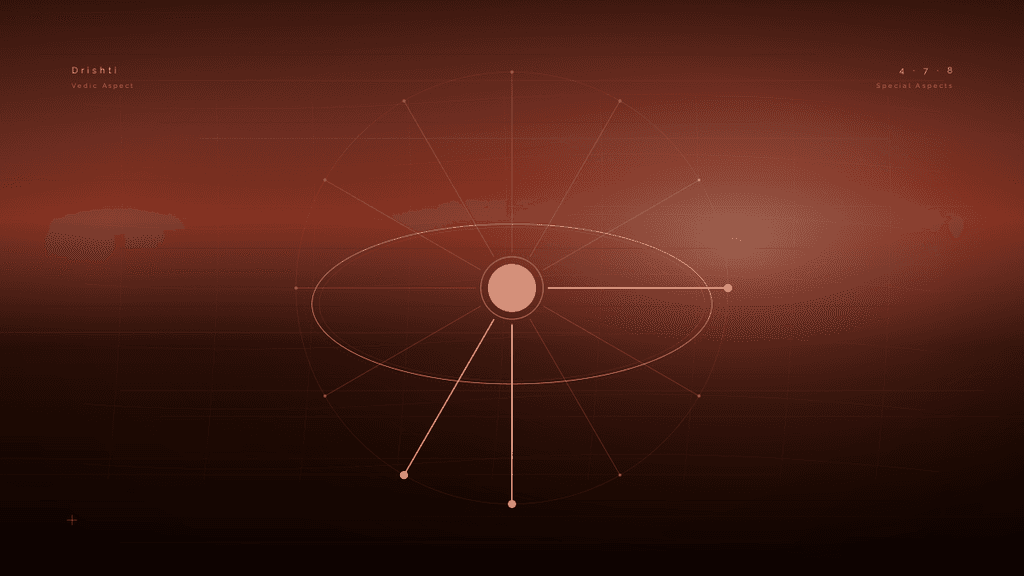
Saturn's 3rd and 10th House Aspects: The Discipline Drishti
Saturn casts three aspects in any chart. The default seventh aspect that every graha (planet) carries plus two special aspects on the third and tenth bhavas (houses) counted from its placement. This piece walks through what those two special aspects mean, why classical texts treat them as carrying the karma-axis discipline signature and how the destination bhava reads under Saturn's slow-build drishti (aspect).
The structural logic of Saturn's special aspects
Drishti is the Sanskrit word for sight, glance or aspect. In Vedic astrology, drishti is the mechanism by which a graha (planet) influences a bhava (house) it does not physically occupy. Every graha occupies one sign and one bhava at any moment; the drishti formula extends the planet's influence to other bhavas without the planet physically being there. Classical Parashara assigns each graha a set of aspect houses counted from the graha's own placement.
The default aspect is the seventh; every graha aspects the seventh house counted from itself. Three grahas carry additional special aspects. Mars aspects the 4th and 8th in addition to the 7th. Jupiter aspects the 5th and 9th in addition to the 7th. Saturn aspects the 3rd and 10th in addition to the 7th. The special aspects are unique to these three planets and classical texts treat them as carrying full strength along with the default seventh.
Saturn's special aspects align with Saturn's natural karaka houses. The 3rd house signifies parakrama (effort, courage, initiative, siblings, communication) and Saturn is read as a strong significator of disciplined sustained effort. The 10th house signifies karma (profession, public role, status, achievement) and Saturn is the natural karaka of karma in classical texts. Saturn's aspects on the 3rd and 10th from any position carry the karma-axis signature directly into the destination bhavas. The combined 3rd, 7th and 10th aspects together cover the karma axis (3rd, 10th) and the partnership axis (7th); Saturn thus has structural reach across both effort and the structural relationships that constrain it.
Why the 3rd and 10th aspects align with karma
The 3rd and 10th houses are two of the four upachaya (growing) houses. The four upachayas are the 3rd, 6th, 10th and 11th. Upachaya houses are read as benefiting from malefic energy because they reward sustained effort, disciplined work and the kind of slow-build outcome that requires friction. Saturn is the natural malefic of effort; classical reading treats Saturn's aspects on upachaya destinations as supportive rather than adverse.
The 10th house specifically is one of the four kendras (angles) of the chart. The four kendras are the 1st, 4th, 7th and 10th. Kendras carry the highest structural significance because they anchor the chart's framework: the lagna anchors the self, the 4th anchors the home and inner life, the 7th anchors partnership and the 10th anchors public role and action. The 10th house is both a kendra and an upachaya, which gives it dual structural weight. Saturn as the natural karaka of the 10th and the natural malefic of effort is read as the planet most at home casting drishti onto this bhava.
The 3rd house is an upachaya but not a kendra. It is one of the three kama (desire) houses (3rd, 7th, 11th) and is read as the house of self-directed effort, courage and personal initiative. Saturn's aspect on the 3rd carries the discipline signature into the bhava of effort itself, producing a structural pattern of sustained directed energy. The 3rd house in classical texts is sometimes called the house of valour because it represents the willingness to do hard sustained work; Saturn's aspect on this house compounds the willingness with structural discipline.
The three houses Saturn aspects from each placement
Saturn aspects three bhavas from any placement: the 3rd, 7th and 10th counted from its own position. The structural reading runs through each placement.
Saturn in the 1st house occupies the lagna and aspects the 3rd (effort), the 7th (partnership) and the 10th (career). This placement is one of the most structurally consequential because Saturn aspects both upachaya houses on the karma axis and the partnership kendra. The reading is a disciplined personality with sustained effort and a serious career orientation; partnership tends to involve responsibility or age difference. Tempora's reading of the underlying configuration sits in Saturn in the first house.
Saturn in the 2nd house occupies the bhava of accumulated wealth and family and aspects the 4th (home, mother), the 8th (longevity, transformation) and the 11th (gains). The 4th aspect is read as restrictive for property and home matters; the 8th aspect is read as supportive of longevity through discipline; the 11th aspect is read as supportive of slow-build gains through sustained effort.
Saturn in the 3rd house occupies its karaka bhava and aspects the 5th (children, education), the 9th (dharma, father) and the 12th (expenses, foreign). The placement is read as supportive because Saturn sits in an upachaya house of effort and the structural reading is the native carrying disciplined effort as a default. The 5th and 9th aspects bring restriction or delay to the trikona axis; the 12th aspect carries effort signatures into spiritual or foreign matters.
Saturn in the 4th house occupies the kendra of home and inner life and aspects the 6th (debt, disease), the 10th (career) and the lagna itself. Saturn's 10th aspect on the lagna from the 4th is the classical disciplined-personality configuration. Tempora's reading on the personality signature appears in aspect on the lagna lord.
Saturn's 10th aspect and its destination bhavas
The 10th aspect from Saturn lands on the tenth bhava counted from Saturn's own placement. The destination bhava varies by Saturn's house. The structural reading varies with the destination because the aspect carries Saturn's signature into that specific area of life.
Saturn from the 1st casts the 10th aspect onto the 10th bhava itself. The aspect carries the lagna's lived-life signature into the karma bhava. Reading: the native's serious cast of personality directly shapes their career and public role. This is one of the strongest 10th-aspect configurations because Saturn sits in a kendra (the lagna) and aspects another kendra (the 10th) which is also Saturn's natural karaka. Classical reading associates this configuration with disciplined career achievement that comes slowly but durably.
Saturn from the 2nd casts the 10th aspect onto the 11th. The reading is sustained effort flowing from family wealth into gains. Saturn from the 3rd casts the 10th aspect onto the 12th. The reading is effort flowing into spiritual matters, foreign work or expenses with discipline. Saturn from the 4th casts the 10th aspect onto the lagna; the disciplined-personality configuration noted above.
Saturn from the 5th casts the 10th aspect onto the 2nd. The aspect carries discipline into family wealth, sometimes producing the structural reading of slow-accumulated reserves. Saturn from the 6th casts the 10th aspect onto the 3rd; this is one of the strongest configurations for sustained effort because Saturn sits in an upachaya (6th) and aspects the karaka upachaya of effort (3rd). Saturn from the 7th casts the 10th aspect onto the 4th, bringing discipline into home and mother matters.
Saturn from the 8th casts the 10th aspect onto the 5th. The 5th is a trikona and the aspect carries Saturn's restrictive signature into education and children; reading is delayed or hard-won creative output. Saturn from the 9th casts the 10th aspect onto the 6th, another upachaya; supportive for sustained effort against obstacles. Saturn from the 10th casts the 10th aspect onto the 7th; disciplined partnership. Saturn from the 11th casts the 10th aspect onto the 8th, mixing effort with the dushtana signature. Saturn from the 12th casts the 10th aspect onto the 9th; restriction on the dharmic crown.
Saturn's 3rd aspect and its destination bhavas
The 3rd aspect from Saturn lands on the third bhava counted from Saturn's own placement. The destination varies similarly. Saturn from the 1st casts the 3rd aspect onto the 3rd bhava itself; effort onto effort, supportive. Saturn from the 2nd casts the 3rd aspect onto the 4th; restriction on home. Saturn from the 3rd casts the 3rd aspect onto the 5th; restriction on children. Saturn from the 4th casts the 3rd aspect onto the 6th; effort on the malefic of debt and disease.
Saturn from the 5th casts the 3rd aspect onto the 7th; serious partnership signature. Saturn from the 6th casts the 3rd aspect onto the 8th; deep restriction or transformation. Saturn from the 7th casts the 3rd aspect onto the 9th; restriction on dharma. Saturn from the 8th casts the 3rd aspect onto the 10th; effort on career through difficult means.
Saturn from the 9th casts the 3rd aspect onto the 11th; dharmic discipline flowing into gains. Saturn from the 10th casts the 3rd aspect onto the 12th; career discipline flowing into spiritual or foreign matters. Saturn from the 11th casts the 3rd aspect onto the lagna; one of the more consequential personality configurations because the karaka of gains casts effort onto the self. Saturn from the 12th casts the 3rd aspect onto the 2nd; spiritual restriction on family wealth.
The 3rd aspect is generally read as more uniformly supportive than the 10th aspect because the 3rd house signifies pure effort and Saturn's signature on effort is structurally positive. The 10th aspect is more consequential because the 10th house is a kendra; the aspect carries more structural weight but can also be more visibly difficult depending on the receiving bhava.
Reading destination by house category
The structural reading of any Saturn aspect distinguishes four destination categories. The reading is conditional on which category the receiving bhava belongs to.
Upachaya destinations (3rd, 6th, 10th, 11th) read as supportive. Saturn's malefic energy is read as productive on these houses because they reward sustained effort. Saturn's 3rd aspect on the 6th (the malefic house of debt and disease) is read as bringing disciplined effort to overcoming difficulty; Saturn's 10th aspect on the 11th (the upachaya of gains) is read as bringing slow-build accumulation of returns. These configurations show the highest empirical lift in Tempora's calibration.
Kendra destinations (1st, 4th, 7th, 10th) read as carrying serious structural weight. Saturn's aspect on a kendra brings discipline, delay and durable outcomes to a structural axis of the chart. The reading is mixed: the configuration supports long-build maturation but tends to require sustained effort and the slow timing can read as restrictive in the short term. Saturn's 10th aspect on the lagna from the 4th house is the classical disciplined-personality configuration; Saturn's 7th aspect on the 1st from the 7th is the responsible-marriage configuration.
Trikona destinations (1st, 5th, 9th) read as carrying delay or restriction on the dharmic axis but with the durable upside that Saturn brings. Saturn's aspect on the 5th can read as delayed children or restricted creative output that eventually produces something durable. Saturn's aspect on the 9th can read as restricted relationship with father or delayed dharmic development that eventually produces a serious orientation. Dushtana destinations (6th, 8th, 12th) read as adverse because Saturn's malefic signature compounds the difficult bhava. The exception is the 6th house, which is both a dushtana and an upachaya; Saturn's aspect on the 6th is read on balance as supportive because the upachaya quality dominates.
The discipline reading on the lagna lord
One of the most consequential applications of Saturn's special aspects is when one of them lands on the lagna lord. The lagna lord is the planetary ruler of the ascending sign and is read as the steward of the self. Saturn aspecting the lagna lord with its 10th-aspect signature carries the discipline signature directly into the steward of the lived life. The reading associates this configuration with a serious, responsible, slow-build personality.
The placement that produces this aspect varies by ascendant. For Aries lagna the lagna lord is Mars; Saturn casts the 10th aspect on Mars from any position nine houses behind Mars. The structural pattern repeats across the twelve ascendants. When Saturn and the lagna lord sit in the karma-axis relationship of ten houses apart with Saturn nine behind the lagna lord, the 10th aspect lands on the steward of the self.
The personality reading associated with Saturn aspecting the lagna lord covers a recognisable cluster of features: seriousness, responsibility from a young age, a tendency to take on burdens that others avoid, slow but durable maturation, often-delayed but enduring achievement and an orientation toward work, structure and long-term outcomes. The reading is not negative; the configuration produces what classical texts describe as a karma-yogi structural signature. Tempora's structural reading on this configuration sits in aspect on the lagna lord.
How Tempora computes Saturn's aspects
Tempora computes planetary positions on the Swiss Ephemeris with the True Pushya Paksha ayanamsa by PVRN Rao. The Swiss Ephemeris returns planetary longitudes to arc-second precision; the True Pushya Paksha ayanamsa fixes the sidereal zero point at Pushya nakshatra's start. The aspect computation runs in two modes.
The default mode is whole-sign aspect computation. Saturn aspects the 3rd, 7th and 10th bhavas counted from its own sign; the aspect is read as landing on the whole sign that occupies the destination bhava regardless of the planet's exact degree within its own sign. This is the classical Parashara approach. The optional mode is degree-based orb computation, which follows the BPHS rasi-drishti reading more strictly and is useful when the destination bhava is close to a sign boundary.
The destination-category reading is applied as a structural overlay. Saturn aspects on upachaya bhavas are flagged as supportive; kendra aspects as structurally weighty; trikona aspects as delayed-but-durable; dushtana aspects as adverse. The calibrated lift over base-rate is computed against the Tempora 117-pair grid for native chart configurations. The configurations with the highest empirical lift are Saturn aspecting the 10th from a strong placement (own sign of Capricorn or Aquarius, exalted in Libra or in a kendra from the Moon) and Saturn aspecting the 3rd from any placement. The configurations with mixed empirical signature are Saturn aspecting trikonas; the delayed outcomes are real but require dasha (planetary period) context to time. Tempora's coverage of Saturn's broader role in chart reading sits in Saturn in the 10th house and the related Saturn mahadasha piece.
Saturn aspect quick reference
Saturn aspects the 3rd, 7th and 10th bhavas counted from its placement. The 3rd house is Saturn's karaka of effort; the 10th house is Saturn's karaka of karma and one of the four kendras. The 10th aspect carries the highest structural weight because the destination is both kendra and karaka. The reading varies by destination category. Upachaya destinations (3rd, 6th, 10th, 11th) read as supportive of sustained effort. Kendra destinations read as carrying serious structural weight with slow-build durable outcomes. Trikona destinations read as carrying delay or restriction on the dharmic axis. Dushtana destinations (6th, 8th, 12th) read as adverse; the 6th is an exception because it is also upachaya. Tempora computes the aspect on the Swiss Ephemeris with True Pushya Paksha ayanamsa in whole-sign default or degree-based orb mode.
What the framework does not predict
The 3rd and 10th aspect readings are structural and not absolute. They do not predict that Saturn's 10th aspect on the lagna produces unhappiness; the reading is that the native carries a disciplined cast of personality with slow-build durable outcomes. Whether that orientation expresses as career achievement, responsibility, depression, late marriage or other outcomes depends on the rest of the chart and on the choices the native makes.
They do not predict that Saturn's aspect produces failure. The configuration carries delay and effort signatures; the outcome depends on whether the native sustains the effort that Saturn's aspect requires. Classical reading treats Saturn's aspect on the 10th as one of the most reliable karma-yogi configurations precisely because the structural signature is sustained effort that produces durable outcomes. The configuration is silent on whether the native chooses to engage the effort.
They do not predict timing on their own. The aspect is a permanent structural feature of the natal chart. Whether the discipline signature activates in a particular year depends on the dasha (planetary period) running at that time. A native with Saturn's 10th aspect on the lagna in the natal chart shows the disciplined-personality signature most clearly during Saturn's Vimshottari mahadasha or during transits where Saturn activates the aspect by aspecting its own natal position. Reading the aspect without the dasha context produces a structural statement without a timing one.
Conclusion
Saturn's 3rd and 10th house aspects are the two special drishtis that Saturn casts in addition to the default seventh. The 3rd aspect lands on Saturn's karaka bhava of effort; the 10th aspect lands on Saturn's karaka bhava of karma and one of the four kendras. Classical Parashara assigns both aspects full strength. The structural reading distinguishes four destination categories: upachaya destinations read as supportive of sustained effort, kendra destinations carry serious structural weight, trikona destinations carry delay with durable upside and dushtana destinations read as adverse with the 6th-house exception. The disciplined-personality configuration is Saturn from the 4th house casting the 10th aspect on the lagna. The aspect is computed on the Swiss Ephemeris with True Pushya Paksha ayanamsa in whole-sign default or degree-based orb mode. The framework reads the aspect as a permanent structural feature of the natal chart and depends on the dasha and transit context to convert structure into timing.
Saturn's 3rd and 10th glances in the 2026 to 2028 sky
The natal aspect map this piece walks through has a transit twin, and Saturn's slowness makes the transit version unusually stateable. Saturn sits in Pisces until 23 May 2027. From Pisces its 3rd glance falls in Taurus, its 7th in Virgo and its 10th in Sagittarius, so natal planets and whole-sign houses in those three signs receive the effort and karma drishti continuously through that date. Saturn then enters Aries on 23 May 2027, and the whole map steps forward one sign: 3rd into Gemini, 7th into Libra, 10th into Capricorn.
The Aries chapter carries a caveat the calendar itself supplies. Saturn retreats into Pisces from 4 November 2027 to 11 February 2028 before re-entering Aries to stay until 2030. During those three months the Pisces map returns: Taurus, Virgo and Sagittarius pick the glances back up and the Gemini, Libra and Capricorn destinations get a pause. Any statement about the Aries-era aspects between late 2027 and early 2028 needs that retreat attached.
Two features of the second chapter stand out in the framework's own terms. The 10th glance from Aries lands in Capricorn, Saturn's own sign, so the karma aspect falls on a destination whose lord is the aspecting planet itself, a self-dispositor loop the tradition reads as Saturn supervising its own portfolio. Capricorn also hosts transit Rahu until 15 July 2028, which places the amplifier under the karma glance for the first year of the Aries stay. On the mental axis, the same sign-level arithmetic dates when transit Saturn's glances reach a natal Moon, and the Saturn aspect on the Moon note runs that reading in full.
The limits are the standing ones. A transit drishti is dated weather: it opens at the ingress, closes at the exit and colours whatever the natal chart already holds in the destination sign. The natal aspect keeps the structural reading, the destination category logic above applies per chart rather than per sign and intensity follows degree contact, which the engine computes to fractions of a degree. No graded call on a Saturn-aspect population sits on the public scoreboard, so the map is computable while any calibrated lift stays open.
Frequently asked questions
What are Saturn's 3rd and 10th house aspects?
Saturn's 3rd and 10th house aspects are the two special drishtis (aspects) that Saturn casts in addition to the default seventh aspect that every graha (planet) casts. From any position in the chart, Saturn aspects the third bhava (house) counted forward from itself and the tenth bhava counted forward from itself. Classical Parashara assigns these aspects full strength because the 3rd house is Saturn's karaka (significator) bhava of effort, courage and sustained action while the 10th house is Saturn's karaka bhava of karma, profession and public role. Together with the default 7th aspect, Saturn covers the karma axis (3rd, 10th) and the partnership axis (7th).
Why does Saturn aspect the 3rd and 10th houses?
Classical Vedic astrology assigns Saturn the natural significations of discipline, effort, karma and slow-build outcomes. Parashara assigns Saturn the 3rd and 10th aspects because these houses align with Saturn's natural significations. The 3rd house signifies parakrama (effort, courage, initiative) and the 10th house signifies karma (profession, public role, status). Saturn's signature of disciplined sustained effort is read as naturally extending along this axis. The 3rd and 10th houses are also the two upachaya (growing) houses outside the 6th and 11th; upachaya houses are read as benefiting from malefic energy because they reward sustained effort. Saturn as the natural malefic of effort is read as the planet most at home casting drishti onto the upachaya axis.
Which houses does Saturn aspect from each placement?
Saturn aspects the 3rd, 7th and 10th houses counted from its own placement. From the first house (lagna), Saturn aspects the 3rd, 7th and 10th. From the second house, Saturn aspects the 4th, 8th and 11th. From the third house, Saturn aspects the 5th, 9th and 12th. From the fourth house, Saturn aspects the 6th, 10th and the first. From the fifth house, Saturn aspects the 7th, 11th and 2nd. From the sixth house, Saturn aspects the 8th, 12th and 3rd. From the seventh house, Saturn aspects the 9th, the first and 4th. From the eighth house, Saturn aspects the 10th, 2nd and 5th. From the ninth house, Saturn aspects the 11th, 3rd and 6th. From the tenth house, Saturn aspects the 12th, 4th and 7th. From the eleventh house, Saturn aspects the first, 5th and 8th. From the twelfth house, Saturn aspects the 2nd, 6th and 9th.
What is Saturn's 10th aspect on the lagna?
Saturn from the 4th house casts the 10th aspect onto the first house (lagna, the ascendant). This configuration is read as carrying disciplined personality, slow-build maturation and a generally serious cast of life. The lagna represents the self, the body and the lived life. Saturn's 10th aspect on the lagna carries the karma-axis signature directly onto the person. Classical reading associates this configuration with a steady, disciplined personality, delayed but durable achievement, responsibility from a young age and a tendency toward serious vocations. The configuration is not read as inauspicious; it carries Saturn's natural slow-build signature into the lived self and is the structural foundation for sustained achievement.
How strong is Saturn's 3rd aspect compared to its 10th aspect?
Classical Parashara assigns Saturn's three special aspects equal full strength on paper. In practice, conservative readers treat the 3rd aspect as carrying Saturn's effort signature most strongly because the 3rd house is the upachaya bhava of pure effort. The 10th aspect carries the karma-and-status signature most strongly because the 10th house is the kendra (angle) of public role. The 7th aspect carries the partnership signature. The 10th aspect is widely read as the most consequential of Saturn's three drishtis because the 10th house is one of the four kendras and carries the highest structural significance for career, status and public outcomes. The 3rd aspect is read as the most uniformly auspicious because the 3rd is an upachaya house that benefits from malefic input.
Is Saturn's aspect always negative?
Saturn is a natural malefic but its aspects are not uniformly negative. The classical reading distinguishes between Saturn's effect on different houses. Saturn's aspect on dushtana (malefic) houses (the 6th, 8th, 12th) is read as adverse because it compounds the difficult signature. Saturn's aspect on upachaya houses (the 3rd, 6th, 10th, 11th) is read as supportive because upachaya houses benefit from malefic energy that drives sustained effort. Saturn's aspect on trikona houses (the 1st, 5th, 9th) is read as carrying delay or restriction but with the upside of disciplined long-build outcomes. Saturn's aspect on kendra houses (the 1st, 4th, 7th, 10th) carries a serious structural signature that requires effort but supports durable outcomes. The reading depends on the receiving bhava and the rest of the chart.
How does Tempora read Saturn's aspects?
Tempora computes planetary positions on the Swiss Ephemeris with the True Pushya Paksha ayanamsa by PVRN Rao and applies the classical aspect formulas from Parashara's Brihat Parashara Hora Shastra. Saturn's 3rd and 10th aspects are computed as whole-sign aspects by default with an option to use degree-based orb tightening. The structural reading distinguishes Saturn's aspect on upachaya houses (read as supportive of sustained effort), kendra houses (read as carrying serious structural weight), trikona houses (read as carrying delay with durable upside) and dushtana houses (read as adverse). The calibrated lift over base-rate is computed against the Tempora 117-pair grid; configurations with Saturn aspecting the 10th house from a strong placement show the highest empirical lift for career achievement.
Where do Saturn's 3rd and 10th aspects fall between 2026 and 2028?
From Pisces, which Saturn occupies until 23 May 2027, the 3rd glance falls in Taurus, the 7th in Virgo and the 10th in Sagittarius. From Aries, entered 23 May 2027, the map steps to Gemini, Libra and Capricorn. The retreat matters: Saturn returns to Pisces from 4 November 2027 to 11 February 2028, restoring the earlier map for those three months before the Aries stay resumes and holds into 2030. In the second chapter the 10th glance lands in Saturn's own sign Capricorn, which also hosts transit Rahu until 15 July 2028. These are sign-level windows: what they mean for a given chart depends on which natal planets and whole-sign houses occupy the destination signs, intensity follows degree contact and the natal aspect map keeps the structural reading.
Read next
This article was first published on 05 June 2026. It documents conventional Vedic teaching on Saturn's special 3rd and 10th-house aspects and Tempora Research's structural reading method on the karma axis. Internal audit log maintained for methodology revisions; any subsequent material change to the framework above will be appended here with a dated note. This article represents conventional Vedic teaching and Tempora Research method documentation. It does not constitute medical, financial, legal or professional advice.