Aspect on the Lagna Lord: The Personality Reading
The lagna (ascendant) is the seat of the chart-holder's body, vitality and personality. The lord of the rising sign carries that energy outward and any drishti (aspect) onto the lagna lord projects directly onto the personality. This piece walks through how a Jupiter, Venus, Mars, Saturn or nodal aspect on the lagna lord shapes the chart-holder's projection, how multiple aspects combine and what the framework reads alongside.
The lagna and the lagna lord in classical Vedic astrology
The lagna is the Sanskrit word for the ascendant, the point on the eastern horizon where the ecliptic crosses at the moment of birth. The lagna is the first house in the natal chart and the seat of the chart-holder's body, vitality, personality, self-projection and overall life force. Classical texts treat the lagna as the most important single point in any natal chart because it anchors the house structure: all other houses are counted from the lagna and every reading runs through the lagna's energetic state.
The lord of the lagna is the planet that rules the sign rising on the eastern horizon. A Cancer-rising chart has the Moon as the lagna lord because the Moon rules Cancer. A Leo-rising chart has the Sun as the lagna lord because the Sun rules Leo. A Sagittarius-rising chart has Jupiter as the lagna lord because Jupiter rules Sagittarius. A Scorpio-rising chart has Mars as the lagna lord in the conventional reading (some lineages use Ketu as a co-ruler of Scorpio). The mapping is fixed by the sign-rulership table: Aries-Mars, Taurus-Venus, Gemini-Mercury, Cancer-Moon, Leo-Sun, Virgo-Mercury, Libra-Venus, Scorpio-Mars, Sagittarius-Jupiter, Capricorn-Saturn, Aquarius-Saturn, Pisces-Jupiter.
The lagna lord carries the lagna's energy outward into whichever house it sits in. A Cancer-rising chart with the Moon (lagna lord) in the 10th house projects the Cancer-vitality into the career sector; the chart-holder's identity is built through their work. A Leo-rising chart with the Sun (lagna lord) in the 2nd house projects the Leo-vitality into the family and wealth sector; the chart-holder's identity is built through accumulating wealth and family standing. The aspect reading on the lagna lord works on this carrier function: whatever aspects the lagna lord projects onto the rising sign's energy carries the projection into the chart-holder's personality.
Jupiter's aspect on the lagna lord
Jupiter's drishti onto the lagna lord is one of the most supportive aspect configurations in any natal chart. Jupiter carries three glances: the standard 7th aspect shared by all planets and Jupiter's two special aspects (the 5th and the 9th from Jupiter's own position). The 5th and 9th aspects land on the trikona (trine 1/5/9) positions which are the most auspicious houses and the 9th aspect specifically is read as the grace aspect because the 9th house is the seat of dharma (right action) and fortune. Tempora's detailed reading on Jupiter's 9th house aspect covers the grace projection in full.
When any of Jupiter's three drishti lands on the lagna lord, the personality picks up Jupiter signatures: wisdom, restraint, optimism, generosity, philosophical orientation, teacher disposition and the structural backbone of dharma. The chart-holder reads as guided by a higher principle and projects a sense of expansiveness and abundance even when the rest of the chart is challenging. The reading is particularly consequential when the lagna lord is also weak or afflicted; Jupiter's aspect provides structural support that prevents the personality from being overwhelmed by other chart pressures.
A strong Jupiter (own sign Sagittarius or Pisces, exalted in Cancer, in a kendra 1/4/7/10 or trikona) aspecting the lagna lord projects the strongest personality support. A moderate Jupiter aspecting the lagna lord projects moderate support. A weak Jupiter (debilitated in Capricorn, combust, conjunct Rahu in the Guru Chandala Yoga) aspecting the lagna lord projects diluted or compromised support; the chart-holder may carry the philosophical orientation but the practical execution is compromised. The reading is layered with Jupiter's own house placement: a Jupiter in the 9th aspecting the lagna lord through its 9th glance (which would put Jupiter aspecting the 5th house, not the lagna lord directly unless the lagna lord sits in the 5th) is one of the strongest possible personality-support configurations.
Venus, Moon and Mercury: the benefic supporting cast
Venus's drishti onto the lagna lord projects beauty, harmony, artistic orientation, charm, marital sensibility and the softening influence of Shukra (Venus's Sanskrit name). Venus carries only the standard 7th aspect; it does not have the special drishti pair that Jupiter, Saturn and Mars carry. When Venus aspects the lagna lord, the chart-holder reads as aesthetically inclined, socially graceful, often physically attractive and oriented toward harmony in relationships. The reading is particularly consequential for the marriage axis because Venus is the karaka (significator) of marriage and the personality picks up marriage-supportive signatures when Venus projects onto the lagna lord.
The Moon's drishti onto the lagna lord projects emotional sensitivity, intuitive intelligence, mental stability when the Moon is in dignity and emotional volatility when the Moon is weak. The Moon carries only the standard 7th aspect. The waxing Moon (Shukla Paksha, from new moon to full moon) projects supportive emotional signatures. The waning Moon (Krishna Paksha, from full moon to new moon) projects more conditional signatures depending on the Moon's other dignity layers. A strong Moon (own sign Cancer, exalted in Taurus, waxing in Shukla Paksha, in a kendra) aspecting the lagna lord projects strong emotional stability and intuitive depth.
Mercury's drishti onto the lagna lord projects intellectual sharpness, communicative skill, analytical orientation, business acumen and youthful flexibility. Mercury carries only the standard 7th aspect. Mercury's classification as benefic or malefic is contextual: a Mercury conjunct another benefic projects benefic signatures and a Mercury conjunct a malefic projects modified signatures that can read as cleverness without ethical grounding. When Mercury aspects the lagna lord from a clean benefic state, the chart-holder reads as articulate, quick-witted and intellectually engaged. When Mercury aspects the lagna lord from a malefic-conjunct state, the chart-holder may read as clever but emotionally distant or ethically flexible.
Mars's aspect on the lagna lord
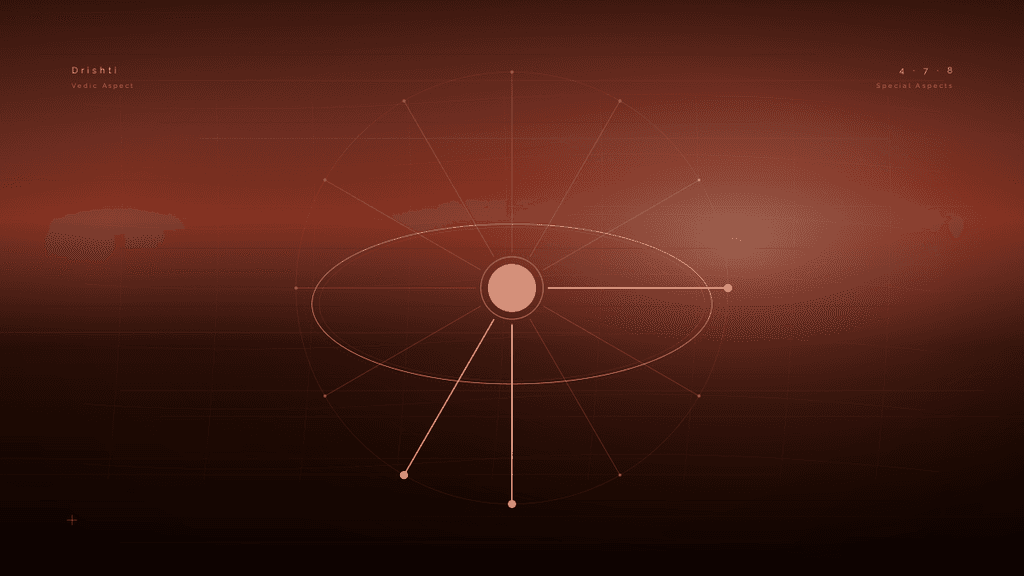
Mars's drishti onto the lagna lord projects activation, energy, courage, fast reactivity and a warrior personality. Mars carries three glances: the standard 7th aspect plus Mars's two special aspects (the 4th and the 8th from Mars's own position). Tempora's detailed reading on the Mars special aspects covers the three-glance projection in full. When any of Mars's three drishti lands on the lagna lord, the chart-holder reads as energetic, action-oriented, sometimes aggressive, fast in decision-making, physically active and oriented toward direct execution.
The reading depends heavily on Mars's dignity. A Mars in own sign (Aries or Scorpio) or exaltation (Capricorn) aspecting the lagna lord projects disciplined warrior energy: the chart-holder is a leader, athlete, military officer, surgeon or executive who acts with controlled force. The personality reads as decisive, courageous and physically capable. A Mars in debilitation (Cancer) or combust (within ten degrees of the Sun, with the exact orb varying by lineage) aspecting the lagna lord projects raw reactivity, anger, accident-proneness and friction in the personality without the disciplined channel. The chart-holder may read as quick to anger, impulsive and physically reckless.
A Mars aspect on the lagna lord is also one of the conventional indicators of physical scars, surgeries or injuries on the body because the lagna is the seat of the physical body and Mars rules the surgeon's knife and the accident in classical reading. The reading does not predict catastrophic injury; it predicts a body that operates on Mars's frequency, which depending on Mars's dignity can produce either disciplined athletic capacity or a tendency toward physical accidents. The composite reading runs alongside the lagna lord's own house placement and the strongest aspect on the lagna point itself.
Saturn's aspect on the lagna lord
Saturn's drishti onto the lagna lord is conventionally read as one of the most restrictive aspect configurations for the personality. Saturn carries three glances: the standard 7th aspect plus Saturn's two special aspects (the 3rd and the 10th from Saturn's own position). Tempora's reading on the Saturn's 3rd and 10th aspects covers the discipline projection in full. When any of Saturn's three drishti lands on the lagna lord, the personality picks up Saturn signatures: discipline, restraint, seriousness, slow maturation, the burden of responsibility, sometimes melancholy and a deep orientation toward structure and patience.
The chart-holder reads as old beyond their years, often carrying responsibility from a young age and projects a sense of weight and gravity. The personality is often built through hardship rather than inherited ease; the chart-holder may have a difficult childhood, an early loss or a sense of carrying others's burdens from young. The reading is one of the structural foundations for the Saade Sati (the seven-and-a-half year Saturn transit through the three signs around the natal Moon) and other Saturn-driven life-axis transformations.
The reading depends heavily on Saturn's dignity. Saturn in own sign (Capricorn or Aquarius) or exaltation (Libra) aspecting the lagna lord projects disciplined maturation: the chart-holder grows into responsibility steadily and builds structural achievement over time. The personality reads as patient, structured and capable of sustained long-arc work. Saturn in debilitation (Aries) aspecting the lagna lord projects restrictive friction without the maturation payoff; the chart-holder carries the burden but does not necessarily build the structural foundation that Saturn's higher expression provides. The reading interacts with Saturn's house placement: a Saturn in own sign in the 10th aspecting the lagna lord through its 10th glance produces a classical signature for a self-made executive who builds slow-burn institutional achievement.
The Sun, Rahu and Ketu on the lagna lord
The Sun's drishti onto the lagna lord projects authority, visibility, leadership orientation, sometimes ego and the chart-holder's relationship to power. The Sun carries only the standard 7th aspect. The Sun's classification is mildly malefic by intrinsic nature but functionally benefic when ruling a kendra or trikona. When the Sun aspects the lagna lord from a strong placement (own sign Leo, exalted in Aries, in a kendra), the chart-holder reads as authoritative, visible and naturally inclined toward leadership. When the Sun aspects from a weak placement (debilitated in Libra, combust the lagna lord or sitting next to the lagna lord with a wide degree spread that classical texts read as the Sun overpowering the lagna lord), the reading projects ego, pride and a fragile sense of self that the chart-holder may overcompensate for.
Rahu's drishti onto the lagna lord is contested in classical lineages. The conservative reading restricts Rahu to the standard 7th aspect. The more liberal reading gives Rahu the trikona (trine 1/5/9) aspects. When Rahu aspects the lagna lord, the personality picks up obsession, amplification, foreign elements, sudden ambition and a sense of the chart-holder being driven by an unconventional purpose. The chart-holder may read as ambitious in an unusual way, drawn to foreign contexts or non-traditional careers and may carry a sense of identity confusion or rapid identity shifts. Tempora's reading on Rahu aspects on natal planets covers the obsession projection in full.
Ketu's drishti onto the lagna lord is similarly contested. The conservative reading restricts Ketu to the standard 7th aspect; the more liberal reading gives Ketu the trikona aspects. When Ketu aspects the lagna lord, the personality picks up detachment, mystical orientation, spiritual sensitivity, sometimes self-doubt and a sense of the chart-holder seeking something beyond the ordinary. The chart-holder may read as introspective, drawn to spiritual or occult investigation and uncertain about material ambition. Tempora's reading on Ketu's aspect on the ascendant covers the detachment projection in full and the lagna lord case is structurally similar but operates through the carrier-planet rather than directly on the lagna point.
The composite aspect signature on the lagna lord
Multiple aspects on the lagna lord combine into a composite personality signature where the strongest aspect carries the headline and the weaker aspects modify the projection. The composite is read in three layers. Layer one: the benefic-malefic balance. A lagna lord aspected by Jupiter plus Saturn produces a personality combining wisdom and discipline; the chart-holder is a serious teacher, an institutional builder or a long-arc strategist. A lagna lord aspected by Mars plus Rahu produces a personality combining activation and obsession; the chart-holder is a driven entrepreneur, a competitive professional or an athlete with unusual ambition. Layer two: aspect strength. The 7th aspect carries the highest classical strength as the natural opposition; an aspect from a planet in own sign or exaltation outweighs an aspect from a debilitated or combust planet. Layer three: orb precision. Aspects that land within tight orb on the exact degree of the lagna lord carry stronger projections than aspects landing at the house cusp.
How the lagna lord aspect reading sits in the chart
The aspect on the lagna lord is one layer in a three-layer personality reading. The first layer is the lagna lord's own house placement: a Cancer-rising Moon (lagna lord) in the 10th house projects the Cancer-vitality into career; a Cancer-rising Moon in the 6th house projects into service-and-health. The house placement sets the primary domain through which the personality operates. The second layer is the lagna lord's own sign placement: a Moon in Taurus is exalted and projects strong, stable emotional vitality; a Moon in Scorpio is debilitated and projects volatile emotional vitality. The sign placement sets the energetic state of the carrier-planet.
The third layer is the aspect set on the lagna lord, which is the focus of this reading. The aspects modify the projection that the house placement and sign placement set up. A Cancer-rising Moon in the 10th in Taurus aspected by Jupiter from the 6th house (Jupiter's 5th aspect lands on the 10th from the 6th) produces a classical signature for a wise career-builder who works through institutional structures: the personality reads as grounded (Taurus Moon), career-projecting (10th house), supported by wisdom and dharma (Jupiter aspect). The composite is more specific than any single layer.
The reading also runs alongside the strongest aspect on the lagna point itself (the ascendant degree, not the lagna lord). A lagna aspected by Saturn directly projects Saturn signatures onto the physical body and the early-life period; a lagna aspected by Jupiter directly projects Jupiter signatures onto the body and the early-life period. The lagna point aspect and the lagna lord aspect are read together. The composite personality reading is the product of the lagna point aspect, the lagna lord's own placement and the aspect set on the lagna lord.
How Tempora computes the aspect on the lagna lord
Tempora's lagna lord aspect reading runs on the Swiss Ephemeris with the True Pushya Paksha ayanamsa by PVRN Rao. The Swiss Ephemeris returns each planet's sidereal longitude to arc-second precision and the True Pushya Paksha ayanamsa fixes the sidereal zero point at Pushya nakshatra's start. The computation runs in four stages.
Stage one identifies the rising sign at the birth moment from the local sidereal time computed for the birth coordinates. Stage two identifies the lord of the rising sign from the sign-rulership table. Stage three computes each aspect onto the lagna lord by projecting all standard 7th aspects from every planet plus Mars's 4th and 8th aspects, Jupiter's 5th and 9th aspects, Saturn's 3rd and 10th aspects and the contested nodal aspects (the conservative reading uses only the 7th aspect for Rahu and Ketu; the liberal reading uses the trikona aspects). Stage four reads each aspecting planet's dignity (sign placement, combustion, retrogression, conjunction state, kendra-trikona-dusthana classification) and reports the composite personality signature.
The output is presented as one layer in the personality reading along with the lagna lord's own house placement, the lagna lord's own sign dignity and the strongest aspect on the lagna point itself. The framework feeds into the wider chart reading along with the dasha-bhukti scan (the Vimshottari, the 120-year planetary period sequence) and is never read in isolation. The personality signature is a probability gradient that interacts with the chart-holder's life circumstances over time; a strong Jupiter aspect on the lagna lord supports the personality but does not predict the chart-holder's specific life outcomes which depend on the wider chart and the active dasha period.
Conclusion
The aspect on the lagna lord is one of the most consequential personality-reading layers in classical Vedic astrology because the lagna lord carries the rising sign's energy outward into the chart-holder's projection. A Jupiter aspect supports wisdom and dharma; a Venus aspect supports beauty and harmony; the waxing Moon supports emotional stability; Mercury supports intellect; the Sun projects authority; Mars projects activation and warrior energy; Saturn projects discipline and slow maturation; Rahu projects obsession and amplification; Ketu projects detachment and mysticism. The composite personality reading combines the lagna lord's own house and sign placement with the aspect set onto the lagna lord and with the strongest aspect on the lagna point itself. The framework is one layer in the wider chart-reading stack and is never presented as a single-layer prediction.
The lagna lord under the 2026 to 2028 sky
Every aspect this piece has walked through is natal, fixed at the birth moment. The moving sky adds a dated second layer: transit drishti onto the sign the lagna lord occupies. Which planet serves as lagna lord and where it sits depends on the rising sign, and the rising sign changes roughly every two hours, so the layer only resolves against a computed chart. The sign-level map is still stateable in advance, and the current one carries unusually firm dates.
Jupiter, the strongest benefic glance, is exalted in Cancer from 27 May 2026 to 19 June 2027 after a first taste from 6 October to 18 December 2025. From Cancer it conjoins any lagna lord placed in Cancer and casts its 5th aspect into Scorpio, its 7th into Capricorn and its 9th into Pisces. A chart whose lagna lord sits in one of those four signs receives the exalted-Jupiter projection for the full window. When Jupiter moves to Leo, tasted 23 October 2026 to 3 February 2027 and held from 19 June 2027, the aspected signs step to Sagittarius, Aquarius and Aries.
Saturn runs the restrictive side of the same map. In Pisces until 23 May 2027 it conjoins Pisces-placed lagna lords and casts its 3rd glance into Taurus, its 7th into Virgo and its 10th into Sagittarius. From Aries, entered 23 May 2027 with a retreat into Pisces from 4 November 2027 to 11 February 2028, the glances step to Gemini, Libra and Capricorn. The nodes follow the 5th and 9th convention the corpus uses: Rahu in Aquarius with Ketu in Leo until 27 December 2026, then Rahu in Capricorn with Ketu in Cancer until 15 July 2028, which puts Rahu's glances into Taurus and Virgo and Ketu's into Scorpio and Pisces across the second chapter. For a Cancer-rising chart the lagna lord is the Moon itself, so a Saturn glance onto the Moon's sign doubles as a mental-axis reading; the Saturn aspect on the Moon note carries that thread.
The limits travel with the signal. A transit drishti onto the lagna lord is weather over a standing structure: the natal aspect set holds the personality signature and the dated layer colours it for the window, then withdraws at the ingress out. A sign-level map is also the coarsest resolution the framework offers, since aspect strength follows degree contact and the engine computes orbs to fractions of a degree. Tempora's public scoreboard grades dated forward calls and carries no lagna-lord population signature, so these windows are computable while any calibrated lift stays an open question.
Frequently asked questions
What is the lagna lord and why does its aspect reading matter?
The lagna lord is the ruler of the sign rising on the eastern horizon at the moment of birth. The lagna (ascendant) itself is the first house and the seat of the chart-holder's body, vitality, personality, self-projection and overall life force in classical Vedic astrology. The lord of that sign carries the lagna's energy outward into whichever house it sits in. A Cancer-rising chart has the Moon as the lagna lord; a Leo-rising chart has the Sun; a Sagittarius-rising chart has Jupiter. The aspect reading on the lagna lord matters because any drishti (aspect) onto the lagna lord projects directly onto the chart-holder's personality, vitality and overall projection. A benefic aspect on the lagna lord supports the chart-holder; a malefic aspect projects friction onto the personality, the vitality and sometimes the physical body.
How does a Jupiter aspect on the lagna lord read?
Jupiter's drishti onto the lagna lord is one of the most supportive aspect configurations in any natal chart. Jupiter carries three glances: the standard 7th aspect shared by all planets and Jupiter's two special aspects (the 5th and the 9th from Jupiter's own position). When any of Jupiter's three drishti lands on the lagna lord, the personality picks up Jupiter signatures: wisdom, restraint, optimism, generosity, philosophical orientation, teacher disposition and the structural backbone of dharma (right action). The chart-holder reads as guided by a higher principle and projects a sense of expansiveness and abundance even when the rest of the chart is challenging. A strong Jupiter (own sign Sagittarius or Pisces, exalted in Cancer, in a kendra or trikona) aspecting the lagna lord projects the strongest personality support.
What does a Saturn aspect on the lagna lord predict?
Saturn's drishti onto the lagna lord is conventionally read as one of the most restrictive aspect configurations for the personality. Saturn carries three glances: the standard 7th aspect plus Saturn's two special aspects (the 3rd and the 10th from Saturn's own position). When any of Saturn's three drishti lands on the lagna lord, the personality picks up Saturn signatures: discipline, restraint, seriousness, slow maturation, the burden of responsibility, sometimes melancholy and a deep orientation toward structure and patience. The chart-holder reads as old beyond their years, often carrying responsibility from a young age and projects a sense of weight and gravity. The reading depends heavily on Saturn's dignity: Saturn in own sign (Capricorn or Aquarius) or exaltation (Libra) projects disciplined maturation, while Saturn in debilitation (Aries) projects restrictive friction without the maturation payoff.
What does a Mars aspect on the lagna lord predict?
Mars's drishti onto the lagna lord projects activation, energy, courage and a fast-reactive personality. Mars carries three glances: the standard 7th aspect plus Mars's two special aspects (the 4th and the 8th from Mars's own position). When any of Mars's three drishti lands on the lagna lord, the chart-holder reads as energetic, action-oriented, sometimes aggressive, fast in decision-making and physically active. The reading depends on Mars's dignity. A Mars in own sign (Aries or Scorpio) or exaltation (Capricorn) aspecting the lagna lord projects disciplined warrior energy: the chart-holder is a leader, athlete, military officer or executive who acts with controlled force. A Mars in debilitation (Cancer) or combust aspecting the lagna lord projects raw reactivity, anger, accident-proneness and friction in the personality without the disciplined channel.
Does a node (Rahu or Ketu) aspect on the lagna lord count?
Rahu and Ketu carry contested special aspects in different schools of classical Vedic astrology. The conservative reading restricts the nodes to the standard 7th aspect (the opposition glance shared by all planets). The more liberal reading gives Rahu and Ketu the trikona (trine 1/5/9) aspects in some lineages. A Rahu aspect on the lagna lord projects obsession, amplification, foreign elements, sudden ambition and a sense of the chart-holder being driven by an unconventional purpose. A Ketu aspect on the lagna lord projects detachment, mystical orientation, spiritual sensitivity, sometimes self-doubt and a sense of the chart-holder seeking something beyond the ordinary. The nodal aspects are read with extra care because the nodes are shadow planets and their projections operate through attraction and renunciation rather than direct material outcomes.
How do multiple aspects on the lagna lord combine?
Multiple aspects on the lagna lord combine into a composite personality signature where the strongest aspect carries the headline reading and the weaker aspects modify the projection. The composite is read in three layers. First the benefic-malefic balance: a lagna lord aspected by Jupiter plus Saturn produces a personality combining wisdom and discipline, while a lagna lord aspected by Mars plus Rahu produces a personality combining activation and obsession. Second the aspect strength: the 7th aspect carries the highest classical strength as the natural opposition and an aspect from a planet in own sign or exaltation outweighs an aspect from a debilitated or combust planet. Third the orb precision: aspects that land within tight orb on the exact degree of the lagna lord carry stronger projections than aspects landing at the house cusp. Tempora's reading on aspect strength by degree covers the orb scoring.
How does Tempora compute the aspect on the lagna lord?
Tempora's lagna lord aspect reading runs on the Swiss Ephemeris with the True Pushya Paksha ayanamsa by PVRN Rao. The Swiss Ephemeris returns each planet's sidereal longitude to arc-second precision and the True Pushya Paksha ayanamsa fixes the sidereal zero point at Pushya nakshatra's start. The computation identifies the rising sign at the birth moment from the local sidereal time, identifies the lord of that sign, computes each aspect onto the lagna lord (the standard 7th from every planet plus Mars's 4th and 8th, Jupiter's 5th and 9th, Saturn's 3rd and 10th and the contested nodal aspects), reads each aspecting planet's dignity (sign placement, combustion, retrogression, conjunction state), reports the composite personality signature and feeds the reading into the wider chart-reading stack. The output is presented as one layer in the personality reading along with the lagna lord's own house placement and the strongest planet aspecting the lagna itself.
Which transits aspect the lagna lord between 2026 and 2028?
The answer depends on which sign the lagna lord occupies, which a computed chart settles. Sign-level: Jupiter, exalted in Cancer from 27 May 2026 to 19 June 2027, conjoins a lagna lord placed in Cancer and aspects one placed in Scorpio, Capricorn or Pisces; from Leo, held from 19 June 2027, the map steps to Sagittarius, Aquarius and Aries. Saturn in Pisces until 23 May 2027 conjoins a Pisces-placed lagna lord and aspects Taurus, Virgo and Sagittarius; from Aries, with a retreat into Pisces from 4 November 2027 to 11 February 2028, it aspects Gemini, Libra and Capricorn. The nodes shift from the Aquarius-Leo axis to Capricorn-Cancer on 27 December 2026. A transit drishti colours the personality reading for its window and withdraws at the ingress out; the natal aspect set holds the standing signature.
Read next
This article was first published on 06 June 2026. It documents conventional Vedic teaching on aspects onto the lagna lord and Tempora Research's personality reading method. Internal audit log maintained for methodology revisions; any subsequent material change to the framework above will be appended here with a dated note. This article represents conventional Vedic teaching and Tempora Research method documentation. It does not constitute medical, financial, legal or professional advice.