Ketu Aspect on the Ascendant: Identity Detachment in Vedic Astrology
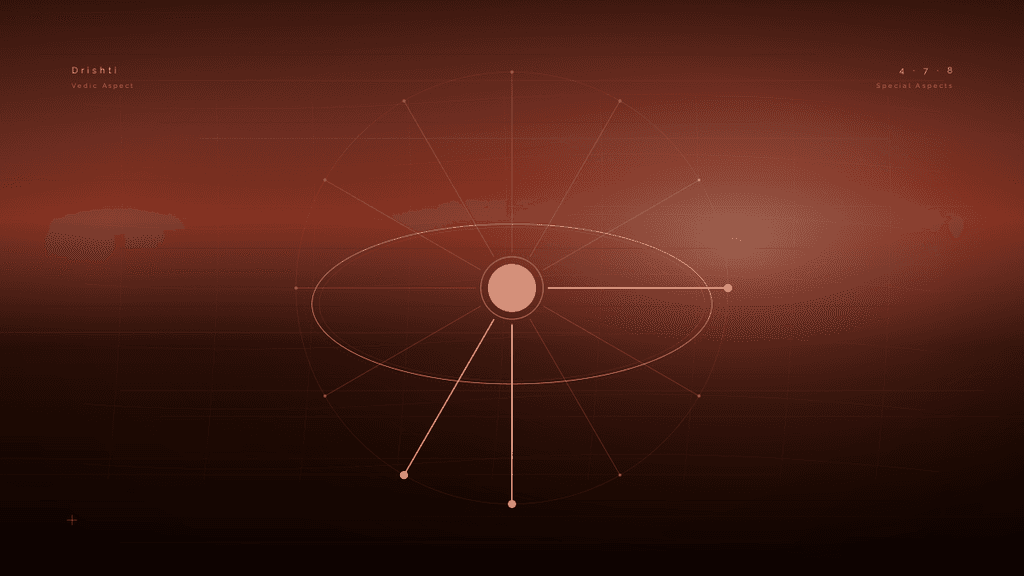
Ketu casts a default seventh-house drishti (aspect) like every graha (planet). The lagna comes under Ketu only when Ketu sits in the seventh house. Some lineages extend Ketu's special aspects to the fifth and ninth from itself; Tempora reads the default seventh as standard and the others as a secondary lineage-specific signature.
What drishti means and what Ketu is
Drishti (literally sight or aspect) is the Vedic technique that lets a graha (planet) act on a house or another graha it does not occupy. Every graha casts a default seventh-house aspect (a hundred and eighty degrees away from itself). Mars, Jupiter and Saturn cast additional special aspects beyond the seventh. The nodes (Rahu and Ketu) are treated differently by different lineages. The mainstream Parashari position is that Rahu and Ketu cast only the seventh-house aspect as default and pick up the fifth and ninth aspects under specific commentary lineages.
Ketu is the south node of the Moon. It is the geometric opposite of Rahu and sits exactly a hundred and eighty degrees away from Rahu at every moment. Ketu has no physical body; it is a mathematical point where the Moon's orbital plane crosses the ecliptic moving from north to south. The classical karaka (significator) list for Ketu covers moksha (liberation), severance, the discarded past, the headless body, the flag, sudden withdrawal, intuition without language, mathematical and philosophical insight and renunciation.
The ascendant or lagna is the rising sign at the moment of birth. It represents the body, the face, the outward personality, the way the native enters a room, the first impression they leave and the structural physical health. When a graha aspects the lagna, it places its signature on this entry layer of the chart. The native carries the aspecting graha's flavour in their visible self even when that graha sits elsewhere in the chart.
The aspect rule and which placements activate it
Ketu's default seventh-house drishti lands on the lagna only when Ketu sits in the seventh house from the ascendant. The seventh house is the partnership house, the house of the spouse, of open enemies and of the marketplace. Ketu in the seventh casts its aspect across the chart and onto the first house. The native carries Ketu's signature on their visible self and the partner sits inside that signature as well, which makes the seventh-from-seven placement consequential for both identity and marriage.
Under lineages that grant Ketu the fifth and ninth aspects (parallel to Rahu's expanded aspect set and parallel to Jupiter's special fifth and ninth), the lagna picks up an additional Ketu signature when Ketu sits in two more positions. Ketu in the ninth house from the ascendant casts a fifth-house aspect that lands on the lagna because the fifth counted from the ninth is the first. Ketu in the fifth house from the ascendant casts a ninth-house aspect that lands on the lagna because the ninth counted from the fifth is the first. These two placements are read as softer secondary signatures in lineages that accept them and as no signature at all in lineages that do not.
Tempora's reading reports the default seventh-house aspect as a primary structural signature and the fifth and ninth aspects as secondary lineage-specific signatures. The user can toggle whether the secondary signatures appear in the output. The default state shows the secondary signatures with a clear label so the native knows the reading is not coming from mainstream Parashari but from the commentary lineage that extends Ketu's aspects.
The structural reading: identity detachment
Ketu's drishti on the lagna pulls a thread of detachment through the native's self-presentation. The mechanism is consistent across the three placements that produce the aspect. The lagna represents how the native enters a room. Ketu is the karaka of severance and the discarded past. When Ketu aspects the lagna the native often reports that their visible self is not the real self. The body feels like a costume. The face that other people see does not match the inner self the native experiences from inside.
The lived effect is layered. Achievements that look impressive from outside feel hollow from inside. A promotion, a public recognition or a high-status invitation lands without the corresponding inner glow that other native report after similar events. The native may underclaim, undercharge or quietly disappear from situations where others would press their advantage. The standard ego-grip that lets a native protect their public image is loose or missing. Some native experience this as freedom; others experience it as a chronic sense that they are not properly inhabiting their own life.
The aspect also shapes the body. Ketu signatures tend to produce slim, wiry or unusually proportioned physiques. The face often carries something hard to read; observers find it difficult to tell what the native is feeling because the usual signals (small expressions of pride, small tells of insecurity) are dampened. The voice can be quiet or carry an unusual timbre. Hair patterns sometimes show Ketu signatures (early greying, patchy beard growth, unusual cowlicks). These body-level effects are stronger when Ketu occupies the first house directly; the aspect-only reading produces softer body-level effects and stronger inner-experience effects.
Ketu in the seventh: the partnership-and-self axis
The seventh-from-lagna placement is the strongest of the three aspect-producing positions because Ketu sits directly opposite the lagna and concentrates the full default drishti on the self-image axis. The native carries Ketu's signature on their visible self and meets partnership through the same signature.
The partnership reading is conventional. Ketu in the seventh is classically read as carrying delay or detachment in marriage, a partner who carries Ketu's signature (spiritual, withdrawn, philosophical, sometimes from a different cultural or religious background than the native) or an experience of partnership that does not fit the expected social template. The native may marry late, marry across cultural lines or experience a strong sense that the marriage is fulfilling a karmic obligation rather than a social expectation. Some native do not marry at all and report contentment with that choice.
The identity reading layered on top of the partnership reading is that the native's visible self is shaped by the experience of relationship. The native learns who they are partly by watching how partners respond to them. When Ketu's aspect dissolves the partner's grip (through delay, distance, withdrawal or unconventional dynamics), it also dissolves the feedback the native uses to construct their public identity. The result is a person whose self-image is constructed from internal material rather than from partner-mirroring, which is a structural advantage for solo creative work or research and a structural friction for vocations that require constant relational calibration.
Ketu in the ninth and fifth: the secondary readings
Under the lineage that grants Ketu the fifth and ninth aspects, the lagna picks up softer secondary signatures when Ketu sits in the ninth or the fifth house from the ascendant. These secondary readings are not accepted in all schools; Tempora reports them with a label and the user can decide whether to weight them.
Ketu in the ninth house casts a fifth-house aspect on the lagna under the extended-aspect lineage. The ninth house is the house of dharma, the father, the guru and long-distance travel; Ketu in the ninth is classically read as carrying detachment from the father, a non-conventional or sudden teacher and a religious or philosophical search that does not fit the family of origin. When this Ketu also aspects the lagna by the fifth aspect, the native's self-presentation carries a layer of the ninth-house material. The native reads as someone who is searching, someone whose visible identity is partly defined by their dharmic orientation and someone who other people register as having a teacher quality even if the native does not see themselves that way.
Ketu in the fifth house casts a ninth-house aspect on the lagna under the extended-aspect lineage. The fifth house is the house of intelligence, children, creativity and purva punya (the karmic credit carried from prior births). Ketu in the fifth is classically read as carrying spiritual intelligence, possible difficulty with children, sudden creative insights and an early sense of the unseen. When this Ketu also aspects the lagna by the ninth aspect, the native's self-presentation carries a layer of the fifth-house material. The native reads as someone with unusual perception, someone whose creativity surfaces in compressed bursts and someone whose intelligence is structured differently from the school-taught template.
When the aspect is supportive and when it is friction
The maleficence of a Ketu aspect on the lagna is contextual to what the native is trying to build. Vocations that benefit from low ego-grip, internal direction-finding and tolerance for ambiguity read the aspect as supportive. Research, mathematics, philosophy, religious or contemplative life, monastic vocations, occult practice, deep coding, theoretical physics and certain forms of independent creative work all benefit from the structural dissolution that Ketu provides at the lagna. The native who is trying to do this kind of work finds that the Ketu-on-lagna signature removes the social drag that other people experience and lets them sustain deep solo focus.
Vocations that depend on a sharp, well-defended public identity read the same aspect as friction. Sales, performance, politics, public-facing entrepreneurship, celebrity work, brand-building and any career path where the native's visible self is the primary asset will struggle against the dissolving signature. The native does not naturally project the confidence and ego-grip the work requires. They can build it through deliberate practice but they pay an ongoing cost that other native do not pay. Tempora's coverage of how individual graha aspects shape a chart's overall functioning is laid out in the methodology cluster including the reading on aspect strength by degree.
The other contextual factor is the lagna lord's placement. If the lagna lord sits in a strong house (kendra or trikona) and in a friendly sign, the native carries enough structural support to use the Ketu aspect well. If the lagna lord sits in a dusthana (sixth, eighth or twelfth house) or in a debilitated sign, the Ketu aspect compounds the existing weakness in the self-image axis and the native experiences the dissolution as friction rather than as freedom.
When the signature surfaces most strongly
The Ketu-on-lagna signature is structural and present throughout life but it surfaces in lived experience during specific timing windows. The strongest surfacing is during Ketu's mahadasha (the seven-year major period in the Vimshottari dasha system covered in Tempora's reading on the Vimshottari dasha calculator table). During Ketu mahadasha the native carries the aspect's flavour through their daily life and reports the most direct lived experience of identity detachment, public-self vs inner-self splitting and the characteristic Ketu cycles of withdrawal from situations that previously held the native's attention.
The second-strongest surfacing is during Ketu's antardasha (sub-period) within any other mahadasha. The antardashas of Ketu repeat across the Vimshottari cycle and produce shorter windows of the same identity-detachment experience. The third-strongest surfacing is during transits of Ketu over natal sensitive points (the lagna itself, the natal Moon, the lagna lord). These transits occur on an eighteen-year cycle because Ketu retrograde-transits the zodiac in roughly eighteen years.
The fourth surfacing window is during eclipses on the lagna axis or the seventh-house axis. Eclipses are Rahu-Ketu signatures by definition (an eclipse is the alignment of the Sun, Moon and one of the nodes). Eclipses falling on the natal lagna or the seventh-from-lagna sign carry strong identity-axis activation and the native who already has the Ketu aspect on the lagna experiences these eclipses as particularly consequential. Tempora's coverage of eclipse triggering and the broader timing of structural signatures is in eclipse axis in national charts.
How Tempora reads Ketu's aspect on the ascendant
Tempora's reading runs on the Swiss Ephemeris with the True Pushya Paksha ayanamsa by PVRN Rao. Ketu's position is computed as the geometric opposite of Rahu's mean node to arc-second precision; Rahu is computed using the mean-node formula by default and the user can toggle to true-node computation for finer placement near sign boundaries.
The computation flags Ketu's seventh-house aspect on the lagna as a default primary signature whenever Ketu sits in the seventh house from the ascendant. The fifth and ninth aspects from Ketu are flagged as secondary lineage-specific signatures whenever Ketu sits in the ninth or the fifth house. The reading reports the primary signature without qualification and reports the secondary signatures with a clear lineage label so the native knows whether the reading is coming from mainstream Parashari or from the extended-aspect commentary lineage.
The aspect is then evaluated against the lagna lord's placement, the natal Moon, any other graha sitting in the first house and the Ketu nakshatra (the sidereal mansion Ketu occupies). The reading also identifies the Vimshottari dasha periods when the Ketu-on-lagna signature is expected to surface most strongly. The output is a structural reading paired with timing windows so the native can correlate the abstract signature against lived experience. The reading is paired with Tempora's coverage of Rahu in the first house for native who carry both nodal signatures actively on the lagna axis.
The Ketu-on-lagna structural signature
Ketu casts a default seventh-house drishti on the ascendant when Ketu sits in the seventh house. Under extended-aspect lineages Ketu also casts a fifth-house aspect on the lagna when in the ninth and a ninth-house aspect on the lagna when in the fifth. The structural signature is identity detachment: the visible self feels separate from the inner self, achievements feel hollow from inside, the native underclaims and undercharges. The signature is supportive for research, contemplative or solo-creative vocations and friction for sales, performance or public-identity vocations. The signature surfaces most strongly during Ketu's mahadasha, during Ketu antardashas, during Ketu transits over natal sensitive points and during eclipses on the lagna axis.
What the framework does not predict
The Ketu-aspect-on-lagna reading is structural and is silent on three fronts. It does not predict the native's specific vocation. The reading tells you that the signature supports certain vocations and frustrates others; it does not tell you which vocation within the supported set the native will choose. That information comes from the tenth house, the tenth lord, the Atmakaraka (the soul-significator from the Jaimini system) and the lived choices the native has already made.
It does not predict the native's relationship outcomes in isolation. The seventh-house Ketu placement carries relationship implications but those implications interact with the rest of the seventh-house reading (the seventh lord, the navamsa seventh, Venus or Jupiter for the karaka layer). Tempora's coverage of the full seventh-house reading is in the cluster on seventh-lord matching and related techniques.
It does not constitute medical, financial, legal or professional advice. The reading is descriptive of conventional Vedic structural signatures and is paired with timing windows for lived-experience surfacing. The native's life choices, professional decisions and personal relationships should be made on the basis of competent professional advice from the relevant domains, not on the basis of an astrological reading.
Conclusion
Ketu's drishti on the ascendant places a dissolving signature on the native's self-presentation and self-image. The default seventh-house aspect activates when Ketu sits in the seventh house from the lagna. Under extended-aspect lineages the fifth and ninth aspects activate when Ketu sits in the ninth or the fifth. The structural reading is identity detachment: visible self separate from inner self, achievements hollow from inside, underclaiming, quiet withdrawal from situations where others would press. The aspect is supportive for vocations that benefit from low ego-grip and friction for vocations that depend on a sharp public identity. The lagna lord's placement and the rest of the first-house reading determine whether the dissolution lands as freedom or as friction. The signature surfaces most strongly during Ketu's mahadasha, during Ketu antardashas in other mahadashas, during Ketu transits and during eclipses on the lagna axis. The Tempora reading computes the aspect on the Swiss Ephemeris with the True Pushya Paksha ayanamsa and reports the default and lineage-specific signatures separately so the native can apply the reading according to their preferred school.
Transit Ketu and the lagna, 2026 to 2028
The natal aspect this piece maps is fixed at birth, and the transit version runs on a dated timetable. Ketu occupies Leo until 27 December 2026, then Cancer until 15 July 2028. A Leo-rising chart therefore carries transit Ketu over the lagna sign itself through late 2026, and a Cancer-rising chart carries the same weather from 27 December 2026. The conjunction case is the strongest transit form of the dissolving signature: the sign of self-presentation hosts the detachment point for the length of the stay.
The aspect routes follow the whole-sign map. By the default seventh-house drishti, Ketu in Leo glances the lagna of Aquarius rising, and Ketu in Cancer glances the lagna of Capricorn rising. Under the fifth and ninth convention the corpus follows for the nodes, Ketu in Leo also reaches Sagittarius and Aries, and Ketu in Cancer reaches Scorpio and Pisces. A Pisces-rising chart in the second chapter carries a doubled weight: transit Saturn occupies Pisces until 23 May 2027 and returns during its retreat from 4 November 2027 to 11 February 2028, so the lagna holds Saturn's gravity while receiving Ketu's glance.
The timing section above lists eclipses on the lagna axis among the strongest surfacing windows, and this window carries a dated one: the solar eclipse of 12 August 2026 falls on the Cancer-Leo cusp, the exact boundary Ketu crosses that December. For Leo and Cancer lagnas the eclipse and the nodal chapter change bracket the same six months, which is as concentrated as this axis gets in the current calendar. Rahu mirrors every step from the opposite sign, Aquarius then Capricorn, so the partnership house of the affected lagnas carries the amplification pole at the same time; the Rahu aspect on natal planets note maps that side.
The limits hold. Transit Ketu over or onto a lagna is dated weather; the standing identity-detachment signature belongs to the natal placement alone. The maps here are sign-level and person-independent, while a lagna is degree-specific and changes roughly every two hours of birth time, so the reading only lands against a computed chart. No graded call on a nodal-lagna population sits on Tempora's scoreboard, and the windows above are computable while any calibrated lift stays open.
Frequently asked questions
Does Ketu aspect the ascendant?
Ketu casts a default seventh-house drishti (aspect) like every graha (planet). The ascendant comes under Ketu's aspect only when Ketu sits in the seventh house from the lagna. Some classical lineages extend Ketu's special aspects to the fifth and ninth houses from itself in the same way Rahu does, which would place an additional aspect on the lagna when Ketu sits in the ninth (fifth aspect on lagna) or the fifth (ninth aspect on lagna). Tempora reads the default seventh aspect as standard and the fifth and ninth aspects as a lineage-specific reading that is applied as a softer secondary signature.
What does Ketu's drishti on the lagna do to identity?
Ketu's drishti on the ascendant pulls a thread of detachment through the native's self-presentation. The lagna represents how the person enters a room and how their body and personality first land in the world. Ketu is the karaka (significator) of moksha, severance and the discarded past. When Ketu aspects the lagna the native often reports a sense that their visible self is not the real self. The body feels like a costume. Achievements that look impressive from outside feel hollow from inside. The native may underclaim, undercharge or quietly disappear from situations where others would press their advantage.
Is Ketu aspecting the lagna malefic?
Ketu is classed as a natural malefic but its mode is different from Mars or Saturn. Mars cuts. Saturn restricts. Ketu dissolves. A Ketu aspect on the lagna is not actively harmful in the way a Mars aspect would be. It is dissolving in the sense that it removes the native's grip on a stable self-image. For native who are pursuing a spiritual or research-oriented life, this dissolution is read as a structural gift. For native who depend on a sharp public identity (sales, performance, politics) the same signature is read as a structural friction. The maleficence is contextual to what the native is trying to build.
Which house placement of Ketu casts the aspect on the ascendant?
Three placements can cast Ketu's drishti on the lagna depending on which aspect set is used. Ketu in the seventh house casts the default seventh-house aspect on the lagna under any system. Ketu in the ninth house casts a fifth-house aspect on the lagna under lineages that grant the nodes the fifth and ninth aspects. Ketu in the fifth house casts a ninth-house aspect on the lagna under the same lineage convention. The seventh-from-seven placement is the strongest of the three because it sits opposite the lagna and concentrates the full drishti onto the self-image axis.
What is the difference between Ketu in the first house and Ketu aspecting the first house?
Ketu in the first house occupies the lagna directly. The native carries Ketu's signature inside their body and outward presentation: a slim or unusual physique, a quiet manner, a face that does not register as easy to read and often a feeling of being other or out of place. Ketu aspecting the first house from the seventh, the fifth or the ninth places the dissolution at one remove. The body and face do not carry Ketu's mark visibly but the native experiences a cyclical sense of disappearing from their own life. The first-house placement is constant. The aspect-only reading is more episodic and surfaces during Ketu's dasha (planetary period) and during transits triggering the natal aspect.
Does Ketu on the ascendant indicate past-life karma?
Classical texts read Ketu as the karaka of past-life residue. Ketu on or aspecting the ascendant is conventionally read as the native carrying a strong past-life imprint that shows up as an early sense of having been here before, a comfort with religious or philosophical material that the native did not formally study or a feeling of finishing something they did not start. This is teaching-layer content rather than a verifiable claim. Tempora reports the conventional reading without endorsing or refuting the metaphysical framing. The structural reading (identity detachment, low ego-grip) holds whether the past-life framing is accepted or not.
How does Tempora read Ketu's aspect on the ascendant?
Tempora's reading runs on the Swiss Ephemeris with the True Pushya Paksha ayanamsa by PVRN Rao. The Ketu position is computed as the geometric opposite of Rahu's mean node to arc-second precision. The system flags Ketu's seventh-house aspect on the lagna as a default structural signature and the fifth and ninth aspects from Ketu as lineage-specific secondary signatures. The aspect is then evaluated against the lagna lord's placement, the natal Moon and any other graha sitting in the first house. The output is a structural reading paired with the dasha periods when the Ketu-on-lagna signature is expected to surface most strongly in the native's lived experience.
When does transit Ketu cross or aspect the ascendant between 2026 and 2028?
Ketu occupies Leo until 27 December 2026 and Cancer from that date until 15 July 2028, so Leo-rising and then Cancer-rising charts carry the transit conjunction over the lagna sign. By the default seventh drishti the glance reaches Aquarius rising in the first chapter and Capricorn rising in the second. Under the fifth and ninth convention the corpus follows for nodes, Ketu in Leo also reaches Sagittarius and Aries lagnas, and Ketu in Cancer reaches Scorpio and Pisces lagnas, with Pisces simultaneously holding transit Saturn until 23 May 2027. The solar eclipse of 12 August 2026 lands on the Cancer-Leo cusp, the boundary Ketu crosses that December. These are dated weather windows; the standing detachment signature belongs to the natal placement, and the exact lagna needs a computed chart because the rising sign changes about every two hours.
Read next
This article was first published on 05 June 2026. It documents conventional Vedic teaching on Ketu's aspect on the ascendant including the default seventh-house drishti and the lineage-specific fifth and ninth aspects. Internal audit log maintained for methodology revisions; any subsequent material change to the framework above will be appended here with a dated note. This article represents conventional Vedic teaching and Tempora Research method documentation. It does not constitute medical, financial, legal or professional advice.