Rahu in the 1st House: The Boundary-Crossing Self
Rahu in the 1st house places the lunar north node on the body and self register. The chart owner often presents as unconventional, ambitious, hungry for distinction or carrying a foreign-influence signature on the identity. The reading is structural. The texture depends on the dispositor of Rahu, the running mahadasha and the planets aspecting the lagna.
What Rahu in the 1st house encodes
The 1st house, called Tanu Bhava in Sanskrit (the body house), is the seat of the body, the physical constitution, the temperament, the personality and the life direction. The classical karaka or significator is the Sun, which signifies vitality and soul. When Rahu (the lunar north node, a shadow point on the chart where the lunar orbit crosses the ecliptic) occupies this house, the body and self register receives a sustained amplification across the life. The signature operates as a low-grade hum until activated by dasha or transit, at which point the unconventional-self-formation theme surfaces in concrete events.
The classical literature treats Rahu in the 1st as a position of strong worldly orientation. The chart owner often presents as physically distinctive, magnetic or hard to place on first impression. The body itself often carries a non-conventional register; this can mean unusual height or build, unconventional features or simply a presentation that does not slot into the cultural defaults of the chart owner's birth context. The personality reads as ambitious, restless, hungry for distinction and willing to break form to achieve it.
The deeper layer is identity formation. Rahu's nature is to want what it does not have and to construct identity around that wanting. With Rahu in the 1st, the chart owner often arrives at identity through experimentation, foreign exposure or rejection of inherited templates rather than through direct continuity with the family or cultural origin. This is the structural source of the foreign-residency signature; Rahu in the 1st often moves the body to a different geography in order to construct a self that the origin geography cannot hold.
The dispositor of Rahu sets the texture
Rahu does not rule any sign in classical Parashari Vedic astrology. The reading of Rahu in any house runs through its dispositor, the planet that rules the sign Rahu occupies. With Rahu in the 1st, the dispositor is the lagna lord. The lagna lord's house placement, sign dignity and conjunctions set the texture of how Rahu in the 1st operates.
A lagna lord in its own sign, exalted or in a kendra (angular) house produces durable amplification. The chart owner channels the Rahu signature into productive identity-construction; foreign-residency arcs, when they fire, integrate into a coherent life arc rather than fragmenting it. A lagna lord in dusthana (the 6th, 8th or 12th, the difficult houses), debilitated or combust produces unstable identity formation. The amplification runs ahead of the structural support and the chart owner can read as overreaching, status-driven or restless.
The aspect pattern on Rahu also matters. Jupiter aspecting Rahu in the 1st reads as guru-aspecting-rahu, the classical mitigation pattern, where Jupiter's wisdom register supports the unconventional self-formation and tempers the worldly hunger. Saturn aspecting Rahu in the 1st produces a heavier reading: structural pressure on identity, late-developing self-recognition and a long arc to integration. Mars aspecting Rahu in the 1st adds force; the chart owner reads as physically assertive and willing to fight for distinction.
Foreign-residency arcs
The most documented event class for Rahu in the 1st is the foreign-residency arc. The 1st house is the body. Rahu's nature is to seek what is not nearby. The combination produces a structural pull to relocate the body across a cultural or geographic boundary. The arc can manifest as study abroad, work-based relocation, marriage migration or long-stay travel that converts into residence.
The timing of foreign-residency arcs follows the standard rule. The dasha must activate a planet that supports the move, typically Rahu itself, the lagna lord, the 9th lord (long-distance journeys, foreign lands) or the 12th lord (residence in foreign places). The transit must confirm; Jupiter or Saturn moving over the natal Rahu, the lagna or the 9th or 12th house from the lagna gives the structural ratification. Without the transit, dasha activation produces intent or possibility without crystallisation; with both, the move tends to manifest within a window of several months.
Charts where the dispositor of Rahu sits in the 9th or 12th house carry the highest probability of foreign-residency arcs. Charts where the 4th house (the home, the foundation) is heavily afflicted but Rahu in the 1st is supported also tend to relocate; the structural pull away from origin combined with the structural support for cross-border identity produces the move.
Significant amplification events
Beyond geography, Rahu in the 1st produces a class of events that the conventional reading calls amplification events. These are moments where the body and self register receives a sudden, disproportionate expansion: public recognition, viral attention, abrupt status changes, encounters with people of significantly different scale than the chart owner's prior context. The events are often unexpected by the chart owner; the conventional reading is that Rahu engineers exposure rather than the chart owner seeking it.
Amplification events cluster around eclipse points. The Rahu-Ketu axis is always 180 degrees apart and the solar and lunar eclipses each year occur on this axis. When the eclipse axis activates the natal Rahu in the 1st (typically when transit Rahu or Ketu touches the natal Rahu position or aspects it), the amplification register fires. This is the structural source of the conventional teaching that eclipses near the natal Rahu position are watershed moments for chart owners with Rahu prominent on the chart.
The Tempora reading of these events tracks the Rahu 18.6-year orbital cycle (the time Rahu takes to complete one circuit of the zodiac) and the transit overlay against the natal placement. The full mechanism is documented in the Rahu Mahadasha overview. Amplification events do not require the Rahu mahadasha to fire; they can occur in any mahadasha when the transit alignment is right. Rahu mahadasha simply concentrates the event density.
Identity-axis confusion as a risk profile
The structural risk of Rahu in the 1st is identity-axis confusion. The chart owner can read the Rahu amplification as the self and lose track of which parts of the identity are constructed and which are inherent. The pattern manifests three ways. First, image management can overtake substance; the chart owner becomes attached to how they are perceived and loses access to their own inner reading. Second, the foreign-residency arc can produce displacement rather than integration; the chart owner moves across cultures without rooting in either. Third, ambition for distinction can drive action that does not match the chart owner's actual capacities; overreach produces predictable correction.
The mitigation in classical reading is Jupiter aspect, a strong lagna lord and Ketu in the 7th in good condition. Ketu in the 7th (which is automatic when Rahu is in the 1st, since the nodes are always 180 degrees apart) provides the spiritual counterweight; the partnership house holds the detachment register and pulls the chart owner toward integration rather than performance. The condition of Ketu in the 7th and the dispositor of Ketu modulate how strongly this counterweight operates.
For chart owners with Rahu in the 1st experiencing identity-axis confusion, the standard reading is that the Saturn return at age 28 to 30 and the second Saturn return at age 58 to 60 are the structural resolution points. Saturn's pressure on the system forces integration; the parts of the identity that were constructed without ground tend to crumble during these windows and the parts that have structural support tend to consolidate.
Per-ascendant variation
The universal Rahu signature is amplified self-formation, but the texture changes with the lagna sign because the dispositor of Rahu changes. The following reading walks the 12 ascendants briefly; each carries a different practical texture.
| Ascendant | Rahu in 1st sign | Dispositor | Texture |
|---|---|---|---|
| Aries | Aries | Mars | Direct, action-coded, physical amplification. Athletic or martial identity register. Mars dispositor in own sign or exalted produces durable signature. |
| Taurus | Taurus | Venus | Aesthetic, luxury and partnership-coded amplification. The body reads as attractive or stylistically distinctive. Venus dispositor strength matters. |
| Gemini | Gemini | Mercury | Communication, media and intellectual register dominate. Often produces public-facing media or writing identity. |
| Cancer | Cancer | Moon | Emotional and home-rooted amplification. The body reads as fluid; foreign-residency arcs are particularly strong here. |
| Leo | Leo | Sun | Authority, recognition and command-comfortable amplification. Strong leadership identity. Sun dispositor in kendra produces durable signature. |
| Virgo | Virgo | Mercury | Analytical, service-oriented amplification. The chart owner reads as intellectually distinctive and detail-coded. |
| Libra | Libra | Venus | Partnership and aesthetic amplification. Identity often constructed through partnership or design register. |
| Scorpio | Scorpio | Mars | Intense, occult or research-coded amplification. The chart owner reads as magnetic and hard to read. The classical tradition treats Rahu in Scorpio with caution. |
| Sagittarius | Sagittarius | Jupiter | Philosophical, teaching or long-distance amplification. Strong dispositor (Jupiter) produces wisdom-coded signature. |
| Capricorn | Capricorn | Saturn | Institutional, career-coded amplification. The chart owner reads as ambitious and structurally serious. |
| Aquarius | Aquarius | Saturn | Unconventional, technology or community-coded amplification. Aquarius is sometimes assigned Rahu co-rulership; the signature reads as native. |
| Pisces | Pisces | Jupiter | Spiritual, dissolving or boundary-crossing amplification. Foreign-residency arcs strong; identity often artistic or devotional. |
The texture above is the starting reading. The dispositor's actual house placement, sign dignity and conjunctions refine it further. A Cancer ascendant with Rahu in the 1st and the Moon in the 9th in own sign reads very differently from the same combination with the Moon in the 6th and debilitated.
This placement in the 2026 to 2028 sky
A natal Rahu in the 1st is the standing condition; a slow transit crossing the lagna sign is what brings the body and self register forward on a datable calendar. Three ascendants carry a direct contact in this cycle. For an Aquarius ascendant the 1st house is Aquarius, where transiting Rahu itself sits from 9 June 2025 to 27 December 2026, so the north node returns over its own natal position and the identity theme reads at full volume through late 2026. For a Leo ascendant the 1st house is Leo, which transiting Ketu occupies across the same window to 27 December 2026 and which the solar eclipse of 12 August 2026 marks on the Cancer to Leo cusp, placing the south node and an eclipse point on the natal Rahu. For a Capricorn ascendant the 1st house is Capricorn, where Rahu moves next from 27 December 2026 to 15 July 2028, opening the same self-register activation in the second chapter of the transit. Each of these is a dated window when the theme surfaces; the transit times the activation and does not fix what the chart owner does inside it, since the natal placement is the standing condition and the passing body is only the trigger. Rahu itself takes about eighteen months to cross a sign and comes back to the sign of a natal Rahu about every eighteen years, so the node's own return is the cleanest same-planet contact for this placement, and for the Aquarius and Capricorn ascendants above that return is unfolding in the present sky rather than at a distant point.
Connection to Rahu Mahadasha
Rahu in the 1st natal house receives its most intense activation during the 18-year Rahu Mahadasha because the dasha lord then activates its own placement. The cumulative reading is that the entire 18 years operates on the body and self register. Identity rebuilds. The public profile reshapes. Foreign-residency arcs, if they have not already fired, are most likely to fire in this window. The unconventional signature surfaces in worldly form rather than remaining latent.
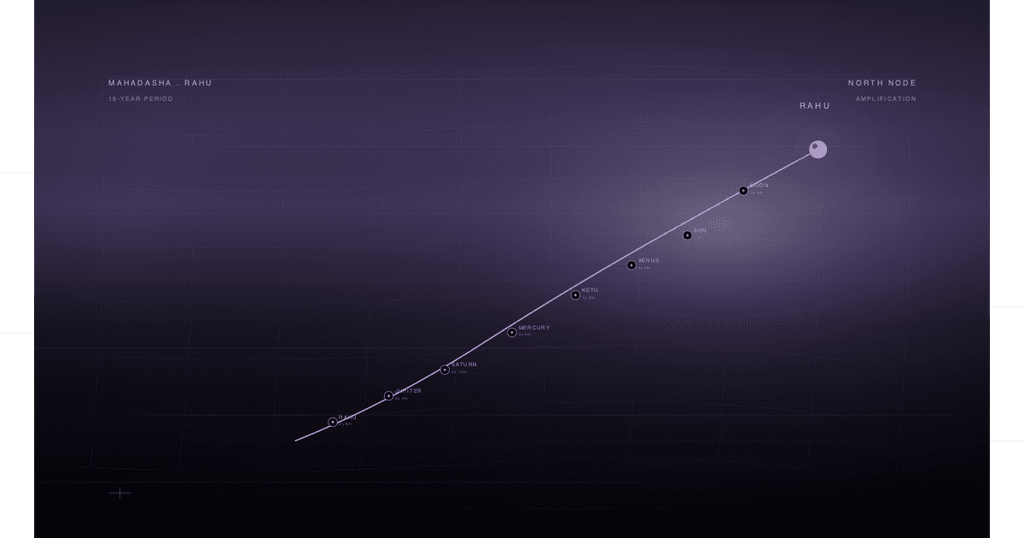
The sub-periods carry distinct textures. Rahu-Rahu, the opening sub-period of 2 years 8 months 12 days, is the strongest single activation window; the pure Rahu tone hits the body and self register without any other planetary modifier. Rahu-Jupiter, the second sub-period, often delivers the most positive amplification because Jupiter's wisdom register tempers Rahu's hunger. Rahu-Saturn, the third sub-period, is the longest and the heaviest; structural pressure on identity tests the constructions of the prior windows. The full sub-period sequence is documented in the Rahu Mahadasha overview with the per-ascendant readings in the rahu-mahadasha-by-ascendant series.
Chart owners with Rahu in the 1st entering Rahu Mahadasha at any age should expect the 18 years to be defining. The standard reading is that this window does not pass without reshaping the chart owner's self-presentation in a way that is visible to their original cohort. Mid-mahadasha, around years 8 to 11, tends to deliver the structurally heaviest events.
How to read your own chart
The reading procedure for Rahu in the 1st in your chart runs in four layers.
- Confirm the placement. Generate the natal chart using the Lahiri or Pushya Paksha ayanamsa. The 1st house begins at the lagna degree. Confirm Rahu sits within the 1st bhava boundaries. A 4-minute birth-time error shifts the lagna by roughly 1 degree; a 60-minute error can move Rahu out of the 1st bhava entirely. Birth-time accuracy is the prerequisite.
- Identify the dispositor. The dispositor is the planet ruling the sign on the lagna (which is also the sign Rahu occupies, since both share the 1st house). Note the dispositor's house placement, sign dignity (exalted, own-sign, neutral, debilitated), conjunctions and Ashtakavarga score at that sign.
- Identify aspects on Rahu in the 1st. Jupiter, Saturn and Mars all cast non-standard aspects beyond the 7th. Rahu itself aspects the 5th, 7th and 9th from its position. The aspect pattern adds the aspecting planets' registers to the Rahu in the 1st reading.
- Identify the running mahadasha and the upcoming transits of Jupiter and Saturn. The dasha sets the activation window; the transit sets the event timing. The Tempora Rahu-ruled nakshatras piece covers the specific transit signatures most likely to fire amplification events.
If you want this reading computed against your own chart with the dasha-transit overlay and three dated moments from your past as the calibration check, the Tempora Kaal Imprint at the bottom of this page returns it in roughly twelve seconds.
What the framework does not predict
The Rahu in the 1st reading is structural. It does not predict specific dates of foreign-residency moves, the country of relocation or the precise public-facing identity the chart owner will construct. It predicts the structural conditions under which these events become likely and the windows of activation. The texture is probabilistic; chart owners with similar Rahu in the 1st configurations produce statistically clustered but individually distinct life arcs.
The framework also does not equate Rahu in the 1st with bad outcomes. The classical literature treats this placement as structurally significant rather than inherently afflicting. A well-supported Rahu in the 1st with a strong dispositor and Jupiter aspect produces some of the most distinctive and worldly successful chart owners on record.
Frequently asked questions
What does Rahu in the 1st house mean in Vedic astrology?
Rahu in the 1st house (Tanu Bhava) places the lunar north node on the body and self register. The chart owner often presents as unconventional, ambitious, hungry for distinction or carrying a foreign-influence signature on their identity. Rahu in the 1st amplifies the lagna sign, distorts the conventional reading of the ascendant and introduces a boundary-crossing tone to how the chart presents in the world. The classical reading combines this with the dispositor of Rahu (the planet ruling the lagna sign), the planets aspecting Rahu and the running Vimshottari mahadasha.
Is Rahu in the 1st house good or bad?
Rahu in the 1st house is neither inherently good nor bad. It is a structural amplifier on the body and self register. The reading depends on three factors: the sign Rahu occupies (dignity ranking from exalted in Taurus or Gemini to debilitated in Scorpio or Sagittarius in classical disagreement), the dispositor of Rahu (a strong dispositor produces durable amplification; a weak dispositor produces unstable identity formation) and the running dasha. A well-supported Rahu in the 1st produces foreign-residency arcs, unconventional public profiles and strong worldly success. A poorly supported Rahu in the 1st produces identity confusion, restlessness and status-driven action without ground.
Does Rahu in the 1st house cause foreign residence?
Foreign-residency arcs are a documented signature of Rahu in the 1st, particularly when the dispositor of Rahu sits in the 9th or 12th house and the running mahadasha activates Rahu or its dispositor. The 1st house is the body and self register; Rahu in the 1st often manifests as physical relocation, cross-border identity formation, study or work abroad or partnership with a foreign-origin partner who shapes the self. The signature is probabilistic, not deterministic. Charts where the dispositor sits in dusthana houses or where the 4th house is afflicted carry a higher likelihood of foreign-residency arcs.
How does Rahu in the 1st house vary by ascendant?
The per-ascendant overlay depends on which sign Rahu occupies and which house the dispositor of that sign rules. For Aries ascendant Rahu in the 1st sits in Aries with Mars as dispositor: the amplification is direct, action-coded and physical. For Taurus ascendant Rahu in the 1st sits in Taurus with Venus as dispositor: the amplification reads through luxury, aesthetic and partnership axes. For Gemini ascendant Rahu in the 1st sits in Gemini with Mercury as dispositor: communication, media and intellectual register dominate. The pattern continues for each ascendant; the universal Rahu signature is amplified self-formation but the texture changes with the dispositor.
What is the connection between Rahu in the 1st house and Rahu Mahadasha?
Rahu in the 1st natal house produces its most intense activation during the 18-year Rahu Mahadasha because the dasha lord then activates its own placement. The cumulative reading is that the entire 18-year period operates on the body and self register: identity rebuilds, the public profile reshapes, foreign-residency arcs are most likely to fire and the unconventional signature surfaces in worldly form. The Rahu-Rahu sub-period at the start of the dasha is the strongest activation window. The Tempora rahu-mahadasha overview article documents the full 18-year sequence.
How do I read my own chart for Rahu in the 1st house?
Use a four-layer read. Layer one: locate Rahu and confirm it sits in the 1st bhava (which depends on accurate birth time, since the lagna degree shifts roughly 1 degree per 4 minutes). Layer two: identify the dispositor of Rahu (the planet ruling the lagna sign) and note its house, sign dignity and conjunctions. Layer three: identify planets aspecting Rahu in the 1st (Mars, Jupiter and Saturn cast non-standard aspects; Rahu itself aspects the 5th, 7th and 9th from itself). Layer four: identify the running mahadasha and ask whether the dasha lord activates Rahu, the lagna lord or the houses Rahu aspects. The combined reading gives the texture of the Rahu in the 1st signature for that chart.
When is a natal Rahu in the 1st house activated in 2026 to 2028?
The natal placement is standing; a slow transit over the lagna sign dates its activation. An Aquarius ascendant carries the 1st house in Aquarius, where transiting Rahu returns over its own position from 9 June 2025 to 27 December 2026. A Leo ascendant carries it in Leo, held by transiting Ketu to 27 December 2026 and marked by the 12 August 2026 solar eclipse on the Cancer to Leo cusp. A Capricorn ascendant carries it in Capricorn, where Rahu transits from 27 December 2026 to 15 July 2028. Rahu spends about eighteen months in each sign and returns to a natal sign about every eighteen years, so its own return is the direct trigger; every such window dates when the identity theme comes forward and does not determine the outcome.
Read next
This article documents the conventional Vedic reading of Rahu in the 1st house using the Tempora structural framework. Calibration runs on the Swiss Ephemeris with True Pushya Paksha ayanamsa by PVRN Rao. Internal audit log maintained. This article represents conventional Vedic teaching and Tempora Research method documentation; it does not constitute medical, financial, legal or professional advice. First published 2026-06-05 by Tempora Research.