Rahu in the 2nd House: Foreign Wealth and Family Amplification
Rahu in the 2nd house places the lunar north node on the wealth, family and speech register. The chart owner often acquires wealth through foreign or unconventional channels. The family of origin frequently carries a cross-cultural element. Speech shows code-switching or multilingual signatures. The texture depends on the dispositor of Rahu and the running dasha.
What Rahu in the 2nd house encodes
The 2nd house, called Dhana Bhava in Sanskrit (the wealth house), is the seat of accumulated resources, the family of origin, the early conditioning around money, the kutumba (extended family lineage), the face and the speech apparatus. The classical karaka for the 2nd is Jupiter, which signifies wealth, family and the teaching register. When Rahu occupies this house, the wealth and family register receives the standard Rahu amplification: foreign sources, unconventional channels, magnified scale and a hunger that drives the chart owner to accumulate beyond what the family origin would predict.
The classical literature treats the 2nd house as a maraka (literally "killer") house in longevity analysis, which adds caution to any Rahu placement here. The maraka classification is a structural feature, not a verdict on the chart owner. It signals that the 2nd house carries the capacity to deliver both wealth accumulation and the eventual depletion of that wealth, depending on which planetary periods activate it and which planets aspect it. Rahu in the 2nd amplifies both registers; the chart owner often experiences both significant accumulation and significant volatility around resources.
The deeper layer is family pattern. The 2nd house is where the chart owner is conditioned in early life around money, family identity and resource flow. Rahu in the 2nd typically means the family register itself carries a foreign-axis signature: at least one parent or grandparent born in a different region or country, a family business that operates across borders, a household with multiple languages or a family event (migration, marriage across cultures, business expansion abroad) that has shaped the kutumba lineage. The chart owner inherits this foreign-axis structure even when they do not consciously identify with it.
Foreign-business wealth as the primary signature
The most documented wealth signature for Rahu in the 2nd is foreign-business wealth. The chart owner typically does not accumulate primary wealth through the same channels as their immediate family or cultural cohort. Instead, the wealth source carries a foreign or unconventional marker: cross-border trade, foreign clients, work for a multinational, export businesses, technology platforms with global reach, currency or commodity trading, foreign real estate or media businesses that operate across cultural boundaries.
The mechanism is structural. The 2nd house is the wealth house. Rahu's nature is to seek what is not nearby and to amplify whatever it touches. The combination produces a structural pull to source wealth from outside the chart owner's immediate context. The cleanest expression is the chart owner who builds a business with foreign clients, ships abroad, partners with foreign-origin collaborators or accumulates wealth in a foreign currency. The signature does not require physical relocation; it requires that the wealth itself carry a foreign-axis component.
The timing of foreign-business wealth follows the dasha-transit rule. The dasha must activate Rahu, the 2nd lord or the natal Jupiter. The transit must confirm; Jupiter moving over the natal Rahu or the 2nd house or Saturn moving over the 11th house (the house of gains) tends to deliver the most concrete wealth events. Chart owners with Rahu in the 2nd often see their primary wealth accumulation in their Rahu Mahadasha or in the antardashas of the dispositor of Rahu inside other mahadashas.
The family-line foreign axis
The 2nd house carries the kutumba (the extended family lineage in Sanskrit). Rahu in the 2nd places a foreign-axis signature on this lineage. The pattern manifests in three layers, often in combination.
The first layer is parental origin. One parent or a grandparent on either side, is often born in a region or country different from the chart owner's immediate cultural context. This can mean inter-state or inter-regional marriage within a single country, cross-national marriage or migration in a prior generation that has shaped the family identity. The chart owner inherits the resulting multi-axis family register as the default condition.
The second layer is family business. Where the family has a business or professional tradition, Rahu in the 2nd often shows the business operating across borders or in non-traditional sectors. This can mean import-export trade, hospitality serving foreign clients, professional services to multinationals or the family's professional identity centred on a non-traditional field for their cohort.
The third layer is family event. The family history often contains a defining event involving relocation, cross-cultural marriage, asset distribution across borders or significant cultural integration. These events shape the chart owner's inherited resource base and identity register. The Tempora second house piece covers the broader 2nd house reading framework that the Rahu placement modifies.
Speech with code-switching and multilingual register
The 2nd house is the seat of vak (speech in Sanskrit). The classical literature treats speech as one of the primary signifiers of the 2nd because the wealth house holds both the resources and the means by which the chart owner deploys them. Rahu in the 2nd produces a distinctive speech register.
The most common signature is multilingualism or code-switching. Chart owners with Rahu in the 2nd often grow up with multiple languages, develop a third or fourth language in adolescence or move fluently between registers (formal, technical, regional, casual) in their primary language. The speech itself often carries an accent or pattern that does not match the cultural default of their immediate context. This is not random; it is the structural Rahu amplification on the vak register expressing through linguistic identity.
The second signature is the speech-related profession. A significant proportion of chart owners with Rahu in the 2nd find professional traction in fields where speech is the primary instrument: broadcasting, voice work, translation, language teaching, public speaking, writing, journalism, podcasting or sales. The amplification on the vak register, combined with the unconventional sourcing register, produces practical capacity to deploy speech for resource accumulation.
The risk profile, when Rahu in the 2nd receives malefic aspect from Mars, Saturn or a debilitated Sun, includes speech-related friction. This can manifest as a childhood stammer that resolves through deliberate work, a defensive or evasive speech pattern, controversial public speech that produces external pushback or speech that does not match internal intention. The conventional reading is that this register can be worked on; the structural signature is not a fixed verdict.
Unconventional-inheritance arcs
The 2nd house carries the inheritance register at the structural level. The 8th house (the opposite of the 2nd) carries inheritance through transformation and other-people's-resources; the 2nd carries the direct accumulated family resource that flows to the chart owner. Rahu in the 2nd produces unconventional-inheritance arcs.
The pattern is that the chart owner often receives resources from family routes that do not match the cultural default. This can mean inheritance from a relative outside the immediate family (an uncle, a step-parent, a family friend treated as family), inheritance from a foreign-origin family branch, inheritance in non-traditional asset classes (foreign property, business stakes, intellectual property) or inheritance with conditions or complications that distinguish it from a clean transfer. The signature does not predict the size of the inheritance; it predicts the foreign-axis or unconventional shape of the transfer.
The timing of inheritance events follows the standard rule. The dasha must activate Rahu, the 2nd lord, the 8th lord or the natal Jupiter. The transit must confirm. Inheritance events for chart owners with Rahu in the 2nd often cluster in the Rahu Mahadasha or in the Rahu antardasha inside other mahadashas. The Saturn-Rahu transit configurations also tend to deliver these events when Rahu is well-supported on the natal chart.
Per-ascendant variation
The texture of Rahu in the 2nd changes with the lagna sign because Rahu occupies a different zodiacal sign and the dispositor changes. The following table walks the twelve ascendants briefly.
| Ascendant | Rahu in 2nd sign | Dispositor | Wealth channel texture |
|---|---|---|---|
| Aries | Taurus | Venus | Aesthetic, luxury and partnership-coded wealth. Often through arts, design, fashion or hospitality. Venus dispositor strength matters. |
| Taurus | Gemini | Mercury | Communication, media, commerce-coded wealth. Often through trading, publishing, multilingual business. |
| Gemini | Cancer | Moon | Real-estate, food, hospitality-coded wealth with strong foreign-axis. Often through property abroad or hospitality chains. |
| Cancer | Leo | Sun | Leadership-coded wealth. Often through public profile, political connection or entertainment industry. |
| Leo | Virgo | Mercury | Service, analytical, detail-coded wealth. Often through consulting, healthcare or technical services. |
| Virgo | Libra | Venus | Partnership, design, mediation-coded wealth. Often through joint ventures or aesthetic professions. |
| Libra | Scorpio | Mars | Research, occult, intensive-coded wealth. Often through investigation, surgery, mining or transformative industries. |
| Scorpio | Sagittarius | Jupiter | Teaching, philosophical, long-distance-coded wealth. Often through publishing, academia or international advisory. |
| Sagittarius | Capricorn | Saturn | Institutional, structural-coded wealth. Often through long-arc business, infrastructure or government contracts. |
| Capricorn | Aquarius | Saturn | Technology, network, community-coded wealth. Often through platforms, software or cooperative structures. |
| Aquarius | Pisces | Jupiter | Spiritual, artistic, dissolving-coded wealth. Often through creative industries, devotional work or fluid asset classes. |
| Pisces | Aries | Mars | Action, sports, military-coded wealth. Often through entrepreneurship or competitive professional fields. |
The texture above is the starting reading. The dispositor's actual house placement, sign dignity and conjunctions refine it further. A Cancer ascendant with Rahu in the 2nd in Leo and the Sun in the 10th in own sign reads very differently from the same combination with the Sun in the 6th and debilitated.
When the current sky activates a natal Rahu here
The wealth and speech register of a 2nd-house Rahu is the standing condition; a slow body crossing that sign is what dates when the theme is drawn forward. For a Capricorn ascendant the 2nd house is Aquarius, where transiting Rahu sits from 9 June 2025 to 27 December 2026, so the node returns over its own natal seat and the accumulation and family-voice signature reads loudest through late 2026. For a Cancer ascendant the 2nd house is Leo, held by transiting Ketu to 27 December 2026 and crossed by the solar eclipse of 12 August 2026 on the Cancer to Leo cusp, which lands the south node and an eclipse point on the natal Rahu. For a Gemini ascendant the 2nd house is Cancer, where exalted Jupiter transits from 27 May 2026 and transiting Ketu follows from 27 December 2026 to 15 July 2028, stacking a benefic pass and a node over the placement in sequence. These are dated activation windows; the transit sets the timing and the natal Rahu supplies the condition, so a passing body opens the theme without settling the result. Rahu crosses one sign in roughly eighteen months and comes back to a given sign about every eighteen years, which makes the node's own return the direct same-planet trigger for a 2nd-house Rahu, live now for the Capricorn ascendant and arriving in the next chapter for a Sagittarius ascendant whose 2nd house is Capricorn from 27 December 2026 to 15 July 2028.
Connection to Rahu Mahadasha
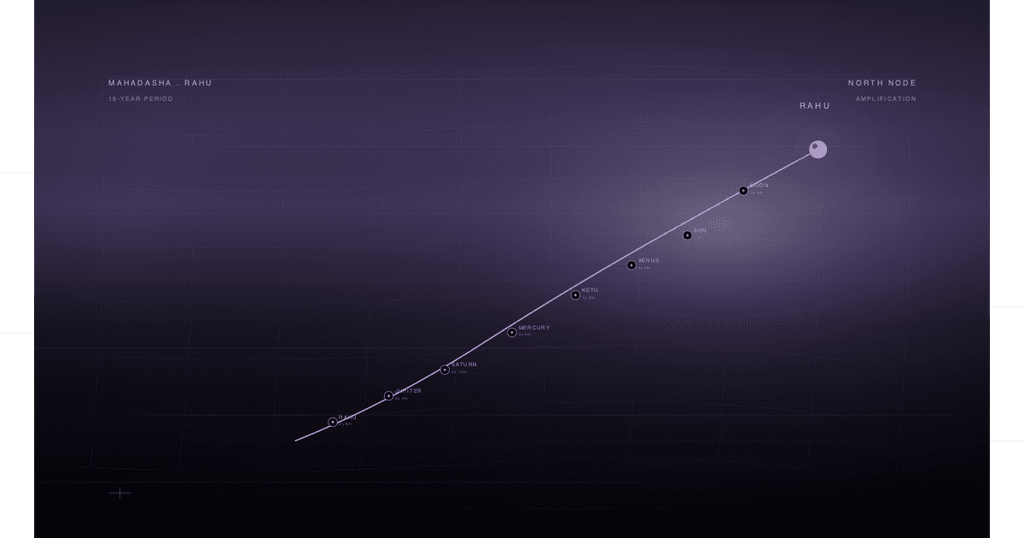
Rahu in the 2nd natal house produces its most intense activation during the 18-year Rahu Mahadasha. The wealth, family and speech registers all reshape during this window. The standard pattern is that wealth accumulation peaks in the Rahu-Jupiter sub-period (years 2 to 5 of the dasha) because Jupiter is the wealth karaka and amplifies the 2nd house register through the dasha lord. The Rahu-Venus sub-period (years 11 to 14) often delivers the second wealth peak, typically through partnership-related or aesthetic-channel income.
Family events tend to cluster in different sub-periods. The Rahu-Saturn sub-period (years 5 to 8) often delivers structural family transitions: relocations, inheritances with conditions, family business pivots or inter-generational shifts in identity. The Rahu-Moon sub-period (years 15 to 17) often delivers events involving the mother, the matrilineal family branch or emotional integration of the family register.
Chart owners with Rahu in the 2nd entering Rahu Mahadasha typically see their primary wealth accumulation in this 18-year window. The Tempora Rahu Mahadasha overview and the per-ascendant Rahu mahadasha series document the full sub-period sequence. The texture is highest when the dispositor of Rahu also activates in the Vimshottari sequence around the same window.
How to read your own chart
The reading procedure for Rahu in the 2nd in your chart runs in four layers.
- Confirm the placement. Generate the natal chart using the Lahiri or Pushya Paksha ayanamsa. The 2nd house begins 30 degrees after the lagna. Confirm Rahu sits within the 2nd bhava boundaries; birth-time accuracy matters because a 60-minute error can shift Rahu out of the 2nd.
- Identify the dispositor. The dispositor is the planet ruling the sign on the 2nd house. Note its house placement, sign dignity, conjunctions and Ashtakavarga score. A dispositor in the 1st, 4th, 5th, 9th, 10th or 11th house in good dignity produces durable wealth amplification; a dispositor in 6th, 8th or 12th in poor dignity produces volatile or restricted wealth.
- Identify aspects on the 2nd house and on Rahu. Jupiter aspecting the 2nd or Rahu is the strongest mitigation and amplification combined; Saturn aspect produces structural pressure on wealth and family; Mars aspect produces volatile speech and confrontational family register. Rahu itself aspects the 6th, 8th and 10th houses from the 2nd.
- Identify the running mahadasha and the position of Jupiter by transit. The dasha sets the activation window; Jupiter transit over the 2nd house or the natal Rahu position tends to deliver the concrete wealth events.
If you want this read computed against your own chart with the dasha-transit overlay and three dated moments from your past as the calibration check, the Tempora Kaal Imprint at the bottom of this page returns it in roughly twelve seconds.
What the framework does not predict
The Rahu in the 2nd reading is structural. It does not predict the specific monetary amount of accumulated wealth, the specific business sector the chart owner will work in or the exact dates of inheritance events. It predicts the structural conditions under which foreign-axis wealth becomes likely and the windows of activation. The texture is probabilistic; chart owners with similar Rahu in the 2nd configurations produce statistically clustered but individually distinct wealth and family arcs.
The framework also does not equate Rahu in the 2nd with wealth automatically. The 2nd is a maraka house and Rahu's amplification can run in either direction. The reading depends on the dispositor strength, the running dasha and the broader chart support. A poorly supported Rahu in the 2nd can produce wealth volatility, family friction or speech-related friction rather than accumulation.
Frequently asked questions
What does Rahu in the 2nd house mean in Vedic astrology?
Rahu in the 2nd house (Dhana Bhava, the wealth house) places the lunar north node on the family, accumulated resources, speech and the early conditioning around money. The chart owner often acquires wealth through foreign sources, unconventional channels or business activities outside the family's traditional register. The family of origin frequently carries a foreign or cross-cultural element on at least one side. Speech often shows code-switching or multilingual signatures. The classical reading combines this with the dispositor of Rahu, the planets aspecting the 2nd house and the running Vimshottari mahadasha.
Does Rahu in the 2nd house bring wealth?
Rahu in the 2nd house is structurally associated with sudden, unconventional or foreign-sourced wealth, but it is not a guarantee. The signature operates as amplification on the wealth register; whether that amplification delivers money or extracts it depends on the dispositor of Rahu, the natal Jupiter (the karaka for wealth and family) and the running dasha. A well-supported Rahu in the 2nd with a strong dispositor in a kendra house and benefic aspect on the 2nd produces durable foreign-business wealth. A poorly supported Rahu in the 2nd with a weak dispositor or malefic aspects on the 2nd produces volatile wealth, family disruption and speech-related friction.
What does Rahu in the 2nd house say about the family?
The 2nd house carries the family of origin, the early conditioning around resources and the kutumba (extended family lineage). Rahu in the 2nd often shows a family structure that diverges from the cultural default of the chart owner's birth context. This can mean a parent born in a different region or country, a family business with foreign connections, multilingual household norms, blended family structures or family events that involve relocation or cross-cultural integration. The signature does not predict harmony or dysfunction; it predicts foreign-axis presence on the family register.
How does Rahu in the 2nd house affect speech?
The 2nd house is the seat of vak (speech) in Vedic astrology. Rahu in the 2nd often produces a speech register that does not match the cultural default. Common signatures include early multilingualism, code-switching between languages or registers, distinctive accent or speech pattern, unconventional vocabulary or content of speech and in some cases speech-related professions (broadcasting, voice work, translation, writing). When malefically aspected, the signature can produce speech-related friction, including a stammer or speech difficulty in childhood that often resolves through deliberate work.
How does Rahu in the 2nd house vary by ascendant?
The per-ascendant overlay depends on which sign Rahu occupies in the 2nd and which house the dispositor of that sign rules. For Aries ascendant Rahu in the 2nd sits in Taurus with Venus as dispositor: aesthetic, luxury and partnership-coded wealth amplification, often through arts or design. For Taurus ascendant Rahu in the 2nd sits in Gemini with Mercury as dispositor: communication, media, commerce-coded wealth. For Cancer ascendant Rahu in the 2nd sits in Leo with Sun as dispositor: leadership-coded wealth, often through public profile or political connection. The texture continues per ascendant; the universal Rahu signature is foreign-axis wealth amplification but the channel changes with the dispositor.
What is the connection between Rahu in the 2nd house and Rahu Mahadasha?
Rahu in the 2nd natal house produces its most intense activation during the 18-year Rahu Mahadasha. The wealth, family and speech registers all reshape during this window. Foreign-business wealth tends to peak in the Rahu-Jupiter and Rahu-Venus sub-periods (years 2 to 5 and years 11 to 14 of the dasha). Family events, including cross-cultural marriages, inheritances or relocations, often cluster in the Rahu-Saturn and Rahu-Moon sub-periods. The Tempora rahu-mahadasha overview article documents the full 18-year sequence and the sub-period readings.
When is a natal Rahu in the 2nd house activated in 2026 to 2028?
The placement is standing; a slow transit over the 2nd-house sign dates the activation. A Capricorn ascendant holds the 2nd in Aquarius, where transiting Rahu returns over its own position from 9 June 2025 to 27 December 2026. A Cancer ascendant holds it in Leo, occupied by transiting Ketu to 27 December 2026 and marked by the 12 August 2026 solar eclipse on the Cancer to Leo cusp. A Gemini ascendant holds it in Cancer, crossed by exalted Jupiter from 27 May 2026 and by transiting Ketu from 27 December 2026 to 15 July 2028. Rahu takes about eighteen months per sign and returns to a natal sign about every eighteen years, so its own return is the cleanest trigger; each window dates when the wealth and speech theme surfaces and does not fix the outcome.
Read next
This article documents the conventional Vedic reading of Rahu in the 2nd house using the Tempora structural framework. Calibration runs on the Swiss Ephemeris with True Pushya Paksha ayanamsa by PVRN Rao. Internal audit log maintained. This article represents conventional Vedic teaching and Tempora Research method documentation; it does not constitute medical, financial, legal or professional advice. First published 2026-06-05 by Tempora Research.