Rahu in the 3rd House: Unconventional Initiative and Upachaya Excellence
Rahu in the 3rd house is one of the strongest classical placements for the north node. The 3rd is an upachaya house, a growing house, where planets gain strength with the chart owner's age and effort. Rahu's natural amplification combines with this growth principle to produce sustained gains through unconventional initiative, communication and boundary-crossing collaboration. The classical tradition lists this placement as supporting longevity, courage, fame and the publishing register.
What Rahu in the 3rd house encodes
The 3rd house, called Sahaja Bhava in Sanskrit (the house of siblings and initiative), is the seat of effort, courage, the hands, the will to act, short-distance travel, siblings (particularly younger siblings and brothers in the classical tradition), communication, writing and the entire register of agency the chart owner deploys in the world. The classical karaka is Mars, which signifies action and courage. When Rahu occupies the 3rd, the effort and communication register receives sustained amplification across the life. The amplification compounds because the 3rd is an upachaya house.
The upachaya classification is structural and load-bearing for the Rahu in the 3rd reading. Upachaya means growing or improving over time in Sanskrit. The four upachaya houses are the 3rd, 6th, 10th and 11th. Planets placed in upachaya houses become structurally stronger with the chart owner's age and accumulated effort; they deliver more in the second half of life than the first. Rahu's natural register (worldly desire, amplification, unconventional initiative) maps cleanly onto the upachaya growth principle. The combination produces the most cooperative arrangement Rahu has with any house environment: amplification of a register that itself rewards sustained effort.
The classical sources are explicit about this placement. The Brihat Parashara Hora Shastra notes that Rahu in upachaya houses produces longevity, fame and sustained gains. Phaladeepika lists Rahu in the 3rd as supporting courage, success against adversaries and creative writing. The cumulative reading across traditions is that this is one of the three placements where Rahu's typically demanding texture becomes a structural asset rather than a structural friction.
Unconventional-publishing and the writing register
The most documented professional signature for Rahu in the 3rd is the writing, publishing and media register. The 3rd house governs the hands, the act of writing and the communication of ideas across distance. Rahu's amplification on this register produces chart owners who write, publish, broadcast or create content as a primary professional channel.
The unconventional component is structural. Rahu does not amplify the standard publishing register; it amplifies the boundary-crossing version. Chart owners with Rahu in the 3rd often write in fields that did not exist in their parents' generation, publish across borders, work in emerging media (podcasting, video, newsletter, online platforms), translate or interpret across languages, write for audiences that span multiple cultural contexts or work in technical writing for fields that have not yet stabilised. The signature does not require traditional book publishing; it requires that the writing or content work carry a foreign-axis or unconventional component.
The timing of publishing-related professional gains follows the dasha-transit rule. The dasha must activate Rahu, the 3rd lord, Mercury (the karaka for writing) or the dispositor of Rahu. The transit must confirm. Jupiter moving over the 3rd house, the natal Rahu position or the 10th house (career) tends to deliver concrete publication or visibility events. The standard pattern for chart owners with Rahu in the 3rd is that publication-related gains compound across the life, with the largest gains typically arriving in the second half rather than the first.
Boundary-crossing communication as the deeper signature
Beneath the publishing register sits a deeper communication signature. Chart owners with Rahu in the 3rd often function as bridges between domains, cultures or communities that do not otherwise communicate. This signature manifests three ways.
The first is linguistic boundary-crossing. The chart owner often speaks or writes in multiple languages, moves between registers in their primary language or works in translation, interpretation or cross-cultural communication. The 3rd house holds short-distance journeys structurally; in modern context this maps to the journey between languages and cultural contexts the chart owner makes routinely.
The second is domain boundary-crossing. The chart owner often combines fields that conventional professional practice keeps separate: technical writing for the humanities, business writing for technical fields, journalism crossing into philosophy, philosophy crossing into journalism. The Rahu amplification on the communication register pushes the chart owner toward cross-domain integration as a default mode.
The third is community boundary-crossing. The chart owner often builds audiences or collaborator networks that span multiple communities that do not otherwise overlap. The 3rd house is the house of collaboration and Rahu's amplification produces network-building that crosses lines other people keep distinct. This is the structural source of the disproportionate-network signature; chart owners with Rahu in the 3rd often have professional networks that look unusual when listed.
Foreign-sibling collaboration
The 3rd house is the seat of sahaja (siblings in Sanskrit, particularly brothers and younger siblings in the classical reading). Rahu in the 3rd often shows a sibling configuration that diverges from the cultural default. The pattern manifests in three layers.
The first layer is sibling geography. Chart owners with Rahu in the 3rd often have siblings born in different geographies than themselves, siblings who relocate abroad early in their adult lives or siblings whose adult lives unfold across borders. The standard reading is that the sibling axis itself carries a foreign-axis structure that the chart owner inherits rather than constructs.
The second layer is sibling profession. Where the chart owner's siblings have professional identities, those identities often diverge from the cultural default or from the chart owner's own profession in distinctive ways. The sibling network often becomes a structural support for the chart owner's own foreign-axis or unconventional work; the chart owner collaborates with siblings or sibling-equivalents (close cousins, step-siblings) in ways that would not happen with a more conventional sibling configuration.
The third layer is sibling relationship structure. The chart owner often has either an unusually close or unusually distant sibling relationship that shapes their own communication register. The Rahu amplification on the sahaja axis tends to push the relationship into one of the two extremes rather than the conventional middle. The Tempora third house piece covers the broader 3rd house reading framework that the Rahu placement modifies.
Courage, risk and the action register
The 3rd house governs courage and the will to act. The classical karaka is Mars. Rahu in the 3rd amplifies the courage register: the chart owner often acts on opportunities others avoid, takes risks others find imprudent and demonstrates structural capacity for sustained effort against opposition. The standard reading is that this is the placement where Rahu's worldly hunger and the 3rd house's action principle align rather than conflict.
The risk profile is that the chart owner can read as reckless or as taking unwarranted initiative when the structural support is weak. A Rahu in the 3rd with a weak dispositor, no Jupiter aspect and an afflicted Mars can produce repeated cycles of bold initiative that fail to consolidate. The amplification fires the action but the broader chart does not catch the results. The mitigation in classical reading is Jupiter aspect on Rahu or on the 3rd house and a strong Mars.
For chart owners with Rahu in the 3rd well supported, the courage register tends to compound across the life. Each successive initiative builds on the prior, the network expands, the communication reach grows and the publishing or content output scales. The upachaya growth principle operates on the entire action axis rather than on isolated events. This is the structural source of the conventional teaching that Rahu in the 3rd often produces self-made fortune and disproportionate worldly success.
Per-ascendant variation
The texture of Rahu in the 3rd changes with the lagna sign because Rahu occupies a different zodiacal sign and the dispositor changes. The table walks the twelve ascendants briefly.
| Ascendant | Rahu in 3rd sign | Dispositor | Initiative channel texture |
|---|---|---|---|
| Aries | Gemini | Mercury | Classic publishing and media signature. Writing, journalism, multilingual communication, commerce. Strong Mercury dispositor produces sustained writing-career arc. |
| Taurus | Cancer | Moon | Emotional, hospitality, food-coded initiative. Often family business reinvention or hospitality publishing. |
| Gemini | Leo | Sun | Leadership-coded initiative. Often entertainment, political journalism or public-figure communication. |
| Cancer | Virgo | Mercury | Analytical, technical, service-coded initiative. Often technical writing, healthcare communication or detail-coded media. |
| Leo | Libra | Venus | Aesthetic, partnership, mediation-coded initiative. Often design publishing, fashion media or diplomatic communication. |
| Virgo | Scorpio | Mars | Investigation, research, occult-coded initiative. Often investigative journalism, research writing or transformative content. |
| Libra | Sagittarius | Jupiter | Teaching, philosophical, long-arc initiative. Often academic publishing, international advisory or wisdom-coded content. |
| Scorpio | Capricorn | Saturn | Institutional, structural, career-coded initiative. Often industry publication, corporate communication or long-arc media build. |
| Sagittarius | Aquarius | Saturn | Technology, network, community-coded initiative. Often software writing, online platform-building or community media. |
| Capricorn | Pisces | Jupiter | Spiritual, artistic, devotional-coded initiative. Often spiritual writing, fluid creative content or boundary-crossing artistic work. |
| Aquarius | Aries | Mars | Action, sports, military-coded initiative. Often sports journalism, action-focused content or entrepreneurial communication. |
| Pisces | Taurus | Venus | Aesthetic, luxury, sensory-coded initiative. Often food writing, lifestyle media or aesthetic-coded content. |
The texture above is the starting reading. The dispositor's actual house placement, sign dignity and conjunctions refine it further. A Pisces ascendant with Rahu in the 3rd in Taurus and Venus in the 10th in own sign produces a very different texture from the same combination with Venus in the 6th and debilitated.
Dated activations of this placement
A natal Rahu in the 3rd is a standing amplifier on courage, communication and the sibling axis; the moving sky decides when that amplifier is switched on. For a Sagittarius ascendant the 3rd house is Aquarius, where transiting Rahu returns over its own natal position from 9 June 2025 to 27 December 2026, giving the writing and effort register a full-volume window through late 2026. For a Gemini ascendant the 3rd house is Leo, which transiting Ketu holds to 27 December 2026 and which the 12 August 2026 solar eclipse marks on the Cancer to Leo cusp, setting the south node and an eclipse on the natal Rahu. For a Taurus ascendant the 3rd house is Cancer, crossed by exalted Jupiter from 27 May 2026 and by transiting Ketu from 27 December 2026 to 15 July 2028, so a benefic transit and a node reach the placement one after the other. Each is a datable window of activation while the natal Rahu remains the fixed condition beneath it, so the transit triggers the theme and leaves its expression open. Because Rahu walks a sign in about eighteen months and comes back to any given sign about every eighteen years, the node's own return is the direct trigger for a 3rd-house Rahu, present now for the Sagittarius ascendant and reaching a Scorpio ascendant whose 3rd house is Capricorn from 27 December 2026 to 15 July 2028.
Connection to Rahu Mahadasha
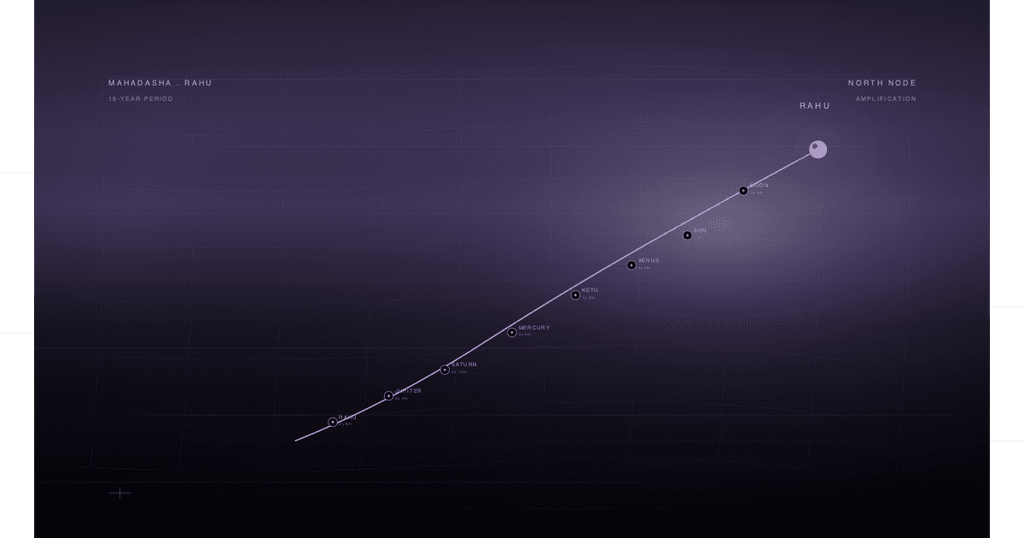
Rahu in the 3rd natal house produces unusually strong activation during the 18-year Rahu Mahadasha because the upachaya house compounds the amplification rather than dissipating it. The cumulative reading is that the entire 18 years operates as a peak professional and creative window rather than as a difficult-Rahu window. The chart owner often builds the bulk of their lifetime professional output in this period.
The sub-periods carry distinct textures. Rahu-Mercury, typically in years 7 to 9 of the dasha, often delivers the largest publishing or writing gains because Mercury is the karaka for writing and the sub-period activates the communication register directly. Rahu-Jupiter, in years 2 to 5, often delivers the most cross-cultural visibility and the long-arc audience building. Rahu-Mars, in years 17 to 18, delivers the courage and risk-tolerance peaks; many chart owners with Rahu in the 3rd take their largest professional risks in this closing sub-period and find them rewarded.
Chart owners with Rahu in the 3rd entering Rahu Mahadasha should expect the 18 years to be defining and structurally favourable rather than friction-heavy. The Tempora Rahu Mahadasha overview documents the full sub-period sequence. The standard pattern for this placement is that Rahu mahadasha matches the conventional teaching of an upachaya-strong dasha: gains compound, visibility builds and the closing sub-periods consolidate the structural position the dasha has established.
How to read your own chart
The reading procedure for Rahu in the 3rd in your chart runs in four layers.
- Confirm the placement. Generate the natal chart using the Lahiri or Pushya Paksha ayanamsa. The 3rd house begins 60 degrees after the lagna. Confirm Rahu sits within the 3rd bhava boundaries; birth-time accuracy matters because a 60-minute error can shift Rahu out of the 3rd.
- Identify the dispositor of Rahu and the natal Mars. The dispositor is the planet ruling the sign on the 3rd house; Mars is the karaka for the 3rd. Both layers participate in the reading. A strong dispositor and a strong Mars produce durable upachaya excellence; a weak dispositor with an afflicted Mars produces volatile initiative.
- Identify aspects on the 3rd house and on Rahu. Jupiter aspecting either is the strongest mitigation; the wisdom register tempers Rahu's hunger and supports the writing career. Saturn aspecting the 3rd produces structural pressure and slow-developing gains. Mars aspecting Rahu produces high-energy initiative.
- Identify the running mahadasha and the position of Jupiter by transit. The dasha sets the activation window; Jupiter transit over the 3rd house or the natal Rahu position tends to deliver the concrete visibility and publication events.
If you want this read computed against your own chart with the dasha-transit overlay and three dated moments from your past as the calibration check, the Tempora Kaal Imprint at the bottom of this page returns it in roughly twelve seconds.
What the framework does not predict
The Rahu in the 3rd reading is structural. It does not predict the specific titles the chart owner will publish, the specific media channels they will work in or the precise audience size they will reach. It predicts the structural conditions under which publishing, communication and boundary-crossing initiative become likely and the windows of activation. Chart owners with similar Rahu in the 3rd configurations produce statistically clustered but individually distinct career arcs.
The framework also does not equate Rahu in the 3rd with automatic success. The upachaya principle requires effort; the gains arrive in response to sustained initiative rather than as gift. A chart owner with Rahu in the 3rd who does not invest the effort the placement structurally supports produces minimal outcomes regardless of the favourable signature. The classical reading is that this is one of the highest-leverage placements available to disciplined effort.
Frequently asked questions
Why is Rahu in the 3rd house considered one of the best placements?
Rahu in the 3rd house is widely considered one of the three strongest classical placements for Rahu (alongside the 6th and 11th, the other upachaya houses). The 3rd is the house of effort, courage, communication and short-distance travel. Upachaya means growing or improving over time; planets in upachaya houses become structurally stronger with the chart owner's age and effort. Rahu's natural amplification register combines with the upachaya growth principle to produce sustained gains through effort, communication and unconventional initiative. The classical sources (BPHS, Phaladeepika) list this placement as supporting longevity, courage, fame and creative writing or publishing.
What does Rahu in the 3rd house signify?
Rahu in the 3rd house (Sahaja Bhava) places the lunar north node on the register of effort, initiative, courage, short-distance travel, siblings, communication, writing and the will to act. The chart owner typically carries amplified initiative, an unconventional communication register, willingness to take risks others avoid and capacity for sustained effort across long arcs. The sibling axis often carries a foreign or unconventional signature; siblings may be born in different geographies, follow non-traditional paths or play disproportionate roles in the chart owner's life. The publishing, writing and media registers are common professional channels.
Does Rahu in the 3rd house cause foreign travel?
The 3rd house is the house of short-distance travel rather than long-distance journeys (which is the 9th house). Rahu in the 3rd often produces frequent short-haul travel, regional mobility within the chart owner's country, repeated cross-state or cross-province movement for work or family reasons or in modern context frequent international short-haul work travel. Long-arc foreign-residency is more strongly associated with Rahu in the 4th, 9th or 12th. Rahu in the 3rd produces the courier-and-collaboration pattern of frequent movement to maintain a distributed network rather than the relocation pattern.
How does Rahu in the 3rd house affect siblings?
The 3rd house is the seat of sahaja (siblings, brothers especially in the classical tradition). Rahu in the 3rd often shows a sibling configuration that diverges from the cultural default. This can mean siblings born in different geographies, half-siblings or step-siblings, siblings who follow non-traditional paths, an unusually close or unusually distant sibling relationship or a sibling who plays a defining role in the chart owner's life. The signature does not predict the number of siblings; it predicts the foreign-axis or unconventional shape of the sibling relationships.
How does Rahu in the 3rd house vary by ascendant?
The per-ascendant overlay depends on which sign Rahu occupies in the 3rd and which house the dispositor of that sign rules. For Aries ascendant Rahu in the 3rd sits in Gemini with Mercury as dispositor: communication, writing and commerce-coded initiative; classic publishing or media signature. For Taurus ascendant Rahu in the 3rd sits in Cancer with Moon as dispositor: emotional, hospitality-coded initiative often involving family business or food. For Gemini ascendant Rahu in the 3rd sits in Leo with Sun as dispositor: leadership-coded initiative often in entertainment or politics. The texture continues per ascendant; the universal Rahu in upachaya signature is unconventional initiative with sustained gains, with the channel set by the dispositor.
What is the connection between Rahu in the 3rd house and Rahu Mahadasha?
Rahu in the 3rd natal house produces unusually strong activation during the 18-year Rahu Mahadasha because the upachaya house compounds the amplification rather than dissipating it. The standard pattern is that effort, communication and creative initiative all reshape during this window and the gains are durable. The classical reading flags Rahu mahadasha for chart owners with Rahu in the 3rd as a peak period for publishing, media work, writing-related fame and disproportionate professional gains. The Rahu-Mercury and Rahu-Jupiter sub-periods often deliver the strongest publishing and communication events. The Rahu-Mars sub-period often delivers the courage and risk-taking events.
When is a natal Rahu in the 3rd house activated in 2026 to 2028?
The natal placement stands; a slow transit over the 3rd-house sign dates its activation. A Sagittarius ascendant holds the 3rd in Aquarius, where transiting Rahu returns over its own position from 9 June 2025 to 27 December 2026. A Gemini ascendant holds it in Leo, occupied by transiting Ketu to 27 December 2026 and marked by the 12 August 2026 solar eclipse on the Cancer to Leo cusp. A Taurus ascendant holds it in Cancer, crossed by exalted Jupiter from 27 May 2026 and by transiting Ketu from 27 December 2026 to 15 July 2028. Rahu takes about eighteen months per sign and returns to a natal sign about every eighteen years, so its own return is the direct trigger, and every such window dates when the courage and communication theme comes forward without fixing the outcome.
Read next
This article documents the conventional Vedic reading of Rahu in the 3rd house using the Tempora structural framework. Calibration runs on the Swiss Ephemeris with True Pushya Paksha ayanamsa by PVRN Rao. Internal audit log maintained. This article represents conventional Vedic teaching and Tempora Research method documentation; it does not constitute medical, financial, legal or professional advice. First published 2026-06-05 by Tempora Research.