Rahu in the 4th House: Foreign Home and Mother-Line Amplification
Rahu in the 4th house places the lunar north node on the foundation. The home, the mother, accumulated comfort and real estate all receive sustained amplification. Foreign-home arcs are the signature event class. The mother often carries a foreign-axis register. Property accumulation can be significant. The reading depends on the dispositor of Rahu, the natal Moon and the running dasha.
What Rahu in the 4th house encodes
The 4th house, called Sukha Bhava in Sanskrit (the house of happiness and comfort), is the seat of the home, the mother, the immediate residential foundation, real estate, vehicles, the emotional baseline and the early childhood environment. The classical karaka is the Moon, which signifies the mother and the emotional register. When Rahu occupies the 4th, the foundation register receives sustained amplification: the home is rarely simple, the mother often plays an outsized role, the chart owner accumulates or moves across multiple residences and the early environment frequently carries a foreign-axis signature.
The 4th house is one of the four angular kendra houses (the 1st, 4th, 7th and 10th). Planets placed in kendra houses are structurally prominent on the chart; they cast their register across the entire life rather than operating in a localised domain. Rahu in a kendra is therefore high-visibility; the foundation-amplification register shows up clearly to anyone reading the chart owner's life. This is the structural source of the conventional teaching that Rahu in the 4th produces highly visible foreign-home arcs rather than quiet ones.
The classical sources treat Rahu in the 4th with mixed reading. The amplification can deliver significant property accumulation, foreign-home success and a strong emotional foundation when the dispositor of Rahu and the natal Moon are strong. The same amplification can produce unsettled foundation, mother-related friction and repeated relocation when the support is weak. The classical reading frames this as a placement where the chart owner's foundation work matters more than for most placements; the structural conditions force engagement with home, mother and residence rather than allowing the chart owner to coast on inherited stability.
Foreign-home arcs as the primary event class
The most documented signature for Rahu in the 4th is the foreign-home arc. The 4th is the home. Rahu's nature is to seek what is not nearby. The combination structurally pulls the chart owner's residential foundation across a cultural or geographic boundary. The pattern is consistent across the classical literature and modern observational records.
Foreign-home arcs manifest in several shapes. The most common is study abroad converting into residence; the chart owner leaves for an educational purpose and the foundation work happens in the new geography rather than the origin. The second is work-based long-term relocation; the chart owner takes a professional role abroad and constructs the home there. The third is marriage migration; the chart owner partners with someone from a different geography and the home foundation forms in that geography. The fourth, increasingly common in modern context, is multiple-residence periods where the chart owner maintains homes in different geographies without committing to a single primary residence.
The timing of foreign-home arcs follows the standard rule. The dasha must activate Rahu, the 4th lord, the dispositor of Rahu or the 12th lord (the house of foreign residence). The transit must confirm; Jupiter or Saturn moving over the 4th house, the natal Rahu position or the 12th house tends to deliver the concrete relocation events. Chart owners with Rahu in the 4th who have not had a foreign-home arc by their Saturn return at age 28 to 30 often experience one during the return or in the immediately following dasha activation.
The unconventional mother-relationship
The 4th house is the seat of the mother in classical Vedic astrology. The karaka is the Moon. Rahu in the 4th places the amplification register on the maternal relationship. The pattern manifests in three layers.
The first layer is mother's origin or biography. Chart owners with Rahu in the 4th often have mothers born in a different region or country than the chart owner's immediate cultural context, mothers with unconventional professional or life arcs, mothers who relocated significantly during their own lives or mothers whose biography itself shaped the chart owner's relocation pattern. The signature does not require the mother to be foreign-born in a strict sense; it requires that the maternal biography carries a foreign-axis or unconventional component.
The second layer is relationship intensity. The mother-relationship often reads as unusually close or unusually distant rather than the conventional middle. Rahu amplifies the register; chart owners often experience the maternal bond as a defining feature of their life or as a defining absence that shapes their work. The amplification pushes the relationship toward one of the extremes.
The third layer is mother-related events. The mother often plays a disproportionate role in significant events of the chart owner's life: relocations, professional pivots, marriage decisions, financial events. Major mother-related events (illness, geographic move, professional change) often cluster in the running Rahu mahadasha or in Rahu antardasha periods inside other mahadashas. The Tempora fourth house piece covers the broader 4th house reading framework that the Rahu placement modifies.
Real-estate amplification
The 4th house governs immovable property and real estate. Rahu in the 4th typically amplifies the real-estate register across the chart owner's life. The pattern manifests in three documented forms.
The first form is multiple-property accumulation. Chart owners with Rahu in the 4th often acquire multiple properties across their lives rather than committing to a single primary residence. The accumulation pattern can be sequential (selling one property to acquire the next) or parallel (holding multiple properties simultaneously). The amplification register pushes toward expanded portfolio rather than stable single ownership.
The second form is professional real-estate work. A significant proportion of chart owners with Rahu in the 4th end up working in real-estate-related fields: property development, real-estate investment, architecture, construction, hospitality (which is real estate as a service) or platforms that operate in the property market. The amplification on the immovable-property register often converts into a professional channel rather than only personal accumulation.
The third form is foreign-property ownership. Chart owners with Rahu in the 4th often own real estate in a country different from their primary residence. This can result from foreign-home arcs (the chart owner relocates but keeps the original property or vice versa), from family inheritance with foreign branch (often the unconventional-inheritance signature mentioned in the 2nd house article) or from investment activity that follows the chart owner's foreign-axis network. The timing of major property events follows the standard dasha-transit rule.
The emotional foundation question
The 4th house is the emotional baseline. The Moon is its karaka. Rahu's amplification on this register raises a structural question: how stable is the foundation when the register itself is set to amplify?
When the dispositor of Rahu is strong, the natal Moon is well-placed and Jupiter aspects either Rahu or the 4th house, the chart owner typically integrates the amplification into a workable emotional foundation. The foreign-home arc, the mother-relationship and the real-estate activity all function as features of a coherent life rather than as sources of friction. The amplification produces variety and depth rather than instability.
When the dispositor is weak, the natal Moon is afflicted (combust, debilitated, in dusthana houses or under malefic aspect) and there is no Jupiter mitigation, the structural risk profile emerges. The foundation can read as unsettled across the life: the chart owner moves between residences without committing, the mother-relationship carries unresolved friction, the property work generates volatility rather than stability and the emotional baseline reads as restless or hard to ground. This is not a verdict; it is a structural pattern that responds to deliberate work. The classical mitigation is strengthening the Moon (through nakshatra-aligned routines and Monday observances in the traditional reading) and strengthening the dispositor of Rahu.
The Saturn return at age 28 to 30 and the second Saturn return at age 58 to 60 tend to be structural integration points for chart owners with Rahu in the 4th. The pressure forces engagement with foundation questions that the amplification register otherwise allows the chart owner to defer.
Per-ascendant variation
The texture of Rahu in the 4th changes with the lagna sign because Rahu occupies a different zodiacal sign and the dispositor changes. The following table walks the twelve ascendants briefly.
| Ascendant | Rahu in 4th sign | Dispositor | Foundation channel texture |
|---|---|---|---|
| Aries | Cancer | Moon | Amplified emotional and matrilineal register. Strong foreign-home signature. Moon dispositor in own sign produces durable foundation amplification. |
| Taurus | Leo | Sun | Leadership-coded home, prestige real-estate, often visible mother-figure. Sun dispositor strength matters. |
| Gemini | Virgo | Mercury | Analytical, service-coded home; often multiple residences for work reasons. Mother often has analytical or technical profession. |
| Cancer | Libra | Venus | Aesthetic, partnership-coded home, luxury real-estate. Often beautiful homes; mother often plays partnership-shaping role. |
| Leo | Scorpio | Mars | Intense, transformative home; significant property events. Often property dispute or inheritance friction. Caution placement. |
| Virgo | Sagittarius | Jupiter | Teaching, philosophical, long-distance-coded home. Strong Jupiter dispositor produces stable foreign-home arc. |
| Libra | Capricorn | Saturn | Institutional, durable real-estate; long-arc property build. Mother often plays structural role in chart owner's career. |
| Scorpio | Aquarius | Saturn | Technology, network, community-coded home. Often non-traditional living arrangements or chosen-family structures. |
| Sagittarius | Pisces | Jupiter | Spiritual, fluid, devotional-coded home. Often ashram-like residence, artistic foundation or boundary-crossing home. |
| Capricorn | Aries | Mars | Action, entrepreneurial home; often self-built foundation. Mother often plays direct, action-coded role. |
| Aquarius | Taurus | Venus | Aesthetic, luxury, sensory-coded home. Strong real-estate accumulation. Mother often refined or aesthetically distinctive. |
| Pisces | Gemini | Mercury | Communication, mobile, multi-language home. Often multiple residences for communication work; mother often multilingual. |
The texture above is the starting reading. The dispositor's actual house placement, sign dignity, conjunctions and the condition of natal Moon refine it further. A Pisces ascendant with Rahu in the 4th in Gemini and Mercury in the 10th in own sign produces a different reading from the same combination with Mercury in the 6th and combust.
How the 2026 to 2028 transits reach this house
The home and foundation reading of a 4th-house Rahu holds steady across life; a slow transit through the 4th sign is what gives it a date. For a Scorpio ascendant the 4th house is Aquarius, where transiting Rahu returns over its own natal seat from 9 June 2025 to 27 December 2026, bringing the property and mother-line themes forward through the close of 2026. For a Taurus ascendant the 4th house is Leo, occupied by transiting Ketu to 27 December 2026 and crossed by the solar eclipse of 12 August 2026 on the Cancer to Leo cusp, which drops the south node and an eclipse point onto the natal Rahu. For a Capricorn ascendant the 4th house is Aries, where Saturn arrives on 23 May 2027, steps back into Pisces on 4 November 2027 and returns to hold from 11 February 2028, so the foundation theme is tested in a staggered pass across three dates. Every one of these is a dated window of activation resting on a standing natal condition, so the transit fixes the timing and leaves the outcome to the chart. Rahu itself takes close to eighteen months in a sign and comes back to a natal sign about every eighteen years, which makes its own return the direct trigger, live now for the Scorpio ascendant and reaching a Libra ascendant whose 4th house is Capricorn from 27 December 2026 to 15 July 2028.
Connection to Rahu Mahadasha
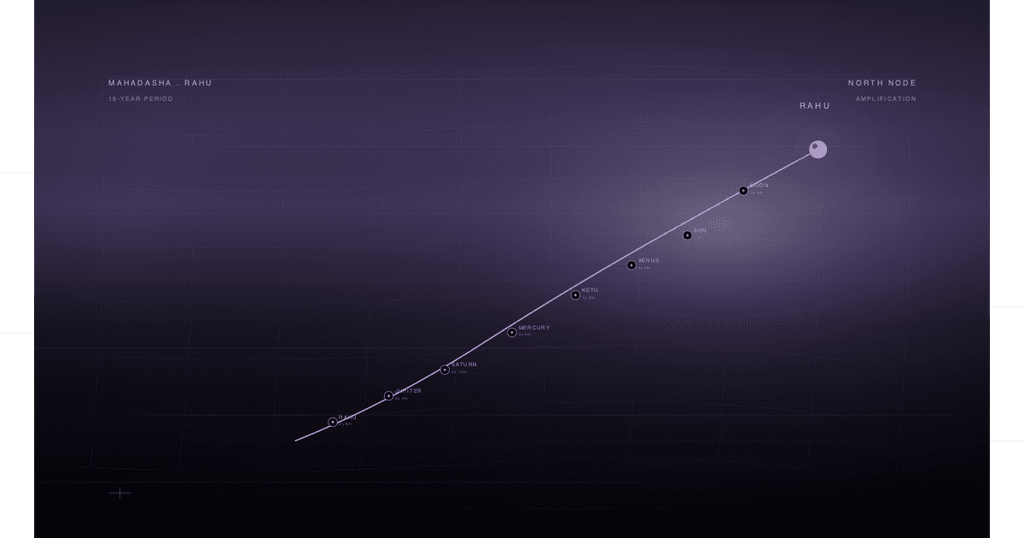
Rahu in the 4th natal house produces its most intense activation during the 18-year Rahu Mahadasha. The home, mother and real-estate registers all reshape during this window. Foreign-home arcs that have been latent often fire in this dasha. Major real-estate transactions cluster here. Mother-related events, sometimes significant ones, often occur in this window.
The sub-periods carry distinct textures. Rahu-Moon, typically in years 15 to 17 of the dasha, often delivers the most concentrated mother-related events because the Moon is the karaka for mother and the sub-period activates the maternal axis directly. Rahu-Venus, in years 11 to 14, often delivers property accumulation, particularly in aesthetic or luxury real-estate and is the sub-period most associated with constructing a "settled" foreign home if one has not yet formed. Rahu-Mars, in years 17 to 18, can deliver relocation pressure or property disputes; the energy register pushes the chart owner toward change rather than consolidation. Rahu-Saturn, in years 5 to 8, often delivers the long-arc foundational work: the building or significant renovation of the primary home, the structural mother-related event or the institutional property purchase.
Chart owners with Rahu in the 4th entering Rahu Mahadasha should expect the 18 years to define their foundation in a way that is visible to anyone who knew them before. The Tempora Rahu Mahadasha overview documents the full sub-period sequence. The standard reading is that this is the placement where Rahu mahadasha most reliably produces structurally significant material outcomes (property, home, family-foundation) alongside the emotional and relational reshaping.
How to read your own chart
The reading procedure for Rahu in the 4th in your chart runs in four layers.
- Confirm the placement. Generate the natal chart using the Lahiri or Pushya Paksha ayanamsa. The 4th house begins 90 degrees after the lagna. Confirm Rahu sits within the 4th bhava boundaries; birth-time accuracy matters because a 60-minute error can shift Rahu out of the 4th.
- Identify the dispositor of Rahu and the natal Moon. The dispositor is the planet ruling the sign on the 4th house; the Moon is the karaka. Both layers participate. A strong dispositor and a strong Moon produce durable foundation amplification; a weak dispositor with an afflicted Moon produces unsettled foundation patterns.
- Identify aspects on the 4th house and on Rahu. Jupiter aspecting either is the strongest mitigation; the wisdom register supports the integration of foreign-home arcs and mother-relationship work. Saturn aspecting the 4th produces structural pressure and slow-developing foundation; the chart owner often builds the home foundation late but durably. Mars aspecting Rahu in the 4th produces volatile property activity and confrontational family register.
- Identify the running mahadasha and the position of Jupiter by transit. The dasha sets the activation window; Jupiter transit over the 4th house, the natal Rahu position or the 12th house tends to deliver the concrete relocation and property events.
If you want this read computed against your own chart with the dasha-transit overlay and three dated moments from your past as the calibration check, the Tempora Kaal Imprint at the bottom of this page returns it in roughly twelve seconds.
What the framework does not predict
The Rahu in the 4th reading is structural. It does not predict the specific country of relocation, the specific number of properties the chart owner will acquire or the precise shape of the mother-relationship. It predicts the structural conditions under which foreign-home arcs, real-estate amplification and unconventional mother-relationships become likely and the windows of activation. Chart owners with similar Rahu in the 4th configurations produce statistically clustered but individually distinct foundation arcs.
The framework also does not equate Rahu in the 4th with bad outcomes. Many of the most materially successful chart owners on record carry this placement; the amplification on the immovable-property register often produces significant accumulation. The classical reading frames this as a placement requiring deliberate engagement with foundation questions rather than as a placement that fails by default.
Frequently asked questions
What does Rahu in the 4th house mean in Vedic astrology?
Rahu in the 4th house (Sukha Bhava, the house of happiness, home and foundation) places the lunar north node on the register of mother, home, real-estate, vehicles, comfort and emotional foundation. The chart owner often experiences foreign-home arcs (residence abroad, repeated relocations or non-traditional living arrangements), an unconventional mother-relationship and amplified real-estate activity across the life. The 4th is an angular kendra house in classical reading; planets there are structurally prominent. Rahu in the 4th can produce both significant material accumulation around property and unsettled emotional foundation, depending on the dispositor strength and the running dasha.
Does Rahu in the 4th house cause foreign residence?
Foreign-residency arcs are one of the most documented signatures of Rahu in the 4th, particularly when the dispositor of Rahu sits in the 9th or 12th house and the running mahadasha activates Rahu, the dispositor or the 12th lord. The 4th house is the seat of the home and the immediate residential foundation; Rahu's nature is to seek what is not nearby. The combination structurally pulls the chart owner's home base across a cultural or geographic boundary. The signature manifests as study abroad converting into residence, work-based long-term relocation, marriage migration or multiple-residence periods where the chart owner maintains homes in different geographies.
What does Rahu in the 4th house say about the mother?
The 4th house is the seat of the mother in classical Vedic astrology. Rahu in the 4th often produces a mother-relationship that diverges from the cultural default. Common signatures include a mother born in a different region or country than the chart owner's birth context, a mother with an unconventional profession or life arc, an unusually intense or unusually distant mother-relationship, a mother who relocates or who shapes the chart owner's relocation pattern. The signature does not predict harmony or conflict; it predicts the foreign-axis or unconventional shape of the maternal relationship. The condition of natal Moon (the karaka for mother) and its dispositor refine the reading further.
Does Rahu in the 4th house affect property and real estate?
The 4th house governs immovable property, real estate, vehicles and accumulated comfort. Rahu in the 4th typically amplifies real-estate activity across the life. The chart owner often acquires multiple properties, deals in real estate professionally, owns property across different geographies or experiences significant property events (purchases, sales, inheritances or disputes). Foreign property is particularly common; the chart owner may own real estate in a country different from their primary residence. The timing follows the standard dasha-transit rule; major property events tend to fire in Rahu Mahadasha or in the antardasha of Rahu or its dispositor inside other mahadashas.
How does Rahu in the 4th house vary by ascendant?
The per-ascendant overlay depends on which sign Rahu occupies in the 4th and which house the dispositor of that sign rules. For Aries ascendant Rahu in the 4th sits in Cancer with Moon as dispositor: amplified emotional and matrilineal register, strong foreign-home signature. For Taurus ascendant Rahu in the 4th sits in Leo with Sun as dispositor: leadership-coded home and prestige-driven real-estate. For Cancer ascendant Rahu in the 4th sits in Libra with Venus as dispositor: aesthetic, partnership-coded home and luxury real-estate. The texture continues per ascendant; the universal Rahu in 4th signature is foreign-home amplification and mother-line foreign axis, with the specific channel set by the dispositor.
What is the connection between Rahu in the 4th house and Rahu Mahadasha?
Rahu in the 4th natal house produces its most intense activation during the 18-year Rahu Mahadasha. The home, mother and real-estate registers all reshape during this window. Foreign-residency arcs that have been latent often fire in this dasha; major real-estate transactions cluster here; mother-related events (sometimes significant ones) often occur in this window. The Rahu-Moon sub-period (years 15 to 17) often delivers the most concentrated mother-related events. The Rahu-Venus sub-period (years 11 to 14) often delivers property accumulation. The Rahu-Mars and Rahu-Saturn sub-periods can deliver relocation pressure or property disputes. The Tempora rahu-mahadasha overview article documents the full sequence.
When is a natal Rahu in the 4th house activated in 2026 to 2028?
The placement is the standing condition; a slow transit through the 4th-house sign dates it. A Scorpio ascendant holds the 4th in Aquarius, where transiting Rahu returns over its own seat from 9 June 2025 to 27 December 2026. A Taurus ascendant holds it in Leo, held by transiting Ketu to 27 December 2026 and crossed by the 12 August 2026 solar eclipse on the Cancer to Leo cusp. A Capricorn ascendant holds it in Aries, where Saturn arrives on 23 May 2027, steps back on 4 November 2027 and returns on 11 February 2028. Rahu crosses a sign in about eighteen months and returns to a natal sign about every eighteen years, so its return is the direct trigger, and each window dates when the home and foundation theme surfaces while leaving the result open.
Read next
This article documents the conventional Vedic reading of Rahu in the 4th house using the Tempora structural framework. Calibration runs on the Swiss Ephemeris with True Pushya Paksha ayanamsa by PVRN Rao. Internal audit log maintained. This article represents conventional Vedic teaching and Tempora Research method documentation; it does not constitute medical, financial, legal or professional advice. First published 2026-06-05 by Tempora Research.