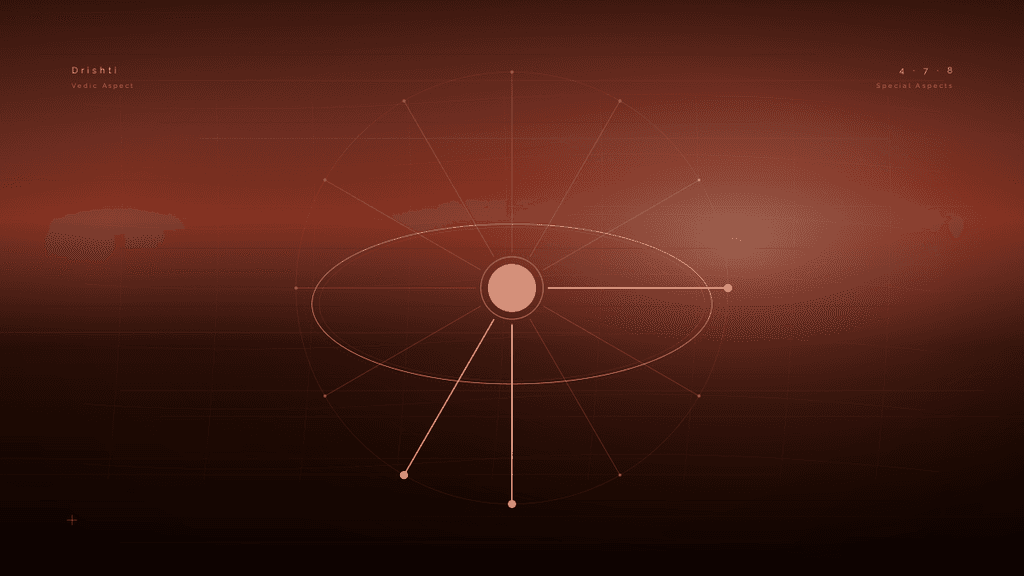
Mutual Aspect Yoga and Parivartana: When Two Graha Exchange Sight
Two graha (planets) can relate to each other through three classical configurations: yuti (conjunction), parivartana (mutual exchange of signs of rulership) and mutual aspect (each graha aspects the other). This piece walks through what each configuration means structurally and why parivartana is read as stronger than mutual aspect even though both are bidirectional relationships.
The three ways two graha can relate
Vedic astrology treats every graha (planet) as a unit that carries certain natural significations (karaka responsibilities) and certain functional significations (lordship of one or two houses in a given chart). Two graha can form three kinds of structural relationship that change how their combined significations read.
The first relationship is yuti (conjunction). Two graha sit in the same rashi (sign) and their longitudes are within an orb that classical texts vary on (some allow the full sign, some require a tight orb of ten or fifteen degrees). The graha's significations blend on the spot. Yuti is the most physically intimate of the three relationships because the graha occupy the same house and carry the same sign-influence.
The second relationship is parivartana (literally exchange or rotation). Two graha sit in each other's signs of rulership. For example, Mercury sits in Taurus (Venus's sign) and Venus sits in Gemini (Mercury's sign). The two graha have swapped their owned territory. Each graha is a guest in the other's house and the host is reciprocally a guest in the first graha's house. Parivartana is the structural relationship in which the two graha are deeply entangled at the level of sign rulership.
The third relationship is mutual aspect. Two graha aspect each other simultaneously. Because every graha casts a default seventh-house aspect, any pair sitting in opposite signs automatically forms a mutual aspect. The graha do not occupy the same house and do not share each other's signs; they only see each other across the chart. This is the softest of the three relational structures but it is still bidirectional and is read more strongly than a one-way aspect.
The default mutual aspect: opposite signs
The simplest case of mutual aspect yoga is two graha sitting in opposite signs of the zodiac. Aries faces Libra. Taurus faces Scorpio. Gemini faces Sagittarius. Cancer faces Capricorn. Leo faces Aquarius. Virgo faces Pisces. When two graha sit in any of these opposite-sign pairs, they form a default mutual aspect because both cast their seventh-house drishti at each other.
The structural reading of an opposite-sign mutual aspect is that the two graha continuously inform each other's significations even though they sit in different parts of the chart. The native experiences the two graha as a linked pair. A Venus-Mars mutual aspect across the Taurus-Scorpio axis carries Venus's relational and aesthetic significations into Mars's energetic and assertive significations and vice versa. The native carries a Venus-Mars flavour through both the sphere Venus rules and the sphere Mars rules; the two cannot be read in isolation.
The seventh-house mutual aspect is the most common form of mutual aspect because it forms automatically whenever two graha occupy opposite signs. The chart of any given moment carries on average two to three opposite-sign mutual aspects among the nine graha. The configuration is therefore a common structural signature rather than a rare yoga; what matters is which specific graha pair is in mutual aspect and which houses they occupy in the natal chart.
Special-aspect mutual configurations
Mars, Jupiter and Saturn each cast additional special aspects beyond the default seventh. Mars casts the fourth and eighth aspects. Jupiter casts the fifth and ninth aspects. Saturn casts the third and tenth aspects. When two graha both cast a special aspect on each other simultaneously, they form a special-aspect mutual configuration.
The most common special-aspect mutual configurations involve Mars and Saturn. Mars's fourth aspect from house six lands on house nine. Saturn's tenth aspect from house twelve lands on house nine. If Mars sits in house six and Saturn sits in house twelve, they form a mutual aspect across house nine (Mars's fourth lands on Saturn's house twelve; Saturn's third aspect from house twelve lands on house two not house six, so this is a one-way Mars-on-Saturn aspect actually; the cleaner example is Mars and Saturn in mutual seventh aspect from houses one and seven respectively).
The cleaner example is Mars and Jupiter forming a mutual aspect through their special aspects. Mars in house one casts its fourth aspect on house four, its seventh on house seven and its eighth on house eight. Jupiter in house four casts its fifth on house eight, its seventh on house ten and its ninth on house twelve. If Mars sits in house one and Jupiter sits in house four, Mars's fourth aspect lands on Jupiter and Jupiter's seventh aspect does not land back on Mars; this is a one-way Mars-on-Jupiter aspect. For a true mutual special-aspect configuration, both graha need to be casting aspects that land on each other. The cleanest case is Mars in house one and Jupiter in house seven where both cast the default seventh aspect at each other; this is the standard opposite-sign mutual aspect not a special-aspect mutual.
Genuine special-aspect mutual configurations are rarer than opposite-sign mutual aspects because they require the geometry to align in both directions. Tempora's coverage of the special aspects of each graha sits in the reading on Mars special aspects and Jupiter's special aspects are covered in Jupiter's ninth-house aspect on fortune.
Parivartana yoga: the sign exchange
Parivartana yoga is structurally distinct from mutual aspect because it involves rashi (sign) ownership exchange rather than sight exchange. The configuration forms when two graha sit in each other's signs of rulership. The classical Vedic lordship assignments are: Sun rules Leo; Moon rules Cancer; Mars rules Aries and Scorpio; Mercury rules Gemini and Virgo; Jupiter rules Sagittarius and Pisces; Venus rules Taurus and Libra; Saturn rules Capricorn and Aquarius. Rahu and Ketu do not own signs in mainstream Parashari (some lineages assign them co-rulership of certain signs).
When two graha sit in each other's signs, each is hosted by the other. The classical reading is that they exchange their results: the graha in the borrowed sign gives the result of the original sign-owner's significations and the original sign-owner gives the result of the borrowing graha's significations. The houses involved (the two houses where the graha sit) also exchange their qualitative readings. The first house under a parivartana with the seventh house, for example, gives results coloured by partnership and the seventh house gives results coloured by selfhood.
The strength of parivartana comes from the fact that each graha is functionally treated as if it were in its own sign. A graha in its own sign carries swakshetra strength (own-house bala in the Shadbala calculation). Parivartana effectively grants both graha access to swakshetra strength because each is hosted by the other and the hosting relationship is reciprocal. Classical texts read this as one of the strongest structural yogas after the dignified placements (exaltation and own-sign) themselves.
The three types of parivartana
Classical Vedic texts distinguish three named types of parivartana based on which houses the exchanging lords involve. The type determines the qualitative reading of the yoga.
Maha parivartana (the great exchange) involves the lords of two kendra (angular) houses (the first, fourth, seventh and tenth) or two trikona (trinal) houses (the first, fifth and ninth) or a kendra-trikona combination. The classical reading is that maha parivartana is the strongest and most beneficial form of parivartana because the kendra and trikona houses are themselves the strongest in the chart. A maha parivartana involving the first and tenth lords carries strong career signatures; a maha parivartana involving the fifth and ninth lords carries strong dharma-and-purvapunya signatures.
Dainya parivartana (the wretched exchange) involves at least one dusthana (the sixth, eighth or twelfth house). The classical reading is that dainya parivartana carries compound friction because each lord brings the other's dusthana implication. A dainya parivartana between the sixth and eighth lords combines the enemy-and-debt signatures of the sixth with the sudden-and-hidden signatures of the eighth, which classical teaching reads as a difficult yoga that produces effort-rewarded but friction-rich outcomes.
Khala parivartana (the wicked exchange) involves the third house with some other house. The third house carries upachaya (improvement-by-effort) signatures and the parivartana involving it produces mixed results: the native earns the yoga's benefits but only through effort and confrontation. Khala parivartana is read as carrying favourable outcomes that require active work to extract.
How to spot the configurations in a chart
Mutual aspect yoga is identified by checking each pair of graha for bidirectional aspect. The opposite-sign case is the easiest: any two graha that sit in opposite signs (Aries-Libra, Taurus-Scorpio, Gemini-Sagittarius, Cancer-Capricorn, Leo-Aquarius, Virgo-Pisces) form a default mutual aspect. For special-aspect mutual configurations, the chart needs to be checked against the aspect tables of Mars, Jupiter and Saturn to see whether both graha are casting aspects that land on each other.
Parivartana yoga is identified by checking the sign placements against the rulership table. The system steps through each graha and asks: which sign does this graha sit in. Then it asks: does the lord of that sign sit in this graha's sign of rulership. If both conditions hold for a pair, the pair forms parivartana. The check needs to be done for all nine graha pairs against the rulership lookup.
A chart can carry both configurations between the same pair of graha. If Sun sits in Aries (Mars's sign) and Mars sits in Leo (Sun's sign), Sun and Mars are in parivartana. If additionally Sun's degree in Aries and Mars's degree in Leo place them opposite each other on the chart wheel they also form an opposite-sign mutual aspect; this is impossible because Aries and Leo are not opposite signs. The two configurations are therefore mutually exclusive for the same pair of graha (parivartana involves sign-ownership exchange across non-opposite signs in most cases). A graha pair can form parivartana or mutual aspect but rarely both simultaneously.
The lived effect of each configuration
The lived effect of an opposite-sign mutual aspect is a continuous co-flavouring of the two graha's significations through the native's life. The native experiences the two graha as a linked pair. A Sun-Saturn opposite-sign mutual aspect across the Leo-Aquarius axis, for example, produces a lifelong tension between the Sun's authority and Saturn's restriction. The native carries this tension structurally and reports it through their relationship to authority, their experience of long-build projects and their sense of being judged or restricted by their own ambition.
The lived effect of a maha parivartana is a structural strength across the two houses involved. A maha parivartana between the lords of the first and tenth houses, for example, gives the native a structural alignment between self-image and career path. The native finds that their visible identity and their professional identity reinforce each other; what they are seen for is what they actually do and what they do is what they want to be seen for. This is a strong yoga in any chart and Tempora's coverage of the wider yoga taxonomy is in Akhanda Samrajya yoga and the surrounding wealth-yoga cluster.
The lived effect of a dainya parivartana is a structural friction between the two houses involved. A dainya parivartana between the sixth and twelfth lords, for example, carries a lifelong pattern of enemies and hidden losses feeding into each other. The native finds that the things that hurt them (sixth house: enemies, debts, illness) and the things they invest in or lose to (twelfth house: foreign places, expenses, withdrawal) cross-fertilise their friction. The yoga is structural; the friction is real but the native who understands the configuration can read their patterns and route around them.
Strength ranking against other configurations
The classical strength ranking of relational configurations between two graha is consistent across major Parashari texts. Yuti (conjunction in one house) sits at the top tier because the graha share one sign and act as a unit. Parivartana sits at the same top tier because the sign-exchange is structurally equivalent to each graha being in its own sign. Mutual aspect sits at the middle tier as a sight-only relationship that flavours both graha but does not exchange their sign-strength. One-way aspect sits at the bottom tier because only one direction of influence is active.
Within the parivartana tier, maha parivartana sits at the strongest position, dainya parivartana at the structurally weakest position (because of dusthana involvement) and khala parivartana at an intermediate position with effort-based outcomes. Within the mutual aspect tier, special-aspect mutual configurations are read as slightly stronger than the default seventh-aspect mutual because they involve the additional aspect-casting graha's particular signatures (Mars's intensity, Jupiter's expansion or Saturn's structure).
The strength ranking interacts with the rest of the chart. A maha parivartana between two lords sitting in good signs and free of malefic aspects gives a clean strong yoga. The same maha parivartana between two debilitated lords sitting in bad signs is structurally strong but qualitatively muted. Tempora's reading on aspect strength by degree covers the way exact-degree calibration adjusts the lived weight of any aspect-based configuration.
How Tempora computes mutual aspect and parivartana
Tempora's computation runs on the Swiss Ephemeris with the True Pushya Paksha ayanamsa by PVRN Rao. The system computes sidereal longitudes for all nine graha (Sun, Moon, Mars, Mercury, Jupiter, Venus, Saturn, Rahu and Ketu) to arc-second precision and applies the ayanamsa correction at chart-cast time.
Parivartana detection runs in two stages. Stage one builds the rulership table (Sun rules Leo, Moon rules Cancer, Mars rules Aries and Scorpio and so on). Stage two iterates through each graha pair and asks: does graha A sit in graha B's owned sign and does graha B sit in graha A's owned sign. When both conditions hold the pair is flagged as parivartana. The system then classifies the parivartana as maha (both houses kendra or trikona), dainya (at least one dusthana involved) or khala (third house involved). The classification is reported alongside the configuration so the native gets the qualitative reading without needing to look up the classical type.
Mutual aspect detection runs against the aspect tables. The default seventh-aspect mutual is detected by checking pairs in opposite signs. The special-aspect mutual configurations are detected by checking each graha's full aspect set and looking for bidirectional coverage. The system reports the configuration with the houses involved, the graha involved and the aspect type (default seventh, Mars special, Jupiter special, Saturn special). The output is paired with Tempora's reading on the lordship and sign-strength of each participating graha so the native gets a complete structural picture rather than a flag-only listing. The broader methodology behind Tempora's chart computation sits in Swiss Ephemeris accuracy for Vedic charts.
The relational-configuration test
Two graha can form three classical relational configurations: yuti (conjunction in one house), parivartana (sign-rulership exchange) and mutual aspect (sight-only bidirectional aspect). Yuti and parivartana sit at the top strength tier; mutual aspect sits at the middle tier; one-way aspect sits at the bottom tier. Parivartana has three named types: maha (kendra-trikona exchange, strongest), dainya (dusthana involvement, friction-rich) and khala (third-house involvement, effort-rewarded). Mutual aspect can be the default seventh-house variety (opposite-sign placement) or a special-aspect variety (Mars, Jupiter or Saturn casting aspects on each other from non-opposite positions). The configurations are mutually exclusive for any given graha pair; a pair forms one configuration at a time.
What the framework does not predict
The mutual aspect and parivartana readings are structural and silent on three fronts. They do not predict the specific life event the configuration will produce. The reading tells you that two graha are bidirectionally related and that their combined significations carry a certain flavour; it does not tell you which specific event in which year the configuration will manifest. That timing information comes from the dasha (planetary period) reading and the transit reading layered on top of the structural configuration.
They do not predict the native's response to the configuration. A maha parivartana gives a structural advantage; whether the native uses it well depends on their lived choices, their environment and the other graha-level signatures in the chart. The structural reading is descriptive, not deterministic. The native who recognises a strong yoga can work with it; the native who ignores it can leave the structural advantage unused.
They do not constitute medical, financial, legal or professional advice. The reading is descriptive of conventional Vedic structural signatures and the relational configurations between graha pairs. The native's life choices, professional decisions and personal relationships should be made on the basis of competent professional advice from the relevant domains, not on the basis of an astrological reading of graha-pair configurations.
Conclusion
Mutual aspect yoga and parivartana yoga are the two bidirectional relational configurations between graha pairs that sit short of yuti (conjunction in one house). Mutual aspect is the sight-only relationship: two graha aspect each other and their significations co-flavour but they do not share each other's signs. Parivartana is the sign-exchange relationship: two graha sit in each other's owned signs and each gains the strength of the other's territory. Parivartana is structurally stronger because of the sign-rulership exchange. The three named types of parivartana (maha, dainya, khala) carry different qualitative readings based on which houses the lords involve. Mutual aspect comes in default seventh-aspect form (opposite signs) and special-aspect form (Mars, Jupiter or Saturn casting aspects on each other). Tempora computes both configurations on the Swiss Ephemeris with the True Pushya Paksha ayanamsa and reports each configuration with its full structural reach into the chart. The classical strength ranking places yuti and parivartana at the top tier, mutual aspect at the middle tier and one-way aspect at the bottom; the rest of the chart determines how each configuration lives out in practice.
Parivartana and mutual aspect under the 2026 to 2028 sky
Parivartana and mutual aspect are standing relationships between two graha, fixed by the natal chart. A transit does not rewrite an exchange or a mutual sight. What the 2026 to 2028 sky can do is spotlight the link for a dated window, when a slow body transits one of the two signs the configuration involves or casts an aspect on one of the paired graha.
Jupiter exalted in Cancer from 27 May 2026 to 19 June 2027 is the brightest spotlight in the window. It sits in Cancer, so any natal parivartana or mutual aspect that involves Cancer or the Moon, which rules Cancer, is lit from the outside while Jupiter holds the sign. Jupiter's aspects from Cancer reach the 5th sign Scorpio, the 7th sign Capricorn and the 9th sign Pisces, so an exchange or mutual sight whose graha sit in those signs receives transit Jupiter's benefic drishti across the same stretch. When Jupiter moves to Leo from 19 June 2027 the lit sign and the three aspected signs step forward by one.
Saturn adds a slower and heavier spotlight. In Pisces until 23 May 2027 it lights any configuration involving Pisces and casts its special aspects on Taurus, Virgo and Sagittarius from that seat. Its Aries entry from 23 May 2027, firm from 11 February 2028, moves the lit sign to Aries. A maha parivartana between kendra and trikona lords reads the Jupiter spotlight as support. A dainya parivartana that pulls in a dusthana reads the Saturn spotlight as pressure on the friction the exchange already carries.
Pair the signal with its limit. The spotlight is a dated window over one leg of a two-sided relationship. The exchange or mutual aspect itself is the standing structure, active across the dashas of both graha. A transit through one involved sign leaves the sign-rulership swap that defines parivartana exactly where the birth chart set it. It marks the months when the sky draws attention to a link the chart already holds. Tempora grades dated calls on the public scoreboard and no parivartana or mutual-aspect population signature is posted there. The Jupiter mahadasha note sets out how a Jupiter period and this Jupiter transit read as one overlay on a natal configuration.
Frequently asked questions
What is mutual aspect yoga in Vedic astrology?
Mutual aspect yoga is the configuration in which two graha (planets) aspect each other simultaneously. Because every graha casts a default seventh-house drishti (aspect), any two graha sitting exactly seven houses apart (in opposite signs) automatically form a mutual aspect. The configuration is read as a bidirectional relationship in which each graha's significations are flavoured by the other. Mutual aspect yoga is the weakest of the three classical relational configurations: it is weaker than parivartana yoga (mutual exchange of signs) and weaker than yuti (conjunction) but stronger than a one-way aspect.
What is parivartana yoga?
Parivartana yoga (literally exchange yoga) is the configuration in which two graha sit in each other's signs of rulership. For example, if the Sun sits in Cancer (Moon's sign) and the Moon sits in Leo (Sun's sign), the two graha have exchanged signs and form a Sun-Moon parivartana. Parivartana is the strongest of the relational configurations because each graha gains the strength of the other graha's sign. The classical reading is that the two graha behave as if they are exchanged: each graha gives the result of the other's significations and the houses involved produce results as if the lords were swapped.
How do mutual aspect and parivartana differ in strength?
Parivartana is structurally stronger because it involves actual sign rulership exchange. The two graha are physically inhabiting each other's territory and gain the strength of that exchange across all of their natural significations. Mutual aspect is a relational signature only; the two graha see each other across the chart but neither sits in the other's sign. The classical ranking is yuti (conjunction in one house) and parivartana (sign exchange) at the top tier, mutual aspect at the middle tier and one-way aspect at the bottom tier. Tempora reads parivartana as a strong structural yoga and mutual aspect as a softer relational flavour.
Are there different types of parivartana?
Classical texts distinguish three types of parivartana based on which houses the exchanging lords involve. Maha parivartana (the great exchange) involves two kendra (angular) or trikona (trinal) houses and is read as the strongest and most beneficial. Dainya parivartana (the wretched exchange) involves at least one dusthana (the sixth, eighth or twelfth house) and is read as carrying compound friction because each lord brings the other's dusthana implication. Khala parivartana (the wicked exchange) involves the third house with another house and is read as carrying mixed results with effort-based outcomes. The maha type is the parivartana to look for first when scanning a chart for strong yogas.
How does mutual aspect yoga affect the houses involved?
Mutual aspect yoga affects four houses in total: the two houses occupied by the graha and the two houses they aspect. Because they sit opposite each other (for the seventh-aspect-only case), the two houses are seventh from each other and each graha aspects the other's house. The flavour of each house is shaped by both graha. For example, a Mars-Saturn mutual aspect across the second and eighth axis carries Mars-Saturn signature on both the wealth house (second) and the longevity house (eighth). The native experiences both houses through the combined Mars-Saturn lens: wealth that comes through effort, restriction and structural slowness in the second; longevity issues that have a sudden-and-restricted character in the eighth.
Can a parivartana be cancelled?
Parivartana itself is not cancelled but its effective strength can be reduced by several factors. If one or both of the exchanging graha are debilitated, combust (within ten degrees of the Sun) or in a state of avastha that weakens them, the parivartana still forms but produces softer results. If the exchange happens between malefic lords (sixth, eighth and twelfth) the parivartana is the dainya type and carries inherent friction even though it is technically active. If the exchange happens between graha that are deeply hostile by nature (Sun-Saturn for example) the parivartana produces unstable results. The configuration is not cancelled but its quality varies sharply based on these surrounding factors.
How does Tempora compute mutual aspect and parivartana?
Tempora's computation runs on the Swiss Ephemeris with the True Pushya Paksha ayanamsa by PVRN Rao. The system computes sidereal longitudes for all nine graha to arc-second precision. Parivartana is detected by checking each graha pair to see whether one sits in the rashi (sign) ruled by the other and vice versa. Mutual aspect is detected by checking pairs that sit in opposite signs (default seventh aspect) or in any other house combination that triggers the special aspects of Mars, Jupiter or Saturn on both sides. The system reports the configuration type (maha, dainya or khala parivartana; default or special mutual aspect), the houses involved and the lordship details so the native can read the structural reach into the chart.
Can a 2026 to 2028 transit change a parivartana or mutual aspect?
A transit spotlights the link for a dated window without altering the standing structure. Parivartana is a sign-rulership exchange fixed at birth and mutual aspect is a bidirectional sight fixed at birth, and a passing planet leaves both as the chart set them. Jupiter exalted in Cancer from 27 May 2026 to 19 June 2027 lights any configuration involving Cancer or the Moon, and its aspects from Cancer reach Scorpio, Capricorn and Pisces. Saturn in Pisces until 23 May 2027 lights configurations involving Pisces, then moves the lit sign to Aries after its entry firm from 11 February 2028. A maha parivartana reads the Jupiter spotlight as support and a dainya parivartana reads the Saturn spotlight as added pressure. The window marks attention while the exchange itself runs across the dashas of both graha.
Read next
This article was first published on 05 June 2026. It documents conventional Vedic teaching on mutual aspect yoga and parivartana yoga including the three named types (maha, dainya, khala) and the relational strength ranking against yuti and one-way aspect. Internal audit log maintained for methodology revisions; any subsequent material change to the framework above will be appended here with a dated note. This article represents conventional Vedic teaching and Tempora Research method documentation. It does not constitute medical, financial, legal or professional advice.