Saturn in the 10th House: Career Summit Through Discipline. Karma-Karaka
Saturn at the 10th house puts the natural significator of structure, discipline and time at the chart's house of profession, public standing and action in the world. Saturn is one of the four karakas for the 10th. Karaka at karaka-bhava is one of the strongest single configurations in Parashari technique. The reading is a long, slow climb that ends in a defining career summit, often in the second half of life. This piece walks through the placement classically, by ascendant, by dasha activation and by transit window.
What the 10th house carries and what Saturn does to it
The 10th house in Parashari technique is Karma Bhava, the house of action in the world. It carries the chart owner's profession, public standing, authority, the work that the world identifies them with and the long-arc reputation that outlives them. It is a kendra (angular house) and an upachaya (a growing house), the only house in the zodiac that holds both classifications. It is the midheaven, the most prominent of the four kendras. It also forms the artha trine with the 2nd and 6th, anchoring the chart's material world.
The 10th has four classical karakas: Sun (authority and leadership), Mercury (commerce and articulation), Jupiter (advisory and dharmic profession) and Saturn (discipline and institutional standing). Karaka-at-own-house is a strong configuration for any planet because the planet's significations get expressed at the house that measures those very significations. Saturn-at-10th is the durability variant.
Saturn does not lift the 10th-house reading rapidly. Saturn slows the early career, extends apprenticeship, delays the first significant title and rewards the long arc. The native rarely flashes early. They build. By midlife and especially in the second half of life, the structure they have built becomes the structure the world identifies them with. The classical sources are clear: BPHS Chapter 35 reads Saturn in 10th as profession-giver, recognition through discipline, durable public standing. Phaladeepika Chapter 14 marks 10th-house Saturn as one of the principal placements for sustained worldly success.
Karaka at karaka-bhava: the strongest career grammar
The Parashari principle of karaka-at-own-house is one of the strongest grammatical configurations in the system. When the natural significator of a house sits at that house, the significations expressed by the planet and the significations measured by the house combine into a durable signal. Saturn is the karaka of discipline, time, structure, institutions, long-arc work and authority through endurance. The 10th house measures profession, public standing, action in the world and the reputation that authority builds. Saturn at the 10th expresses the planet's nature through its own measuring house. The result is durable institutional standing.
Some teachers complicate this with the rule that karaka-at-own-house can also produce affliction (the karaka over-saturates the house). The Parashari sources do not consistently apply this caveat to Saturn at the 10th. Sun at the 1st (sun is karaka of 1st but karaka-at-1st can scorch lagna), Mars at the 3rd and Jupiter at the 5th sometimes carry the caveat. Saturn at the 10th is more consistently read as durable rather than over-saturated, because Saturn's nature (slow, structural) and the 10th house's nature (action across time) reinforce rather than compound.
Per-ascendant variation
The reading shifts with the ascendant because the ascendant determines Saturn's sign at the 10th, whether Saturn is a benefic or malefic for the chart owner and which other houses Saturn rules. The twelve-ascendant table below is the practical reading frame.
| Ascendant | 10th sign | Saturn dignity | Reading |
|---|---|---|---|
| Aries | Capricorn | Own sign | Saturn rules 10th and 11th from Aries; at own sign in 10th. Strong career configuration. Builds durable structural career; common in engineering, government, infrastructure. The 11th lord at 10th adds income-axis stability to the career outcome. |
| Taurus | Aquarius | Own sign · yogakaraka | Exceptional. Saturn is yogakaraka for Taurus (rules 9th and 10th, two yoga-houses). In 10th at own sign (Aquarius) as primary Raja-yoga-karaka. One of the most powerful career placements in the entire Parashari zodiac. Long-arc institutional eminence, durable public standing, often historical-scale recognition. |
| Gemini | Pisces | Neutral | Saturn rules 8th and 9th, sits in Jupiter's sign at 10th. 9th lord at 10th is a strong Raja yoga (dharma-karma yoga). Reading is dharmic-institutional career: academia, law, ministry, foreign-service. Sit in Pisces softens Saturn's harshness; reading is humane authority. |
| Cancer | Aries | Debilitated | Hardest single ascendant case. Saturn debilitated in Aries at 10th, ruling 7th and 8th (a maraka and 8th lord). Reading is delayed and conflict-ridden career; constructive only when neecha-bhanga (debility cancellation) rules apply (Mars in kendra or trinal or in own sign). When mitigated, produces unusual institutional career through structural perseverance. |
| Leo | Taurus | Friendly | Saturn rules 6th and 7th, sits in Venus's sign at 10th. 7th lord at 10th is a strong relationship-public yoga. Reading is career through partnership: business partnership, public-facing service, hospitality, refined-craft profession. Sit in Taurus stabilises Saturn substantially. |
| Virgo | Gemini | Friendly | Saturn rules 5th and 6th. 5th lord at 10th is a strong intelligence-career yoga. Reading is articulate professional life with strong analytical or writing component. Sit in Gemini is dispositor-supportive (Mercury rules Gemini, which makes Mercury rule the 10th and Saturn's Mercury-friendly nature stabilises the placement). |
| Libra | Cancer | Enemy sign | Saturn rules 4th and 5th, sits in Moon's sign at 10th. 4th lord at 10th is a strong home-public yoga. Reading is career involving home, real estate, hospitality or domestic-axis institutional work. Saturn in Cancer is enemy-sign; the placement reads moderate strength, dependent on Moon's condition. |
| Scorpio | Leo | Enemy sign | Saturn rules 3rd and 4th, sits in Sun's sign at 10th. Reading is authority-friction in career: native climbs by managing relations with higher authority, often initially difficult. When supported by a strong Sun, produces leadership career; when weak, produces sustained authority-clash. |
| Sagittarius | Virgo | Friendly | Saturn rules 2nd and 3rd, sits in Mercury's sign at 10th. Reading is career through skilled work and analytical communication. Sit in Virgo is detail-orientation; common in finance, accounting, software, technical writing, structured consulting. Strong placement for technical-track careers. |
| Capricorn | Libra | Exalted | Saturn rules lagna and 2nd, exalted in Libra at 10th. Lagna lord at 10th in exaltation is one of the strongest single Raja yogas in the Parashari list. Reading is durable public-facing career, eminence through balanced authority, profession in partnership-axis (law, diplomacy, public service, balanced-institution work). |
| Aquarius | Scorpio | Enemy sign | Saturn rules lagna and 12th, sits in Mars's sign at 10th. Lagna lord at 10th yoga is strong even from enemy sign. Reading is career through transformation, research, occult, surgery, deep-knowledge profession. Sit in Scorpio is intense; common in investigation-axis or longevity-axis careers. |
| Pisces | Sagittarius | Neutral | Saturn rules 11th and 12th, sits in Jupiter's sign at 10th. 11th lord at 10th is income-axis career yoga. Reading is career with foreign or institutional-religion component; common in international institutional work, dharmic teaching, hospital or hospitality. Sit in Sagittarius softens Saturn humanely. |
The Taurus-ascendant exceptional case
Taurus ascendant deserves its own section because Saturn in the 10th for Taurus is one of the most powerful career placements in the entire Parashari zodiac and the article would be incomplete without it. Taurus has the 9th and 10th houses ruled by Saturn. The 9th and 10th are the two yoga-houses (one trine and one kendra) and a single planet ruling both makes that planet the yogakaraka for the chart. Yogakarakas are the primary Raja-yoga producers for their ascendants.
Saturn as yogakaraka, sitting in own sign Aquarius at the 10th house, is the maximum-strength configuration. Saturn is at its own house, in its own sign, ruling both the trine and the kendra that produces yoga, on the chart owner's most career-prominent house. The classical reading is durable institutional eminence, often historical-scale recognition, a career that defines an era or an industry and authority that outlives the chart owner's working years. The pattern is conditional on the dispositor of Aquarius (Saturn itself) being well-placed (which it is by definition here), the Sun's condition (which modulates the authority register) and the absence of severe affliction from malefic aspects.
Modern examples of Taurus ascendants with strong Saturn at 10th are not catalogued in the public Parashari literature, but the reading principle is unambiguous in the sources. A Taurus-ascendant client showing Saturn at the 10th in Aquarius runs one of the chart configurations the tradition treats as a structural near-guarantee of career durability when the dasha layer cooperates.
The Capricorn-ascendant exalted case
Capricorn ascendant gets Saturn exalted in Libra at the 10th house. Saturn rules lagna and 2nd for Capricorn. Lagna lord at the 10th house in exaltation is among the strongest classical Raja yogas in the Parashari list. The reading is identity-and-career fusion: the chart owner's profession becomes their identity, public recognition is durable and the career-summit pattern is long-arc and visible. Common career outcomes for this configuration include law (Libra's nature is balance and justice), diplomacy, public service, ethics-anchored institutional leadership and any profession that requires sustained balanced judgement under public scrutiny.
The Cancer-ascendant difficult case
The single ascendant where Saturn at the 10th is read hardest is Cancer. Saturn is debilitated in Aries at the 10th for Cancer ascendant and additionally rules the 7th and 8th from Cancer. The 7th lord is a maraka (death-inflicting house) and the 8th lord is a dusthana lord. Saturn in this configuration is a malefic for Cancer ascendant in two ways simultaneously. The reading is delayed career, conflict-ridden professional ascent, public-standing reversals and authority-clash. The Parashari rescue is neecha-bhanga (debility cancellation), which applies when Mars (the dispositor of Aries) is in a kendra or trinal house from the ascendant or in own sign. When neecha-bhanga applies, the Saturn debility is cancelled and the placement reads as career through structural perseverance. When it does not apply, the placement reads as the hardest case in this house.
The defining career event: dasha activation
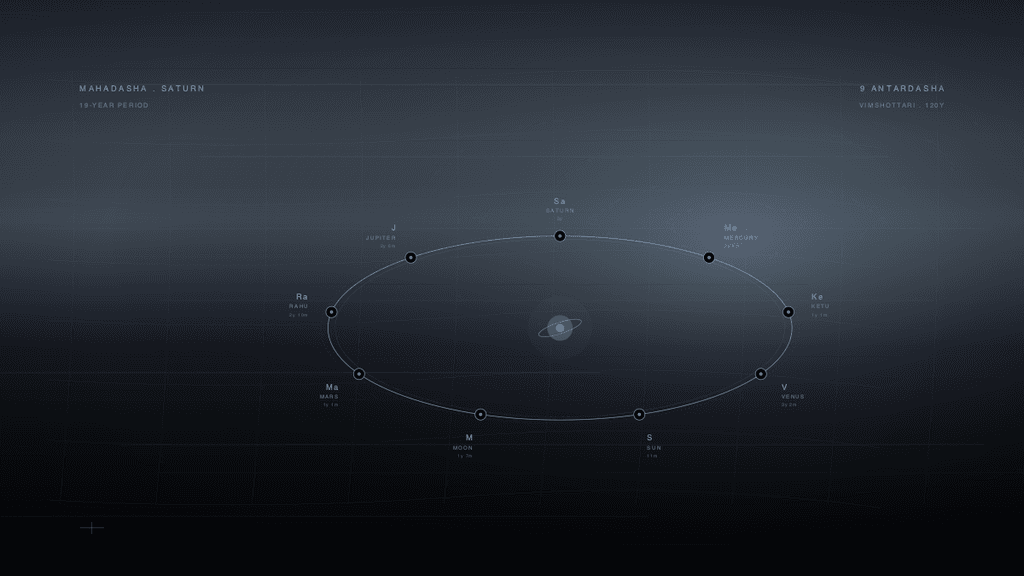
Three timing layers stack. Saturn mahadasha (the 19-year Saturn period in the Vimshottari system) directly fires the 10th-house career event during the long period. When Saturn dasha falls in midlife or later (any age 35 onwards depending on the natal Nakshatra sequence), the defining career summit typically lands within it. For the long-period reading, see the parent piece Saturn mahadasha: how to read the 19-year period. The Saturn-Saturn antardasha (the first sub-period of Saturn mahadasha) is often the structural laying of the foundation; Saturn-Mercury and Saturn-Venus sub-periods typically deliver the visible recognition events.
The 10th lord's mahadasha is the second activation. The dispositor's period fires the 10th-house themes through its own significations and house pairings. For Taurus ascendant the 10th lord is Saturn itself (already the same 19-year arc). For Aries ascendant the 10th lord is also Saturn. For other ascendants the 10th lord's dasha is a separate window; a Capricorn-ascendant native with Saturn at the 10th runs Venus mahadasha (Libra is ruled by Venus, so Venus is the 10th lord) as the secondary career activation.
Sun mahadasha is the third standard window. Sun is the karaka for authority and recognition. Sun's 6-year period fires recognition events for 10th-house Saturn placements, often delivering visible appointment, election or formal title.
Transit windows
Outside the dasha layer, the Saturn return transit is the principal long-arc career marker. Saturn return at age 29 (Saturn's first orbit back to its natal position) marks the first career re-anchoring for any chart with Saturn at the 10th. Common events at this return: first significant role, departure from an early apprenticeship into independent work, marriage-and-career consolidation. The reading is documented in the Saturn return piece.
Saturn return at age 58 marks the institutional summit. Common events at this second return: corner-office position, board appointment, published-authority status, a defining career-capstone project. The two-return pattern (29 and 58) gives the chart owner two structural inflection points spaced almost three decades apart and a chart with Saturn at the 10th reads both as career-axis events rather than personal-axis events.
Jupiter's transit through the natal 10th sign (approximately one year) provides a constructive overlay for the career and often coincides with promotion or recognition events. Saturn's transit through the natal 10th sign (approximately two and a half years) provides the structural-pressure overlay where the career structure is tested. Eclipses on the natal 10th sign or its opposite mark high-significance career inflection windows.
Tempora measurement note
The article documents the classical Saturn-in-10th reading drawn from BPHS Chapter 35, Phaladeepika Chapter 14 and Sarvartha Chintamani as the tradition's own framework. The per-ascendant variation table is reconstructed from these sources. The Tempora calibrated signature library does not currently include a labelled per-house Saturn signature scored against a chart corpus; the per-house planet placements are an open calibration question for a future study. The placement is presented here as a classical reading with its sources cited rather than as a Tempora-calibrated finding. Tempora's chart engine runs the Swiss Ephemeris with the True Pushya Paksha ayanamsa for any individual chart computation referenced in the imprint surface below.
What the reading does not predict
The classical reading is precise about disposition and timing windows but explicitly limited on three fronts. It does not predict an exact career or industry; it predicts the structural conditions under which institutional and durable careers become likely. It does not predict an exact event date; the dasha-transit overlay narrows windows to months not days. It does not predict the durability of any single position; the reading is structural disposition for the career arc as a whole, not a guarantee on any single appointment. A chart with Saturn at the 10th is not condemned to early stagnation; the reading describes a career timeline that rewards patience.
Dated activation windows for a 10th-house Saturn
Saturn is the natural significator of the 10th, so a 10th-house Saturn is a career placement working in its own domain, and the 2026 to 2028 sky times its activation by ascendant. A Gemini ascendant carries the 10th house in Pisces, where transit Saturn has sat since 20 March 2025 and stays until 23 May 2027, so this native runs a Saturn return over the career house across the window, timed by the natal degree. A Cancer ascendant places the 10th house in Aries, reached by transit Saturn on 23 May 2027, released to Pisces on 4 November 2027 and re-entered from 11 February 2028, so the return over the Karma Bhava perfects across that retrograde double pass. A Libra ascendant has the 10th house in Cancer, which exalted Jupiter crosses from 27 May 2026 to 19 June 2027, a benefic pass over standing and authority that reads as elevation rather than a Saturn contact. Under the dates runs the cadence: Saturn takes about 29.5 years to return to a sign, and its re-entry over the natal position is the same-planet contact classical practice reads as the career signature coming due. Each window times a condition already fixed in the chart, where the placement stands and the transit sets the clock. These dates mark when the theme is live rather than any settled promotion.
Frequently asked questions
What does Saturn in the 10th house mean in Vedic astrology?
Saturn in the 10th house places the natural karaka of the 10th house at its own house. The 10th house is Karma Bhava (the house of profession, public standing, action in the world, authority and reputation) and Saturn is one of its four classical karakas alongside Sun, Mercury and Jupiter. The placement is read as one of the strongest classical career configurations because the natural significator of structure, discipline and long-arc work sits at the house that measures structure, discipline and long-arc work. The reading is a defining career summit through sustained effort, typically delivered in the second half of life, with durable institutional standing as the long-term outcome. Sources: Brihat Parashara Hora Shastra Chapter 35, Phaladeepika Chapter 14, Sarvartha Chintamani.
Is Saturn in the 10th house good or bad?
Saturn in the 10th is classically a strong placement. As karaka at its own house, it delivers career durability and public standing even at moderate dignity. The reading is constructive for almost every ascendant when supported by a well-placed 10th lord and an unafflicted Sun (the natural karaka for authority). The challenging cases are narrow: severe combustion, debilitation in Aries (which only occurs at the 10th for Cancer ascendant) or the 10th lord in a dusthana. The general rule is that 10th-house Saturn slows early career and rewards late career; the chart owner builds public standing slowly and then holds it durably.
Which ascendants get the best Saturn in 10th house result?
Taurus ascendant is the exceptional case. Saturn is the yogakaraka for Taurus (rules 9th and 10th) and in the 10th sits in Aquarius (own sign) at its own house as the chart's primary Raja-yoga-karaka. This is one of the most powerful career configurations in the entire Parashari zodiac and produces durable institutional eminence over a long arc. Capricorn ascendant runs Saturn in own sign at the 10th (Libra is the 10th sign which is Venus's, not own, so Saturn sits in Libra-exalted there) wait correction: for Capricorn ascendant the 10th sign is Libra and Saturn is exalted in Libra. So Capricorn ascendant gets Saturn exalted at the 10th, which is the next-strongest case. Aquarius ascendant runs Saturn ruling lagna and 12th, sitting in Scorpio at the 10th; this is a strong lagna-lord-at-10th yoga but Saturn sits in an enemy sign so the reading is conditional on Mars (the dispositor) being well-placed.
Does Saturn in the 10th house delay career?
Saturn delays early career almost universally when it sits in the 10th. The native rarely shows early professional brilliance or rapid promotion in the first decade of working life. The pattern is a long apprenticeship, a slow climb, a mid-career consolidation between roughly 35 and 45 and a defining career summit in the second half of life that compounds for the rest of the working arc. The trade-off is that the career, when it arrives, is unusually durable. Saturn does not give a fast career. It gives a long one. The Saturn mahadasha (19 years) is the principal activation window for the defining career event when it falls in midlife or later.
What kind of career does Saturn in the 10th house give?
The most common career registers for Saturn in 10th are institutional, governmental, judicial, military, religious-institutional, academic, infrastructure, mining and heavy industry, oil and gas, engineering, construction, traditional crafts and any long-time-horizon profession. The pattern is structural rather than entrepreneurial in the fast-growth sense; even when the native runs their own business, it tends to be in a long-time-horizon domain or built up brick by brick over decades. Authority and a reputation for reliability are common outcomes. Recognition typically arrives late and is durable when it does.
When does Saturn in 10th house deliver the career event?
Three timing layers stack. Saturn mahadasha (19 years) directly fires the 10th-house career event during the long period; when this period falls in midlife or later (ages 35 onwards) the defining career summit typically lands within it. The 10th lord's mahadasha is the second activation and fires when the dispositor's period runs. Sun mahadasha is the third standard window because Sun is the karaka for authority and recognition. Outside the dasha layer, Saturn return at age 29 marks an early career re-anchoring, often a first major role; Saturn return at age 58 marks the institutional summit, often a corner-office position, a board seat or a published-authority appointment.
When is a natal Saturn in the 10th house activated in 2026 to 2028?
The window is ascendant-specific. A Gemini ascendant carries the 10th-house Saturn in Pisces and is in a Saturn return over the career house now, since transit Saturn holds Pisces from 20 March 2025 to 23 May 2027. A Cancer ascendant holds it in Aries, activated as transit Saturn enters on 23 May 2027, steps back on 4 November 2027 and returns from 11 February 2028. A Libra ascendant sees exalted Jupiter cross the 10th house from 27 May 2026 to 19 June 2027. Saturn returns to a sign about every 29.5 years, the deeper same-planet trigger. Each date is an activation window over the standing placement rather than a guaranteed career event.
- The 10th house · the deep-dive on Karma Bhava
- Saturn mahadasha · the 19-year period
- Saturn in the 9th house · long-arc dharma
- Saturn in the 11th house · the labha own-sign case
- Saturn in the 12th house · the foreign-residency case
- Saturn return · ages 29 and 58
- The 4th-10th house axis · home and career
- Career findings cluster
This article was prepared by Tempora Research as an informational piece in the Planet-in-House cluster. Methodology is documented in Tempora's research-publishing standards and reproducible against the public engine running the Swiss Ephemeris with the True Pushya Paksha ayanamsa. Internal audit log maintained. This article does not constitute medical, financial, legal or professional advice. First published 2026-06-05 by Tempora Research.