Saturn in the 9th House: Long-Arc Dharma and Father-Line Discipline
Saturn at the 9th house places the natural planet of structure on the chart's house of higher learning, long journeys, father and ethical framework. The reading is rarely about an early bright fortune. It is about a fortune that gets built. Long degrees, late residencies abroad, an institutional career with a recognisable dharmic spine and a father whose discipline becomes the chart owner's own. This piece walks through the placement classically, by ascendant, by dasha activation and by transit window.
What the 9th house carries and what Saturn does to it
The 9th house in Parashari technique is Bhagya Bhava, the house of fortune. It carries several registers at once. It is the house of higher learning beyond the immediate schooling (university, post-graduate work, scholarship), the house of long-distance travel and foreign residency, the house of the father (in most schools), the house of the ethical or religious framework the chart owner accepts and the house of the guru figure who transmits that framework. It is also a trine (trikona) and counts as one of the three dharma houses together with the 1st and 5th. The natural karaka is Jupiter, the natural planet of dharma, teaching and benevolent expansion.
Saturn is the natural planet of structure, restriction, time and durability. When Saturn occupies the 9th house, every register the 9th carries is read through Saturn's slow grammar. Higher learning becomes longer learning. Foreign moves become structured postings rather than free wanderings. The father becomes a figure of duty rather than expansion. The ethical framework becomes a discipline rather than a celebration. Fortune becomes built rather than inherited. Saturn does not destroy the 9th-house themes; it elongates them and adds weight.
The classical sources are direct on this. Brihat Parashara Hora Shastra Chapter 35 reads Saturn in the 9th as long-life-giving and dharma-deepening when supported, friction with father and orthodoxy when not. Phaladeepika Chapter 13 marks 9th-house Saturn as the placement where religious or institutional work becomes a vocation. Sarvartha Chintamani adds the timing layer: events on this house activate during Saturn periods and during the dispositor's periods.
Dignity matters: Saturn's sign at the 9th
Saturn is not exalted or in own sign at the 9th house in the natural zodiac (which would be Sagittarius, where Saturn is neutral). The placement's quality is entirely a function of the ascendant, because the ascendant determines which sign falls on the 9th. The seven situations worth knowing are the following.
- Own sign at the 9th. This happens for Taurus ascendant (Capricorn on 9th) and Gemini ascendant (Aquarius on 9th). These are the strongest cases and both produce yogakaraka-grade outcomes for Taurus.
- Exalted at the 9th. This happens for Virgo ascendant (Libra on the 2nd, but the 9th is Taurus, so this is not the case) and actually occurs only when Libra is the 9th sign, which is Aquarius ascendant. Saturn exalted in Libra at the 9th for Aquarius ascendant is the most beautifully positioned single case after Taurus yogakaraka.
- Debilitated at the 9th. This happens for Leo ascendant (Aries on 9th). Saturn debilitated in Aries at the 9th is the hardest single reading and produces the most extended delays in higher education, father-relationship friction and dharmic doubt.
- Friendly sign at the 9th. Saturn reads its dispositor as friend or foe. Saturn's friends are Mercury and Venus; its enemies are Sun, Moon and Mars. The dispositor at the 9th sets the reading's emotional grain.
- Combust Saturn. Saturn within roughly 15 degrees of the Sun at the 9th loses some structural expression. The placement reads as restriction without the durability that usually accompanies it. This is the silent under-performance pattern.
- Retrograde Saturn. Retrograde Saturn at the 9th is read as additional structural depth, often a past-life carry-forward of dharma. The native carries a worked-in discipline from the start rather than discovering it.
- Hemmed Saturn. Saturn at the 9th hemmed between malefics in the 8th and 10th reads as extreme structural pressure; the same Saturn hemmed between benefics reads as protected long-arc fortune.
Saturn in the 9th by ascendant
The reading shifts substantially with the ascendant because the ascendant determines Saturn's sign on the 9th, whether Saturn is a benefic or malefic for the chart owner and which other houses Saturn rules. The twelve-ascendant table below is the practical reading frame.
| Ascendant | 9th sign | Saturn dignity | Reading |
|---|---|---|---|
| Aries | Sagittarius | Neutral | Saturn rules 10th and 11th, both upachaya. 9th here adds dharmic-institutional career layer to Saturn's natural Karma-axis work. Reading is constructive when Jupiter (the dispositor) is well-placed. |
| Taurus | Capricorn | Own sign | Yogakaraka. Saturn rules 9th and 10th and sits at 9th in own sign. This is the strongest single case in the zodiac. Long-arc dharmic eminence, durable institutional career, father-line transmission carried forward as structural identity. |
| Gemini | Aquarius | Own sign | Saturn rules 8th and 9th and sits at 9th in Aquarius (own sign). Strong dharmic foundation through longevity-axis work; common in academic, research and institutional-religion careers. The 8th-lord layer adds a hidden or occult dimension to the dharma. |
| Cancer | Pisces | Neutral friend | Saturn rules 7th and 8th and aspects from 9th onto 3rd, 11th, 6th. Reads as a karmic-axis Saturn at the dharma house. Father relationship coloured by transformation events. Higher learning often arrives mid-career through an unusual route. |
| Leo | Aries | Debilitated | Hardest reading. Saturn debilitated in Aries at 9th, ruling 6th and 7th (a maraka). Extended delays in higher education, friction with father, dharmic doubt early. Constructive only when neecha-bhanga (debility cancellation) rules apply: Mars (Aries lord) in kendra or trinal to Saturn or in own sign. |
| Virgo | Taurus | Friendly | Saturn rules 5th and 6th, sits in Venus's sign at the 9th. Reads as creative-disciplinary dharma; common in writing, scholarship and institutional teaching. Saturn at 9th for Virgo ascendant is one of the better non-own-sign cases. |
| Libra | Gemini | Friendly | Saturn rules 4th and 5th (5th lord at 9th is dharma-dharma yoga). Reads as fortune through educated communication, publishing, institutional teaching of intellectual subjects. The father is often a teacher or scholar figure. |
| Scorpio | Cancer | Enemy sign | Saturn rules 3rd and 4th, sits in Moon's sign at 9th. Reads as friction between the emotional home base and the dharmic call to leave. Father relationship often distant in the geographical sense (father lives elsewhere or the native lives away from the father's country). |
| Sagittarius | Leo | Enemy sign | Saturn rules 2nd and 3rd, sits in Sun's sign at the 9th. Reads as authority-friction in the dharmic register. Father often a public figure or authority figure with whom the relationship carries weight. Higher learning under formal institutions rather than self-directed study. |
| Capricorn | Virgo | Friendly | Saturn rules the 1st and 2nd (lagna lord at 9th is a strong Raja yoga). Reads as long-arc dharmic identity, late but durable foreign moves, institutional career anchored in service work. The lagna lord at the 9th is one of the strongest single yogas in the Parashari list. |
| Aquarius | Libra | Exalted | Saturn rules the 1st and 12th (a maraka but also lagna lord at 9th) and sits exalted in Libra. After Taurus, this is the next-strongest case. Long-arc dharmic eminence, foreign residency as structural elevation rather than escape, father transmission carried as long-arc institutional identity. |
| Pisces | Scorpio | Enemy sign | Saturn rules 11th and 12th, sits in Mars's sign at the 9th. Reads as foreign residency through structural pressure (relocation for work, study or family obligation). Father relationship often carries an 8th or 12th-house theme (illness, distance, premature loss). Reading is conditional on Mars (the dispositor) being well-placed. |
The father reading
The 9th house in most schools of Parashari technique is the principal house of the father, with the 10th read for the father in a female chart by some teachers. Saturn at the 9th carries a recognisable father pattern. The father is read as serious, dutiful, often older than the cultural norm at the time of the native's birth, sometimes absent in a structural sense (working in another city or country, deceased early, emotionally formal). The relationship rarely reads as playful or expansive. It reads as weight. The native often carries forward the father's discipline as their own dharma whether or not the father explicitly taught it.
A debilitated Saturn here (Leo ascendant) intensifies the difficulty. The father may be ill, absent or otherwise unable to provide the structural transmission. A well-placed Saturn here (Taurus, Gemini, Aquarius ascendants) produces a father who is a durable structural anchor even when he is undemonstrative. The father's profession often involves long-time-horizon work: government service, military, traditional crafts, religious work, academia.
For deeper father-line work, the 9th lord's placement and the Sun's condition modulate the reading. The Sun is the natural karaka for father in some schools and reads in concert with the 9th. A combust or debilitated Sun together with Saturn at the 9th amplifies the difficulty signal; an exalted or own-sign Sun together with Saturn at the 9th softens it substantially.
Higher education and credentialing
Higher education is one of the strongest 9th-house registers and Saturn here reads it long-arc. The native rarely gets the early frictionless university experience. The pattern is one or more of the following: extended degrees, late start to formal higher education, mid-career master's or doctoral work, an unusual route through institutional learning (correspondence, professional certification, evening programmes alongside work). The retention is often deeper than the average peer who took the shorter path. Saturn rewards the long route with structural depth rather than the short route with surface knowledge.
The activation windows for higher-education events are Saturn dasha, the 9th lord's dasha and Jupiter dasha (Jupiter being the natural karaka). Saturn return at age 29 routinely fires a credentialing event when 9th-house Saturn is otherwise undated. The second Saturn return at age 58 fires a second credentialing pattern, often retirement-from-one-discipline-into-teaching-another.
Common career outcomes for a well-placed Saturn at the 9th include academia (teaching, research, university administration), law (especially constitutional or institutional law), religious or philosophical work in a structured tradition, foreign-service work and any career that requires sustained institutional credentialing. The less-supported placements still produce these outcomes but often at a slower timeline and with more lateral moves between disciplines before settling.
Foreign residency under structure
The 9th house is the principal house of long-distance travel and foreign residency, sharing this register with the 12th house (which is more often read for permanent settlement abroad). Saturn at the 9th reads the foreign register as structurally arrived at. The chart owner does not typically migrate on a whim. They migrate through a posting, a scholarship, a long-term employer transfer or a structured visa programme. The move often happens later than the cultural-norm age for the native's peer group. Once it happens, it tends to be durable.
For the 12th-house foreign-residency reading, see the companion piece will I settle abroad: 12th house reading. The 9th-house Saturn case is a parallel signature that delivers foreign residency through institutional structure rather than the 12th-house dissolution-of-home pattern.
Dasha activation: when 9th-house Saturn fires
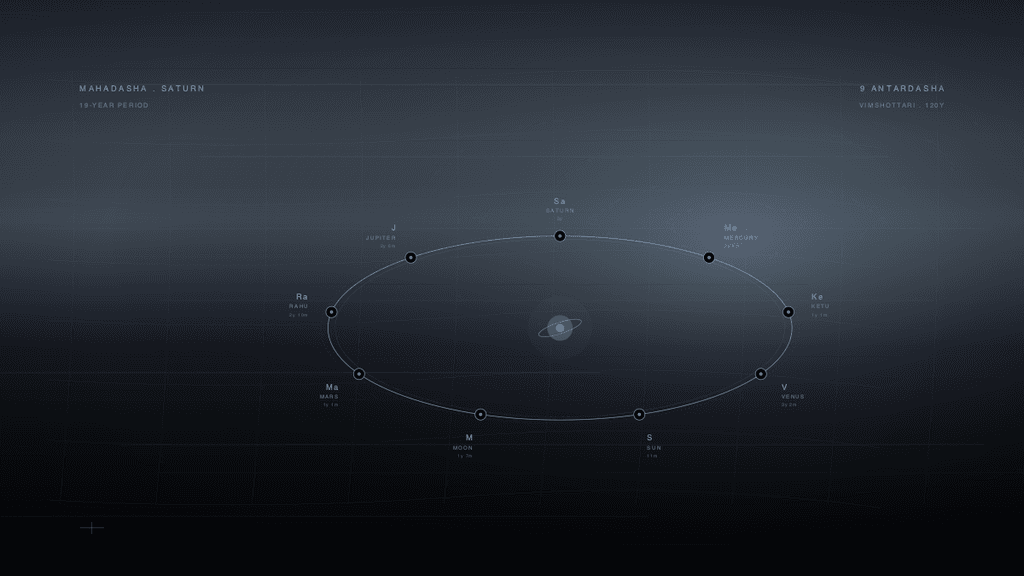
Three windows dominate. Saturn mahadasha (19 years in the Vimshottari system) directly activates the 9th-house register through the entire long period. The constructive register dominates when Saturn is well-placed at the 9th and the dispositor supports; the challenging register dominates when Saturn is afflicted, combust or debilitated. Saturn mahadasha at the 9th is the chart's principal dharmic-formation window regardless of timing. For the long-period reading, see the parent piece Saturn mahadasha: how to read the 19-year period.
The mahadasha of the 9th lord activates the same house through the dispositor's signification. For Taurus ascendant this is Saturn itself (which already runs the 19-year arc). For Gemini ascendant the 9th lord is Saturn (again the same 19-year arc). For other ascendants the 9th-lord dasha is a separate window that activates the 9th-house themes through the dispositor's house-rulership pairings. A Sagittarius-ascendant native with Saturn at the 9th (sitting in Leo) runs Sun mahadasha as the secondary 9th-house activation.
Jupiter mahadasha is the third standard activation. Jupiter is the natural karaka for the 9th house and Jupiter's 16-year period often fires 9th-house events through Saturn's structural channel when Saturn occupies the 9th. The classical pattern is dharmic credentialing during Jupiter dasha, structural delivery during Saturn dasha.
Transit windows
Outside the dasha layer, three transit patterns matter. Saturn return at age 29 (Saturn's first orbit back to its natal position) marks the long-arc dharmic re-anchoring event for any chart with Saturn at the 9th. The second return at age 58 marks the second re-anchoring, often a shift from active institutional work into teaching, advisory or mentorship roles. Both windows are documented in the Saturn return piece.
Jupiter's transit through the natal 9th sign (one full year approximately) activates the 9th-house register constructively for any chart but reads with extra weight when Saturn occupies the house. Jupiter contacts Saturn and fires the dharmic-credentialing pattern through the natural karaka. Conversely, Saturn's transit through the natal 9th sign (two and a half years) is the long-duration structural-pressure window where the dharmic framework gets tested.
Sade Sati (Saturn's seven-and-a-half-year transit through the 12th, 1st and 2nd from the natal Moon) intersects the 9th-house Saturn placement when the natal Moon is positioned such that Sade Sati moves Saturn through transit return. The activation amplifies, the structural pressure intensifies and the dharmic theme gets a forced examination. The constructive outcome for a well-placed natal Saturn is consolidation. The challenging outcome for an afflicted natal Saturn is dharmic crisis.
Tempora measurement note
The article documents the classical Saturn-in-9th reading drawn from BPHS Chapter 35, Phaladeepika Chapter 13 and Sarvartha Chintamani as the tradition's own framework. The per-ascendant variation table is reconstructed from these sources. The Tempora calibrated signature library does not currently include a labelled per-house Saturn signature scored against a chart corpus; the per-house planet placements are an open calibration question for a future study. The placement is presented here as a classical reading with its sources cited rather than as a Tempora-calibrated finding. Tempora's chart engine runs the Swiss Ephemeris with the True Pushya Paksha ayanamsa for any individual chart computation referenced in the imprint surface below.
What the reading does not say
The classical reading is precise about disposition and timing windows but explicitly limited on three fronts. It does not predict an exact event date; the dasha-transit overlay narrows windows to months not days. It does not predict a specific career or country; it predicts the structural conditions under which dharmic and foreign-residency events become likely. It does not predict the durability of any single relationship; the father-relationship reading is structural disposition and does not determine outcome on its own. A chart with Saturn at the 9th is not condemned to a hard father story. It is read as a chart that carries father-line discipline as a structural feature.
This placement across the 2026 to 2028 transits
A 9th-house Saturn holds the fortune and belief axis as a standing feature, and the 2026 to 2028 transits time its activation by ascendant. A Cancer ascendant carries the 9th house in Pisces, where transit Saturn has held since 20 March 2025 and remains until 23 May 2027, so this native is inside a Saturn return over the dharma house across the window, fixed by the natal degree. A Leo ascendant places the 9th house in Aries, reached by transit Saturn on 23 May 2027, drawn back to Pisces on 4 November 2027 and re-entered to stay from 11 February 2028, completing the return over that double pass. A Scorpio ascendant has the 9th house in Cancer, which exalted Jupiter crosses from 27 May 2026 to 19 June 2027, the natural significator of the 9th passing over it in its own exaltation, a benefic pass on fortune rather than a Saturn contact. The cadence sits under the dates: Saturn takes about 29.5 years to circle back to a sign, and its re-entry over the natal position forms the same-planet contact classical practice names as the trigger. Each window is timing over a fixed natal condition, where the placement stands and the transit only clocks it. No date here compels a particular result.
Frequently asked questions
What does Saturn in the 9th house mean in Vedic astrology?
Saturn in the 9th house (Bhagya Bhava in Sanskrit, the house of dharma and fortune) places the natural planet of structure, restriction and durability on the 9th-house register of higher learning, long-distance travel, father-line transmission, religious or philosophical practice and the chart owner's working ethical framework. The reading is long-arc: fortune that is built rather than inherited, credentialing through institutions, late or hard-won foreign residency and a father relationship coloured by duty, distance or premature responsibility. Saturn here is neither own-sign nor exaltation, so the placement's quality depends on Saturn's natal sign, the dispositor (the 9th lord) and the ascendant context. Sources: Brihat Parashara Hora Shastra Chapter 35, Phaladeepika Chapter 13.
Is Saturn in the 9th house good or bad?
The classical reading does not assign a single verdict. Saturn in 9th is constructive when the dispositor is well-placed, when Saturn sits in a friendly or own sign (Capricorn or Aquarius reach 9th only for Taurus and Gemini ascendants) and when Jupiter is unafflicted; it produces durable dharmic work, long careers in academia, law or institutional teaching and credentials that compound. It is challenging when Saturn is debilitated in Aries (only at 9th for Leo ascendant), combust or hemmed between malefics; it then reads as friction with the father, delayed or aborted higher education, restricted travel and a long phase of dharmic doubt before the structure is rebuilt.
Does Saturn in the 9th house delay higher education or travel?
Saturn slows the 9th-house registers it touches. Higher education tends to extend in time (longer degrees, late master's or doctoral work, mid-career credentialing) rather than fail; foreign travel and residency tend to arrive through structured channels (a posting, a scholarship, a long-term visa under an employer) rather than spontaneous moves. The native rarely gets the early easy 9th-house outcomes (gap-year travel, frictionless university admission, an inherited belief system) and instead earns the same outcomes on a longer timeline with deeper retention. Saturn's mahadasha and antardasha periods are the standard activation windows for these events.
What does Saturn in the 9th house say about the father?
The 9th house is the principal house of the father in Parashari technique (some schools read the 9th for father in a male chart and the 10th in a female chart). Saturn here reads the father as serious, dutiful, often older or absent in a structural sense (working abroad, ill, deceased early, emotionally formal) rather than playful or expansive. The relationship carries weight rather than warmth. A debilitated or afflicted Saturn here intensifies the distance or hardship; a well-placed Saturn here produces a father who is a structural anchor even when undemonstrative. The native often carries forward the father's discipline as their own dharma.
Which ascendants get the best Saturn in 9th house result?
Taurus ascendant is the strongest classical case. Saturn rules the 9th and 10th houses for Taurus and is a yogakaraka. Saturn in the 9th for Taurus ascendant is in own sign (Capricorn), at its own house, as the chart's primary Raja-yoga karaka. The reading is long-arc dharmic eminence, durable institutional career and a father-line structural transmission that anchors the life. Gemini ascendant is the second-strongest case: Saturn rules the 8th and 9th and in 9th (Aquarius) is in own sign at its own house, producing structurally sound dharma and longevity-axis work. For other ascendants the reading is more conditional and depends on the dispositor and the natal aspects.
When does Saturn in 9th house activate by dasha?
Three windows dominate. Saturn mahadasha (19 years) at any point in life directly activates the 9th-house register through the entire decade-and-a-half period; the constructive register dominates when Saturn is well-placed and the dispositor supports, the challenging register dominates when Saturn is afflicted or combust. The mahadasha of the 9th lord activates the same house through the dispositor's signification and house pairings. The mahadasha of Jupiter (the natural karaka for the 9th house) routinely fires 9th-house events through Saturn's structural channel when Saturn occupies the 9th. Outside dasha windows, Saturn's transit return at ages 29 and 58 marks long-arc dharmic re-anchoring moments.
When is a natal Saturn in the 9th house activated in 2026 to 2028?
It depends on the ascendant. A Cancer ascendant carries the 9th-house Saturn in Pisces and is in a Saturn return over the dharma house now, with transit Saturn in Pisces from 20 March 2025 to 23 May 2027. A Leo ascendant holds it in Aries, triggered as transit Saturn enters on 23 May 2027, retreats on 4 November 2027 and returns from 11 February 2028. A Scorpio ascendant sees exalted Jupiter cross the 9th house from 27 May 2026 to 19 June 2027. Saturn returns to a sign about every 29.5 years, the deeper same-planet trigger. Each date is an activation window over the standing placement rather than a fixed event.
- The 9th house · the deep-dive on the dharma house
- Saturn mahadasha · the 19-year period
- Saturn in the 10th house · the karma-karaka case
- Saturn in the 11th house · the labha own-sign case
- Saturn in the 12th house · the foreign-residency case
- Saturn return at 29 · the first re-anchoring
- Will I settle abroad: 12th house reading
- The 3rd-9th house axis · effort and fortune
This article was prepared by Tempora Research as an informational piece in the Planet-in-House cluster. Methodology is documented in Tempora's research-publishing standards and reproducible against the public engine running the Swiss Ephemeris with the True Pushya Paksha ayanamsa. Internal audit log maintained. This article does not constitute medical, financial, legal or professional advice. First published 2026-06-05 by Tempora Research.