Saturn in the 12th House: Foreign Discipline, Hospital and Retreat
Saturn at the 12th house puts the natural planet of structure and time at the chart's house of expenses, foreign places, hospitals and bed, retreat and moksha. The 12th is a dusthana but it is also the only house in the zodiac that measures spiritual liberation. The reading is widely misunderstood as universally bad. The classical sources read it as three principal registers that resolve very differently: long-arc foreign residency under structural channels, institutional-hospital or retreat-axis work and structural-spiritual practice that compounds over decades.
What the 12th house carries and what Saturn does to it
The 12th house in Parashari technique is Vyaya Bhava, the house of expenses. The register is wider than the literal name suggests. It carries six principal themes simultaneously: expense and loss (the financial outflow that does not return), foreign places and permanent settlement abroad, hospitals and confinement, bed and bed-pleasure (sleep, rest and intimate-partnership night-life), isolation and retreat (silence, monastic life, solitary practice) and moksha (spiritual liberation, the only positive register the 12th carries and one of the four life-goals in the classical scheme). The 12th is one of the three dusthanas (alongside the 6th and 8th) but it is the only house in the zodiac that measures liberation, which gives it a unique structural significance.
Saturn at the 12th carries the slow, structural, long-arc quality through every register simultaneously. Expense becomes structural and recurring rather than spike. Foreign residency becomes durable and institutional rather than spontaneous. Hospital and bed register becomes either profession-connected (long career in medicine, nursing, hospice or hospital administration) or personal-confinement (extended treatment, chronic conditions). Retreat becomes a sustained practice rather than a holiday. Spirituality becomes a structural discipline rather than an inspiration.
The classical sources read this carefully. Brihat Parashara Hora Shastra Chapter 35 reads Saturn in 12th as foreign-residency-giving, expense-prone, moksha-supporting when other conditions hold. Phaladeepika Chapter 14 marks 12th-house Saturn as one of the principal placements for sustained spiritual practice in those charts where the religious or philosophical layer is otherwise activated. Sarvartha Chintamani adds that the constructive and challenging registers split sharply on Saturn's dignity, the dispositor and the Jupiter condition.
The dusthana grammar and the moksha exception
The 12th is one of three dusthanas (difficult houses): the 6th (enemies, debt, disease, daily friction), the 8th (longevity, occult, secrets, sudden change) and the 12th (expense, loss, foreign, moksha). Malefics at dusthanas are classically not read uniformly negatively. Mars and Saturn at the 6th are read as vipreet-raja-yoga (reverse king-making yoga) candidates because they fight the 6th's themes from within and convert friction into outcome. Saturn at the 12th does not consistently produce vipreet-raja-yoga but it does produce a parallel pattern: structural endurance through the dissolution register, which classical literature reads as the basis for sustained spiritual practice.
The moksha register makes the 12th unique among the dusthanas. Moksha is one of the four classical life-goals (dharma, artha, kama, moksha) and the 12th is its natural house. Saturn, the natural planet of restriction-as-discipline, fits the moksha register more naturally than it fits the expense or hospital registers. A chart with Saturn at the 12th, well-disposed, with a strong Jupiter or 9th lord, often becomes a chart that converts the dusthana's loss-register into the spiritual-discipline-register. The pattern is recognised across major schools of Parashari technique.
The challenging register does not vanish because the moksha register exists. It coexists. A chart can simultaneously carry chronic expense (the negative reading) and durable retreat practice (the positive reading); the dasha-transit layer typically separates which is active at which life stage.
Per-ascendant variation
The reading shifts with the ascendant because the ascendant determines Saturn's sign at the 12th, whether Saturn is benefic or malefic for the chart owner and which other houses Saturn rules. The twelve-ascendant table below is the practical reading frame.
| Ascendant | 12th sign | Saturn dignity | Reading |
|---|---|---|---|
| Aries | Pisces | Neutral · friendly dispositor | Strongest case among non-own-sign placements. Saturn rules 10th and 11th from Aries (both upachaya), sits in Jupiter's friendly sign at 12th. Reading is gain through foreign or institutional work, durable foreign settlement, structural-spiritual practice during Saturn mahadasha. Jupiter dispositor softens Saturn humanely. |
| Taurus | Aries | Debilitated · yogakaraka | Mixed. Saturn is yogakaraka for Taurus (rules 9th and 10th) but at 12th is debilitated in Aries. The yogakaraka status partly redeems the debilitation but the placement still carries structural pressure on the foreign and expense registers. Constructive only when neecha-bhanga (debility cancellation) applies through Mars in kendra or trinal. |
| Gemini | Taurus | Friendly | Saturn rules 8th and 9th from Gemini, sits in Venus's sign at 12th. 9th lord at 12th is dharma-loss yoga with foreign-residency component. Reading is dharmic foreign residency, ashram or research-centre work abroad, sustained meditation during Saturn periods. |
| Cancer | Gemini | Friendly | Saturn rules 7th and 8th, sits in Mercury's sign at 12th. Reading is foreign residency through articulate or writing work, secrecy-axis institutional appointment, structured nightlife or sleep pattern. Common in writers, researchers and analysts with foreign components. |
| Leo | Cancer | Enemy sign | Saturn rules 6th and 7th, sits in Moon's sign at 12th. Reading is moderate. Sit in Cancer is enemy-sign; placement reads pressure on emotional foundation through expense or foreign settlement. Hospital register more often emphasised here than in other ascendants. |
| Virgo | Leo | Enemy sign | Saturn rules 5th and 6th, sits in Sun's sign at 12th. Reading is authority-friction in foreign settings, expense through children or speculation, conditional on Sun's strength. Strong when Sun is exalted or own-sign. |
| Libra | Virgo | Friendly | Saturn rules 4th and 5th, sits in Mercury's sign at 12th. Reading is analytical foreign work, research-centre or technical-institution settlement, structured rest pattern. Common in academic researchers and skilled-professional foreign settlers. |
| Scorpio | Libra | Exalted | Strong placement. Saturn exalted in Libra at 12th, ruling 3rd and 4th. Reading is foreign residency through balanced-axis or partnership work, durable institutional appointment abroad, retreat practice with strong dharmic-balance signature. Common in diplomats, balanced-partnership foreign settlers. |
| Sagittarius | Capricorn | Own sign | Strong case. Saturn in own sign Capricorn at 12th, ruling 2nd and 3rd from Sagittarius. Reading is durable foreign settlement, structural meditation practice, institutional-axis work abroad, sustained retreat during Saturn mahadasha. Own-sign Saturn at dusthana is the structural-endurance variant. |
| Capricorn | Sagittarius | Neutral · friendly dispositor | Saturn rules lagna and 2nd, sits in Jupiter's friendly sign at 12th. Lagna lord at 12th is conditional. Constructive when Jupiter is well-placed (foreign settlement carries the lagna's identity into the foreign register). Challenging when Jupiter is afflicted (identity loss in foreign settings). |
| Aquarius | Capricorn | Own sign | Strong case. Saturn in own sign Capricorn at 12th, ruling lagna and 12th from Aquarius. Lagna lord at 12th in own sign reads as identity-axis foreign settlement, structural meditation practice. Common in monastic-axis or sustained-research foreign careers. |
| Pisces | Aquarius | Own sign | Strong case. Saturn in own sign Aquarius at 12th, ruling 11th and 12th from Pisces. 11th lord at 12th is income-loss yoga at the surface but produces gain-through-foreign-channels when well-placed. Reading is durable foreign income, structural network in foreign settings, network-axis spiritual practice. |
Foreign residency under structure
Saturn in the 12th is one of the two principal signatures for permanent settlement abroad in Vedic astrology, alongside Rahu in 12th and 4th lord in 12th. The 12th-house Saturn variant reads the foreign residency as structural and durable. The native does not migrate on a whim. The move comes through one of several structured channels: a posting at an institution abroad, a long-term employer transfer, a structured visa programme (skilled-worker, scientific-researcher, institutional-religious), a sponsored academic or research appointment or a foreign settlement under formal sponsorship. The move tends to happen later than the cultural-norm age for the peer group and tends to last once it happens.
For the dedicated 12th-house foreign-settlement reading with the full multi-signature framework, see the companion piece will I settle abroad: 12th house reading. The 9th-house Saturn case is a parallel structural-foreign-residency signature; see the companion Saturn in the 9th house piece for that variant.
Hospital, bed and the medicine connection
The 12th house carries the hospital register, which Parashari technique reads two principal ways. The professional reading: a career in medicine, nursing, hospital administration, hospice, mental-health institutional work or any long-term institutional-care profession. The personal reading: extended hospital events, chronic conditions requiring institutional care, recurring confinement events. The split is set by the 12th lord (the dispositor of the hospital register), the 6th house (disease register) and the Moon condition. Saturn at 12th alone is not a hospitalisation predictor. It is a hospital-axis sensitivity marker that resolves into either profession or condition based on the broader chart.
The bed and bed-pleasure register is the third 12th-house theme. Saturn at 12th classically reads as restricted or disturbed sleep, low-frequency intimate partnership night-life (especially when Venus is also afflicted) and a structured, disciplined private life. The reading is conditional on Venus, the 7th lord and the Moon. A well-placed Venus with Saturn at 12th produces structured but durable intimate partnership. An afflicted Venus with Saturn at 12th can produce the more difficult reading. The chart's broader marriage-and-partnership layer modulates this independently.
Retreat, meditation and the moksha register
The moksha register is the 12th house's unique positive theme and Saturn here matches it more naturally than any other planet. Saturn's nature is structure, restriction, discipline and time. Sustained spiritual practice requires the same. The classical pattern: a chart with Saturn at the 12th, well-disposed, with a supportive Jupiter or 9th lord, produces a long-arc meditation, retreat or monastic-axis practice that compounds over decades. The native may not announce this as a spiritual identity; the practice often runs alongside an institutional career rather than replacing it.
Specific examples of the constructive reading from classical literature: sustained daily meditation practice that develops over decades, monastic vocation in a structured tradition (Vedic, Buddhist, Christian-monastic, Sufi), long retreats undertaken seriously rather than touristically, research-axis spiritual scholarship (academic study of religious traditions as practice rather than as field) and any structured contemplative life. The Saturn mahadasha period is the principal activation window for these patterns; the 19-year arc gives enough time for the practice to develop a structure of its own.
Dasha activation: when 12th-house Saturn fires
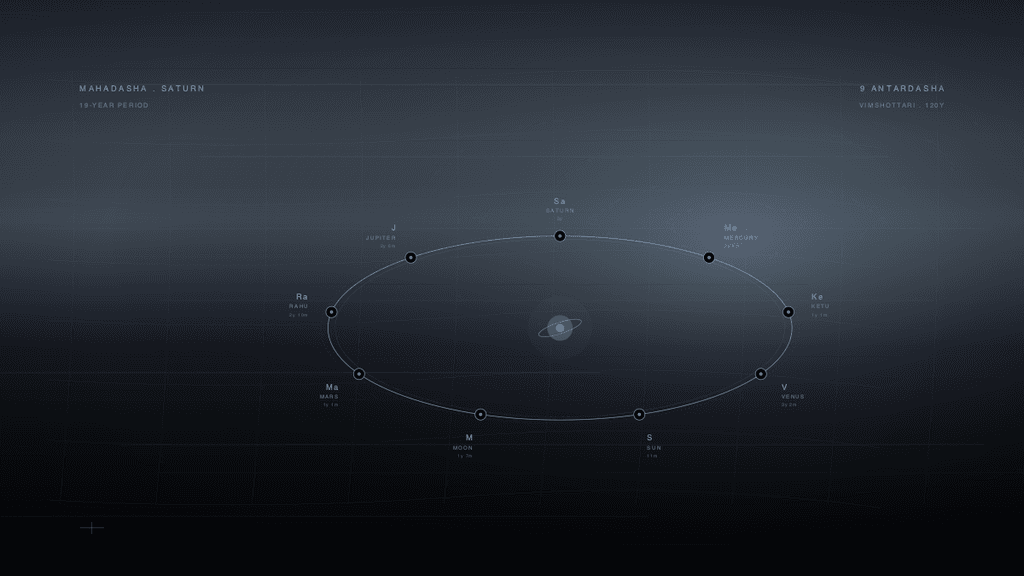
Three windows dominate. Saturn mahadasha (the 19-year Saturn period in the Vimshottari system) is the principal activation window for the 12th-house themes. The chart owner running Saturn mahadasha with Saturn at the 12th typically sees the period as the long-arc structural-foreign-spiritual window of the life. Common events include foreign relocation under a structural channel, deepening meditation or retreat practice, institutional-hospital appointment, sleep-and-rest pattern restructuring and quiet structural expense (e.g. long-term housing payments, sustained tuition, charitable commitments). For the long-period reading, see Saturn mahadasha: how to read the 19-year period.
The 12th lord's mahadasha is the second activation. The dispositor's period fires the 12th-house themes through its own signification. For Sagittarius ascendant the 12th lord is Saturn itself (same 19-year arc). For Aquarius ascendant the 12th lord is also Saturn. For other ascendants the 12th-lord dasha is a separate window; an Aries-ascendant native with Saturn at the 12th runs Jupiter mahadasha (Pisces is ruled by Jupiter, the 12th lord) as the secondary 12th-house activation.
Jupiter mahadasha is the third standard window. Jupiter is the natural karaka for moksha (the 12th's principal positive register) and Jupiter's 16-year period routinely fires constructive 12th-house events for any chart, more so when Saturn occupies the house. The Saturn-Jupiter and Jupiter-Saturn antardasha periods are the most frequently cited single windows for major foreign or spiritual events.
Transit windows
Outside the dasha layer, three transit patterns matter. Saturn return at age 29 (Saturn's first orbit back to its natal position) marks the first foreign-or-retreat re-anchoring for charts with Saturn at the 12th. Common events: first major foreign relocation, decision to take long-term meditation seriously, first institutional-hospital appointment, structural decision about private life and rest pattern. Saturn return at age 58 marks the second re-anchoring, often a deepening of the retreat or moksha register, retirement-into-spiritual-practice or a formal monastic step.
Jupiter's transit through the natal 12th sign (approximately one year) provides a constructive overlay for the spiritual and foreign registers and often coincides with formalisation of long-running practice or visible deepening of foreign-residency arrangements. Saturn's transit through the natal 12th sign (approximately two and a half years) provides the long-duration structural-test window. Eclipses on the natal 12th sign or its opposite mark high-significance inflection windows for the 12th-house themes.
Sade Sati (Saturn's seven-and-a-half-year transit through the 12th, 1st and 2nd from the natal Moon) intersects the 12th-house Saturn placement when the natal Moon is at the right position. The Sade Sati of a chart with natal Saturn at the 12th often coincides with the most structurally significant foreign or retreat event of the life. The constructive outcome is consolidation. The challenging outcome is the extended dusthana register firing across an extended time.
Tempora measurement note
The article documents the classical Saturn-in-12th reading drawn from BPHS Chapter 35, Phaladeepika Chapter 14 and Sarvartha Chintamani as the tradition's own framework. The per-ascendant variation table is reconstructed from these sources. The Tempora calibrated signature library does not currently include a labelled per-house Saturn signature scored against a chart corpus; the per-house planet placements are an open calibration question for a future study. The placement is presented here as a classical reading with its sources cited rather than as a Tempora-calibrated finding. Tempora's chart engine runs the Swiss Ephemeris with the True Pushya Paksha ayanamsa for any individual chart computation referenced in the imprint surface below.
What the reading does not predict
The classical reading is precise about disposition and timing windows but explicitly limited on three fronts. It does not predict an exact foreign country, hospital event or spiritual tradition; it predicts the structural conditions under which foreign-residency, hospital-axis and retreat events become likely. It does not predict an exact event date; the dasha-transit overlay narrows windows to months not days. It does not predict moksha as an outcome. Moksha is a structural register the placement carries; whether the chart owner realises it is a question of personal practice, not of natal disposition. A chart with Saturn at the 12th is not condemned to loss. The reading describes a structural sensitivity to the 12th's registers that resolves constructively or challengingly based on the broader chart context.
This 12th-house Saturn in the moving sky of 2026 to 2028
A 12th-house Saturn holds the expense, retreat and foreign axis as a standing condition, and the 2026 to 2028 transits time when it is activated by ascendant. An Aries ascendant carries the 12th house in Pisces, where transit Saturn has sat since 20 March 2025 and stays until 23 May 2027, so this native runs a Saturn return over the Vyaya Bhava across the window, with the exact contact fixed by the natal degree. A Taurus ascendant places the 12th house in Aries, reached by transit Saturn on 23 May 2027, released to Pisces on 4 November 2027 and re-entered from 11 February 2028, so the return over the loss-and-liberation house perfects across that retrograde double pass. A Leo ascendant has the 12th house in Cancer, which exalted Jupiter crosses from 27 May 2026 to 19 June 2027, a benefic pass over the retreat house that reads as relief on the expense-and-solitude register rather than a Saturn contact. Beneath the dates runs the cadence: Saturn takes about 29.5 years to return to a sign, and its re-entry over the natal position forms the same-planet contact classical practice reads as the placement coming forward. Each window times a condition already fixed in the chart, where the natal Saturn stands and the transit only sets the clock. None of these dates decides a specific outcome on its own.
Frequently asked questions
What does Saturn in the 12th house mean in Vedic astrology?
Saturn in the 12th house (Vyaya Bhava in Sanskrit, the house of expenses, foreign places, hospital and bed, retreat, meditation, isolation and moksha) places the natural planet of structure and time at the chart's house of dissolution and transcendence. The 12th is a dusthana (a difficult house), but it is also the house of moksha (spiritual liberation) and the natural house of Pisces. Saturn at the 12th reads three principal registers: long-arc foreign residency through structural channels, institutional-hospital or retreat-axis work and structural-spiritual practice that compounds over decades. The placement is widely misunderstood as universally bad; the classical sources distinguish constructive and challenging registers carefully.
Is Saturn in the 12th house good or bad?
The classical reading is conditional. Saturn in 12th is constructive when the dispositor (the 12th lord) is well-placed, when Saturn is in a friendly or own sign and when Jupiter or the Moon supports the placement. The constructive register produces durable foreign residency, structural meditation or retreat practice, institutional work in hospitals, ashrams or research centres and a recognised contribution in fields requiring sustained solitude (research, scholarship, monastic-axis work). The challenging register dominates when Saturn is debilitated in Aries (only at 12th for Taurus ascendant), combust or hemmed between malefics. The challenging reading is chronic expense, isolation without practice, hospital confinement, foreign losses or sleep and rest disturbance. The placement is rarely a universally bad signature.
Does Saturn in the 12th house mean settling abroad?
Saturn in the 12th is one of the standard signatures for permanent settlement abroad in Vedic astrology. The 12th house is the principal house of foreign places (sharing this register with the 9th, which is long-distance travel more broadly). Saturn at the 12th reads the foreign residency as structural and durable rather than spontaneous: a posting at an institution abroad, a long-term employer transfer, a structured visa programme like skilled-worker or scientific-researcher channels or a foreign settlement under formal sponsorship. The move tends to happen later than the cultural-norm age for the peer group and tends to last once it happens. For the dedicated 12th-house foreign-settlement reading see the companion piece will-i-settle-abroad-12th-house.
What about hospital and bed-pleasure with Saturn in 12th?
The 12th house carries the hospital and bed register, which Parashari technique reads three ways. The hospital register reads as either professional connection to hospitals (a career in medicine, nursing, hospital administration, hospice or institutional-care work) or as personal hospital events (extended treatment, chronic conditions requiring institutional care). The bed-pleasure register reads as the quality of rest, sleep and intimate-partnership night-life. Saturn at 12th can produce restricted or disturbed sleep, low conjugal activity (especially when Venus is also afflicted) or simply a disciplined, structured private life. The hospital event reading is conditional on the 12th lord, the Moon and the 6th house all being assessed together; Saturn at 12th alone is not a hospitalisation predictor.
Which ascendants get the best Saturn in 12th house result?
Aries ascendant gets the strongest case. Saturn rules 10th and 11th from Aries and at the 12th sits in Pisces (Jupiter's sign, friendly to Saturn). The reading is gain through foreign or institutional work, durable foreign settlement under structural channels and a constructive interpretation of the 12th's themes. Sagittarius ascendant gets Saturn in own sign Capricorn at the 12th house, which is structurally durable; Saturn rules 2nd and 3rd from Sagittarius. The classically difficult case is Taurus ascendant where Saturn is debilitated in Aries at the 12th and is the yogakaraka; the yogakaraka status partly redeems the debilitation but the reading still carries structural pressure on the foreign and expense registers.
When does Saturn in 12th house activate by dasha?
Saturn mahadasha (19 years) is the principal activation window for the 12th-house themes. The chart owner running Saturn mahadasha with Saturn at the 12th house typically sees the period as the long-arc structural-foreign-spiritual window of the life. Common events: foreign relocation under structural channel, deepening meditation or retreat practice, institutional-hospital appointment, sleep-and-rest pattern restructuring. The 12th lord's mahadasha is the second activation and fires when the dispositor's period runs. Jupiter mahadasha is the third standard window because Jupiter is the natural karaka for moksha (the 12th's principal positive register) and Jupiter's transit activations through the natal 12th sign constructively overlay any Saturn placement there.
When is a natal Saturn in the 12th house activated in 2026 to 2028?
The window is ascendant-specific. An Aries ascendant carries the 12th-house Saturn in Pisces and is in a Saturn return over the expense house now, since transit Saturn holds Pisces from 20 March 2025 to 23 May 2027. A Taurus ascendant holds it in Aries, activated as transit Saturn enters on 23 May 2027, steps back on 4 November 2027 and returns from 11 February 2028. A Leo ascendant sees exalted Jupiter cross the 12th house from 27 May 2026 to 19 June 2027. Saturn returns to a sign about every 29.5 years, the deeper same-planet trigger. Each date is an activation window over the standing placement rather than a fixed event.
- The 12th house · the deep-dive on Vyaya Bhava
- Saturn mahadasha · the 19-year period
- Will I settle abroad: 12th house reading
- Saturn in the 9th house · long-arc dharma
- Saturn in the 10th house · karma-karaka
- Saturn in the 11th house · sustained-network gains
- Saturn return · ages 29 and 58
- The 6th-12th house axis · friction and dissolution
This article was prepared by Tempora Research as an informational piece in the Planet-in-House cluster. Methodology is documented in Tempora's research-publishing standards and reproducible against the public engine running the Swiss Ephemeris with the True Pushya Paksha ayanamsa. Internal audit log maintained. This article does not constitute medical, financial, legal or professional advice. First published 2026-06-05 by Tempora Research.