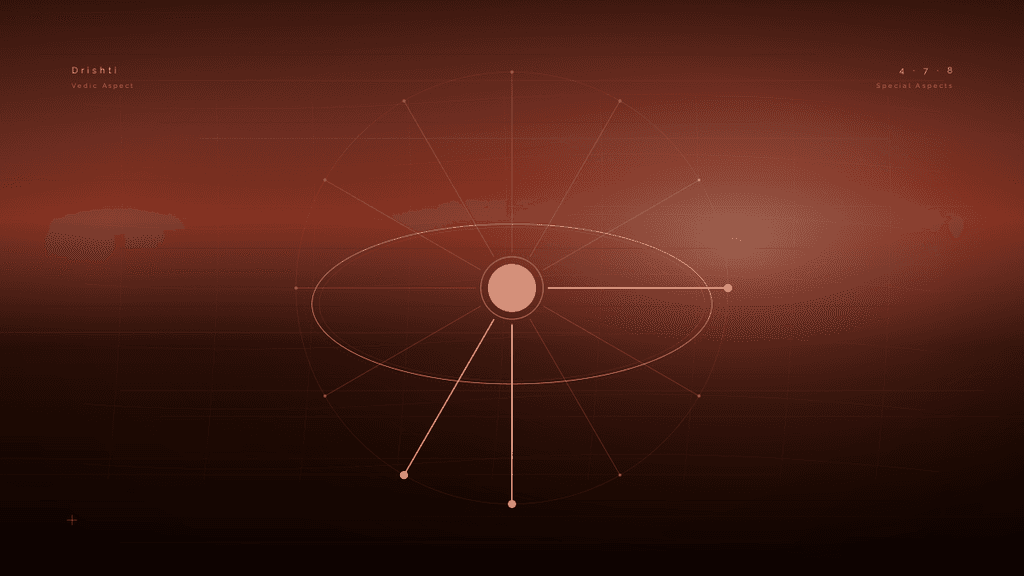
Saturn aspect on natal planets: the structural 3rd, 7th and 10th drishti
Every planet aspects the 7th house from itself. Saturn, Mars and Jupiter also cast special aspects to specific additional houses. Saturn's special aspect reaches the 3rd and 10th houses on top of the 7th, and because Saturn is the significator of structure, discipline and time, its aspect does not damage the planet it touches so much as test it. This page covers the Saturn aspect planet by planet, what it disciplines, what it does not predict, and where transit Saturn aspects natal planets from 2025 to 2028.
The aspect framework for Saturn
A planet in classical Vedic astrology influences the house it sits in and the houses it aspects (drishti). All planets aspect the 7th from themselves. Three planets have additional special aspects: Jupiter to the 5th and 9th, Mars to the 4th and 8th, and Saturn to the 3rd and 10th.
The 3rd is the house of effort, courage and self-driven action; the 10th is the house of career, public standing and duty. Saturn, the significator of sustained work, discipline and karmic consequence, casting its special aspect onto the effort-and-career axis is coherent in the classical scheme: the planet of structured labour reinforces the houses of labour and standing wherever it looks. Saturn's aspect on the 3rd and 10th is why a well-placed Saturn is a career-building and sustained-effort signature.
What Saturn actually does to a planet it aspects
Saturn's aspect is the most demanding of the special aspects, but demanding is not the same as damaging. Where Jupiter's aspect blesses and Mars's aspect forces, Saturn's aspect tests. The classical reading has four consistent effects:
1. Delay. Whatever the aspected planet signifies tends to arrive later, slower and after more effort than it otherwise would. Saturn's aspect on the 5th-house lord can delay children; on Venus it can delay or mature marriage; on the 10th lord it slows early career before building a durable one.
2. Discipline. The aspected planet's domain is forced into structure, routine and seriousness. Saturn's aspect on Mercury produces methodical, rigorous thinking; on Mars it produces controlled, strategic rather than impulsive action. The aspect removes the easy and the frivolous.
3. Maturation and durability. What Saturn's aspect delays, it also makes last. The aspected planet's domain, once it develops, tends to be stable, tested and hard to dislodge. Saturn builds slowly but permanently. A career, relationship or skill developed under a Saturn aspect is typically more durable than one that came easily.
4. Weight and seriousness. The aspected planet carries a sober, responsible, sometimes heavy quality. There can be a felt sense of duty, limitation or burden attached to the domains the planet governs.
The one caution: an afflicted or debilitated Saturn aspecting an already-weak planet can tip from testing into genuine suppression. The difference between a Saturn aspect that matures and one that suppresses is Saturn's own dignity and the aspected planet's underlying strength.
Planet-by-planet Saturn aspect signatures
The Saturn aspect reads differently depending on which planet receives it, because Saturn disciplines whatever the aspected planet governs.
Saturn aspect on the Sun
Tests authority. The native's leadership and self-expression develop late and through sustained effort, often against early obstruction. The father-relationship can carry distance, duty or delay. Strong signature for earned rather than inherited authority, for institutional and administrative roles, and for authority that is respected because it was built slowly. The caution is early self-doubt or a heavy father-theme.
Saturn aspect on the Moon
Disciplines the emotional life. Saturn aspecting the Moon reads as emotional seriousness, self-containment and a tendency toward caution or melancholy. This is a classical signature to name honestly: it can carry a weight on the mind and mother-theme. But it also produces emotional maturity, resilience and the capacity to hold difficulty. The maturation is real; so is the initial heaviness.
Saturn aspect on Mars
Controls the force. Mars aspected by Saturn acts with discipline, patience and strategy rather than impulse. The classical Saturn-Mars combination is friction between the accelerator and the brake, but channelled it produces controlled power: engineers, surgeons, disciplined athletes, strategic operators. Uncontrolled it produces frustration, stop-start action, or suppressed anger. Channelling is the whole game with this aspect.
Saturn aspect on Mercury
Structures the intellect. Mercury aspected by Saturn thinks methodically, rigorously and in depth rather than quickly. Strong signature for research, systems, law, mathematics, disciplined writing and any field rewarding sustained precision over speed. The caution is over-caution or pessimism in thinking, and slower verbal or commercial reflexes.
Saturn aspect on Venus
Matures relationship and pleasure. Venus aspected by Saturn reads as delayed or serious relationships, loyalty and commitment over romance, and often a significant age or status difference with partners. Marriage tends to come later and last longer. Strong signature for durable partnership and disciplined artistry. The caution is emotional reserve or a felt scarcity in the pleasure-and-affection register early in life.
Saturn aspect on Jupiter
Grounds the expansion. Jupiter aspected by Saturn has its optimism and growth tempered by realism and structure. Reads as patient, principled, long-horizon building: institution-builders, sustained scholars, ethical administrators. The benefic expansion of Jupiter is made durable by Saturn's structure. The caution is that faith can be shadowed by doubt, and growth can feel effortful rather than graceful.
Saturn aspect on Rahu
Disciplines the amplifier. Rahu aspected by Saturn has its boundary-pushing ambition slowed and structured. Reads as sustained, patient worldly ambition that builds over decades rather than seeking shortcuts, or as ambition repeatedly tested by obstruction before it succeeds. The classical note is that Saturn on Rahu can produce either a disciplined long-game operator or a chronically-frustrated striver, depending on Saturn's dignity.
Saturn aspect on Ketu
Deepens the detachment into discipline. Ketu aspected by Saturn reads as serious, austere spirituality, renunciate discipline, or a felt weight in the Ketu-house domains. Strong signature for genuine ascetic practice and sustained inner work rather than passing detachment.
The effort-and-career reinforcement reading
Because Saturn aspects the 3rd and 10th (effort and career) plus the 7th, a well-placed Saturn tends to reinforce the work-and-standing axis of the chart from wherever it sits. This is why Saturn, despite its difficult reputation, is a genuine career-builder: its aspect onto the 10th house of profession, and onto the 3rd house of self-driven effort, applies exactly the discipline those houses reward. A strong Saturn casting its aspect onto the career and effort houses is one of the most reliable sustained-achievement signatures in the classical scheme.
This is the constructive face of Saturn's aspect: the same testing that feels like obstruction in youth becomes the durability and standing of a built career in maturity. Saturn's aspect rewards the long game.
What strengthens (and what to watch) with a Saturn aspect
The Saturn aspect matures cleanly when: Saturn is in its own sign (Capricorn, Aquarius) or exaltation (Libra); Saturn is unretrograde and uncombust; and the aspected planet has underlying strength (Saturn tests strength into durability; it can suppress genuine weakness). A dignified Saturn aspect is a build signature.
The Saturn aspect suppresses rather than matures when: Saturn is debilitated (Aries) or combust; Saturn is the functional malefic for that ascendant; or the aspected planet is already weak or afflicted, so the test becomes too heavy to pass. Read Saturn's dignity and the aspected planet's strength before deciding whether the aspect builds or burdens.
What the Saturn-aspect reading does not predict
- Not damage or failure. Saturn's aspect delays and tests; it does not doom the aspected planet. The domains it touches typically succeed late and durably rather than not at all.
- Not a substitute for the aspected planet's own condition. A strong planet under a Saturn aspect matures into durability; a weak one can be suppressed. The aspect modifies; the planet's own strength decides the direction.
- Not a timing signal by itself. The aspect is a standing birth-chart feature. When its testing and its eventual maturation show up is a dasha-and-transit question.
- Not uniformly difficult. For ascendants where Saturn is a yogakaraka or functional benefic (Taurus and Libra risings), the Saturn aspect is a strongly favourable build signature, not a burden. Read Saturn's functional role first.
When the Saturn aspect activates in the life
A natal Saturn aspect is always present, but its effect is foregrounded during the mahadasha or antardasha of Saturn; during the period of the aspected planet; during Sade Sati and the Saturn return; and when transit Saturn activates the natal Saturn or the aspected planet. The testing phase and the maturation phase are often separated by years: the discipline is felt first, the durability arrives later, usually across a full Saturn period or return cycle.
How Tempora computes the Saturn aspect
Tempora's engine computes Saturn's special aspect by sign-count under whole-sign drishti: Saturn aspects the 3rd, 7th and 10th signs from the sign it occupies. Saturn's aspect is classically held to be strongest of all the special aspects (full strength on all three), so the engine does not discount the 3rd or 10th relative to the 7th. Saturn's own dignity (own-sign, exalted, debilitated, combust, retrograde) weights the reading, so a debilitated Saturn's aspect is read as heavier and less constructive than a dignified Saturn's.
Transit Saturn across the natal planets, 2025 to 2028
Transit Saturn carries the same 3rd, 7th and 10th aspect. As Saturn moves slowly (2.5 years per sign), its aspect rests on the same natal planets for long stretches, delivering sustained discipline to specific chart houses. The 2025 to 2028 walk (engine-computed under True Pushya Paksha):
| Period | Transit Saturn sign | Aspects (3rd/7th/10th from it) |
|---|---|---|
| 20 Mar 2025 to 23 May 2027 | Pisces | Taurus, Virgo, Sagittarius |
| 23 May 2027 to 4 Nov 2027 | Aries (debilitated) | Gemini, Libra, Capricorn |
| 4 Nov 2027 to 11 Feb 2028 | Pisces (retrograde return) | Taurus, Virgo, Sagittarius |
| From 11 Feb 2028 | Aries | Gemini, Libra, Capricorn |
Natives with natal planets in the aspected signs receive a sustained transit-Saturn discipline for the duration of that leg. Because Saturn is slow, these are multi-year testing windows, not brief passes. The full walk with retrograde dates is in Saturn transit 2027 and the multi-year Saturn transit 2025 to 2028 calendar. The Moon-count version of Saturn's transit pressure is Sade Sati.
Conclusion
The Saturn aspect is the classical toolkit's testing-and-building signature. It delays, disciplines and matures the planet it touches, making that planet's domain slower, more serious and ultimately more durable, all subject to Saturn's own dignity and functional role for the ascendant. Read it as the structural counterweight to Jupiter's blessing, and remember that what Saturn's aspect delays, it also makes last.
Frequently asked questions
Which houses does Saturn aspect?
Saturn aspects the 3rd, 7th and 10th houses (or signs, under whole-sign drishti) counted from its own position. Every planet aspects the 7th; Saturn's special additional aspects are the 3rd and 10th, the effort-and-career axis. Saturn's aspect is classically held to be full-strength on all three houses.
Is a Saturn aspect always bad?
No. Saturn's aspect tests rather than damages: it delays, disciplines and matures the aspected planet, making its domain slower to develop but more durable once it does. For ascendants where Saturn is a yogakaraka or functional benefic (Taurus and Libra risings), the Saturn aspect is a strongly favourable build signature. The aspect suppresses rather than matures only when Saturn is debilitated or combust, or when the aspected planet is already weak.
What does Saturn aspecting the Moon mean?
Saturn aspecting the Moon disciplines the emotional life. It reads as emotional seriousness, self-containment and a tendency toward caution, sometimes with an early heaviness on the mind or mother-theme. But it also produces emotional maturity, resilience and the capacity to hold difficulty. The initial weight is real; so is the maturation that follows.
Why is Saturn a career-builder despite its reputation?
Because Saturn's special aspects fall on the 3rd house of self-driven effort and the 10th house of career and public standing. Saturn applies exactly the discipline those houses reward. A well-placed Saturn casting its aspect onto the career and effort houses is one of the most reliable sustained-achievement signatures in the classical scheme: the same testing that feels like obstruction in youth becomes durable standing in maturity.
How is the Saturn aspect different from the Jupiter and Mars aspects?
All three cast special aspects but in opposite registers. Saturn aspects the 3rd, 7th and 10th and its register is structural pressure: it disciplines, delays and matures. Jupiter aspects the 5th, 7th and 9th and its register is benefic: it blesses, expands and protects. Mars aspects the 4th, 7th and 8th and its register is force: it energises, agitates and pushes to action. Saturn tests where Jupiter cushions.
Where does transit Saturn aspect through 2028?
Transit Saturn carries the same 3rd, 7th and 10th aspect and moves slowly (2.5 years per sign), so these are multi-year windows. From Pisces (20 March 2025 to 23 May 2027) it aspects Taurus, Virgo and Sagittarius. From Aries (23 May 2027, with a retrograde return to Pisces November 2027 to February 2028) it aspects Gemini, Libra and Capricorn. Natives with natal planets in those signs get a sustained transit-Saturn discipline for the whole leg.
Read next
- Jupiter aspect on natal planets · the benefic 5th, 7th and 9th drishti
- Mars aspect on natal planets · the force 4th, 7th and 8th drishti
- Rahu aspect on natal planets · the amplifier aspect
- Aspect strength by degree · how orb changes the reading
- Saturn transit 2027 · where transit Saturn aspects across the year
- Sade Sati · the Moon-count version of Saturn's transit pressure
This article was first published on 30 July 2026. It documents conventional Vedic teaching on Saturn's structural drishti onto natal planets (3rd, 7th and 10th aspects) and Tempora Research's aspect reading method. Internal audit log maintained for methodology revisions; any subsequent material change to the framework above will be appended here with a dated note. This article represents conventional Vedic teaching and Tempora Research method documentation. It does not constitute medical, financial, legal or professional advice.