Rahu in Vedic Astrology: The Complete Guide to the North Node
Rahu is the north lunar node, the point where the Moon's orbit crosses the ecliptic going north. It is a computed point rather than a body, which is why the tradition calls it a shadow planet, and why every rule written for the seven visible grahas has to be adapted before it applies. This page covers what Rahu signifies, how a body that lords no sign is actually read, the eighteen-month transit register, the eclipse geometry that gives the nodal axis its name and the dated nodal calendar through 2028.
What Rahu signifies
The Moon's orbit is tilted by about five degrees to the plane of the Earth's orbit around the Sun. Two planes that are not parallel intersect in a line, and that line meets the zodiac at two opposite points. The northward crossing is Rahu; the southward crossing is Ketu. Nothing occupies either point. They are geometry, and the classical name chhaya graha, shadow planet, records exactly that.
Classical significations attached to Rahu include: amplification, appetite, ambition, foreign countries and foreign languages, the unfamiliar and the unassimilated, technology and machinery, mass communication, crowds, smoke and vapour, poisons and pharmacology, gambling and speculation, illusion, disguise, sudden elevation, sudden reversal, research into what is hidden plus any domain where the operative mode is wanting more of something.
The through-line in that list is hunger rather than harm. Rahu marks where a chart reaches for what it does not already have, which is why the same placement is described in the classical texts as both the seat of worldly attainment and the seat of dissatisfaction. Both descriptions follow from one mechanism: an appetite that grows by being fed. The Rahu aspect on natal planets page works through this planet by planet, showing how the amplification register lands differently on Guru than it does on Shukra or Chandra.
Rahu is classically grouped with the natural malefics alongside Mars, Shani and Ketu. As with Shani, malefic here names a method rather than an outcome. It means the body operates through disruption of the settled state. A well-placed Rahu produces expansion signatures that no benefic can produce; a poorly-placed one produces scattered signatures. Category alone decides nothing.
Rahu and rulership: reading a body that lords no sign
Here the nodes break the standard machinery. In the Parashari scheme every graha owns one or two signs, and the houses those signs occupy from the ascendant are what convert a generic planet into a chart-specific reading. Rahu owns nothing. There is no honest twelve-ascendant lordship table for it, and any table that offers one has invented the rows.
What the tradition uses instead is a stack of three substitutes, applied in order.
The occupied sign. Rahu is widely described as taking on the character of the sign it sits in, more completely than any true planet does. A Rahu in a Shani sign runs the Shani register at Rahu volume; a Rahu in a Kuja sign runs the Mars register the same way. This is the first and strongest of the three substitutes.
The dispositor. The lord of the sign Rahu occupies carries the reading forward. Rahu currently sits in Aquarius, so its dispositor is Shani, and the condition of Shani becomes the condition of Rahu's expression. Where the dispositor is strong and well-placed, the tradition reads Rahu's amplification as channelled into a defined domain; where the dispositor is weak or afflicted, the same amplification is read as diffuse. Because Shani is itself moving through the Saturn transit calendar, the dispositor reading is not static.
The house. Whichever house Rahu falls in from the ascendant supplies the life area. The twelve house-placement pages cover this in full, from Rahu in the 1st house through the 7th, the 10th and the 12th.
Two further points where schools genuinely differ, stated as disputes rather than settled facts. Some later lineages assign Rahu a co-lordship of Aquarius alongside Shani, and Ketu a co-lordship of Scorpio alongside Kuja; the older Parashari material does not, and Tempora does not compute with it. Exaltation is similarly unsettled: Taurus and Gemini are both defended for Rahu in the printed tradition, with Scorpio and Sagittarius as the matching claims for Ketu. Where a source states one of these as fact without naming the alternative, the source is compressing a live disagreement.
Where Rahu falls for each ascendant right now
Since Rahu carries no fixed lordship, the useful twelve-ascendant table is the one computed from its actual position. As of 6 August 2026 Rahu sits at roughly 7 degrees of sidereal Aquarius, in Shatabhisha nakshatra, with Ketu opposite at the same degree of Leo. Whole-sign counting from each lagna converts that single position into twelve different house readings.
| Ascendant | Rahu (Aquarius) | Ketu (Leo) | Axis register |
|---|---|---|---|
| Aries | 11th | 5th | Networks and gains against creative output |
| Taurus | 10th | 4th | Public role against home and inner base |
| Gemini | 9th | 3rd | Belief and distance against near effort |
| Cancer | 8th | 2nd | Shared resources against owned resources |
| Leo | 7th | 1st | Partnership against the body and self-presentation |
| Virgo | 6th | 12th | Work and competition against retreat |
| Libra | 5th | 11th | Creation and speculation against collective gain |
| Scorpio | 4th | 10th | Roots against career visibility |
| Sagittarius | 3rd | 9th | Initiative and voice against inherited belief |
| Capricorn | 2nd | 8th | Income and speech against shared and hidden assets |
| Aquarius | 1st | 7th | Rahu on the lagna, Ketu on the partnership axis |
| Pisces | 12th | 6th | Foreign and unseen against daily work |
Two caveats sit on that table. Whole-sign house counting is the convention here; Placidus or Shripati cusps place a node near a house boundary differently. And on 27 December 2026 the whole column steps back one house, as Rahu moves to Capricorn and Ketu to Cancer, which is the subject of Rahu in Capricorn and Ketu in Cancer.
Rahu transit
Rahu holds each sign for roughly eighteen months, and the pair completes a full circuit of the zodiac in about eighteen and a half years. That places nodal transit between the two-and-a-half-year Shani register and the roughly one-year Guru register in duration, long enough to shape a chapter but short enough that most adults live through a dozen of them.
The structural fact that distinguishes nodal transit from every planetary transit is direction. The nodes regress: they move backwards through the zodiac, entering Aquarius from Pisces, then Capricorn, then Sagittarius. This is not a periodic loop of the kind Mercury or Shani make. The Moon's orbital plane itself precesses westward against the stars, so the crossing points travel backwards continuously. A retrograde planet is temporarily reversed; the nodes are structurally reversed, and that difference is why the tradition reads the nodal sequence as unwinding rather than advancing.
One honest qualification. The mean node regresses smoothly, while the true node wobbles around that mean and can briefly edge forward. Tempora computes with mean node motion, which is why an ingress dated here may sit a few days from the same ingress dated by a true-node source. The full transit mechanics, with the aspect maps and the sign-by-sign reading, are at Rahu and Ketu transit, and the year-specific treatment at Rahu and Ketu transit 2027.
On aspects the corpus follows the convention that the nodes cast the 5th and 9th aspects in addition to the 7th, mirroring Guru's special aspects. This is taught in many Parashari and Jaimini lineages; the conservative teaching restricts the nodes to the 7th aspect only. The convention in use is stated wherever it is applied rather than assumed. General transit-reading mechanics, including the two counting registers from the lagna and from the natal Moon, are at the gochar hub.
Rahu and eclipses: the nodes are where eclipses happen
This section is the astronomy underneath the symbolism, and it is worth stating plainly because it is one of the few places where a classical astrological category maps exactly onto a physical mechanism.
A solar eclipse requires the Moon to pass directly between the Earth and the Sun. A lunar eclipse requires the Earth to pass directly between the Sun and the Moon. Both are three-dimensional alignments. Because the Moon's orbit is tilted about five degrees, a new Moon usually passes above or below the Sun and a full Moon usually passes above or below the Earth's shadow, so most lunations produce no eclipse at all.
The exception is when the new or full Moon happens close to one of the two points where the orbital planes cross. There, and only there, the three bodies can line up in all three dimensions. Those two points are Rahu and Ketu. The nodal axis is the eclipse axis, not by analogy but by definition: an eclipse is an event that happens near a node, and a node is the place where eclipses can happen.
The tradition drew the symbolic conclusion long before the geometry was written down in modern terms. Rahu swallowing the luminaries is the mythic account of exactly this configuration, and the classical instruction to read the eclipse degree against natal placements is a rule about the nodal axis wearing another name. The dated eclipse work in this corpus runs through the 2027 eclipses, the study of eclipses and market behaviour, the total solar eclipse crossing the United States and the eclipse axis in national charts. The standing limitation applies to all of it: eclipse dating is precise, and the reading attached to an eclipse degree is a classical convention rather than an established empirical effect.
Rahu mahadasha
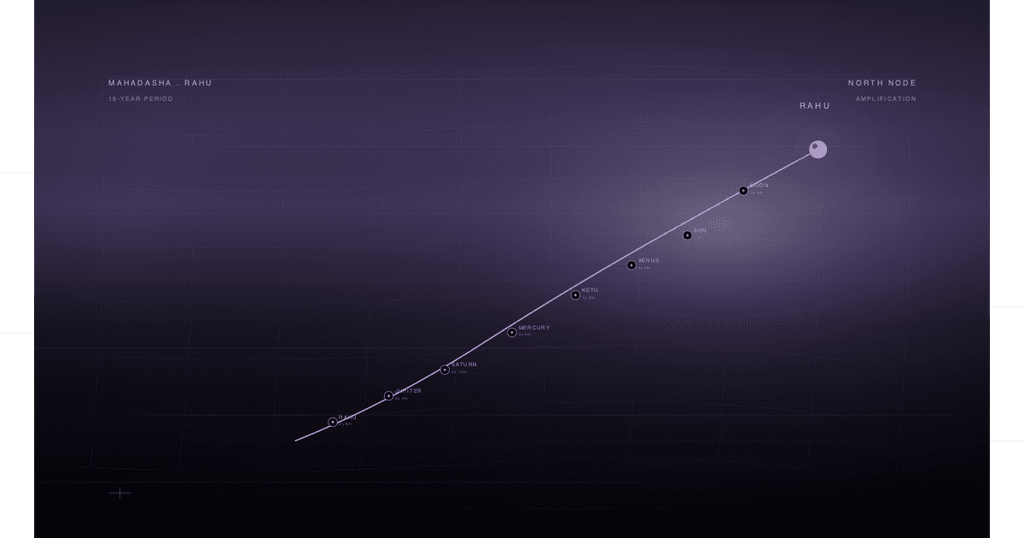
Rahu mahadasha runs 18 years in the Vimshottari cycle, the third-longest planet-lord period after Shukra at 20 years and Shani at 19. Eighteen years is long enough that the period is rarely experienced as a single texture; the classical treatment reads it as a sequence of chapters set by the antardasha lords.
Because Rahu owns no sign, the mahadasha inherits its content from the same three substitutes described above. The Rahu mahadasha hub carries the overview and links the twelve per-ascendant readings, which differ substantially: a Rahu sitting in the 10th from the lagna runs an entirely different eighteen years from a Rahu in the 12th, even before dignity and aspects are considered.
Within the period the antardasha sequence opens with Rahu's own sub-period and proceeds through Guru, Shani, Budha, Ketu, Shukra, Surya, Chandra and Kuja. Three of these carry distinctive classical treatment. The Rahu mahadasha with Jupiter antardasha is the guru-chandala configuration in period form, where expansion and instruction are read as pulling against each other. The Shani sub-period pairs the amplifier with the slowest structural body. The Ketu sub-period is the axis running against itself, one end of a single line lording the period while the other lords the sub-period. Sub-period arithmetic for any mahadasha is at the antardasha calculator table, and the wider system, including the dashas that are not Vimshottari, at the mahadasha hub.
Rahu also lords three nakshatras, Ardra, Swati and Shatabhisha, which is a separate and often overlooked route by which Rahu enters a chart. A natal Moon in any of the three starts the Vimshottari sequence in Rahu mahadasha regardless of where Rahu itself sits. The three are covered at Rahu-ruled nakshatras.
Rahu and Ketu: one axis, two ends
Rahu and Ketu are separated by exactly 180 degrees at every moment, because they are the two ends of a single line. This is not an approximate opposition that tightens and loosens like a planetary aspect; it is an identity. The fact sheet records both nodes at 7.56 degrees on the same day, in Aquarius and Leo respectively, and that exact degree match holds on every other day too.
The practical consequence is that a reading of one node is structurally incomplete. Rahu in the 10th is also Ketu in the 4th. An amplification in one life area is inseparable from a release in the opposite one, and the classical treatment describes the pair as a single mechanism with two visible ends rather than as two bodies that happen to oppose. Whichever house pair the axis falls across becomes the chart's main polarity, which is why the house axis pages read naturally alongside the nodal material.
The same logic governs the calendar. Nodal ingresses always come in pairs, because the two ends cross sign boundaries at the same instant. Every date in the table below is therefore two events. The classical framing of the axis as a karmic vector, with Ketu marking what is already carried and Rahu marking what is being reached for, is worked through at the Rahu and Ketu axis and past-life karma, and the mirrored aspect treatment at Ketu aspect on natal planets. The Ketu end has its own full treatment at the Ketu complete guide.
Rahu in the classical narrative tradition
The Brihat Parashara Hora Shastra treats the nodes across its chapters on the grahas and on dasha, granting them full mahadasha status in the Vimshottari scheme while giving them no sign lordship and no exaltation that the text itself settles. Phaladeepika, in its chapters on planetary effects and on dasha results, carries a fuller set of node-specific results. Both use the conditional grammar that runs through the classical literature: a placement is said to incline toward a result, subject to dignity, aspect and the condition of the lord.
It is worth stating honestly that the classical treatment of the nodes is thinner and more disputed than the treatment of the seven visible grahas. The nodes have no sign, so the whole apparatus of lordship, own-sign strength and mooltrikona is unavailable. Exaltation is contested. The aspect count differs between lineages. Several of the most confident-sounding modern rules about the nodes come from twentieth-century compilations rather than from the older texts, and the compilations do not always agree with one another. A guide that presents nodal rules with the same certainty as, say, Guru's exaltation in Cancer is overstating what the sources support.
The narrative material is correspondingly rich. Rahu is the severed head of an asura who drank the amrita and was decapitated mid-swallow, the head surviving without a body, which is the mythic figure for an appetite that continues past the point of satisfaction. Ketu is the body without the head. Tempora treats these narratives as literary context rather than as operative mechanics; they give readers a handle on the register, and the register is what the computation actually carries.
Rahu remedies (a note)
The nodes attract more remedial literature than any other bodies in the tradition, and a large commercial apparatus has grown around that literature. Classical prescriptions include specific mantra, ritual, charity, gemstone and dietary practices, each with its own regional variation.
Tempora describes what the tradition prescribes and does not sell or promise remedies. The mechanics of Rahu in a chart are the occupied sign, the dispositor, the house, the aspects and the running dasha; those are computable and stated. Ritual traditions carry genuine cultural and personal value, and they are documented here as ethnographic fact rather than as a causal claim. The reproducible-astrology methodology page sets out the computation-based reading stance in full.
The dated nodal calendar, 2025 to 2028
Everything above is structure. This section attaches the dates. Under True Pushya Paksha sidereal computation with mean node motion, the nodal calendar for the current cycle runs as follows. Because the two nodes are one axis, every row is a paired event.
| Date | Rahu | Ketu | Window |
|---|---|---|---|
| 9 June 2025 | Pisces to Aquarius | Virgo to Leo | Holds to 27 December 2026 |
| 27 December 2026 | Aquarius to Capricorn | Leo to Cancer | Holds to 15 July 2028 |
| 15 July 2028 | Capricorn to Sagittarius | Cancer to Gemini | Runs past the scanned window |
Three reading layers hang off that calendar. The sign layer first: while Rahu holds Aquarius it sits in a Shani sign, so Shani's own condition and position carry the dispositor reading; from 27 December 2026 the dispositor is unchanged in name, since Capricorn is also a Shani sign, but the register shifts from the fixed air sign to the movable earth sign. Ketu's dispositor changes across the same boundary, from Surya while Ketu holds Leo to Chandra once it enters Cancer.
The house layer second. Whole-sign counting converts one calendar into twelve, as the table earlier in this page shows. On 27 December 2026 every one of those twelve readings steps back a house at once, which is the single most consequential feature of a nodal ingress: it is not one chart's event, it is a simultaneous reassignment across all of them.
The interval layer third. The gaps between those three dates are close to eighteen and a half months each, which is the observable form of the roughly eighteen-and-a-half-year nodal circuit. Anyone dating a chapter off this calendar should treat the ingress dates as boundaries rather than as switches, since the fact sheet samples daily and a same-day crossing may be recorded on the following day.
The standing limitation applies throughout. These dates are sidereal under one ayanamsa computed with mean node motion; other ayanamsas and true-node computations place the same ingresses a few days apart. Sign-level dating says where a body is, and says nothing about any individual chart's natal dignity, house context or running dasha, which carry the actual reading. The market-facing application of one such window is at Rahu in Pisces and water events.
The nine, one guide each
This page is one of nine. Each planet carries its own structural guide, built the same way and computed from the same ephemeris.
What to read next
- Rahu and Ketu transit: the full dated nodal transit mechanics with aspect maps.
- Rahu aspect on natal planets: the amplification register planet by planet.
- Ketu, the complete guide: the same axis read from the other end.
- Rahu mahadasha: the 18-year period with the twelve per-ascendant readings.
- Rahu and Ketu transit 2027: the Capricorn and Cancer year in detail.
- Ketu-ruled nakshatras: the three lunar mansions on the other end of the axis.
To find Rahu's placement in your own chart with dated mahadasha and transit windows, the Kaal engine computes from birth details under True Pushya Paksha ayanamsa.
Frequently asked
What does Rahu mean in Vedic astrology?
Rahu is the north lunar node, one of the two points where the Moon's orbital plane crosses the ecliptic. It is a computed geometric point rather than a physical body, which is why the tradition calls it a chhaya graha or shadow planet. Rahu is read as the register of amplification, appetite, foreign and unfamiliar domains, sudden expansion and hunger for the significations of whatever it touches.
Does Rahu rule any zodiac sign?
Rahu lords no sign in the standard Parashari scheme, so it carries no house rulership from the ascendant. Three substitutes carry the reading instead: the sign Rahu occupies, the dispositor (the lord of that sign, wherever it sits) and the house Rahu falls in. Some later lineages assign Rahu a co-lordship of Aquarius alongside Shani, and schools disagree about exaltation, with Taurus and Gemini both defended. Tempora states the convention in use rather than asserting one as settled.
Why does Rahu move backwards through the zodiac?
The lunar nodes regress because the Moon's orbital plane itself precesses westward against the stars, completing a circuit in about eighteen and a half years. The ingress order shows it directly: Pisces, then Aquarius, then Capricorn, then Sagittarius. This is a structural fact about the geometry rather than an occasional loop, which is why nodal transits are read differently from planetary retrogrades. The mean node regresses smoothly; the true node wobbles around that mean and can briefly edge forward, so sources using true nodes date the same crossing a few days apart.
How long is Rahu mahadasha?
Rahu mahadasha runs 18 years in the Vimshottari cycle, the third-longest planet-lord period after Venus at 20 years and Shani at 19. Because Rahu lords no sign, the period is read through the sign Rahu occupies, its dispositor and its house, which is why the same 18 years reads differently across the twelve ascendants. The antardasha sequence within it opens with Rahu's own sub-period and closes with the Mars sub-period.
Why do eclipses happen at the Rahu and Ketu axis?
An eclipse requires the Sun, Earth and Moon to line up in three dimensions, not just in longitude. The Moon's orbit is tilted about five degrees to the ecliptic, so alignment is only possible when a new or full Moon happens near one of the two crossing points. Those two points are Rahu and Ketu. The nodal axis is therefore the eclipse axis by definition, which is the astronomical reason the tradition attaches eclipse symbolism to the nodes.
What are classical Rahu remedies?
Classical prescriptions include specific ritual, charity, mantra and dietary practices, and the nodes attract more remedial literature than any other bodies. Tempora treats these as ethnographic prescriptions rather than as operative causal mechanisms. The mechanics of Rahu in a chart are the occupied sign, the dispositor, the house, the aspects and the running dasha. Ritual traditions carry their own value as cultural practice.
Where is Rahu right now and when does it next change sign?
Under True Pushya Paksha sidereal computation Rahu entered Aquarius on 9 June 2025 and sits at roughly 7 degrees of Aquarius in Shatabhisha nakshatra as of 6 August 2026, with Ketu opposite in Leo. Rahu enters Capricorn on 27 December 2026, pairing with Ketu into Cancer on the same date, then enters Sagittarius on 15 July 2028. Other ayanamsas place the same ingresses a few days earlier or later.
This page presents conventional Vedic teaching on the north lunar node applied to the 2025 to 2028 nodal calendar, computed sidereally with the True Pushya Paksha ayanamsa via Swiss Ephemeris using mean node motion. Structural windows are context, not guarantees; the amplification reading is a classical convention rather than an established empirical effect, and individual charts vary in ways a shared calendar cannot capture. This page does not constitute financial, medical, legal or personal advice. First published 6 August 2026 by Tempora Research.