Ketu aspect on natal planets: the dissolving 5th, 7th and 9th drishti
Ketu's drishti is the mirror of Rahu's. Where Rahu amplifies and inflames the planet it aspects, Ketu dissolves it, draining the worldly charge from its significations and turning them inward toward detachment and mastery. This is the dissolving drishti, read planet by planet.
The aspect framework for Ketu
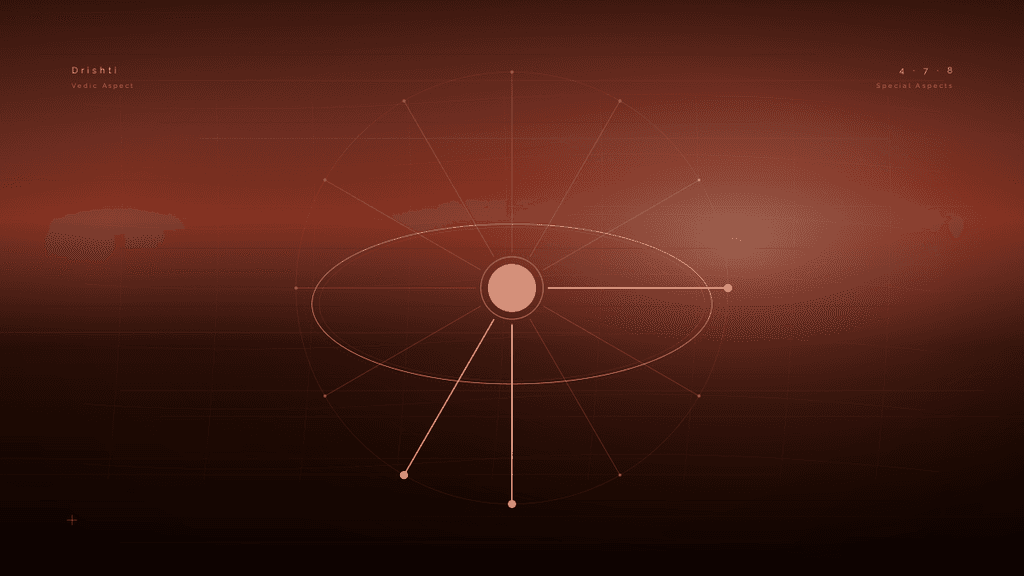
The nodes are shadow points rather than physical bodies, and whether they cast special aspects is school-dependent. The full 7th aspect is accepted across lineages. Many Parashari and Jaimini schools grant Ketu the additional 5th and 9th aspects, the same trine aspects Jupiter casts, so that Ketu aspects the 5th, 7th and 9th signs from itself. Tempora reads the 7th as universal and treats the 5th and 9th as school-dependent, and it notes which framework a reading uses. Because Rahu and Ketu are always exactly opposite, Ketu's 7th aspect always falls on Rahu, and its 5th and 9th mirror Rahu's own.
What Ketu does to a planet it aspects
Ketu is the karaka of detachment, dissolution, past-life residue and moksha, the headless node with no ego-drive of its own. Where Rahu adds worldly hunger to the planet it aspects, Ketu removes it. The aspected planet's significations are drained of their worldly charge and turned inward: they become a site of specialised, almost involuntary mastery, and at the same time a source of dissatisfaction, since the worldly form of them never quite satisfies. The native may be unusually gifted in the planet's domain yet feel curiously uninterested in its rewards, or may experience the planet's themes as something to be released rather than pursued.
Planet-by-planet Ketu aspect signatures
Ketu aspect on the Sun
Ketu aspecting the Sun dissolves the ego and the drive for status. It can read as detachment from authority and recognition, spiritual leadership that does not seek the throne, or a questioning of identity and the father-significations. The Sun's worldly charge is drained; the self is turned inward, sometimes at the cost of confidence, sometimes toward genuine humility.
Ketu aspect on the Moon
Ketu aspecting the Moon detaches the mind and the emotions. It can read as intuitive, psychic or spiritually sensitive feeling and a self-contained emotional nature, and it can read as emotional withdrawal, a sense of not belonging, or feelings that dissolve before they settle. The heart is turned inward and toward release rather than attachment.
Ketu aspect on Mars
Ketu aspecting Mars makes the drive erratic and inward. It is a classic signature for occult, surgical and technical skill, sharp and specialised, and for martial or ascetic discipline. It can also read as sudden, unpredictable bursts of aggression followed by withdrawal, or energy that flares and dissolves. Mars gains penetration and loses steadiness under the Ketu aspect.
Ketu aspect on Mercury
Ketu aspecting Mercury turns the intellect deep and cryptic. It supports research, mysticism, mathematics and a penetrating, intuitive knowing that goes far in a narrow field, and it can read as difficulty communicating plainly, thought that dissolves, or a mind more comfortable with the unspoken than the spoken. The messenger is drawn inward.
Ketu aspect on Jupiter
Ketu aspecting Jupiter spiritualises wisdom and detaches it from dogma. It supports the seeker who questions inherited belief, the moksha-oriented teacher and a philosophy pointed at liberation rather than worldly gain. It can also read as loss of faith, a wandering relationship to purpose, or wisdom that withdraws from teaching. Jupiter's expansiveness is turned toward release.
Ketu aspect on Venus
Ketu aspecting Venus detaches love and pleasure. It can read as a spiritual, non-possessive relationship to beauty and a love that seeks something beyond the material, and it can read as dissatisfaction with ordinary pleasure, detachment in relationship, or affection that dissolves rather than deepens. Venus's warmth meets Ketu's pull toward withdrawal.
Ketu aspect on Saturn
Ketu aspecting Saturn intensifies renunciation. Two significators of detachment and karma together support ascetic discipline, isolation turned toward inner work and endurance of a spiritual kind, and the combination can read as heaviness, loss or a solitary path carrying a felt karmic weight. Saturn's structure meets Ketu's dissolution.
Ketu aspect on Rahu
Ketu's 7th aspect always falls on Rahu, since the nodes sit exactly opposite. This is the axis reading itself: the whole Rahu-Ketu karmic axis, the pull between worldly amplification at the Rahu end and spiritual dissolution at the Ketu end. The mutual aspect between the nodes is the frame within which the other planetary aspects on the axis are read.
What the Ketu aspect does not predict
The Ketu aspect is a dissolving colour, not an event. It says the aspected planet is detached, spiritualised and made a site of specialised mastery, with a risk of loss or dissatisfaction. It does not predict specific outcomes and does not by itself make a chart spiritual or troubled. A Ketu aspect on a dignified, well-placed planet reads very differently from the same aspect on a weak one. Tempora weighs it against Ketu's placement, the aspected planet, the house context and the running dasha, and names the effect size rather than amplifying it.
When the Ketu aspect activates in the life
The aspect is present from birth and becomes a live theme in the Ketu mahadasha, the seven-year major period, and in Ketu antardashas inside other major periods. It is sensitive to eclipse windows on the nodal axis, when the Sun or Moon meets the nodes, and to transits onto the aspected planet. Outside those windows it sits as a quiet, dissolving quality of the aspected planet.
How Tempora computes the Ketu aspect
Tempora computes Ketu's sidereal position with the True Pushya Paksha ayanamsa via Swiss Ephemeris using the True Node, identifies the 5th, 7th and 9th signs from it, and reads the aspect onto whatever planets sit in those signs. The receiving planet's dignity and the running dasha are applied as filters, and the school-dependence of the 5th and 9th aspects is carried into the reading, in line with Tempora's reproducible astrology method.
Frequently asked questions
Which houses does Ketu aspect?
Ketu's aspect is school-dependent. The full 7th aspect is accepted across lineages, and because Ketu always sits exactly opposite Rahu, Ketu's 7th aspect always falls on Rahu. Many Parashari and Jaimini schools also grant Ketu the special 5th and 9th aspects, mirroring Rahu. Under that framework Ketu aspects the 5th, 7th and 9th signs from where it sits, the same houses Jupiter aspects, but with the opposite, subtractive character.
What does a Ketu aspect do to a planet?
Ketu is the significator of detachment, dissolution, past-life mastery and moksha, the headless node that subtracts rather than adds. Where Rahu amplifies and inflames the planet it aspects, Ketu dissolves and detaches it. A planet under a Ketu aspect has its significations spiritualised, made erratic or quietly withdrawn: the native may feel unusually skilled yet strangely uninterested in the planet's worldly rewards, or experience the planet's themes as something to be released rather than pursued.
How is the Ketu aspect different from the Rahu aspect?
They are mirror images on the same axis. Rahu amplifies, obsesses over and inflates the planet it aspects, driving worldly hunger around its significations. Ketu dissolves, detaches and spiritualises the same significations, draining the worldly charge out of them. A planet aspected by Rahu is chased; a planet aspected by Ketu is released. Because the nodes are always opposite, the Rahu aspect and the Ketu aspect describe the two poles of the same karmic axis.
Is a Ketu aspect good or bad?
Neither by itself. A Ketu aspect can give unusual, specialised, almost effortless mastery of the aspected planet's significations, along with a spiritual or detached relationship to them, which is a gift for inner work and for depth in a narrow field. It can also read as loss, confusion, sudden withdrawal or dissatisfaction around those significations, the sense that the worldly form of them never quite satisfies. The reading depends on the aspected planet, on Ketu's placement, and on the running dasha.
When does a Ketu aspect activate in the life?
The aspect is a standing feature of the chart that activates most strongly during the Ketu mahadasha, its seven-year major period, and during Ketu antardashas within other major periods. It also lights up during eclipse windows on the nodal axis and when transits contact the aspected planet or the nodes. Outside those windows it sits as a quiet, dissolving colour on the aspected planet.
How is the Ketu aspect calculated?
Tempora computes Ketu's sidereal position with the True Pushya Paksha ayanamsa via Swiss Ephemeris using the True Node, identifies the 5th, 7th and 9th signs from it, and reads the aspect onto whatever planets occupy those signs. The receiving planet's dignity and the running dasha are applied as configurable filters, and the school-dependence of the 5th and 9th aspects is noted in the reading.
Read next
This article documents conventional Vedic teaching on Ketu's drishti onto natal planets and Tempora Research's aspect reading method. The special 5th and 9th aspects of the nodes are school-dependent, as noted above. Internal audit log maintained for methodology revisions. This article represents conventional Vedic teaching and Tempora Research method documentation. It does not constitute medical, financial, legal or professional advice.
This article was first published on 30 July 2026. It documents conventional Vedic teaching on Jupiter's benefic drishti onto natal planets (5th, 7th and 9th aspects) and Tempora Research's aspect reading method. Internal audit log maintained for methodology revisions; any subsequent material change to the framework above will be appended here with a dated note. This article represents conventional Vedic teaching and Tempora Research method documentation. It does not constitute medical, financial, legal or professional advice.