Rahu in the 12th House: Foreign Residency and Hidden Amplification
Rahu in the 12th house (Vyaya Bhava the house of expense and dissolution, Moksha Bhava the house of liberation in Sanskrit) lands the shadow node of amplification in a dusthana that is also the moksha house. The pattern reads as significant foreign-residency arcs, hospital or prison or large-institutional administration with an unconventional register and moksha-axis amplification events. The Rahu mahadasha is the activation window. The dispositor's strength is the single highest-weight variable.
What the 12th house contains and what Rahu does with it
The 12th house in the rashi chart (the D-1, the natal birth chart) is the Vyaya Bhava (the house of expense and dissolution) and simultaneously the Moksha Bhava (the house of liberation). It carries seven classical significations: foreign residency and life lived away from the place of birth, expenses of all types including the necessary expenses (charity, donation) and the unwanted expenses (loss, theft, fraud), confinement and isolation including hospital stays, prison and monastery residence, the bed and the sleep register (including the sexual register in some classical readings), hidden enemies operating out of sight, the dissolution of the body at the end of life and moksha (liberation, the final spiritual goal of the Vedic path). The classical karakas are Saturn (sorrow, isolation, structural loss) and Ketu (detachment, spiritual development). Sources: Brihat Parashara Hora Shastra Chapter 14, Phaladeepika Chapter 10.
The 12th is a dusthana, one of the three difficult houses (with the 6th and the 8th). Dusthana placement biases planets toward friction, loss or transformation. The 12th is also a moksha house, one of the three liberation houses (with the 4th and the 8th). Moksha placement biases planets toward spiritual development and dissolution of the personal ego register. The two registers stack in a single house, which is why the 12th carries the most divergent reading possibilities in the chart: it is simultaneously where wealth dissolves and where the soul liberates.
Rahu in the 12th amplifies both registers. The foreign-residency significations get amplified into life-defining biographical arcs. The expense register gets amplified into large-scale expenditure on foreign living, institutional confinement or spiritual practice. The hidden-enemy register gets amplified into substantial behind-the-scenes opposition or scandal events. The moksha register gets amplified into large-scale spiritual development, sometimes producing cult-leadership patterns or the leadership of large spiritual movements. Which register dominates depends on Rahu's dispositor and the broader chart configuration.
The foreign-residency pattern
The biographical pattern most consistently associated with Rahu in the 12th is permanent foreign settlement. Three registers stack: the 12th's natural foreign-residency significations, Rahu's boundary-crossing karaka register and the dusthana register that biases the chart owner toward life lived away from the place of birth. The configuration is one of the highest-base-rate single placements for permanent foreign settlement on the chart.
The case literature pattern is recognisable. The native often moves abroad for work, education or marriage during the Rahu mahadasha and the move becomes permanent. The new country becomes the primary residence; the country of birth becomes the visit-occasionally register rather than the home register. The pattern is most clean when Rahu sits with a benefic in the 12th or when the dispositor is well-placed; the move proceeds without crisis. The pattern is most volatile when Rahu sits with a malefic or when the dispositor is afflicted; the move can involve refugee-axis events, political-asylum arcs or family-rupture events around the migration.
For the broader 12th-house reading of foreign residency including the multi-factor diagnostic protocol, see Tempora's Will I settle abroad? 12th-house reading piece. The piece walks through the full four-layer protocol for permanent migration assessment. The Tempora Will I migrate abroad permanently? reading covers the dasha-and-transit timing layer specifically.
The dusthana and the expense-axis register
The dusthana significations of the 12th include necessary and unwanted expenses. Rahu amplifies both. The necessary expense register includes charity, donation, foreign-residency cost (housing, education, healthcare in the foreign country), institutional living cost (hospital, monastery, retreat) and the broader cluster of expense that supports the moksha or dharmic register. The unwanted expense register includes speculative loss, fraud loss, theft and the broader cluster of expense the chart owner does not want.
The hidden-enemy significations of the 12th include enemies operating out of sight, behind-the-scenes opposition and scandal-axis events that come from sources the chart owner cannot see. Rahu amplifies these too. The configuration carries elevated risk for scandal events that originate in foreign countries, hidden financial events that emerge years after they occurred and the broader cluster of trouble that arrives from below the visible surface. The classical mitigation is dharmic strength (the 9th house) and a well-placed Jupiter, both of which provide the protective register that softens Rahu's hidden-amplification energy.
The addiction or escape-axis register sits inside the 12th's dissolution significations. The 12th is the bed-and-sleep house, the register of the unconscious mind, the substance-and-escape domain in some classical readings. Rahu's amplification on these significations can produce addiction patterns, particularly involving substances (alcohol, prescription medication, recreational drugs), screens (television, social media, digital escape) or any mechanism that allows the conscious mind to dissolve temporarily. The risk is most elevated when Rahu sits with a malefic in the 12th, when the dispositor is afflicted or when the Moon is also weak.
The moksha-axis and the spiritual-movement pattern
The 12th is one of the three moksha houses (with the 4th and the 8th). The moksha register is the dissolution of personal identity into the broader spiritual register; classical Vedic teaching reads the 12th as the final house where the soul releases attachment to the body and the personal-ego identification. Rahu in the 12th amplifies the moksha register, often producing biographical arcs of significant spiritual development.
The pattern from case literature divides into two clusters. The first is the individual moksha-axis development: the chart owner pursues serious spiritual practice (meditation, yoga, retreat work, contemplative life) and reaches genuine moksha-axis development inside the Rahu mahadasha. The pattern often produces lives lived in monasteries, ashrams or contemplative communities, sometimes with the chart owner taking formal religious orders. The second cluster is the large-scale moksha-axis leadership: the chart owner becomes the leader of a large spiritual movement, sometimes a cult, sometimes a legitimate religious organisation, sometimes an unconventional spiritual community. Rahu's amplification register on the 12th moksha significations produces the leader-of-movement pattern specifically; the chart owner does not just pursue moksha personally but builds an organisation around the pursuit.
The cult-leadership pattern is worth naming carefully. The case literature includes both legitimate spiritual leaders (founders of meditation traditions, modern yoga lineages, contemplative movements) and the harder cluster (cult founders, controversial gurus, spiritual leaders whose organisations carry abuse-axis or financial-fraud features). The configuration alone does not determine which cluster the chart owner falls into; the determining variables are the dispositor's dignity, the strength of the 9th house (dharmic register), the strength of the 1st house (the self-axis that grounds the leadership) and the broader chart's moral-register configuration. Rahu's classical demon-mythology (the deception-and-immortality story of Svarbhanu) is most operative in this configuration: spiritual leadership amplified by the deception-axis karaka.
The hospital, prison and institutional-administration cluster
The 12th's confinement significations cover hospital, prison and monastery residence. Rahu's amplification on these significations often produces careers in the administration of these institutions rather than residence in them. The case-literature pattern is recognisable: hospital management roles, healthcare-systems administration, pharmaceutical administration at scale, prison administration, intelligence services administration, corrections work, security-axis administration and large-monastery or ashram administration.
The texture is institutional rather than individual. The chart owner often runs the institution rather than receiving services from it. The role is administrative or leadership-axis. The institutions themselves often carry foreign-axis or boundary-crossing features (multinational hospital chains, foreign-government intelligence services, international religious organisations). The Rahu register pulls the work toward the large-scale and the unconventional within the institutional cluster.
Dispositor analysis
Rahu has no own sign. The dispositor (the planet ruling the sign on the 12th cusp) is the single highest-weight variable for the configuration's outcome.
| 12th house sign | Dispositor | Reading texture |
|---|---|---|
| Aries | Mars | Action-axis foreign residency. Military expatriate work, foreign-action careers, surgical or competition-axis foreign roles. |
| Taurus | Venus | Aesthetic or hospitality foreign residency. Luxury-industry foreign work, foreign-aesthetic careers, refined institutional administration. |
| Gemini | Mercury | Communication-axis foreign residency. Foreign-publishing, foreign-language journalism, technology-foreign work. |
| Cancer | Moon | Emotional or maternal foreign residency. Hospital and healthcare foreign work, food-industry foreign work, public-emotional foreign roles. The Moon's dignity is critical. |
| Leo | Sun | Authority-axis foreign residency. Foreign-government leadership, ambassadorial work, foreign-political roles. |
| Virgo | Mercury | Analytical foreign residency. Foreign-technical work, healthcare-systems administration, foreign-pharmaceutical roles. |
| Libra | Venus | Partnership-axis foreign residency. Foreign diplomatic work, foreign-aesthetic partnerships, marriage-driven migration. |
| Scorpio | Mars | Transformation-axis foreign residency. Foreign-intelligence work, occult-axis foreign roles, pharmaceutical-research administration. |
| Sagittarius | Jupiter | Dharmic foreign residency. Foreign-teaching, religious leadership at scale, foreign-philosophical work. One of the strongest configurations. |
| Capricorn | Saturn | Institutional foreign residency. Foreign-government administration, foreign-bureaucratic work, structural foreign appointments. |
| Aquarius | Saturn | Network or technology foreign residency. Foreign-technology work, foreign-platform administration, distributed-systems foreign roles. |
| Pisces | Jupiter | Contemplative foreign residency. Foreign-religious leadership, monastery administration, mass-spiritual-movement leadership. The deepest moksha-axis configuration. |
The dispositor in a kendra or trikona supports. The dispositor in a dusthana (6th, 8th, 12th) intensifies the friction-axis register, producing the harder cluster of Rahu-in-12th outcomes (expense, hidden enemies, addiction, scandal). The dispositor's house placement modulates the foreign-residency texture: dispositor in the 7th can produce marriage-driven migration, dispositor in the 10th can produce career-driven migration, dispositor in the 9th can produce education-driven migration.
Per-ascendant variation
Aries ascendant: Rahu in Pisces, Jupiter dispositor. Contemplative foreign residency. Often produces religious leadership or mass-spiritual-movement work. Jupiter's natal placement determines whether the configuration leans toward genuine moksha development or toward Guru-Chandala-axis controversy.
Taurus ascendant: Rahu in Aries, Mars dispositor. Action-axis foreign residency. Often produces foreign-action careers, surgical work or competition-axis foreign roles. Mars's natal dignity is the variable.
Gemini ascendant: Rahu in Taurus, Venus dispositor. Aesthetic foreign residency. Often produces foreign-aesthetic careers, hospitality foreign work, luxury-industry foreign roles. Venus's natal placement sets the quality.
Cancer ascendant: Rahu in Gemini, Mercury dispositor. Communication-axis foreign residency. Foreign-publishing, technology-foreign work, foreign-language journalism. Mercury's dignity is the variable.
Leo ascendant: Rahu in Cancer, Moon dispositor. Emotional or hospital foreign residency. Foreign-healthcare leadership, foreign-public-emotional work. The Moon's dignity is critical; waxing Moon supports, waning Moon under affliction weakens substantially.
Virgo ascendant: Rahu in Leo, Sun dispositor. Authority-axis foreign residency with enemy-pair friction (Rahu and Sun classically antagonistic). Foreign-government or ambassadorial work; carries reputational-volatility risk.
Libra ascendant: Rahu in Virgo, Mercury dispositor. Analytical foreign residency. Healthcare-systems administration, foreign-technical work, pharmaceutical foreign roles.
Scorpio ascendant: Rahu in Libra, Venus dispositor. Partnership-axis foreign residency. Marriage-driven migration, foreign diplomatic work, aesthetic-partnership foreign roles. One of the most constructive Rahu-in-12th configurations.
Sagittarius ascendant: Rahu in Scorpio, Mars dispositor. Transformation-axis foreign residency. Foreign-intelligence work, occult-axis foreign roles, pharmaceutical research. Classical Rahu debilitation by most modern schools; intense configuration.
Capricorn ascendant: Rahu in Sagittarius, Jupiter dispositor. Dharmic foreign residency. Foreign-teaching, religious leadership at scale, philosophy-foreign work. Jupiter as 12th lord for Capricorn carries the dharmic register strongly.
Aquarius ascendant: Rahu in Capricorn, Saturn dispositor. Institutional foreign residency. Foreign-government administration, foreign-bureaucratic work. Saturn-Rahu friend-pair friction is constructive in this configuration.
Pisces ascendant: Rahu in Aquarius, Saturn dispositor. Network or technology foreign residency. Foreign-technology work, distributed-systems foreign roles, foreign-platform administration.
When the moving nodes and slow planets reach this house
A 12th-house Rahu holds a standing pull toward foreign ground, expense and the moksha axis; the transiting sky is what dates when that pull is brought forward. For a Pisces ascendant the 12th house is Aquarius, where transiting Rahu returns over its own natal seat from 9 June 2025 to 27 December 2026, so the foreign-residency and dissolution register reads hardest through late 2026. For a Virgo ascendant the 12th house is Leo, occupied by transiting Ketu to 27 December 2026 and crossed by the solar eclipse of 12 August 2026 on the Cancer to Leo cusp, which drops the south node and an eclipse point onto the natal Rahu. For a Leo ascendant the 12th house is Cancer, reached by exalted Jupiter from 27 May 2026 and by transiting Ketu from 27 December 2026 to 15 July 2028, so a benefic transit and a node cross the placement one after the other. Each of these dates when the 12th-house theme surfaces over a standing natal charge, so the transit triggers the window and leaves its expression to the chart. Rahu takes close to eighteen months in a sign and comes back to any given sign about every eighteen years, which makes the node's own return the direct same-planet trigger here, running now for the Pisces ascendant and opening for an Aquarius ascendant whose 12th house is Capricorn from 27 December 2026 to 15 July 2028.
Conjunctions, aspects and the Ketu axis
Rahu conjunct Saturn in the 12th produces austere institutional foreign work; the most classical configuration for monastery or prison-administration careers. Rahu conjunct Jupiter in the 12th is the Guru-Chandala yoga in the moksha house; produces large-scale spiritual leadership with elevated cult-axis risk; the dispositor's dignity is the critical variable for which cluster the chart owner falls into. Rahu conjunct Ketu in the 12th is impossible because they are always 180 degrees apart, but Rahu conjunct Mars in the 12th produces foreign-conflict or foreign-surgical careers with elevated risk register. Rahu conjunct Venus in the 12th produces foreign-pleasure or foreign-aesthetic careers with elevated indulgence-axis register. Rahu conjunct the Moon in the 12th produces foreign-emotional or hospital-axis careers with elevated mental-volatility risk.
Ketu (always 180 degrees from Rahu) sits in the 6th house when Rahu is in the 12th. The 6th-12th Rahu-Ketu axis polarises service-and-dissolution. The chart owner often experiences detachment from the 6th-house register (work, service, daily-effort, enemies) and amplification of the 12th-house register (foreign-residency, spiritual development, institutional administration). The pattern produces lives where the day-to-day service register is consciously released and the larger institutional or spiritual register takes over. The pattern is particularly common in monastic and contemplative biographical arcs.
The Rahu mahadasha activation window
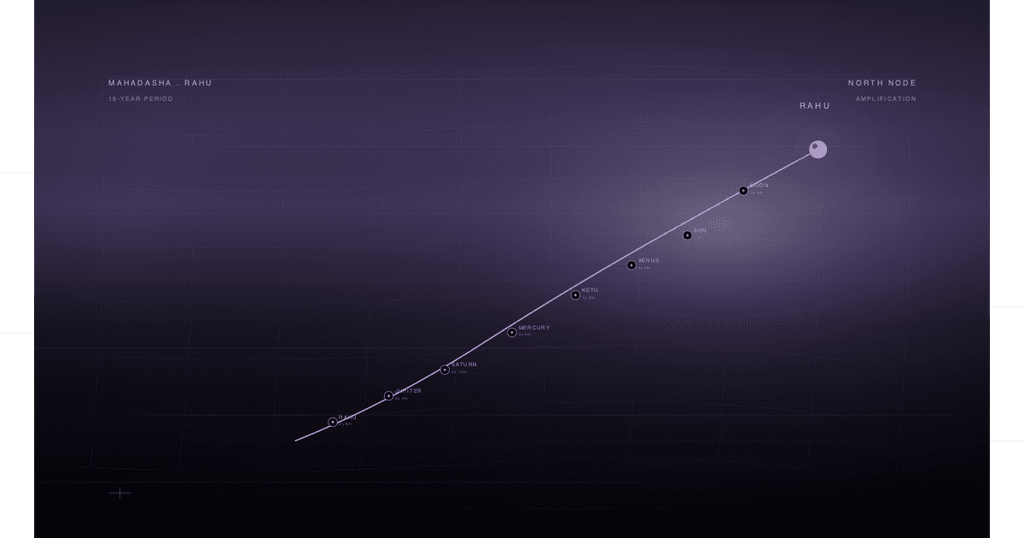
The Rahu mahadasha is the 18-year period when Rahu's karaka register sits in the foreground. For natives with Rahu in the 12th, this period activates the natal placement directly. The headline biographical event of the chart owner's life (the foreign-residency arc, the spiritual-movement leadership, the institutional appointment) typically anchors here.
The pattern from the case literature is recognisable. The early Rahu mahadasha often produces the foreign-residency event: the move abroad for work, education or marriage that becomes permanent. The middle mahadasha (often the Rahu-Saturn sub-period of about 2 years 10 months) often produces the institutional appointment: the hospital administration role, the foreign-government appointment, the prison or correctional leadership. The Rahu-Jupiter sub-period of 2 years 5 months often produces the moksha-axis event: the spiritual movement founding, the religious-leadership appointment, the ashram or monastery affiliation. The Rahu-Ketu sub-period of about 1 year (the node-pair sub-period) produces the most karmically decisive events, often involving foreign-detachment or past-life-axis revelations. The 18-year amplification window is documented in detail at the Rahu mahadasha overview.
Secondary activation windows: the mahadasha of the 12th lord, the mahadasha of Saturn (the karaka for sorrow and isolation, which activates the 12th's dusthana register), the mahadasha of Ketu (the moksha-axis karaka) and the Jupiter or Saturn transit through the 12th house. Eclipse activations on natal Rahu concentrate the foreign-residency and moksha-axis events further.
Reading sequence in practice
- Identify the sign on the 12th house for the natal ascendant. This is Rahu's dispositor.
- Trace the dispositor to its house placement and check dignity. This is the single highest-weight variable.
- Check the 12th lord independently. The 12th lord's house placement is the foreign-residency-direction layer.
- Check the natural karakas Saturn (sorrow and isolation) and Ketu (detachment and moksha) for dignity and aspect.
- Identify conjunctions and aspects to natal Rahu in the 12th. Note Jupiter's aspect specifically; Jupiter softens the dusthana register substantially.
- Note the Ketu placement in the 6th house (always polar opposite). The 6th-12th axis is the service-dissolution polarity.
- Locate the running mahadasha. Rahu mahadasha activates directly. Dasha of the 12th lord, Saturn or Ketu produces secondary activation.
- Cross-confirm with the Navamsa (D-9) for the deeper foreign-residency reading; the Navamsa is the divisional chart for marriage and dharma, both of which often participate in the migration pattern.
What this reading does not predict
The structural reading is precise about register and disposition but explicitly limited on four fronts. It does not predict a specific country of foreign residence; the configuration biases toward migration but does not name the destination. It does not predict whether the moksha-axis register expresses as genuine spiritual development or as the harder Guru-Chandala cluster; that depends on the dispositor and the broader chart's moral configuration. It does not predict the specific institution the chart owner will administer; the cluster is named (hospital, prison, monastery, foreign-government) but the specific role depends on the dispositor and the dasha sequence. It does not predict whether the addiction or escape-axis risk materialises; that depends on the Moon's dignity, Saturn's placement and the dasha sequence. Personal-chart outcomes always depend on the running dasha, the simultaneous transit picture and the strength of the dispositor. Tempora's framework is structural; the dated-call discipline lives at the tracker.
Frequently asked questions
What does Rahu in the 12th house mean?
Rahu in the 12th house (Vyaya Bhava the house of expense and dissolution, Moksha Bhava the house of liberation in Sanskrit) reads as significant foreign-residency arcs, work in hospitals or prisons or large-institutional administration with an unconventional register and moksha-axis amplification events including cult leadership or the leadership of large spiritual movements. The 12th is a dusthana (difficult house) and a moksha house simultaneously; Rahu in the 12th carries both registers. The foreign-residency pattern is the strongest single biographical signature. The pattern often produces lives lived substantially outside the country of birth, in roles connected to hospitals, prisons, monasteries, large-spiritual movements or foreign-government work.
Does Rahu in the 12th house mean foreign settlement?
Yes, often. The 12th house is the classical seat of foreign residency in Vedic astrology; the karaka domain covers foreign settlement, exile, residence away from the place of birth and the broader register of life lived outside the local territory. Rahu's amplification stacks with the 12th's natural significations. The configuration is one of the highest-base-rate single placements for permanent foreign settlement. The pattern often shows up as a move abroad for work, education or marriage that becomes permanent; an immigrant arc that involves significant identity-reformation in the new country; or a refugee or political-asylum arc when the configuration is particularly afflicted. The Rahu mahadasha is the headline activation window for the foreign-residency event.
Is Rahu in the 12th house good or bad?
Classically mixed and texture-dependent. The 12th is a dusthana (difficult house) by classical definition, which biases the placement toward expense, loss, hidden enemies and the dissolution register. The 12th is also a moksha house (one of the three liberation houses with the 4th and 8th), which provides the spiritual-axis upside. Rahu's amplification register stacks with both. When the dispositor is well-placed and Jupiter or another benefic aspects the 12th, the configuration produces constructive foreign-residency arcs, hospital or institutional career success and durable moksha-axis development. When the dispositor is weak, the configuration produces hidden-enemy events, expense-axis losses, addiction-axis risk and the broader cluster of dissolution events. The single most important variable is the dispositor.
What careers suit Rahu in the 12th house?
The pattern from case literature concentrates in five clusters. First, foreign-residency work of all types: foreign-government employment, multinational corporate work, ambassadorial roles, expatriate professional roles and immigration-axis work. Second, hospital and healthcare administration, particularly the large-institution register: hospital management, healthcare systems work, pharmaceutical administration and public-health roles. Third, prison or correctional work and intelligence-axis work: corrections administration, intelligence services, security-axis roles and forensic work. Fourth, monastery, ashram or large-spiritual-institution roles: religious leadership at scale, ashram administration, large-spiritual-movement roles. Fifth, the broader cluster of behind-the-scenes amplification work: consulting that operates without public visibility, R&D leadership, hidden-channel work in finance or politics.
What are the risks of Rahu in the 12th house?
Three risk registers carry across the case literature. First, the expense-axis register: large hidden expenses, financial losses through speculation or fraud, expenditure on foreign residency or institutional living. Second, the addiction or escape-axis register: Rahu's amplification on the 12th's dissolution significations can produce addiction patterns particularly involving substances, screens or any escape mechanism. The risk is most elevated when the dispositor is afflicted or when Rahu sits with a malefic in the 12th. Third, the hidden-enemy or scandal-axis register: enemies operating out of sight, behind-the-scenes opposition, foreign-axis legal issues or the broader pattern of trouble that arrives from sources the chart owner cannot see. The classical mitigation is benefic aspect from Jupiter, a well-placed dispositor and an active dharmic register (5th or 9th-house strength).
When does Rahu in the 12th house deliver its events?
Event timing concentrates inside the 18-year Rahu mahadasha. The headline foreign-residency event, the large-institutional appointment or the moksha-axis spiritual development typically anchors here. Inside the mahadasha, the Rahu-Saturn (about 2 years 10 months) sub-period often carries the structural foreign appointment or institutional role. The Rahu-Jupiter sub-period often carries the spiritual or moksha-axis events. The Rahu-Ketu sub-period (about 1 year, the node-pair) carries the most karmically decisive events, often involving foreign-detachment or past-life-axis revelations. Secondary activation: the mahadasha of the 12th lord, the mahadasha of Saturn (the karaka for sorrow and isolation) and the Jupiter or Saturn transit through the 12th. Eclipse activations on natal Rahu concentrate the events further.
When is a natal Rahu in the 12th house activated in 2026 to 2028?
A 12th-house Rahu is the standing condition; a slow transit over its sign dates the activation. A Pisces ascendant holds the 12th in Aquarius, where transiting Rahu returns over its own seat from 9 June 2025 to 27 December 2026. A Virgo ascendant holds it in Leo, occupied by transiting Ketu to 27 December 2026 and marked by the 12 August 2026 solar eclipse on the Cancer to Leo cusp. A Leo ascendant holds it in Cancer, crossed by exalted Jupiter from 27 May 2026 and by transiting Ketu from 27 December 2026 to 15 July 2028. Rahu takes about eighteen months per sign and returns to a natal sign about every eighteen years, so its return is the direct trigger, and each window dates when the foreign-residency and moksha theme surfaces while leaving its expression open.
- Rahu Mahadasha: the 18-year period of amplification and unconventional rise
- The 12th house: expense, foreign residency and moksha
- Will I settle abroad? the 12th-house reading for foreign residency
- Will I migrate abroad permanently? the dasha-and-transit method
- Rahu in the 11th house: foreign gains and upachaya maximum
This article was prepared by Tempora Research as an informational piece in the Houses cluster. Methodology, calibrated lift figures and reconciliation entries are documented in Tempora's research-publishing standards and reproducible against the public engine. Internal audit log maintained. This article does not constitute medical, financial, legal or professional advice. First published 2026-06-05 by Tempora Research.