Rahu in the 11th House: Foreign Gains, Upachaya Maximum
Rahu in the 11th house (Labha Bhava the gains house in Sanskrit) is one of the strongest classical Rahu placements on the chart. Three structural factors stack: the 11th is an upachaya (growing) house, the 11th is the income-receiving house and Rahu is classically read as a benefic in upachaya placements. The configuration produces large network-driven income through foreign or unconventional channels and is one of the classical signatures for wealth accumulation across the Rahu mahadasha.
Why this is the strongest classical Rahu placement
The 11th house in the rashi chart (the D-1, the natal birth chart) is the Labha Bhava (Sanskrit for the gains house) and carries six classical significations: gains and income of all types, elder siblings, friends and the professional network, the fulfilment of desires (Kama in the broader sense), recognition by peers and large institutions and the income-receiving register (distinct from the 2nd house which reads accumulated wealth). The classical karakas are Jupiter (gains karaka) and Mercury (network and skill in income generation). Sources: Brihat Parashara Hora Shastra Chapter 13, Phaladeepika Chapter 9.
The 11th is one of the four upachaya houses: 3rd, 6th, 10th and 11th. Upachaya means growing or increasing in Sanskrit. The classical reading of upachaya houses is that they improve over time: results from upachaya houses tend to build through life rather than peak early. The upachaya register also has a specific exception to the malefic-house rule: malefics in upachaya houses are classically read as constructive, particularly when they fall in the 3rd, 6th or 11th. The 11th is the strongest upachaya for malefic placement because it is also a benefic income register.
Rahu is classically read as a malefic by general nature but as a benefic in upachaya placements. The 11th is the only house that combines upachaya (growth), Labha (gains), the income-receiving register and the network significations. Rahu's natural karaka register (amplification, foreign channels, unconventional sources, large-scale phenomena) lines up directly with what the 11th carries. The two registers stack without friction. The result is one of the few placements in the chart where Rahu is unambiguously favourable across most ascendants.
The 11th is also a kama house (one of the three desire-fulfilment houses, with the 3rd and the 7th). Rahu's karaka register includes the principle of insatiable desire. The pairing produces what the classical tradition describes as fulfilled desire on a large scale: the chart owner often achieves the income, network and recognition results they aim for, sometimes substantially beyond expectation. The risk register is the corresponding insatiability: Rahu in the 11th rarely produces contentment with the level of gain achieved; the desire register continues amplifying.
The income-amplification pattern
The biographical pattern from the case literature is consistent. Natives with Rahu in the 11th build income through unconventional or foreign channels at scale. Five income clusters recur.
Equity and platform income. The strongest single pattern. Equity gains from technology platforms, stock-option grants that vest into large amounts, founder-equity windfalls, platform-revenue compounding and the broader cluster of equity-axis income. The pattern is common in technology workers, startup founders, early employees at large platforms and platform-revenue earners (content creators, app developers, marketplace sellers).
Foreign-currency income. Income denominated in foreign currency: dollar-paid salaries from foreign employers, foreign-client consulting income, remittance-axis income, foreign-investment returns and foreign-currency trading gains. The pattern is common in immigrant professionals, remote workers for foreign companies and natives with foreign professional networks.
Network-driven business income. Income that flows through the professional network rather than through individual labour: referral-driven consulting, professional-services partnership income, network-marketing income, recruiting and headhunting income and the broader cluster of relationship-mediated income. The 11th's network register and Rahu's amplification stack to produce large-scale income from relationship leverage.
Advertising and promotion income. Income from large-scale visibility: advertising revenue, sponsorship deals, brand partnerships, public-speaking fees, mass-media income, content monetisation and any income source where the size of the audience drives the income. Rahu's mass-audience karaka register and the 11th's gains register concentrate here.
Speculative and windfall income. Lottery-style gains, large bonuses, performance-axis payouts, IPO windfalls, cryptocurrency-axis gains and other windfall-shaped income events. The pattern is common but volatile; the speculative axis cuts both ways and the configuration also carries risk-of-loss when the dispositor is weak.
The common thread is large-scale unconventional income. The dispositor sharpens the direction; Mercury pulls toward network-driven and communication-driven income, Venus toward aesthetic and partnership income, Mars toward action-axis and competition income, Saturn toward platform-and-institutional income, Jupiter toward dharmic-axis and teaching income.
Network, friends and elder siblings
The 11th house reads the friend-and-network register at multiple levels. The natural-friend register (close personal friends), the professional-network register (industry contacts, business networks, institutional affiliations) and the elder-sibling register (the chart owner's older brothers and sisters and by extension the cohort of older peers who serve as informal mentors).
Rahu in the 11th amplifies all three. The friendship register often carries unconventional or boundary-crossing texture: deep friendships with people from different cultural registers, professional friendships that span multiple countries, friendships that originate in unusual contexts (foreign travel, technology platforms, large-scale events). The professional-network register often becomes the chart owner's income vehicle directly; the network is not just supportive of the work but constitutes it. The pattern is most visible in industries where network access is the work itself (consulting, banking, recruiting, partnership-driven firms).
The elder-sibling register carries a recognisable pattern. Natives with Rahu in the 11th often have an elder sibling who carries a foreign-axis or unconventional biography: an elder sibling who emigrates, an elder sibling with an unconventional career, an elder sibling whose own life events affect the chart owner's network and income register. The pattern is consistent enough that the elder-sibling biography often parallels the chart owner's own foreign-residency arc by a few years. Sources for the 11th's elder-sibling significance are in the classical Parashari texts (BPHS Chapter 13).
The risk-register on networks is real and worth naming. Rahu's amplification register can shift the friendship texture toward the transactional: network connections as commodity rather than as friendship in the classical register. The pattern is most visible when Rahu's dispositor is weak. Natives sometimes find that the largest networks they built carry the least depth. The classical reading is to use network breadth for income amplification while maintaining a separate cluster of deep friendships outside the Rahu register, often in the 3rd house (younger siblings, close confidants).
Dispositor analysis
Rahu has no own sign in the classical Parashari tradition. Reading depends on the dispositor (the planet ruling the sign on the 11th cusp).
| 11th house sign | Dispositor | Income texture |
|---|---|---|
| Aries | Mars | Action-axis income. Competition-driven gains, athletic-economy income, action-network income. |
| Taurus | Venus | Aesthetic or hospitality-axis income. Luxury-brand income, aesthetic-network gains, foreign-hospitality income. |
| Gemini | Mercury | Communication-axis income amplification. Publishing income, technology-communication income, network-driven consulting. |
| Cancer | Moon | Public-emotional or consumer-axis income. Food and beverage income at scale, mass-emotional media income. |
| Leo | Sun | Authority-axis income. Political or leadership-platform income, speaking-fee income, executive-network gains. |
| Virgo | Mercury | Analytical or technical-network income. Technology-platform income, healthcare-network income, technical-consulting gains. |
| Libra | Venus | Partnership-axis income. Diplomatic income, aesthetic-industry network income, foreign-relational gains. |
| Scorpio | Mars | Transformation-axis income. Pharmaceutical or intelligence-axis income, occult-research-axis network gains. |
| Sagittarius | Jupiter | Dharmic or teaching-axis income at scale. Mass-audience teaching income, religious or philosophy-platform income. |
| Capricorn | Saturn | Institutional or platform income. Software-platform income, government-network income, bureaucratic-axis gains. |
| Aquarius | Saturn | Network or technology-platform income. One of the strongest single dispositor configurations for platform-and-network income. |
| Pisces | Jupiter | Contemplative or mass-spiritual income. Religious-platform income, pharmaceutical-network income. |
The dispositor's house placement is the second-order variable. Dispositor in a kendra or trikona concentrates the gains. Dispositor in a dusthana (6th, 8th, 12th) introduces friction; the gains still arrive but with cost-axis events alongside.
Per-ascendant variation
The functional reading shifts with ascendant. Rahu in the 11th is one of the few placements where most ascendants benefit, but the texture varies substantially. Tempora's calibration uses the Swiss Ephemeris with the True Pushya Paksha ayanamsa by PVRN Rao for sign-house calculations.
Aries ascendant: Rahu in Aquarius, Saturn dispositor. Network-axis income through technology platforms. One of the strongest single configurations for platform-and-network gains. Saturn's natal placement is the variable.
Taurus ascendant: Rahu in Pisces, Jupiter dispositor. Contemplative or mass-spiritual income. Often produces religious-platform or pharmaceutical-network income. Jupiter's dignity determines the texture.
Gemini ascendant: Rahu in Aries, Mars dispositor. Action-axis network income. Pioneer-register gains, action-platform income, foreign-trade pioneering income.
Cancer ascendant: Rahu in Taurus, Venus dispositor. Aesthetic-industry network income, hospitality-axis gains, luxury-brand income. Venus's natal placement sets the quality.
Leo ascendant: Rahu in Gemini, Mercury dispositor. Communication-axis income amplification. Mass-publishing income, technology-communication income, broadcasting income.
Virgo ascendant: Rahu in Cancer, Moon dispositor. Public-emotional consumer-network income. Consumer-brand income at scale, food-and-beverage network gains. The Moon's dignity is critical.
Libra ascendant: Rahu in Leo, Sun dispositor. Authority-axis network income. Political-platform income, speaking-fee income, executive-network gains. The Sun's natal dignity is the variable.
Scorpio ascendant: Rahu in Virgo, Mercury dispositor. Analytical or technical-network income. Healthcare-platform income, technology-consulting income, technical-publishing income.
Sagittarius ascendant: Rahu in Libra, Venus dispositor. Partnership-axis or diplomatic-network income. Aesthetic-industry network income, foreign-relational gains. One of the most constructive configurations.
Capricorn ascendant: Rahu in Scorpio, Mars dispositor. Transformation-axis income. Pharmaceutical or intelligence-axis income, occult-research network gains. Volatile but potentially large.
Aquarius ascendant: Rahu in Sagittarius, Jupiter dispositor. Dharmic or teaching-axis income at scale. Mass-audience teaching income, religious-platform income.
Pisces ascendant: Rahu in Capricorn, Saturn dispositor. Institutional or platform-network income. Software-platform income, government-network income. Saturn's natal placement determines whether the institutional register is supportive or restrictive.
Dated activations across the current transit cycle
An 11th-house Rahu keeps a standing charge on income, networks and large gains; the transiting sky decides when that charge is released. For an Aries ascendant the 11th house is Aquarius, where transiting Rahu returns over its own position from 9 June 2025 to 27 December 2026, so the earnings and network register reads at full volume through late 2026. For a Libra ascendant the 11th house is Leo, held by transiting Ketu to 27 December 2026 and marked by the 12 August 2026 solar eclipse on the Cancer to Leo cusp, which places the south node and an eclipse point on the natal Rahu. For a Virgo ascendant the 11th house is Cancer, where exalted Jupiter transits from 27 May 2026 and transiting Ketu follows from 27 December 2026 to 15 July 2028, stacking a benefic pass and a node over the gains axis in sequence. These are dated activation windows above a fixed natal condition, so the transit clocks the timing and the placement holds the theme while the size of the gain stays open. Because Rahu walks a sign in about eighteen months and returns to a given sign about every eighteen years, its own return is the direct trigger for an 11th-house Rahu, present now for the Aries ascendant and arriving for a Pisces ascendant whose 11th house is Capricorn from 27 December 2026 to 15 July 2028.
Conjunctions and aspects
Rahu conjunct Jupiter in the 11th is the Guru-Chandala yoga in the gains house: amplified-dharmic income, often through teaching at scale, religious-axis platforms or wisdom-axis publishing. The combination concentrates income-amplification energy strongly. Rahu conjunct Mercury in the 11th produces network-and-communication-driven income at maximum: writers, broadcasters, technology communicators and consultants often show this. Rahu conjunct Venus in the 11th produces aesthetic or partnership-axis income at scale: fashion-industry income, hospitality-industry income, foreign-partnership income. Rahu conjunct Saturn in the 11th produces institutional or platform income; slow-building but durable. Rahu conjunct Mars in the 11th amplifies action-axis or competition-axis gains; carries elevated conflict register but high income potential. Rahu conjunct the Sun in the 11th amplifies authority-axis income, often with political or executive-platform gains.
The 11th lord's placement matters independently. The 11th lord in the 11th itself produces the strongest gains configuration. The 11th lord in a kendra or trikona supports. The 11th lord in a dusthana introduces friction-cost on the gains.
Ketu (always 180 degrees from Rahu) sits in the 5th house when Rahu is in the 11th. The 5th-11th Rahu-Ketu axis polarises creative-output and income-reception. Natives often experience contentment-axis friction: the gains arrive (Rahu in the 11th) but the satisfaction does not (Ketu in the 5th detaches from creative-output and child register). Children-axis events sometimes carry distance or detachment; speculative trading risks the Ketu-loss register on the 5th house side even as the 11th gains.
The Rahu mahadasha gains window
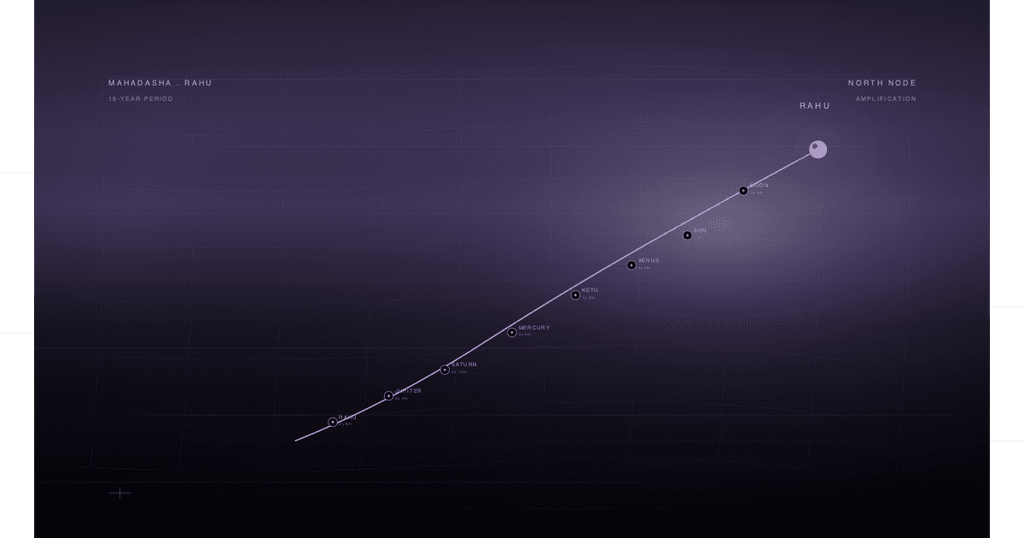
The Rahu mahadasha is the 18-year period when Rahu's karaka register sits in the foreground. For natives with Rahu in the 11th, this period activates the natal placement directly. The headline gains-event of the chart owner's life typically anchors here.
The pattern from the case literature is recognisable. The early Rahu mahadasha often produces the income-foundation event: the first equity grant, the foreign-employment offer, the network-building period. The middle mahadasha (often the Rahu-Saturn or Rahu-Venus sub-period) often produces the structural income event: the IPO, the platform monetisation, the partnership buyout. The Rahu-Venus sub-period of three years is the longest single sub-period and often carries the largest single gain event.
Secondary activation windows: the mahadasha of the 11th lord, the mahadasha of Jupiter (the gains karaka), the mahadasha of any planet conjunct Rahu in the 11th and the Saturn or Jupiter transit through the 11th. Eclipse activations on natal Rahu often coincide with major income events. The 18-year amplification window is documented in detail at the Rahu mahadasha overview.
Reading sequence in practice
- Identify the sign on the 11th house for the natal ascendant. This is Rahu's dispositor.
- Trace the dispositor to its house placement and check dignity.
- Check the 11th lord independently. The 11th lord's house placement is the income-direction layer.
- Check the natural karaka Jupiter for the gains register and Mercury for the network register.
- Identify conjunctions and aspects to natal Rahu in the 11th. Note the Ketu placement in the 5th.
- Locate the running mahadasha. Rahu mahadasha activates the 11th-house Rahu directly. Dasha of the 11th lord or Jupiter produces secondary activation.
- Cross-confirm with the Dhana-yoga structure: Rahu in the 11th plus a 2nd-11th lord combination plus Jupiter in dignity often produces classical Dhana-yoga (wealth combination) signatures.
What this reading does not predict
The structural reading is precise about register and disposition but explicitly limited on three fronts. It does not predict a specific income amount, a specific equity grant or a specific business outcome. It predicts the structural conditions under which large-scale unconventional income becomes likely and the windows in which the income-amplification event tends to concentrate. It does not predict the longevity of the gains; the speculative-axis component carries reversal risk when the dispositor is weak. It does not predict the contentment register; large gains do not in themselves resolve the desire-amplification pattern Rahu carries. Personal-chart outcomes always depend on the running dasha, the simultaneous transit picture, the strength of the dispositor and the resolution of the Navamsa. Tempora's framework is structural; the dated-call discipline lives at the tracker.
Frequently asked questions
Why is Rahu in the 11th house one of the strongest classical placements?
Three structural factors stack. First, the 11th house is the Labha Bhava (the gains house) and the strongest of the three upachaya houses (3rd, 6th, 10th, 11th, the growing or increasing houses). Upachaya houses are the only houses where malefics traditionally produce constructive results over time. Second, Rahu is classically read as a benefic in upachaya placements; the shadow node's amplification register stacks with the upachaya's growth register. Third, the 11th's natural significations (gains, large income, network and elder-sibling support, the fulfilment of desires) align directly with Rahu's karaka domain (amplification, foreign channels, unconventional sources). The configuration produces large network-driven income through foreign or unconventional channels and is one of the classical signatures for wealth accumulation across the Rahu mahadasha.
What does Rahu in the 11th house mean for income and wealth?
Rahu in the 11th biases the chart toward large-scale income through unconventional or foreign channels: equity gains from technology platforms, foreign-currency income, network-driven business income, large-scale promotion income, advertising and platform revenue, foreign-investment returns and the broader cluster of income-amplification sources. The 11th is the income-receiving house (distinct from the 2nd which reads accumulated wealth and the 10th which reads earned career income); Rahu in the 11th amplifies the receiving register specifically. The pattern often shows up as windfall-style income events, large network-driven bonuses, equity vesting events, foreign-source income spikes and platform-revenue compounding.
Does Rahu in the 11th house affect elder siblings?
Yes. The 11th house is the classical significator for elder siblings (the 3rd is younger siblings). Rahu in the 11th often produces an elder-sibling story with the amplification register: an elder sibling who emigrates, an elder sibling with an unconventional career, an elder sibling who carries a foreign-axis biography or an elder sibling whose own life events affect the chart owner's network and income register. The pattern is consistent enough that the elder-sibling biography often parallels the chart owner's own foreign-residency arc. The friend-network register also carries Rahu's signature: many of the chart owner's most consequential professional relationships often originate in foreign or unconventional networks rather than the local register.
Is Rahu in the 11th house good for friendship and social networks?
Yes for unconventional friendships and large networks. The 11th house reads the friend-network register; Rahu amplifies it. The chart owner often builds large networks that cross borders, cultures, professions or social registers in ways the family-of-origin would not have. The network itself often becomes the income vehicle (foreign-axis business contacts, network-driven distribution, professional associations that operate at scale). The texture is unconventional: deep friendships with people from different cultural registers, professional networks that span multiple countries or industries and the broader pattern of social capital accumulated through boundary-crossing channels. The risk register is that some network relationships carry transactional or amplification-axis features (network connections as commodity rather than as friendship in the traditional register).
When does Rahu in the 11th house deliver its gains?
Event timing concentrates inside the Rahu mahadasha (the 18-year amplification period) which directly activates the natal placement. The headline gains-event of the chart owner's life typically anchors here. Inside the mahadasha, the Rahu-Venus sub-period (about 3 years, the longest single sub-period) often delivers the largest income amplification. The Rahu-Mercury (about 2 years 6 months) and Rahu-Jupiter (about 2 years 5 months) sub-periods often carry the network-driven income and the foreign-axis gains respectively. Secondary activation windows: the mahadasha of the 11th lord, the mahadasha of Jupiter (the gains karaka) and the Saturn or Jupiter transit through the 11th house. Eclipse activations on natal Rahu often coincide with major income events.
What are the best ascendants for Rahu in the 11th house?
Most constructive: Aries ascendant (Rahu in Aquarius, Saturn dispositor, network-axis income; technology and platform gains), Sagittarius ascendant (Rahu in Libra, Venus dispositor, aesthetic or partnership-axis income) and Gemini ascendant (Rahu in Aries, Mars dispositor, action-axis network gains). Strong: Cancer ascendant (Rahu in Taurus, Venus dispositor) and Capricorn ascendant (Rahu in Scorpio, Mars dispositor). Mixed: Leo, Virgo and Pisces. The dispositor's house placement and the 11th lord's natal placement together set the texture in every case. Rahu in the 11th is one of the few configurations where most ascendants benefit; the upachaya register provides structural support across the board.
When is a natal Rahu in the 11th house activated in 2026 to 2028?
An 11th-house Rahu is the standing charge; a slow transit over its sign dates each release. An Aries ascendant holds the 11th in Aquarius, where transiting Rahu returns over its own position from 9 June 2025 to 27 December 2026. A Libra ascendant holds it in Leo, occupied by transiting Ketu to 27 December 2026 and marked by the 12 August 2026 solar eclipse on the Cancer to Leo cusp. A Virgo ascendant holds it in Cancer, crossed by exalted Jupiter from 27 May 2026 and by transiting Ketu from 27 December 2026 to 15 July 2028. Rahu crosses a sign in about eighteen months and returns to a natal sign about every eighteen years, so its own return is the direct trigger, and each window dates when the income and gains theme comes forward without fixing its size.
- Rahu Mahadasha: the 18-year period of amplification and unconventional rise
- The 11th house: gains, income, network and elder siblings
- Rahu in the 12th house: foreign residency and hidden amplification
- Rahu in the 10th house: career summit through unconventional channels
- Will I be rich? the Dhana-yoga structure
This article was prepared by Tempora Research as an informational piece in the Houses cluster. Methodology, calibrated lift figures and reconciliation entries are documented in Tempora's research-publishing standards and reproducible against the public engine. Internal audit log maintained. This article does not constitute medical, financial, legal or professional advice. First published 2026-06-05 by Tempora Research.