The Ketu ruled nakshatras, Ashwini, Magha and Mula.
Ketu rules three of the 27 nakshatras in the Vimshottari scheme: Ashwini at 0°00' to 13°20' Aries, Magha at 0°00' to 13°20' Leo and Mula at 0°00' to 13°20' Sagittarius, the last of these written Moola on its own cluster page. The grouping is structural rather than thematic convenience. Each arc opens a fire sign, each sits exactly 120° from the next and each hands a birth Moon the same opening period, the 7-year Ketu mahadasha. What separates the three is register: Ashwini heals and initiates under the twin physicians, Magha holds the ancestral throne under the Pitris and Mula pulls at foundations under Nirriti. This page reads the group as a group; the three dedicated pages carry the full per-nakshatra treatment.
The three arcs side by side
The table gathers the classical attributes documented on the three individual pages. Every value below is the same value the dedicated pages carry, from Brihat Parashara Hora Shastra Chapter 3, Phaladeepika Chapter 7 and Sarvartha Chintamani.
| Attribute | Ashwini | Magha | Mula |
|---|---|---|---|
| Range | 0°00' to 13°20' Aries | 0°00' to 13°20' Leo | 0°00' to 13°20' Sagittarius |
| Sequence position | 1st of 27 | 10th of 27 | 19th of 27 |
| Presiding deity | Ashwini Kumars, the twin celestial physicians | Pitris, the ancestors | Nirriti, goddess of dissolution and disorder |
| Symbol | horse's head | throne, royal-court or palanquin | tied bundle of roots |
| Gana | deva | rakshasa | rakshasa |
| Yoni | horse | rat | dog |
| Nadi | vata | kapha | vata |
| Macro register | swift action, healing, pioneering initiative | ancestral authority, royal lineage, dignified leadership | root-axis seeking, fundamental investigation |
The Vimshottari arithmetic: why Ketu holds three arcs and 7 years
The 27 nakshatras divide among 9 planetary lords, three arcs each. The assignment follows a fixed rotation, so each lord's three nakshatras sit nine positions apart, which is nine times 13°20', exactly 120° of arc. Ketu takes positions 1, 10 and 19: Ashwini, Magha and Mula. Draw the three on the wheel and they form an equilateral triangle over the zero-degrees of Aries, Leo and Sagittarius, the three fire signs.
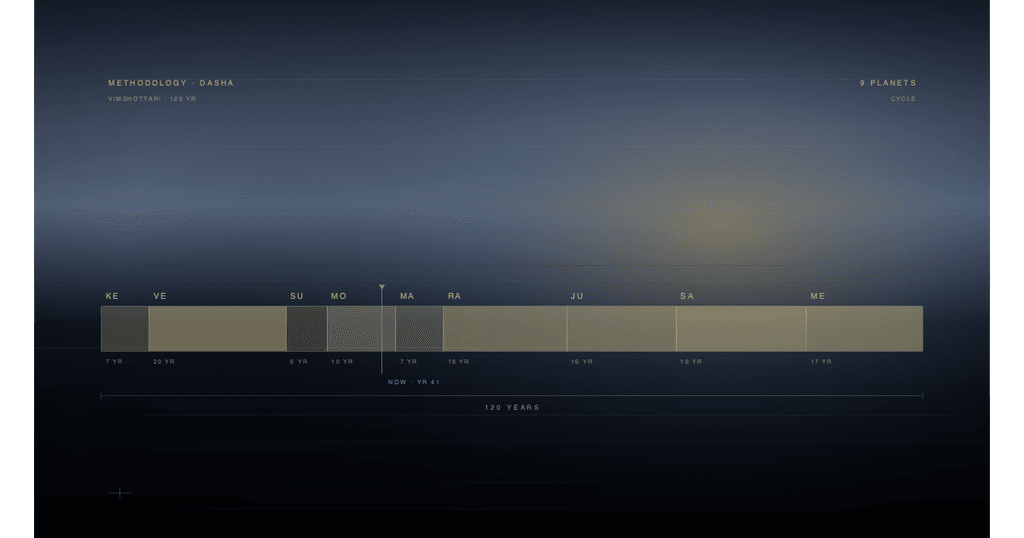
The period lengths come from the same scheme. The Vimshottari cycle as tabulated runs Ketu 7, Venus 20, Sun 6, Moon 10, Mars 7, Rahu 18, Jupiter 16, Saturn 19 and Mercury 17 years, totalling 120. The classical texts assign the durations; the arithmetic only requires that the nine sum to 120. Ketu's 7 years is the joint-shortest allocation with Mars, with only the Sun's 6 briefer, about 5.8 percent of the full cycle. A birth Moon in any Ketu-ruled arc opens at the head of that tabulation: the Ketu mahadasha runs first and Venus follows with the longest period of all, 20 years. The 7 years themselves subdivide into nine antardasha sub-periods in the same fixed order; the Ketu mahadasha overview walks them one by one.
One more consequence of the rotation is worth stating plainly. The lord before Ketu in the rotation is Mercury, who holds positions 9, 18 and 27: Ashlesha, Jyeshtha and Revati, the closing arcs of the three water signs. So every Ketu-ruled nakshatra opens where a Mercury-ruled one closes, and the mahadasha sequence mirrors the geometry: Mercury's 17-year period is the last of the 120-year cycle and Ketu's 7-year period is the first of the next.
Fire-sign starts and the gandanta junctions
All three Ketu-ruled arcs begin at 0°00' of a fire sign, immediately after a water sign ends: Pisces into Aries ahead of Ashwini, Cancer into Leo ahead of Magha, Scorpio into Sagittarius ahead of Mula. These three water-to-fire junctions are the gandanta points of classical practice, the seams where an emotional-dissolution sign hands over to an initiating one and where both the sign boundary and the nakshatra boundary fall together. Practice treats the degrees flanking each junction as a sensitive band; the width of the band varies by school, with the closing pada of the water nakshatra and the opening pada of the fire nakshatra as the common outer bound.
The consequence for this group: the first pada of Ashwini, Magha and Mula each sits inside that gandanta-adjacent band. A Moon in the opening degrees of any of the three is a Moon just across a junction, which is part of why the tradition reads the whole group through severance and fresh starts rather than continuity. The rest of each arc runs clear of the band, so the reading applies to the opening degrees specifically, not to the nakshatra wholesale.
The shared signature: what Ketu rulership stamps on all three
Ketu is the south lunar node, a shadow planet without physical body, classically depicted as the headless body of Svarbhanu from the churning-of-the-ocean narrative. As karaka it signifies separation, detachment, moksha orientation, the residual sediment of prior-life karma and the sudden cut that ends a phase. That is the stamp the rulership presses into all three nakshatras, and each expresses it through its own material.
Ashwini expresses severance as the reset: it opens the entire 27-step wheel, water into fire, and its dawn-physician register cuts away the old condition to start the cure. Magha expresses it as dissolution of personal ambition into the line: the throne is received, not built, and the self steps back so the lineage can occupy the seat. Mula expresses it most literally: the root-cutter pulls structures apart to expose what they stand on. Severance and origin are two faces of one operation here, which is why the moksha karaka fits this trio: each arc ends something in order to reach the beginning of something.
What distinguishes each
Ashwini, the healer-initiator
The 1st nakshatra, 0°00' to 13°20' Aries. The Ashwini Kumars are divine twin physicians who appear at dawn in the Rigveda, restoring youth to the aged and life to the dead, and the horse's-head symbol binds speed to the work of healing. Ashwini is the group's only deva-gana member and its register is the leading edge: fast starting, swift problem-solving, first-mover initiative. Classical professional associations run through medicine and healing, especially emergency medicine and surgery, military and security, athletics, exploration and entrepreneurship.
Magha, the ancestral throne
The 10th nakshatra, 0°00' to 13°20' Leo. The Pitris, the ancestors residing in the lunar mansions, confer lineage and the honour of bloodline; the throne symbol reads as authority received rather than constructed. Where Ashwini initiates, Magha inherits: traditional dignity, honour-bound conduct and the responsibility of representing something older than the self. Classical professional associations run through institutional leadership, government and judiciary, traditional arts where lineage matters, ancestral business continuation and ceremonial roles.
Mula, the root-cutter
The 19th nakshatra, 0°00' to 13°20' Sagittarius. Nirriti presides, the goddess of dissolution and disorder, and the tied bundle of roots is the symbol: investigation that reaches to fundamentals, dissolving surface to expose origin. Mula is the group's excavator, the station that pulls at foundations to see what actually holds. Classical professional associations run through philosophy and fundamental research, archaeology, diagnostic and root-cause medicine, depth psychotherapy and plant-medicine work.
Born with the Moon in a Ketu-ruled nakshatra
The load-bearing fact is common to all three: a natal Moon anywhere in these arcs opens life inside the Ketu mahadasha, and the elapsed fraction of the nakshatra at birth sets how much of the 7 years remains. A Moon at 0°00' of the arc inherits close to the full 7 years. A Moon three-quarters through, near 10° of the sign, keeps one quarter of 7 years, about 1 year 9 months, before the 20-year Venus mahadasha opens. A Moon in the closing degrees keeps only weeks or months. The birth nakshatra is the entry point of the whole 120-year map: fix the degree and every later mahadasha boundary is fixed with it.
Moon in Ashwini
Initiative is the dominant temperamental register: the chart starts things quickly, solves problems through speed and direct action and operates at the leading edge of its field. The opening Ketu years, coloured by Ashwini's dawn-initiative, often read as early-life independence, restless seeking and the dissolution of inherited structures to make room for direct initiative.
Moon in Magha
Inherited authority is the dominant register: traditional dignity, honour-bound conduct and the weight of representing the line. The opening Ketu years, coloured by Magha's ancestral register, often read as early-life formation through tradition and lineage, with personal ambition dissolving in favour of role-fulfilment.
Moon in Mula
Root-seeking is the dominant register: the chart reaches to origins, processes through dissolution-and-rebirth cycles and runs a relentless inquiry that demands fundamentals. The opening Ketu years, coloured by Mula's excavating register, often read as early-life dissolution of inherited structures and the search for fundamental orientation.
One navamsa ladder, shared three ways
Because each Ketu-ruled arc opens at 0°00' of a fire sign, the four padas of all three nakshatras map to the same navamsa sequence: pada 1 to Aries under Mars, pada 2 to Taurus under Venus, pada 3 to Gemini under Mercury, pada 4 to Cancer under the Moon. A pada-2 Moon in Ashwini and a pada-2 Moon in Mula activate the same Taurus navamsa, tempering two different nakshatra registers with the same sensory grounding. The pada fixes which navamsa sign the chart owner activates; the navamsa lord then participates in the reading as a parallel signature alongside Ketu. The per-pada readings, one line per pada per nakshatra, sit on the three dedicated pages.
Transits across the three spans
Beyond the natal-Moon reading, each arc carries significance whenever slow planets cross its 13°20'. Saturn passes a given arc roughly once every 29.5 years, Jupiter once per 12-year cycle and the nodes once every 18 years. In the current window the three arcs run very different skies. Magha is the busy one: Ketu itself transits its own 0°00' to 13°20' Leo segment until 27 December 2026, the lord walking the ground it governs, before the nodes shift to the Capricorn-Cancer axis where Ketu stays in Cancer through 15 July 2028. Jupiter lays its benefic overlay across the same Magha degrees twice, 22 October 2026 to 2 February 2027 and again 19 June to 25 August 2027. Ashwini's headline visitor is Saturn, which reaches the arc on 23 May 2027 in the first of three passes. Mula takes no slow contact at all in 2026 to 2028; its next is Rahu from 26 May 2029.
The computed windows below consolidate the per-nakshatra tables published on the three individual pages: every pass of Saturn, Jupiter and Rahu through each arc, 2024 to 2040. Sidereal positions from the Swiss Ephemeris with the PVRN Rao True Pushya ayanamsha and the mean node, the same engine that computes every chart on this site. Separate rows are separate passes, produced by retrograde motion.
| Span | Planet | Enters | Exits |
|---|---|---|---|
| Ashwini | Jupiter | 2023-12-09 | 2024-01-21 |
| Magha | Jupiter | 2026-10-22 | 2027-02-02 |
| Ashwini | Saturn | 2027-05-23 | 2027-11-03 |
| Magha | Jupiter | 2027-06-19 | 2027-08-25 |
| Ashwini | Saturn | 2028-02-10 | 2028-06-04 |
| Ashwini | Saturn | 2028-11-17 | 2029-02-22 |
| Mula | Rahu | 2029-05-25 | 2030-02-01 |
| Mula | Jupiter | 2031-02-10 | 2031-06-22 |
| Mula | Jupiter | 2031-10-07 | 2031-12-15 |
| Ashwini | Jupiter | 2035-04-01 | 2035-05-28 |
| Magha | Rahu | 2035-08-07 | 2036-04-14 |
| Magha | Saturn | 2036-08-18 | 2037-08-31 |
| Magha | Jupiter | 2038-10-01 | 2039-03-13 |
| Magha | Jupiter | 2039-05-22 | 2039-08-10 |
Beneath the slow signals, the transiting Moon returns to each arc for about a day every 27.3 days and the Sun holds each for roughly a fortnight once a year. Every entry above is a transit over a fixed 13°20' arc and carries the same limitation: the overlay marks a window, and the natal chart underneath decides what the window does.
Calibration status
This page documents the classical reading of the Ketu-ruled group as set out in BPHS Chapter 3, Phaladeepika Chapter 7 and Sarvartha Chintamani, consolidated from the three per-nakshatra pages. The presiding-deity readings, the symbol interpretations, the four-pada navamsa framework and the compatibility attributes are presented as the tradition's own framework. The Tempora calibrated signature library (Note 005) does not currently include nakshatra-specific event signatures. Calibrating nakshatra placements against a labelled chart-corpus is open work.
FAQ
Which nakshatras are ruled by Ketu?
Ketu rules three nakshatras in the Vimshottari scheme: Ashwini at 0°00' to 13°20' Aries (1st of 27), Magha at 0°00' to 13°20' Leo (10th) and Mula at 0°00' to 13°20' Sagittarius (19th), also written Moola. Each opens a fire sign and each carries the 7-year Ketu mahadasha for a native born with the Moon there.
Why does Ketu rule exactly three nakshatras?
The 27 nakshatras divide among the 9 Vimshottari lords in fixed rotation, three arcs each, so every lord's nakshatras sit nine positions and exactly 120° apart. Ketu takes positions 1, 10 and 19, which fall at 0°00' of Aries, Leo and Sagittarius, the three fire signs. Each Ketu-ruled arc opens where a Mercury-ruled one closes, mirroring the mahadasha sequence in which Mercury's 17-year period ends the 120-year cycle and Ketu's 7-year period begins the next.
How long is the opening mahadasha for a Moon born in a Ketu-ruled nakshatra?
The Ketu mahadasha runs 7 years, and the elapsed fraction of the nakshatra at birth sets the remainder. A Moon at 0°00' of the arc inherits close to the full 7 years. A Moon three-quarters through keeps one quarter of 7 years, about 1 year 9 months, before the 20-year Venus mahadasha opens. A Moon in the closing degrees keeps only weeks or months. This is why the birth nakshatra is the entry point of the whole 120-year Vimshottari map.
Do Ashwini, Magha and Mula share the same pada navamsa signs?
Yes. Because each arc opens at 0°00' of a fire sign, the four padas of all three map to the same navamsa sequence: pada 1 to Aries under Mars, pada 2 to Taurus under Venus, pada 3 to Gemini under Mercury, pada 4 to Cancer under the Moon. The pada fixes which navamsa sign the chart owner activates; the nakshatra supplies the register that navamsa tempers.
What distinguishes the three Ketu-ruled nakshatras from each other?
Ashwini is the healer-initiator: the Ashwini Kumars preside, the horse's head is the symbol and the register is swift action, healing and pioneering initiative. Magha is the ancestral throne: the Pitris preside, the throne or palanquin is the symbol and the register is inherited authority and dignified leadership. Mula is the root-cutter: Nirriti presides, the tied bundle of roots is the symbol and the register is fundamental investigation and dissolution to origin. All three share Ketu's severance-and-origin stamp; each expresses it through its own material.
Are the Ketu-ruled nakshatras gandanta zones?
Each begins immediately after a water-to-fire sign junction, Pisces into Aries, Cancer into Leo and Scorpio into Sagittarius, and these three junctions are the gandanta points of classical practice. The sensitive band flanks the junction itself, so the opening pada of each Ketu-ruled nakshatra sits inside the gandanta-adjacent zone while the rest of each arc runs clear of it. The reading applies to the opening degrees specifically, not to the nakshatra wholesale.
Which transits cross the Ketu-ruled arcs between 2026 and 2028?
Magha carries the most: Ketu transits its own 0°00' to 13°20' Leo segment until 27 December 2026, and Jupiter crosses the same degrees from 22 October 2026 to 2 February 2027 and again from 19 June to 25 August 2027. Saturn reaches Ashwini's arc on 23 May 2027, exits 3 November 2027 and returns 10 February to 4 June 2028. Mula takes no slow contact in this window; its next is Rahu from 25 May 2029 to 1 February 2030. Beneath these, the Moon crosses each arc for about a day every 27.3 days and the Sun for roughly a fortnight once a year.
- Ashwini nakshatra · the 1st nakshatra, 0°00' to 13°20' Aries
- Magha nakshatra · the 10th nakshatra, 0°00' to 13°20' Leo
- Mula nakshatra · the 19th nakshatra, 0°00' to 13°20' Sagittarius
- The Ketu major-period overview · the 7 years these three nakshatras open
- The full Nakshatra cluster · all 27 nakshatras and the 9 ruling-planet groups
This article was prepared by Tempora Research as an informational piece in the Nakshatra cluster. Methodology, calibrated lift figures and reconciliation entries are documented in Tempora's research-publishing standards and reproducible against the public engine. Internal audit log maintained. This article does not constitute medical, financial, legal or professional advice. First published 2026-08-14 by Tempora Research.