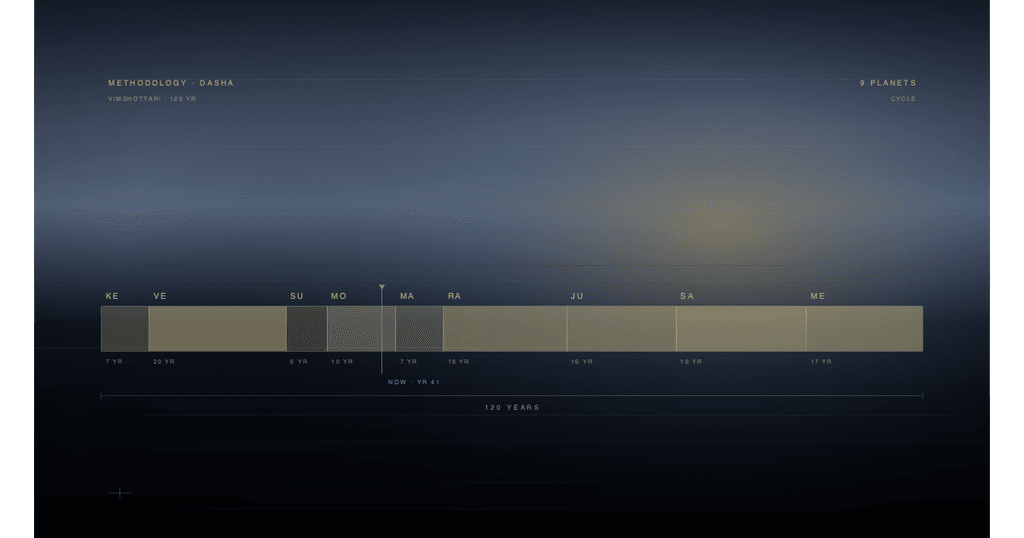
The 27 nakshatras, by ruling planet and degree.
The 27 nakshatras are the foundation layer of the sidereal lattice. Each is a 13°20' arc with a presiding deity, a ruling planet and a four-quarter (pada) subdivision. The natal Moon nakshatra anchors the Vimshottari major-period system. The Tempora cluster covers the 9 ruling-planet groups and 27 individual nakshatras with calibrated context.
What a nakshatra is
The full 360° sidereal zodiac divides into 27 equal arcs of 13°20' each. Each arc is a nakshatra, the term meaning lunar mansion, named after a fixed-star cluster the Moon traverses across its monthly cycle. The Moon spends roughly 24 hours in each nakshatra.
Each nakshatra carries: a presiding deity that sets its symbolic register; a ruling planet that anchors which Vimshottari major period the native enters at birth if their natal Moon falls there; a four-quarter (pada) subdivision of 3°20' each; and a set of classical attributes including gana (temperament), varna (functional class) and yoni (animal-symbol matching key).
The 9 ruling-planet groups
The 27 nakshatras are grouped into 9 sets of three by ruling planet. The pattern is fixed: Ketu rules positions 1, 10, 19. Venus rules 2, 11, 20. Sun rules 3, 12, 21. Moon rules 4, 13, 22. Mars rules 5, 14, 23. Rahu rules 6, 15, 24. Jupiter rules 7, 16, 25. Saturn rules 8, 17, 26. Mercury rules 9, 18, 27.
Each ruling-planet group shares the Vimshottari major-period length. The major-period lengths sum to 120 years exactly. The Ketu-ruled trio of Ashwini, Magha and Mula shows the pattern at its cleanest: three arcs at 0°00' of the three fire signs, each opening the 7-year Ketu mahadasha for a Moon born there.
| Group | Major-period length | Three nakshatras |
|---|---|---|
| Ketu-ruled | 7 yrs | Ashwini, Magha, Moola |
| Venus-ruled | 20 yrs | Bharani, Purva Phalguni, Purva Ashadha |
| Sun-ruled | 6 yrs | Krittika, Uttara Phalguni, Uttara Ashadha |
| Moon-ruled | 10 yrs | Rohini, Hasta, Shravana |
| Mars-ruled | 7 yrs | Mrigashira, Chitra, Dhanishtha |
| Rahu-ruled | 18 yrs | Ardra, Swati, Shatabhisha |
| Jupiter-ruled | 16 yrs | Punarvasu, Vishakha, Purva Bhadrapada |
| Saturn-ruled | 19 yrs | Pushya, Anuradha, Uttara Bhadrapada |
| Mercury-ruled | 17 yrs | Ashlesha, Jyestha, Revati |
Why the natal Moon nakshatra matters
The Vimshottari major-period system, the primary timing engine in this tradition, is anchored on the Moon's natal nakshatra. The planet ruling that nakshatra is the major period the native is born into. A child born with the natal Moon in Pushya nakshatra (Saturn-ruled) enters life in the Saturn major period. A child born minutes earlier with the Moon in the last degree of Punarvasu (Jupiter-ruled) enters in the Jupiter major period.
The exact degree within the nakshatra fixes how much of that opening major period remained at birth. The Moon at 0° of a nakshatra gets the full period. The Moon at the closing degree gets only the residual fraction before transitioning to the next major period in the fixed sequence.
The 27 nakshatras, in order
The Moon traverses the 27 nakshatras in fixed sequence across each 27-day sidereal lunar cycle. The first nakshatra (Ashwini) opens at 0° sidereal Aries.
| Nakshatra | Ruler | Deity | Range |
|---|---|---|---|
| Ashwini | Ketu | Ashwini Kumars | 0°00' to 13°20' Aries |
| Bharani | Venus | Yama | 13°20' to 26°40' Aries |
| Krittika | Sun | Agni | 26°40' Aries to 10°00' Taurus |
| Rohini | Moon | Brahma / Prajapati | 10°00' to 23°20' Taurus |
| Mrigashira | Mars | Soma | 23°20' Taurus to 6°40' Gemini |
| Ardra | Rahu | Rudra | 6°40' to 20°00' Gemini |
| Punarvasu | Jupiter | Aditi | 20°00' Gemini to 3°20' Cancer |
| Pushya | Saturn | Brihaspati | 3°20' to 16°40' Cancer |
| Ashlesha | Mercury | Nagas | 16°40' to 30°00' Cancer |
| Magha | Ketu | Pitris (ancestors) | 0°00' to 13°20' Leo |
| Purva Phalguni | Venus | Bhaga | 13°20' to 26°40' Leo |
| Uttara Phalguni | Sun | Aryaman | 26°40' Leo to 10°00' Virgo |
| Hasta | Moon | Savitar | 10°00' to 23°20' Virgo |
| Chitra | Mars | Vishvakarma | 23°20' Virgo to 6°40' Libra |
| Swati | Rahu | Vayu | 6°40' to 20°00' Libra |
| Vishakha | Jupiter | Indra-Agni | 20°00' Libra to 3°20' Scorpio |
| Anuradha | Saturn | Mitra | 3°20' to 16°40' Scorpio |
| Jyestha | Mercury | Indra | 16°40' to 30°00' Scorpio |
| Moola | Ketu | Nirriti | 0°00' to 13°20' Sagittarius |
| Purva Ashadha | Venus | Apas (waters) | 13°20' to 26°40' Sagittarius |
| Uttara Ashadha | Sun | Vishvadevas | 26°40' Sagittarius to 10°00' Capricorn |
| Shravana | Moon | Vishnu | 10°00' to 23°20' Capricorn |
| Dhanishtha | Mars | Eight Vasus | 23°20' Capricorn to 6°40' Aquarius |
| Shatabhisha | Rahu | Varuna | 6°40' to 20°00' Aquarius |
| Purva Bhadrapada | Jupiter | Aja Ekapada | 20°00' Aquarius to 3°20' Pisces |
| Uttara Bhadrapada | Saturn | Ahir Budhnya | 3°20' to 16°40' Pisces |
| Revati | Mercury | Pushan | 16°40' to 30°00' Pisces |
What this cluster does not predict
The Tempora nakshatra cluster reads structural patterns at the national-chart level and at the cohort level. It does not forecast individual events on a personal chart from a single nakshatra placement. Personal-event forecasting requires the full major-period plus sub-period plus transit overlay and a calibration set the size of which does not exist for individual nativities. The framework is explicit about this scope limit.
FAQ
What is a nakshatra?
A nakshatra is a 13°20' arc of the 360° sidereal zodiac. The full zodiac divides into 27 nakshatras of equal arc. Each is named after a fixed-star cluster and carries a presiding deity, a ruling planet and a four-quarter (pada) subdivision. The nakshatra layer predates the twelve-sign zodiac in the tradition; the Vedas reference the nakshatras directly.
Why does the natal Moon nakshatra matter?
The natal Moon nakshatra anchors the Vimshottari major-period system, the primary timing engine in this tradition. The planet ruling the Moon's natal nakshatra is the major period the native is born into. The exact degree within the nakshatra fixes how much of that major period remained at birth, which sets the entire 120-year sequence.
How are the 27 nakshatras divided by ruling planet?
The 27 nakshatras are grouped into 9 ruling-planet sets of three nakshatras each. Ketu rules positions 1, 10, 19 (Ashwini, Magha, Moola). Venus rules 2, 11, 20 (Bharani, Purva Phalguni, Purva Ashadha). The pattern continues: Sun, Moon, Mars, Rahu, Jupiter, Saturn, Mercury. The 9 major-period lengths sum to 120 years.
What is the 9-step nakshatra grouping called?
There is no single canonical name for the grouping. In this cluster we refer to it as the ruling-planet group. Each group of three nakshatras shares its ruling planet and therefore shares the major-period length when that nakshatra is the natal Moon nakshatra. The three nakshatras inside a group differ in deity, sign placement and pada structure.
Does the Tempora framework forecast personal events from a nakshatra?
No. The cluster reads structural patterns at the national-chart level and at the cohort level. Personal forecasting on a single chart requires the full major-period + sub-period + transit overlay, plus a calibration set the size of which does not exist for individual nativities. The framework is explicit about this scope limit.
- The Mahadasha cluster · Vimshottari major-period sequence and the 9 major-period overviews
- Moon nakshatra prediction · the natal Moon nakshatra as the chart's emotional register
- Nakshatra strength comparison · classical ranking by gana, varna, yoni and tara
- True Pushya Paksha vs Lahiri ayanamsha · the sidereal calibration this cluster uses
This article was prepared by Tempora Research as an informational piece in the Nakshatra cluster. Methodology, calibrated lift figures and reconciliation entries are documented in Tempora's research-publishing standards and reproducible against the public engine. Internal audit log maintained. This article does not constitute medical, financial, legal or professional advice. First published 2026-05-29 by Tempora Research.