Pushya nakshatra, the most auspicious nakshatra in classical literature and the source of Tempora's True Pushya Paksha ayanamsa.
Pushya sits at 3°20' to 16°40' sidereal Cancer. It is the 8th of the 27 nakshatras, ruled by Saturn with Brihaspati (Jupiter) as the presiding deity. The Sanskrit name Tishya translates as the auspicious one. Brihat Parashara Hora Shastra and Phaladeepika both rank Pushya as the single most auspicious nakshatra in the lunar lattice for starting new ventures, with one specific exclusion: marriage. India 1947 is born with the natal Moon at 16°14' Cancer in Pushya pada 4, which makes the India national chart the most-cited case study for Pushya Moon nativities. Tempora's True Pushya Paksha ayanamsa is named after this nakshatra because the sidereal reference point that anchors the entire framework is set against the true position of the Pushya stars in the Cancer constellation.
Range, ruler, deity, attributes
| Range | 3°20' to 16°40' Cancer (sidereal) |
|---|---|
| Position | 8th of 27 nakshatras |
| Sanskrit name | Tishya (the auspicious one) |
| Ruling planet | Saturn (Vimshottari major-period lord) |
| Presiding deity | Brihaspati (Jupiter, the guru of the gods) |
| Symbol | cow's udder, lotus, arrow |
| Yoni (animal) | male goat |
| Gana (temperamental class) | deva (divine) |
| Varna (functional class) | kshatriya (warrior-leader) |
| Tattva (element) | water (Cancer sign substrate) |
| Direction | east |
| Macro register | nourishing, protective, structurally generous |
Why Pushya carries unusual classical weight
Pushya is the rare nakshatra where the planetary ruler and the deity are classical opposites brought into balance. Saturn governs restriction, structure, time and patience. Brihaspati governs expansion, wisdom, teaching and the role of the cosmic preceptor. Most nakshatras carry only one register at the planetary-ruler layer. Pushya carries both at once: Saturn's structural depth held inside Brihaspati's protective expansion. The classical reading is that this is what makes Pushya the most auspicious nakshatra in the lattice. Restriction without wisdom is harsh. Expansion without structure dissipates. Pushya holds both.
Brihat Parashara Hora Shastra (chapter on nakshatra qualities) places Pushya at the highest tier of auspiciousness alongside Rohini and Uttara Phalguni. Phaladeepika calls Pushya the foremost of nakshatras (nakshatra-shreshtha). Muhurta Chintamani and Muhurta Martanda both place Pushya at the top of the muhurta hierarchy for initiating beneficial activity. Across classical sources the consensus is unusually consistent.
The Pushya muhurta and the one classical exclusion
The most practical place Pushya enters daily Vedic life is muhurta selection. The muhurta tradition holds Pushya as the most auspicious nakshatra for starting any new beneficial activity. The named combinations are:
- Guru Pushya yoga. Thursday plus Pushya nakshatra. Thursday is Jupiter's day, Pushya's deity is Jupiter. The combination is considered the most powerful Pushya muhurta in the calendar. Traditionally used for gold purchases, real estate, vehicle purchase, starting education, opening a new business, charitable donations, signing contracts, breaking ground on construction.
- Ravi Pushya yoga. Sunday plus Pushya nakshatra. Sunday is Sun's day. Sun is exalted in Aries and the Sun-Saturn relationship is classically tense, so Ravi Pushya is the secondary Pushya muhurta. Used for the same purposes as Guru Pushya but with less classical weight.
- Shubha Pushya combinations. Pushya falling on any day during specific tithi or panchang alignments (Amrita yoga, Siddhi yoga) is considered additionally fortified.
The one classical exclusion is marriage. The muhurta texts are unusually explicit: Pushya tu varjayet sarvam vivahe karyam shubham. Marriage during Pushya muhurta is classically prohibited because the nourishing-protective register of the nakshatra is read as the protection of the parental family rather than the formation of a new family unit. Every other beneficial activity is favoured. Marriage specifically is forbidden. This is one of the few classical exclusions where the Vedic literature is unanimous across schools.
For Tempora's framework the practical takeaway: if you are choosing a muhurta for a major purchase, business launch, vehicle, real estate, gold, education or any contract that initiates a long arc, Guru Pushya is the strongest available muhurta in any given month. Check the panchang for the Thursday or Sunday when the Moon transits 3°20' to 16°40' sidereal Cancer.
India 1947 as the Pushya case study
India's national chart has the natal Moon at 16°14' Cancer sidereal, which places it in Pushya pada 4 (the final pada of Pushya, mapped to Scorpio navamsa under the 1/4 rule). This makes India the single most-cited Pushya Moon nativity in modern mundane astrology. The chart's character at the national level corresponds with classical Pushya registers in three specific ways.
Nourishing-protective national identity. The Indian state's founding self-image as a protector of diverse populations, the policy emphasis on food security across decades, the agriculture-as-national-priority register all map to Pushya's nourishing-protective signature. The cow as national symbol is the literal Pushya yoni.
Saturn-led national arc. The Saturn Vimshottari major period runs at the chart's opening. India's first 19 years (1947-1966) covered the post-independence structural-building phase: constitutional framework, planning commission, dam-and-steel infrastructure, the Saturn-led foundation work. The Pushya Moon nativity makes the opening Saturn period structurally aligned rather than oppositional.
Pada 4 Scorpio navamsa register. Pada 4 of Pushya falls in Scorpio navamsa. Scorpio is intense, transformative, secretive and structurally hidden. The classical reading of India 1947 at this pada is that the surface nourishing-protective register holds a hidden transformative depth underneath. The Partition trauma, the suppressed grief in the founding moment, the recurring crisis cycles that produce restructuring rather than collapse all align with Pada 4 Scorpio navamsa register inside Pushya's broader protection.
Born under Pushya: what it sets in motion
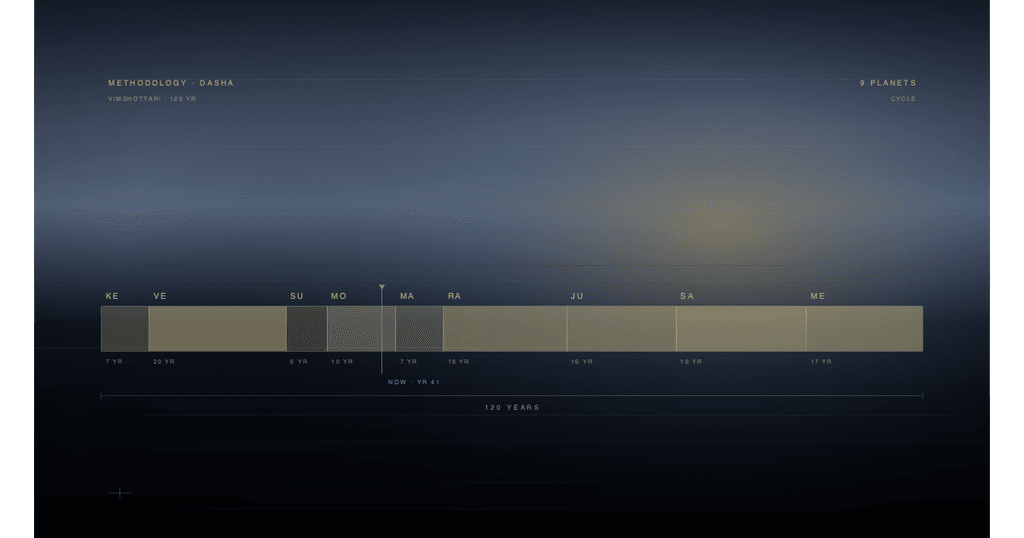
The load-bearing consequence of a Pushya Moon is not the auspicious character it lends the mind, it is that the placement selects the first mahadasha. A Moon in Pushya at birth opens the entire life inside the Saturn mahadasha, and Saturn holds 19 of the 120 Vimshottari years, the longest single period after Venus at 20. The birth nakshatra is therefore the entry point of the whole 120-year map, and Pushya sets that entry to Saturn. How much of the 19 years a person keeps is fixed by where inside the 13°20' arc the Moon fell. A Moon at 3°20' Cancer, the start of Pushya, inherits the full 19 years. A Moon three-quarters of the way through the arc has one quarter of the period left, that is 19 divided by 4, four and three-quarter years, four years and nine months, after which the 17-year Mercury mahadasha that follows Saturn in the sequence begins. A Moon in the closing degrees near 16°40' Cancer inherits only a residual span of Saturn measured in months before Mercury opens. The character of that long opening period, and the Brihaspati-deity modulation specific to Pushya, is set out in the Saturn major-period overview.
The four padas of Pushya
Each pada spans 3°20' of arc. The four padas of Pushya map sequentially to the four navamsa signs starting from Leo (per the 4/1 navamsa mapping convention used in the True Pushya Paksha framework). Pada-level reading qualifies the broad Pushya register with the sign character of the natal Moon's specific position.
| Pada 1 | 3°20' to 6°40' Cancer | Leo navamsa (Sun) | Authority, recognition, visible leadership inside the nourishing register |
|---|---|---|---|
| Pada 2 | 6°40' to 10°00' Cancer | Virgo navamsa (Mercury) | Service, analysis, healthcare, precision-craft inside the nourishing register |
| Pada 3 | 10°00' to 13°20' Cancer | Libra navamsa (Venus) | Partnership, diplomacy, aesthetic register, relational nourishment |
| Pada 4 | 13°20' to 16°40' Cancer | Scorpio navamsa (Mars) | Transformative depth, hidden intensity, the protective shell over deep restructuring (India 1947 sits here at 16°14') |
Saturn-ruler and Brihaspati-deity, the dual signature
The natal Moon in Pushya opens life with the Saturn Vimshottari major period. The full Saturn period runs 19 years. The exact degree of the Moon within Pushya fixes how much of the opening Saturn period remains at birth. Moon at 3°20' Cancer (the start of Pushya) gets the full 19 years. Moon at 16°40' Cancer (the closing degree) gets only the residual fraction before transitioning to the Mercury period that follows Saturn in the Vimshottari sequence.
The Brihaspati-deity layer modulates how the Saturn period reads for Pushya Moon natives specifically. Where Saturn major periods generally read as restructuring through restriction, the Pushya-Brihaspati overlay tends to read more as restructuring through teaching and protected discipline. The classical reading is that Pushya Moon natives in their opening Saturn period are being taught rather than punished. The discipline is real. The framing is protective.
For India 1947 specifically, the opening Saturn period 1947-1966 covered constitutional drafting (Brihaspati-deity layer of structure as teaching), the planning-commission system (Saturn-Brihaspati combined register) and the foundation of major educational and scientific institutions (IIT system founded 1951-1961, AIIMS 1956, ISRO predecessor 1962). The pattern of Saturn-structure inside Brihaspati-teaching is visible at the national-chart scale.
Pushya as the source of the True Pushya Paksha ayanamsa
The sidereal-tropical offset that Vedic astrology uses (the ayanamsa) requires a reference point. Different schools choose different references. The Lahiri ayanamsa fixes Spica (Chitra nakshatra's primary star) at 180°. The Raman ayanamsa uses a slightly different reference. The True Pushya Paksha ayanamsa that Tempora uses fixes the sidereal frame such that the true position of the Pushya stars in the Cancer constellation align with 3°20' to 16°40' Cancer in the sidereal lattice.
The choice of Pushya as the reference point reflects the nakshatra's classical authority. Pushya is the most-cited single nakshatra in the muhurta literature and the foundation of the most-used Vedic auspicious-timing system. Tying the sidereal frame to the true position of Pushya rather than to other reference stars gives the ayanamsa a classical anchor that matches the tradition's own most-emphasised reference. The technical detail of how the True Pushya Paksha ayanamsa is computed against the Swiss Ephemeris is documented in the methodology cluster.
Compatibility and Ashtakoota
Pushya's compatibility attributes are deva gana (divine temperamental class), kshatriya varna (warrior-leader functional class), male goat yoni (animal type for sexual compatibility scoring), east direction. These feed the Ashtakoota system used in marriage matching at the canonical level. Within the standard Ashtakoota framework Pushya scores high with other deva gana nakshatras (Ashwini, Mrigashira, Punarvasu, Hasta, Swati, Anuradha, Shravana, Revati) on the gana-koota axis.
Tempora's framework treats Ashtakoota compatibility scoring as documented classical reference rather than as a calibrated forward-call signature. The reason is that compatibility-outcome longitudinal data large enough to calibrate the system reliably does not exist at usable scale. The scoring is preserved for reference and tradition. Match decisions are better served by Navamsa overlap, seventh-lord Vimshottari period reading and concurrent transits than by Ashtakoota total alone.
What Pushya Moon natives traditionally experience
Career. Pushya Moon natives tend toward nourishing-protective career registers: healthcare, education, food and agriculture, government service, institution-building, family-business stewardship, religious or spiritual teaching, dairy or related industries. The Saturn-Brihaspati combination favours long-arc institutional roles over short-burn entrepreneurial ones.
Family. Strong attachment to mother and to family of origin is the classical signature. Pushya Moon natives often take on caregiver roles within the family unit. The protection axis runs through them.
Marriage. Marriage usually arrives later than average in the Pushya Moon profile because the protective register tends to prioritise the family of origin first. The classical exclusion of marriage during Pushya muhurta is mirrored at the natal level: Pushya Moon natives often face marriage delays or unusual circumstances around the timing of marriage.
Health. Cancer rules chest, stomach and digestion. Pushya Moon natives feel emotional stress in the digestive register specifically. Lymphatic and water-balance issues are also common.
Mind. Steady, deep, slow to anger, slow to change. The protective register can shade into possessiveness if pushed. The Brihaspati-deity overlay produces an unusual capacity for measured judgement in late adulthood.
This span in the 2026 to 2028 sky
Pushya sits wholly inside Cancer, from 3°20' to 16°40', so it takes the full weight of the Cancer transits that Punarvasu catches only in one pada. Jupiter enters Cancer on its full exalted stay from 27 May 2026 and holds the sign until it moves to Leo on 19 June 2027. Across that stretch the exalted benefic crosses the whole of Pushya, all four padas, the strongest slow-transit overlay any of Cancer's nakshatras receives in this window. It is a real signal and it deserves its honest companion, because the one graded public test that ran through exactly this contact missed.
The call was MONJUN2026. The mechanism was an exact transit of Jupiter onto India's natal Moon, which sits in Pushya at 16°14' Cancer, on 21 June 2026 with an orb under 0.1 degree, on a monsoon signature calibrated at 1.41 times base over a small sample of fifteen. The forecast placed June 2026 rainfall in the normal band. It printed about 40 percent below average. The call failed and it stays on the record. This is the discipline the transit demands: Jupiter crossing Pushya is a clean positional fact, and the single small-sample signature built on that exact contact has one published public miss against it. The pairing of the signal with its limitation is the point.
A second slow contact follows. Ketu moves into Cancer from 27 December 2026 and holds until 15 July 2028, walking Pushya's arc through the whole of that span. Between 27 December 2026 and Jupiter's departure on 19 June 2027 there is a computable co-presence of exalted Jupiter and the south node across Pushya, the expansive benefic and the node of dissolution on the same nakshatra at once, a positional reading from the transit calendar rather than a graded forward call. It is worth stating plainly where this places Pushya in the house framework: Tempora's ayanamsa, the True Pushya Paksha, is anchored on Pushya itself, so the house method is named for this exact nakshatra. The reference stars that fix the entire sidereal frame are the Pushya stars in Cancer that these very transits are now crossing. The same-sign neighbour Ashlesha takes the tail of both crossings as Jupiter and later Ketu move through the closing degrees of Cancer.
FAQ
What is Pushya nakshatra and why is it considered the most auspicious?
Pushya is the 8th of the 27 nakshatras, occupying 3°20' to 16°40' sidereal Cancer. The Sanskrit name Tishya means the auspicious one. Brihat Parashara Hora Shastra, Phaladeepika and the muhurta literature place Pushya as the single most auspicious nakshatra for starting beneficial activities. The classical reason is that Pushya is the rare nakshatra where the planetary ruler (Saturn, restriction and structure) and the deity (Brihaspati, expansion and wisdom) are classical opposites brought into balance. Saturn-Brihaspati structural depth held inside protective expansion is what produces the auspicious register.
What is Guru Pushya yoga and what is it used for?
Guru Pushya yoga is the combination of Thursday plus Pushya nakshatra. Thursday is Jupiter's day. Pushya's deity is Brihaspati (Jupiter). The combination is considered the most powerful Pushya muhurta in the calendar and the most powerful single muhurta for starting beneficial activity in general. Traditional uses include gold and silver purchases, real estate transactions, vehicle purchase, starting education, opening a new business, charitable donations, signing contracts and breaking ground on construction. To find the next Guru Pushya in your timezone, check the panchang for the Thursday when the Moon transits 3°20' to 16°40' sidereal Cancer.
Why is marriage classically forbidden during Pushya muhurta?
The classical literature is unusually explicit: Pushya tu varjayet sarvam vivahe karyam shubham. Marriage during Pushya muhurta is forbidden across all major schools because the nourishing-protective register of the nakshatra is read as protection of the parental family rather than formation of a new family unit. Every other beneficial activity is favoured during Pushya. Marriage specifically is the one classical exclusion. This is one of the few cases where Vedic literature is unanimous across schools, so the prohibition holds across regional traditions.
Why is India 1947 the most-cited Pushya Moon case study?
India's national chart has the natal Moon at 16°14' Cancer sidereal, placing it in Pushya pada 4. This makes the India 1947 chart the most-cited Pushya Moon nativity in modern mundane astrology. The chart's character aligns with classical Pushya registers in specific ways: nourishing-protective national identity (food security, agriculture as priority, cow as national symbol matching the Pushya yoni), the Saturn-led opening 19-year Vimshottari period 1947-1966 covering constitutional and institutional foundation-building, plus the Pada 4 Scorpio navamsa register producing the surface protection over hidden transformative depth that Partition trauma and recurring crisis cycles reflect.
What is the True Pushya Paksha ayanamsa and why is it named after Pushya?
The True Pushya Paksha ayanamsa is the sidereal-tropical offset that Tempora's framework uses. It fixes the sidereal frame such that the true position of the Pushya stars in the Cancer constellation align with 3°20' to 16°40' Cancer in the sidereal lattice. Pushya is chosen as the reference point because it is the most-cited single nakshatra in the classical muhurta literature and the foundation of the most-used Vedic auspicious-timing system. Tying the sidereal frame to the true position of Pushya rather than to other reference stars gives the ayanamsa a classical anchor that matches the tradition's own most-emphasised reference. The technical computation runs against the Swiss Ephemeris.
If my Moon is in Pushya, how much of the Saturn mahadasha do I get?
A Moon in Pushya opens life in the Saturn mahadasha, which runs 19 of the 120 Vimshottari years, the longest period after Venus. The share you inherit is set by where inside Pushya's 13°20' arc the Moon fell. A Moon at 3°20' Cancer, the start of Pushya, inherits the full 19 years. A Moon three-quarters through has one quarter left, that is 19 divided by 4, four years and nine months, after which the 17-year Mercury mahadasha follows. A Moon near 16°40' Cancer inherits only a residual span of Saturn measured in months. This is why the birth nakshatra is the entry point of the whole 120-year map.
What crosses Pushya in the 2026 to 2028 sky, and did any Tempora call run through it?
Pushya sits wholly in Cancer, so Jupiter's full exalted Cancer stay from 27 May 2026 to 19 June 2027 crosses all four of its padas, and Ketu joins Cancer from 27 December 2026 to 15 July 2028 for a computable co-presence with Jupiter until Jupiter departs. One graded public call ran through exactly this contact and missed: MONJUN2026, built on an exact Jupiter transit onto India's natal Moon in Pushya at 16°14' Cancer on 21 June 2026, orb under 0.1 degree, on a signature calibrated 1.41 times over fifteen cases. It forecast normal-band June rainfall; the month printed about 40 percent below average. The call failed and stays on the record.
- The Saturn-ruled group · all three Saturn-ruled nakshatras and the 19-year major-period structure
- The full Nakshatra cluster · all 27 nakshatras and the 9 ruling-planet groups
- The Saturn major-period overview · what runs when the natal Moon is here
- Punarvasu nakshatra · the previous nakshatra in sequence
- Ashlesha nakshatra · the next nakshatra in sequence
This article was prepared by Tempora Research as an informational piece in the Nakshatra cluster. Methodology, calibrated lift figures and reconciliation entries are documented in Tempora's research-publishing standards and reproducible against the public engine. Internal audit log maintained. This article does not constitute medical, financial, legal or professional advice. First published 2026-05-29 by Tempora Research.