Uttara Bhadrapada nakshatra, 3°20' to 16°40' Pisces.
Uttara Bhadrapada, Sanskrit for the latter blessed-feet, is the 26th of the 27 nakshatras and sits wholly inside one sign: its full 13°20' arc runs from 3°20' to 16°40' Pisces, all four padas in the water of Pisces with no boundary to cross. Saturn rules it, so a Moon here opens life inside a 19-year Saturn mahadasha, the longest single period in the Vimshottari cycle. The presiding deity is Ahirbudhnya, the serpent of the deep that dwells at the foundation of things, and the symbol is the twin serpents. Purva Bhadrapada before it carries the fierce renouncer-warrior edge and Revati after it holds the gentle completion of the wayfarer; Uttara Bhadrapada between them settles into depth-axis stillness, the sage who has moved past intensity into patient wisdom. Sources: Brihat Parashara Hora Shastra Chapter 3, Phaladeepika Chapter 7, Sarvartha Chintamani.
Range, ruler, deity and classical attributes
| Range | 3°20' to 16°40' Pisces |
|---|---|
| Sequence position | 26th of 27 nakshatras |
| Ruling planet | Saturn (19-year Vimshottari mahadasha) |
| Presiding deity | Ahirbudhnya (the serpent of the deep, cosmic serpent of the foundation) |
| Symbol | twin serpents (also back of funeral cot) |
| Gana (temperamental class) | manushya |
| Varna (functional class) | kshatriya |
| Yoni (animal-axis) | cow |
| Nadi (Ayurvedic constitution) | pitta |
| Macro register | depth-axis wisdom, sustained stillness, compassionate withdrawal, cosmic-serpent register |
Mythology and meaning
Ahirbudhnya the presiding deity is the serpent of the deep, the cosmic serpent dwelling at the foundation of things. Where Purva Bhadrapada is the fierce-renouncer-warrior, Uttara Bhadrapada is the depth-axis sage who has moved past intensity into stillness. The twin-serpent symbol reflects the integrated depth-wisdom. The latter-blessed-feet name reflects the dharmic foundation that endures.
The classical reading walks the presiding deity, the symbol and the ruling planet together to derive the nakshatra's full register. Uttara Bhadrapada's register is shaped by all three: the deity sets the thematic register, the symbol provides the visual-mnemonic and behavioural anchor and the ruling planet anchors the Vimshottari major-period framework and the broader chart-side reading whenever the chart owner runs the ruler's mahadasha.
What Moon in Uttara Bhadrapada reads as
Natives born with the natal Moon in Uttara Bhadrapada carry depth-axis wisdom and sustained stillness as dominant register. The chart operates from depth, processes through patient stillness and carries the compassionate-withdrawal disposition of the mature contemplative. The Moon as the mental and emotional register absorbs the nakshatra's signature directly: the chart owner thinks, feels and habitually responds through the Uttara Bhadrapada register.
Classical professional registers commonly associated with this nakshatra include spiritual teaching at mature register (especially contemplative and depth-axis), counselling and psychotherapy at depth-axis, philosophy and meditation teaching, end-of-life and palliative care, occult and esoteric depth-work, anything requiring sustained stillness and depth-presence. The professional list is illustrative rather than deterministic. The nakshatra produces structural capacity; the chart owner's specific application depends on the broader chart, the dasha sequence and the natal house position of the Moon within the chart.
The four padas and per-pada navamsa signs
Each nakshatra divides into four padas of 3°20' arc each, mapping to the four navamsa signs starting from the position of the first pada. Pada-level reading qualifies the broad nakshatra register with the navamsa sign that the chart owner's Moon (or natal point) actually occupies. The four padas of Uttara Bhadrapada.
- Pada 1. Leo / Sun: depth-authority through dharmic register, the wise-elder authority.
- Pada 2. Virgo / Mercury: precise depth-work, analytical wisdom register.
- Pada 3. Libra / Venus: balanced depth, partnership through wisdom.
- Pada 4. Scorpio / Mars: intense depth-stillness, the transformative wisdom register.
The classical practice reads the pada-level register together with the natal Moon's navamsa sign for full nakshatra reading. The pada determines which navamsa sign the chart owner activates; the navamsa lord then participates in the broader chart reading as a parallel signature alongside the natal lord.
Saturn rulership and the 19-year mahadasha
A native born with the natal Moon in Uttara Bhadrapada opens life in the Saturn mahadasha. The 19-year window foregrounds Saturn's karaka register: Saturn's natural signification activates as the broad thematic frame for the opening phase of the life.
Combined with Uttara Bhadrapada's depth-wisdom register, the opening Saturn mahadasha period often produces early-life formation through patient depth-development, the slow-building of contemplative capacity and the mature-stillness disposition for which this nakshatra is renowned.
The exact degree of the Moon within Uttara Bhadrapada fixes how much of the opening Saturn mahadasha remained at birth. Moon at 0° of the nakshatra inherits the full 19-year period from birth. Moon at the closing degree of the nakshatra inherits only the residual fraction before the next mahadasha begins. The classical computation reduces this to days from the precise degree of Moon within the nakshatra range.
Transit reading: when slow planets cross Uttara Bhadrapada
Beyond the natal-Moon reading, the Uttara Bhadrapada nakshatra carries reading-significance whenever slow planets transit through its 13°20' arc. Saturn at approximately 2.5 years per sign passes through Uttara Bhadrapada once every 29.5 years. Jupiter at approximately 13 months per sign passes through annually within each 12-year cycle. Rahu and Ketu at approximately 18 months per sign pass through every 18 years.
Transit Jupiter through Uttara Bhadrapada provides a benefic overlay on the nakshatra's themes for the duration of the Jupiter transit. Transit Saturn through Uttara Bhadrapada provides a structural-pressure overlay, often producing the consolidation or restructuring of the nakshatra's themes in the chart owner's life. Transit Rahu or Ketu through Uttara Bhadrapada provides an amplification or dissolution overlay depending on which node is transiting and which house the nakshatra occupies on the chart.
Computed windows, 2024 to 2040
Every pass of Saturn, Jupiter and Rahu through Uttara Bhadrapada's 13°20' span in this period. Sidereal positions from the Swiss Ephemeris with the PVRN Rao True Pushya ayanamsha and the mean node, the same engine that computes every chart on this site. Separate rows are separate passes, produced by retrograde motion.
| Planet | Enters | Exits |
|---|---|---|
| Rahu | 2024-07-29 | 2025-04-07 |
| Saturn | 2025-04-17 | 2025-10-20 |
| Saturn | 2026-01-05 | 2026-05-06 |
| Saturn | 2026-10-24 | 2027-01-25 |
| Jupiter | 2034-04-06 | 2034-06-12 |
| Jupiter | 2034-09-24 | 2035-01-29 |
Compatibility attributes and Ashtakoota implications
Uttara Bhadrapada carries gana classification manushya (the temperamental class layer, with three values: deva for divine, manushya for human, rakshasa for intense), varna classification kshatriya (the functional class layer), yoni classification cow (the animal-axis compatibility marker) and nadi classification pitta (the Ayurvedic constitutional axis). These attributes feed Ashtakoota compatibility scoring used in classical Vedic matchmaking. The cluster documents these for reference, not as a forward-call mechanism.
Where Uttara Bhadrapada sits in the 27-step sequence
In the fixed 27-step sidereal nakshatra sequence, Uttara Bhadrapada is the 26th nakshatra. The Moon traverses one nakshatra in approximately 24 hours (the lunar daily motion of approximately 13°10' per day matched against the 13°20' nakshatra arc). The nakshatra boundaries are therefore time-sensitive at the daily and even hourly level: birth time accuracy is the prerequisite for accurate nakshatra identification.
Calibration status
The article documents the classical Uttara Bhadrapada-nakshatra reading as set out in BPHS Chapter 3 (nakshatra significations), Phaladeepika Chapter 7 and Sarvartha Chintamani. The presiding-deity reading, the symbol-interpretation, the four-pada-per-navamsa framework and the gana-varna-yoni-nadi compatibility attributes are presented as the tradition's own framework. The Tempora calibrated signature library (Note 005) does not currently include nakshatra-specific event signatures. Calibrating nakshatra placements against a labelled chart-corpus is open work.
Born under Uttara Bhadrapada: what it sets in motion
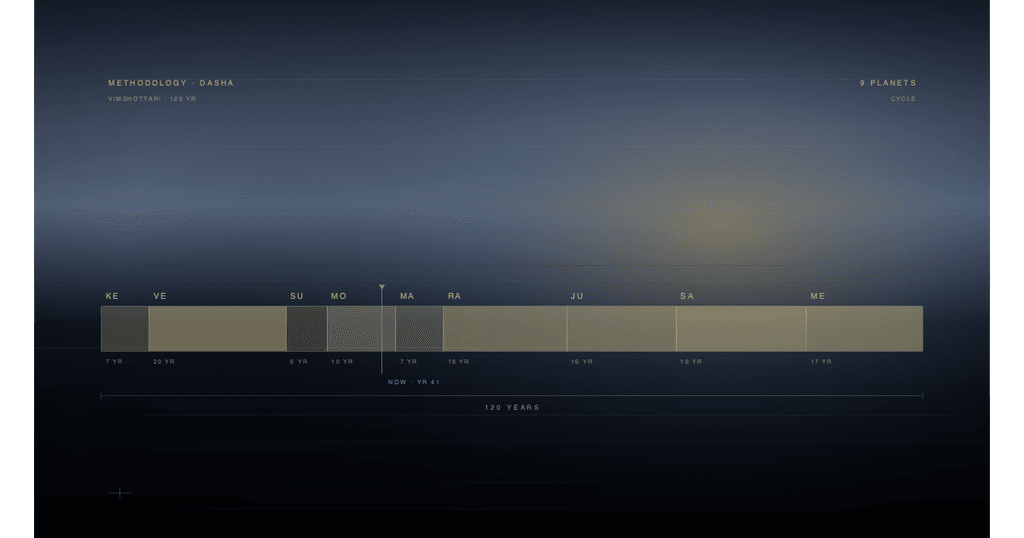
A Moon in Uttara Bhadrapada at birth opens the whole life inside the Saturn mahadasha, and Saturn runs 19 years in the Vimshottari cycle, the longest single period in the whole map. How much of those 19 years a chart receives from birth is set by how far the Moon had already travelled through the nakshatra's 13°20' arc. Born at the very start, a chart inherits close to the full 19-year Saturn period. Born three-quarters of the way through, only one quarter remains: 19 × 0.25 is 4.75 years, about 4 years and 9 months of Saturn before the 17-year Mercury mahadasha takes over. Born halfway, 9.5 years of Saturn remain; born near the closing degree, a matter of months.
This is why the birth nakshatra is the entry point of the entire 120-year map. The nakshatra names the first lord and the fraction names the balance, and from that single handhold the whole sequence unrolls: Saturn, then Mercury, then Ketu and on through the cycle. A long opening Saturn period reads in the classical texts as a slow-building formative chapter of discipline, patience and endurance, which sits closely with Uttara Bhadrapada's own depth-and-stillness register when the placement falls in its early padas.
This span in the 2026 to 2028 sky
Uttara Bhadrapada is pure Pisces, so the whole nakshatra answers to Saturn across this window, and Saturn is the nakshatra's own ruler standing on the arc it governs. Saturn has held Pisces since 20 March 2025 and stays across this span until it enters Aries on 23 May 2027. It then retreats back into Pisces on 4 November 2027 and crosses this arc a second time before re-entering Aries to stay on 11 February 2028. Classical reading treats a Saturn transit over its own nakshatra as a structural-pressure overlay, a period of consolidation or restructuring for whatever house Uttara Bhadrapada occupies in a given chart. The honest limitation is that Saturn marks where structure is tested, not the verdict of the test, and the house placement decides what the pressure actually reaches. No node touches this span in the window, since Rahu works through Aquarius then Capricorn, and Jupiter stays in Cancer, Leo and Virgo. The Moon still crosses for about a day every 27.3 days, and the Sun spends roughly a fortnight in this arc once a year in March. Revati, its Pisces neighbour, sits under the same Saturn tenancy through the identical dates.
FAQ
What is the Uttara Bhadrapada nakshatra and where does it sit on the sidereal lattice?
Uttara Bhadrapada is the 26th of the 27 nakshatras, occupying 3°20' to 16°40' Pisces. The ruling planet is Saturn (19-year Vimshottari mahadasha). The presiding deity is Ahirbudhnya (the serpent of the deep, cosmic serpent of the foundation). The symbol is the twin serpents (also back of funeral cot). The macro register is depth-axis wisdom, sustained stillness, compassionate withdrawal, cosmic-serpent register. Sanskrit uttara bhadrapada meaning the latter blessed-feet. Sources: BPHS Chapter 3, Phaladeepika Chapter 7.
What mythology and meaning is associated with Uttara Bhadrapada?
Ahirbudhnya the presiding deity is the serpent of the deep, the cosmic serpent dwelling at the foundation of things. Where Purva Bhadrapada is the fierce-renouncer-warrior, Uttara Bhadrapada is the depth-axis sage who has moved past intensity into stillness. The twin-serpent symbol reflects the integrated depth-wisdom. The latter-blessed-feet name reflects the dharmic foundation that endures.
What does Moon in Uttara Bhadrapada read as?
Natives born with the natal Moon in Uttara Bhadrapada carry depth-axis wisdom and sustained stillness as dominant register. The chart operates from depth, processes through patient stillness and carries the compassionate-withdrawal disposition of the mature contemplative. The Moon as the mental and emotional register absorbs the nakshatra's signature directly. Professional registers commonly associated: spiritual teaching at mature register (especially contemplative and depth-axis), counselling and psychotherapy at depth-axis, philosophy and meditation teaching, end-of-life and palliative care, occult and esoteric depth-work, anything requiring sustained stillness and depth-presence.
What are the four padas of Uttara Bhadrapada?
Each nakshatra divides into four padas of 3°20' arc each, mapping to four navamsa signs. Uttara Bhadrapada's padas. Pada 1: Leo / Sun: depth-authority through dharmic register, the wise-elder authority. Pada 2: Virgo / Mercury: precise depth-work, analytical wisdom register. Pada 3: Libra / Venus: balanced depth, partnership through wisdom. Pada 4: Scorpio / Mars: intense depth-stillness, the transformative wisdom register. The natal Moon's navamsa sign determines which pada the chart owner activates.
What does the Saturn rulership give Uttara Bhadrapada?
Saturn rulership means a native with Moon in Uttara Bhadrapada opens life in the Saturn mahadasha (19 years). The Saturn karaka register foregrounds across the opening period. Combined with Uttara Bhadrapada's depth-wisdom register, the opening Saturn mahadasha period often produces early-life formation through patient depth-development, the slow-building of contemplative capacity and the mature-stillness disposition for which this nakshatra is renowned.
How is Uttara Bhadrapada read during transit?
Beyond the natal-Moon reading, Uttara Bhadrapada carries significance when slow planets transit through its 13°20' arc. Saturn passes through once every 29.5 years. Jupiter passes annually within each 12-year cycle. Rahu and Ketu pass through every 18 years. Transit Jupiter provides benefic overlay. Transit Saturn provides structural-pressure overlay. Transit Rahu or Ketu provides amplification or dissolution overlay depending on which node and which house the nakshatra occupies.
If I am born in Uttara Bhadrapada, how much of the Saturn mahadasha do I get?
Saturn runs 19 years, the longest single period in the Vimshottari cycle, and the fraction you receive is set by how far the Moon had travelled through Uttara Bhadrapada's 13°20' arc. Born at the start, close to the full 19 years. Born three-quarters through, one quarter remains: 19 × 0.25 is 4.75 years, about 4 years and 9 months, before the 17-year Mercury mahadasha begins. Born halfway, 9.5 years remain. This starting balance is the entry point of the whole 120-year Vimshottari map, which is why the birth nakshatra matters so much.
Does any 2026 to 2028 transit cross Uttara Bhadrapada?
Yes. Saturn crosses it, and Saturn is the nakshatra's own ruler. Saturn has held Pisces since 20 March 2025 and stays across this span until it enters Aries on 23 May 2027, then retreats back into Pisces on 4 November 2027 and crosses again before settling in Aries on 11 February 2028. No node touches this arc in the window and Jupiter does not reach it either. The Moon still crosses for about a day every 27.3 days and the Sun for roughly a fortnight each March.
- The Saturn-ruled group · all three Saturn-ruled nakshatras and the 19-year major-period structure
- The full Nakshatra cluster · all 27 nakshatras and the 9 ruling-planet groups
- The Saturn major-period overview · what runs when the natal Moon is here
- Purva Bhadrapada nakshatra · the previous nakshatra in sequence
- Revati nakshatra · the next nakshatra in sequence
This article was prepared by Tempora Research as an informational piece in the Nakshatra cluster. Methodology, calibrated lift figures and reconciliation entries are documented in Tempora's research-publishing standards and reproducible against the public engine. Internal audit log maintained. This article does not constitute medical, financial, legal or professional advice. First published 2026-05-29 by Tempora Research.