Durudhara Yoga: Planets in Both 2nd and 12th from the Natal Moon
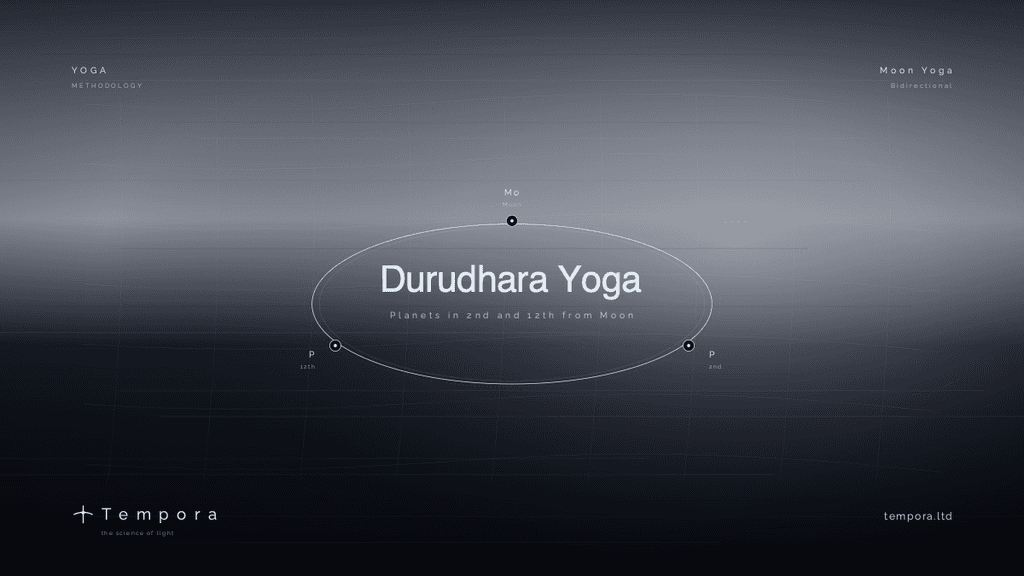
Durudhara yoga forms when planets other than the Sun occupy both the 2nd and the 12th houses counted from the natal Moon, flanking the Moon on both sides. The classical reading is supported public reputation, bidirectional protection of the natal mind and a balanced material and expressive register. It completes the Anapha-Sunapha-Durudhara triad of Moon-position yogas in BPHS Chapter 76 and the tradition treats it as the strongest of the three because both flanks of the lunar foundation are activated. Activation runs through the Vimshottari mahadasha of any planet that participates in the configuration.
Durudhara yoga forms when planets other than the Sun occupy both the 2nd and the 12th houses counted from the natal Moon. The classical reading is supported public reputation, bidirectional protection of the natal mind and balanced material and expressive register. Durudhara is the strongest of the three Moon-position yogas because both sides of the Moon's foundation are activated together. Activates during the Vimshottari mahadasha of any surrounding planet. Source: BPHS Chapter 76.
The classical formation condition
Brihat Parashara Hora Shastra Chapter 76 documents the cluster of Moon-position yogas the classical tradition treats together. The cluster includes Anapha (planets in the 12th from the Moon), Sunapha (planets in the 2nd from the Moon), Durudhara (planets in both the 2nd and the 12th from the Moon) and Kemadruma (no planets in either the 2nd or the 12th from the Moon). All four are counted from the position of the natal Moon, not from the ascendant.
Durudhara forms when any planet other than the Sun occupies the 2nd house counted from the natal Moon AND any planet other than the Sun occupies the 12th house counted from the natal Moon. The Sanskrit word durudhara in this context carries the sense of yoke or both-sides-borne. The configuration names a chart where the natal Moon is structurally flanked on both sides by supporting planets and the chart owner reads as carrying bidirectional support around the mental axis.
The classical reading is that the natal mind is protected from both flanks. The 12th-from-Moon flank governs how the Moon expresses, releases and dreams. The 2nd-from-Moon flank governs how the Moon accumulates speech, family-axis context and material register. When both flanks carry planetary presence, the chart owner reads as anchored from both directions and the classical tradition assigns supported public reputation and balanced material plus spiritual register as the typical reading.
Why both sides of the Moon matter
The classical reasoning treats the natal Moon as the chart's emotional and mental anchor. The houses on either side of the Moon describe how the lunar disposition is contextualised by the rest of the chart. The 12th from the Moon is the immediately-preceding house and the 2nd from the Moon is the immediately-following house in zodiacal order.
The 12th-from-Moon flank carries the register of release, dissolution, retreat and expressive flow. Planets here colour how the chart owner's emotional life lets go of attachment and translates into expression. The 2nd-from-Moon flank carries the register of accumulation, family-axis foundation, speech and sustenance. Planets here colour how the chart owner's emotional life builds and holds. When both flanks are populated, the natal Moon receives ongoing context from both the inflow and the outflow direction and the chart owner reads as supported from both ends of the lunar rhythm.
The classical literature reads this as the bidirectional benefic envelope. The chart owner's public reputation register is anchored because the natal mind does not sit in structural isolation. The mind has built-in input from both sides. The contrast is sharp with Kemadruma, where neither flank is occupied and the natal Moon sits in structural isolation, producing the reading of an unsupported mental axis that the classical tradition treats as a flag for material struggle and emotional volatility unless cancellation conditions apply.
Per-configuration variation by surrounding planets
The classical practice reads Durudhara through the nature of the planets that form the flanks. The configuration always counts the planets other than the Sun (Moon itself is the centre, so the relevant flanking planets are Mars, Mercury, Jupiter, Venus, Saturn and the lunar nodes Rahu and Ketu).
Two benefics flanking the Moon. The strongest classical Durudhara variant. Examples include Jupiter in the 2nd from the Moon with Venus in the 12th from the Moon or Mercury in the 2nd with Jupiter in the 12th. The reading is sustained public reputation, financial stability on the 2nd-from-Moon side and aesthetic-dharmic balance on the 12th-from-Moon side. Jupiter in 2nd plus Venus in 12th specifically reads as aesthetic-dharmic balance with relational warmth at the expressive end and dharmic stability at the accumulating end.
One benefic plus one malefic. The duality variant. Examples include Mars in the 2nd from the Moon with Jupiter in the 12th or Saturn in the 2nd with Venus in the 12th. The reading shifts toward action-on-one-side and reflection-on-the-other. One flank operates through effort or austerity and the other through warmth or stability. The bidirectional envelope is still present but the two sides carry distinct registers.
Two malefics flanking the Moon. The action-discipline variant. Mars in the 2nd with Saturn in the 12th or Saturn in the 2nd with Mars in the 12th. The Durudhara is technically formed and the bidirectional envelope is structurally present, but the envelope reads as discipline-led on both flanks. The chart owner's reputation is hard-won and the natal mind is anchored through austerity and action rather than benefic warmth. Classical practice notes that this variant still outperforms Kemadruma materially because the flanks carry planetary presence even if the presence is structural rather than gentle.
Nodal flanks. Rahu or Ketu in the 2nd or 12th from the Moon adds an axial register to the corresponding flank. Rahu in 2nd shifts the accumulating register toward intensity and ambition. Ketu in 12th shifts the releasing register toward austerity and detachment. Nodal-flank Durudhara is read with extra care for the dasha sequence because the nodes activate through mahadasha bursts.
Dignity modulation
The strength of Durudhara is further modulated by the dignity of the participating planets in the 2nd and 12th from the Moon.
Strongest expression. Participating planets in own or exalted signs. A Jupiter in the 2nd from the Moon sitting in Sagittarius or exalted in Cancer delivers a Durudhara reading at full strength on the 2nd-from-Moon side. A Venus in the 12th sitting in Taurus or Libra or exalted in Pisces delivers the 12th-from-Moon side at full strength.
Moderate expression. Participating planets in friendly signs. The reading is present but qualified by the dilution from non-own non-exalted dignity. The bidirectional envelope still operates.
Reduced expression. Participating planets in enemy signs or debilitated. A debilitated Jupiter (in Capricorn), Venus (in Virgo), Mercury (in Pisces), Mars (in Cancer) or Saturn (in Aries) on the flank technically forms the configuration but the dignity weakness reduces delivery substantially. Classical practice notes such configurations as nominal Durudhara rather than active Durudhara.
Combustion further reduces expression. A planet within roughly 12 degrees of the Sun reads as combust. Because the Sun is by classical rule excluded from forming Durudhara, the relevant combustion check is on planets in the 2nd or 12th from the Moon that happen to also sit close to the Sun. A combust participant delivers reduced bidirectional envelope strength.
Dasha activation
Durudhara yoga is structural. It sits in the chart from birth and becomes active during the Vimshottari mahadasha of any planet participating in the 2nd or 12th from the Moon.
Single-flank activation. When a participating planet runs as mahadasha lord, the corresponding flank of the Durudhara activates. A Jupiter mahadasha (16 years) activates the Jupiter-side of the configuration. A Venus mahadasha (20 years) activates the Venus-side. A Saturn mahadasha (19 years) activates the Saturn-side. The chart owner reads as living through the register the active flank carries.
Antardasha activation. Within other mahadashas, the antardasha of any participating planet activates a shorter Durudhara window from that flank.
Double-flank activation. When one mahadasha lord is on one flank and the antardasha lord within it is on the other flank, both sides of the configuration activate simultaneously. The classical practice treats this as the most concentrated Durudhara window in the chart. Both ends of the bidirectional envelope are running and the chart owner reads as carrying the full Durudhara register during the period.
Transit Jupiter through the houses involved in the Durudhara configuration provides constructive overlay. Transit Saturn through the same houses provides structural-pressure overlay. See Moon mahadasha for the broader Moon-period activation framework and how the Moon's own period interacts with the Durudhara register.
Distinguishing Durudhara from Anapha, Sunapha and Kemadruma
The Moon-position triad and its opposite are sometimes confused. The classical distinctions are clean.
Sunapha yoga. Forms when planets other than the Sun occupy the 2nd from the natal Moon but the 12th from the natal Moon is empty of such planets. Reads as wealth from self-effort, intelligence and capacity for sustained earnings. Sunapha is a one-flank yoga: the accumulating side is active and the releasing side is not. See Sunapha yoga for the full treatment.
Anapha yoga. Forms when planets other than the Sun occupy the 12th from the natal Moon but the 2nd from the natal Moon is empty. Reads as comfortable living, generous disposition and capacity for self-expression. Anapha is the other one-flank yoga: the releasing side is active and the accumulating side is not. See Anapha yoga for the full treatment.
Durudhara yoga. Forms when both flanks are populated. Combines the Sunapha reading on the 2nd-from-Moon side with the Anapha reading on the 12th-from-Moon side. The classical tradition reads this as the strongest of the three because the natal Moon receives planetary context from both flanks simultaneously.
Kemadruma yoga. The opposite condition. Neither the 2nd nor the 12th from the Moon is occupied by any planet other than the Sun. Classical default reading is structural isolation of the natal Moon. Cancellation conditions (kemadruma bhanga) apply when certain compensating placements lift the isolation: a planet aspecting the Moon, the Moon conjunct another planet or planets in kendras from the ascendant.
The four configurations are mutually exclusive on any single chart. A chart carries exactly one of Sunapha, Anapha, Durudhara or Kemadruma at the Moon-position-yoga axis. Durudhara is the strongest, Kemadruma the weakest and Anapha and Sunapha sit between as one-flank variants.
How to identify Durudhara yoga in your own chart
- Compute your sidereal natal chart. Tempora uses the Swiss Ephemeris with the True Pushya Paksha ayanamsa by PVRN Rao.
- Locate the natal Moon. Note the sign the Moon occupies and the house it sits in.
- Identify the 2nd house counted from the Moon (the sign immediately after the Moon's sign in zodiacal order).
- Identify the 12th house counted from the Moon (the sign immediately before the Moon's sign in zodiacal order).
- Check both flanks. List the planets other than the Sun sitting in each.
- If both flanks carry at least one such planet, the Durudhara configuration is formed.
- If only the 2nd-from-Moon flank carries a planet, the configuration is Sunapha. If only the 12th flank carries a planet, the configuration is Anapha. If neither flank carries a planet, the configuration is Kemadruma.
- Classify the Durudhara variant. Two benefics flanking = strongest. Mixed = duality. Two malefics = action-discipline. Nodes on either flank = axial register.
- Check the dignity of the flanking planets. Own-sign or exalted = strongest delivery. Debilitated or combust = reduced delivery.
- Walk the Vimshottari dasha sequence. The mahadasha periods of the flanking planets are the structural activation windows for Durudhara in the lifetime.
What Durudhara yoga does not predict
Durudhara yoga is one component of the chart's structural reading. It does not by itself guarantee specific reputation outcomes or specific wealth thresholds. The classical framework reads Durudhara as a structural-support flag: the chart owner carries the bidirectional envelope around the natal Moon and the supported-reputation register the configuration produces. Whether and how that capacity expresses depends on the dasha sequence, the dignity of the flanking planets, the transit overlay across the lifetime, the chart owner's response architecture and the broader chart context.
The yoga also does not specify the domain of the supported reputation. Some chart owners with strong Durudhara are recognised in commercial axes, others in cultural axes, others in service axes. The yoga supplies the bidirectional envelope; the chart owner's specific domain sits with the rest of the chart and the chart owner's chosen field of effort.
A chart with Durudhara but with the 10th lord debilitated or the 2nd house heavily afflicted by malefic aspects can carry the bidirectional envelope register without the corresponding wealth or career outcomes. Reading Durudhara well requires combining the yoga's structural reading with the career-axis and wealth-axis conditions and the dasha-driven event timing. Compare also with Gajakesari yoga, which is a different Moon-position yoga based on the Moon-Jupiter kendra relationship rather than the 2nd-and-12th flanks.
Calibration status
This article documents the classical Durudhara framework as set out in BPHS Chapter 76, Phaladeepika Chapter 6 and Sarvartha Chintamani Chapter 12. The formation conditions, the per-configuration variation, the dignity modulation and the dasha activation framework are presented as the tradition's own framework. The Tempora calibrated signature library does not currently include Durudhara-based event signatures at population level. Calibrating Durudhara configurations against a labelled chart corpus is open work. See Calibrated lift for the calibration methodology Tempora applies to other classical signatures.
Sources. Brihat Parashara Hora Shastra Chapter 76 (Chandra Yogas). Phaladeepika Chapter 6. Sarvartha Chintamani Chapter 12. Jataka Parijata Chapter 7.
Durudhara yoga under the 2026 to 2028 sky
Durudhara asks for both the 2nd and the 12th from the natal Moon to be occupied by planets other than the Sun at the same time. It is the compound of Anapha and Sunapha and it is set at birth. The dated sky matters here in a specific way. A transit fills at most one of the two flanks, so the 2026 to 2028 window can echo one arm of Durudhara while the other arm stays as the natal chart left it.
Jupiter exalted in Cancer from 27 May 2026 to 19 June 2027 supplies the clearest single arm. For a Gemini Moon, Cancer is the 2nd, so transit Jupiter fills the 2nd flank while the natal 12th flank keeps whatever it holds. For a Leo Moon, Cancer is the 12th, so transit Jupiter fills the 12th flank while the natal 2nd flank keeps its own tenancy. A chart that already carries one arm natally and receives the other by transit reads a complete Durudhara for that window, both sides of the Moon supported at once. Saturn adds the same logic from the slow side. In Pisces until 23 May 2027 it fills the 2nd from an Aquarius Moon and the 12th from an Aries Moon, and its Aries entry from 23 May 2027, firm from 11 February 2028, moves those tenancies to a Pisces Moon and a Taurus Moon.
Venus and Mercury cross either flank several times a year in short passes, so a fully transit-built Durudhara, both arms tenanted by moving bodies at once, is possible only for brief overlaps and reads faintly against the slow-body arm.
Pair the signal with its limit. The natal Durudhara stands on both flanks together and runs across the mahadashas of both participating planets. A transit completes one flank for a dated stretch and lets go on the exit. The strongest reading in this window belongs to a chart that owns one arm and borrows the other from Jupiter or Saturn, and even then the borrowed arm is a window rather than a permanent second support. Tempora grades dated calls on the public scoreboard and no Durudhara population signature is posted there. The Jupiter mahadasha note sets out how a Jupiter period and this Jupiter transit read as one overlay.
Frequently asked questions
Can a 2026 to 2028 transit build a full Durudhara yoga?
Only one arm at a time. Durudhara needs both the 2nd and the 12th from the natal Moon occupied together, and a single transit fills at most one flank. Jupiter exalted in Cancer from 27 May 2026 to 19 June 2027 fills the 2nd for a Gemini Moon and the 12th for a Leo Moon. Saturn in Pisces until 23 May 2027 fills the 2nd for an Aquarius Moon and the 12th for an Aries Moon, then shifts to a Pisces and a Taurus Moon after its Aries entry firm from 11 February 2028. A chart that already carries one arm natally reads a complete Durudhara for the window when a transit supplies the other. The borrowed arm is a dated window while the natal compound is the standing configuration across both participating planets' mahadashas.
What is Durudhara yoga in Vedic astrology?
Durudhara yoga is a classical Moon-position yoga documented in Brihat Parashara Hora Shastra Chapter 76. It forms when any planets other than the Sun occupy both the 2nd house and the 12th house counted from the natal Moon. The Sanskrit word durudhara means yoke or both sides borne. The classical reading is supported public reputation, bidirectional protection of the natal mind, balanced material register on the 2nd side and balanced spiritual or expressive register on the 12th side. Durudhara is the third of three Moon-position yogas in the Anapha-Sunapha-Durudhara triad and the classical tradition treats it as the strongest of the three because both sides of the Moon's emotional foundation are activated together.
How is Durudhara different from Anapha and Sunapha?
All three are Moon-position yogas counted from the natal Moon. Sunapha forms when planets occupy only the 2nd house from the Moon (the wealth and speech axis). Anapha forms when planets occupy only the 12th house from the Moon (the expression and release axis). Durudhara forms when both the 2nd and 12th houses from the Moon are occupied. Durudhara therefore combines the Sunapha reading on one side with the Anapha reading on the other, producing a bidirectional benefic envelope around the Moon. Classical sources treat Durudhara as the strongest of the three because both lunar flanks are supported simultaneously. The opposite configuration, where neither the 2nd nor the 12th from the Moon is occupied by any planet other than the Sun, forms Kemadruma yoga.
How does the benefic or malefic nature of the surrounding planets modulate Durudhara?
The classical reading scales by the nature of the planets in the 2nd and 12th from the Moon. Two benefics surrounding the Moon (Jupiter or Venus or Mercury on each side) produces the strongest Durudhara reading: sustained reputation, financial stability and balanced register on both flanks. One benefic plus one malefic produces a duality reading where one side is supported and the other is action-driven or austere. Two malefics surrounding the Moon (Mars or Saturn on each side) still forms Durudhara but the classical reading shifts toward action-discipline duality: hard-won reputation, discipline-driven outcomes and the structural support of both flanks operating in austere register. Sun is excluded from the count because the Sun's flanking the Moon does not form the yoga.
How is Durudhara yoga activated by dasha?
Durudhara yoga is structural and present in the chart from birth. It becomes active during the Vimshottari mahadasha of any planet that occupies the 2nd or 12th house from the Moon. The classical practice walks the dasha sequence and marks the periods where any surrounding planet runs as mahadasha or antardasha lord. Periods where one of the 2nd-from-Moon planets runs as mahadasha lord activate the wealth and speech axis of the yoga. Periods where one of the 12th-from-Moon planets runs activate the expression and release axis. Double-activation, where one surrounding planet runs as mahadasha and another as antardasha within it, produces the most concentrated Durudhara window in the lifetime.
Why does Durudhara count from the Moon and exclude the Sun from the configuration?
The Anapha-Sunapha-Durudhara triad is specifically about how the natal mind, governed by the Moon, is contextually supported by planets in the houses immediately flanking the Moon. The Sun is excluded by classical rule for two related reasons. First, the Sun is always within one or two signs of the Moon at certain lunar-phase windows (new moon and the surrounding days) and including the Sun would let configuration depend on lunar phase rather than on structural planetary distribution. Second, the Sun's natural register as the soul and authority axis is treated separately in the parallel Sun-position yogas (Vesi, Vasi and Ubhayachari) which use the same 2nd-12th structure but counted from the Sun. Keeping the two triads structurally clean is the classical convention.
Is Durudhara yoga common or rare?
Durudhara is moderately common at the structural level because the natal chart contains seven planets other than the Sun (Moon, Mars, Mercury, Jupiter, Venus, Saturn, Rahu and Ketu) and the configuration only requires at least one planet on each side of the Moon. Most charts where the Moon does not sit at a lonely position end up with planets in at least one of the flanking houses; a significant fraction end up with planets in both. The classical strength of Durudhara depends less on whether it forms and more on which planets form it. Durudhara with two benefics on the flanks is the strongest variant and is moderately rare; Durudhara with mixed benefic or malefic flanks is the more common observed variant.
What does Durudhara yoga not predict?
Durudhara yoga is one component of the chart's structural reading. It does not by itself guarantee specific reputation outcomes or specific wealth thresholds. The classical framework reads Durudhara as a structural-support flag: the chart owner carries bidirectional benefic context around the natal Moon and the supported-reputation register the configuration produces. Whether and how the capacity expresses depends on the dasha sequence, the dignity of the surrounding planets, the transit overlay across the lifetime and the broader chart context. A chart with Durudhara but with the 10th lord debilitated or the 2nd house heavily afflicted can carry the bidirectional protection register without the corresponding wealth or career outcomes.
Read next
- Anapha Yoga: planets in the 12th from the Moon
- Sunapha Yoga: planets in the 2nd from the Moon
- Moon mahadasha: the ten-year lunar period
- Gajakesari Yoga: Moon and Jupiter in kendra
- Calibrated lift: measuring whether a Vedic technique works
This article represents conventional Vedic teaching and Tempora Research method documentation. It does not constitute financial, legal, medical or professional advice. Yoga interpretation depends on the full natal chart; the conditions described here are necessary but not always sufficient. Internal audit log maintained.