Mars Mahadasha Moon Antardasha: the emotionally-driven action closing window
The Moon antardasha is the ninth and final sub-period of the Mars mahadasha, seven months that close the cycle and hand it to Rahu's eighteen years. It follows the brief Sun antardasha, where assertion sought rank and recognition, and lets the register soften from command toward feeling. Mars counts the Moon among his friends, while the Moon, which the classics leave without enemies, meets Mars with even neutrality, so the pairing reads as warm though unequal in its warmth. Tradition gives these months the texture of a homecoming under arms: domestic matters, the mother line and the emotional cost of six years of exertion surface for settlement before the mahadasha ends. A strong natal Moon lets the closing read as consolidation of home and public standing; an afflicted one can make the same months restless, the mind churning faster than events warrant.
Where the sub-period falls in the Vimshottari sequence
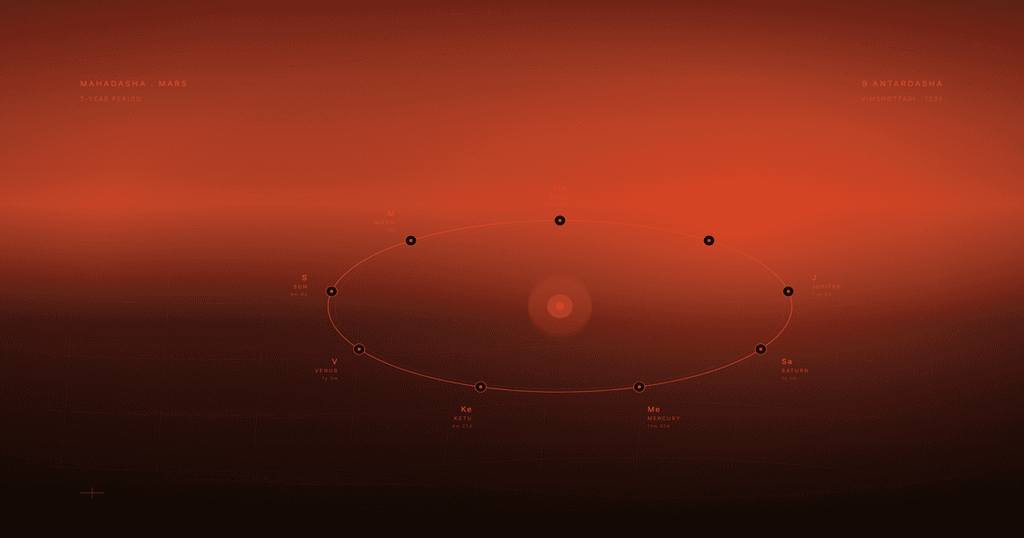
The 7-year Mars mahadasha divides into nine antardasha sub-periods in fixed Vimshottari order starting with Mars itself. The Moon sub-period sits at position 9 of 9. Exact start and end dates for any chart can be computed from the natal Moon nakshatra-pada and the date of Mars mahadasha onset. The Tempora dasha engine produces this to the day.
The arithmetic of this period
The Moon holds 10 years of the 120-year Vimshottari cycle and Mars holds 7, so the Moon antardasha inside the Mars mahadasha runs 7 × 10 / 120 = 0.58 years, which is exactly 7 months. It is the only sub-period in this mahadasha with a round-number length, a small artifact of 10 dividing 120 cleanly. Eight sub-periods come before it and their durations sum to 77 months, 6 years and 5 months, so the Moon antardasha occupies the final seven months of the 84-month cycle and nothing follows it inside this mahadasha.
A closing antardasha does different work from an opening one. The native meeting the Moon here has already lived the full argument of the Mars years, so these months tend to settle accounts, close houses and mark how the era will be remembered rather than start anything the next cycle must inherit unfinished. When the seven months end, the Rahu mahadasha begins from zero with Rahu's own antardasha. The whole arc is set out in the Mars mahadasha overview, and the Moon's conduct across its own ten-year major period is covered in the Moon mahadasha page.
How the source texts read this sub-period
The BPHS antardasha chapters, Mars mahadasha section, grade this sub-period first by the Moon's dignity and then by her phase. A Moon exalted or in own sign, or angular with the lords of the 9th, 4th or 10th, is assigned expanded dominion, perfumes and clothes, reservoirs and cow shelters, marriage-class celebrations and property through royal favour. The text then adds a condition rare elsewhere in the chapter: results arrive in full when the Moon is waxing and reduced when she wanes.
Debilitated, in an enemy sign or in the 6th, 8th or 12th from either reckoning, the Moon instead brings distress in the family and losses of land, wealth and cattle. Where she holds maraka lordship the passage attaches a bodily caution and prescribes Durga and Lakshmi mantras as the remedy. Phaladeepika's bhukti list is mixed here, wealth and children gained alongside spleen complaints, so the two texts stand closer on this pairing than on most. Tempora's engine consumes these positions as inputs, conditioned on the natal Moon's sign, house and phase.
Friendship status and pairing reading
In the classical Parashari friendship matrix, Mars views Moon as friend. The friend-pair classification means the 7 months sub-period classically delivers outcomes where Mars's register (action, courage, brothers, surgery, property and the warrior register) and Moon's register (mind, mother, emotional foundation, public reception and the cyclic register) integrate constructively. Events typically surface from both karaka domains in alignment rather than friction.
The Moon karaka overlay
Moon is the karaka of mind, mother, emotional foundation, public reception and the cyclic register. Across the 7 months sub-period, this karaka set overlays on top of Mars's 7-year action, courage, brothers, surgery, property and the warrior register register. The combined reading is the central output of the sub-period.
How Moon's natal dignity shapes the reading
Moon's natal sign and house set the floor for the 7 months sub-period. Moon at exaltation gives the strongest reading. Own-sign and mooltrikona placement gives clean expression. Debilitation introduces friction that the sub-period must work through. Combust and retrograde state, conjunctions with malefics or benefics and the dispositor's strength all further modulate the reading. See the Moon mahadasha overview for the per-dignity breakdown.
Event classes typical to Mars-Moon sub-period
The 7 months Mars mahadasha Moon antardasha typically surfaces events across these specific domains:
- Constructive integration of Mars-register with Moon-register: friend-pair sub-periods classically deliver outcomes where both planets' karakas align rather than friction.
- Events in Moon's natural karaka domain: mind, mother, emotional foundation, public reception and the cyclic register.
- Events specific to the natal house Moon occupies in the chart.
- Events where the Mars-mahalord and Moon-antarlord houses (both natal and ruled) interact (aspect, mutual reception or natal conjunction).
Transit confirmation protocol
The sub-period reading sets a structural pressure floor of 7 months. Specific event timing inside that window requires the pratyantara (sub-sub-period) overlay and a transit cross-check.
Two transit overlays do most of the work. The standard targets to track: transit Moon through the natal 3rd or 4th house, transit Mars through the natal 4th house, transit Mars-Moon conjunctions or oppositions across the 3-4 axis. These transits intensify the Mars-Moon dynamic within the broader sub-period and concentrate event timing on those windows.
The pratyantara (sub-sub-period) inside the antardasha gives finer timing. The Mars-Moon-Mars pratyantara (about 12 days) and the Mars-Moon-Moon pratyantara (about 18 days) concentrate the emotional-action signal within the 7-month closing window. The Mars-Moon-Saturn pratyantara (about 34 days) reads as the structural-consolidation window. Cross-checking the pratyantara against the transit overlay gives event timing to the week. Tempora's dasha engine produces this data to the day for any chart.
This period against the 2026 to 2028 sky
The dated event that concerns this pairing is the solar eclipse of 12 August 2026, which falls on the Cancer-Leo cusp. Cancer is the Moon's own sign, so a native running the Mars-Moon antardasha through that season has the sub-period lord's home ground eclipsed, and the tradition treats an eclipse touching a dasha lord's domain as a marker worth noting for the mind, the mother line and public reception. The caution belongs in the same breath: an eclipse lasts hours, an antardasha lasts months, and the cusp matters personally only if the natal chart holds something near it, a lagna, a luminary or the natal Moon itself. There is also a structural reason not to lean on lunar transits here, since the Moon completes the whole 27-nakshatra circuit in 27.3 days and crosses every sign in the sky several times inside these seven months. The slow context around the period, Jupiter exalted in Cancer from 27 May 2026 and the nodes shifting to the Capricorn-Cancer axis on 27 December 2026, sets more of the tone than any single lunar pass. The natal Moon's dignity and house remain the base reading throughout.
What the framework does not predict
The Mars-Moon reading is structural. It flags a 7-month window where the conditional probability of three named event classes lifts above chance, but it does not predict that any specific native will experience a specific event inside that window, nor the direction of any event that does fire.
A real-estate or family-action event during the closing sub-period can read as the grand consolidation of the Mars Mahadasha's action arc into a stable home-base or as a one-off event whose meaning resolves in the Rahu Mahadasha that follows; the chart's broader 4th house signals determine which. The framework times the pressure, not the result and timing finer than the antardasha band needs the pratyantara sequence and the transit overlay for the date in question.
How this connects to the broader Mars Mahadasha
The Mars-Moon sub-period is the ninth antardasha inside the 7-year Mars Mahadasha. Reading the sub-period in isolation captures the 7 months; reading it inside the Mahadasha gives the broader arc that places the action meets emotion reading in its proper structural context.
The Tempora Mars Mahadasha method article covers the dispositor analysis, natal-house framework and the broader 6-year texture that this sub-period sits inside. The conditional probability framework holds across the full series: each antardasha is a flagged window for specific event classes whose probability is elevated relative to chance.
Frequently asked questions
How long is the Mars Mahadasha Moon Antardasha and where does it fall in the Vimshottari sequence?
The Mars Mahadasha Moon Antardasha runs 7 months. It is the ninth antardasha inside the 7-year Mars Mahadasha, opening after the Mars-Sun antardasha (4 months 6 days). The full sequence inside the Mars Mahadasha runs Mars-Mars, Mars-Rahu, Mars-Jupiter, Mars-Saturn, Mars-Mercury, Mars-Ketu, Mars-Venus, Mars-Sun and Mars-Moon. Exact start and end dates can be computed from the natal Mars nakshatra-pada and the date of Mars Mahadasha onset.
What does Moon signify in this sub-period and why does it read as action meets emotion?
Moon is the karaka of mind, emotion, mother, public, mass-audience, intuition, fluctuation, water, white, silver. During the broader Mars Mahadasha's action and will reading, Moon contributes the emotional-action overlay. The sub-period sits at the ninth (closing) position in the antardasha sequence and reads as the Mars action and will register meeting Moon's mind, emotion, mother and mass-public significations.
How does Moon's natal dignity shape the Mars-Moon sub-period reading?
Moon's natal house, sign and aspectual state set the floor for the 7-month sub-period. Moon exalted in Taurus, in own sign Cancer or in angular houses (1st, 4th, 7th, 10th) softens the reading toward more auspicious outcomes. Moon debilitated in Scorpio introduces friction. Aspects from Saturn bring sustained structural pressure; aspects from Mars bring competitive or confrontational pressure.
What kinds of events historically correlate with the Mars-Moon sub-period?
Three event classes correlate. Real-estate and home-creation events: Land purchases, home construction, residential moves, family-property decisions. The Mars-Moon sub-period is the most concentrated real-estate window in the closing phase of Mars Mahadasha. The condit. Mother-related milestone events: Mother health events, mother-driven family decisions, matriarchal recognition. The Moon karaka of mother activates within the Mars action register, often producing events that consolidate or close lon. Emotionally-resolved action events: Action arising from settled emotional position. The native closes the Mars Mahadasha with decisions whose emotional foundation has already crystallised. These often precede a Rahu Mahadasha that ampli. The framework reads these as a structural-pressure window for the event class, not a deterministic predictor.
How does this sub-period connect to the broader Mars Mahadasha?
The Mars-Moon sub-period is the ninth antardasha inside the 7-year Mars Mahadasha. It opens after the Mars-Sun antardasha (4 months 6 days). The sub-period reading is best held in tandem with the broader Mars Mahadasha reading from the Tempora Mars Mahadasha method article, which covers the natal house and dispositor framework that sets the texture of the full 16 years.
What does the Tempora framework not predict about this sub-period?
The framework identifies a structural-pressure window of approximately 7 months. It does not predict whether a specific native will experience a specific event in that window. It does not predict outcome direction. It does not predict timing finer than the sub-period band without overlaying the pratyantara (sub-sub-period) and the transit overlay for the date in question. The readings carry conventional weight from classical literature; the framework treats them as structural-pressure flags to cross-check against transit data.
Why is the Mars-Moon antardasha exactly 7 months long?
The Moon holds 10 of the 120 Vimshottari years and Mars holds 7, so the antardasha is 7 multiplied by 10 divided by 120, which is 0.58 years, exactly 7 months. Because 10 divides 120 cleanly it is the only sub-period of the Mars mahadasha with a round-number length. It begins 77 months into the 84-month cycle, after all eight other sub-periods have run.
What happens when the Mars-Moon antardasha ends?
The Moon antardasha is the last sub-period of the Mars mahadasha, so its close ends the seven-year Mars cycle entirely. The Rahu mahadasha begins immediately, opening with Rahu's own antardasha, and the register changes from a short fiery cycle to an eighteen-year nodal one. Classical readers treat the final months of any mahadasha as settlement time, which is part of why this closing period carries a homecoming texture.
What do the classical texts say about Mars-Moon?
The BPHS antardasha chapters, Mars mahadasha section, grade the period by the Moon's dignity and phase, promising dominion, celebrations and property for a strong waxing Moon and losses of land, wealth and cattle for a weak one, with mantras prescribed where she carries maraka lordship. Phaladeepika's bhukti list is mixed, wealth and children alongside spleen complaints, so the texts sit fairly close here. The engine conditions these positions on the natal Moon's sign, house and phase.
Read next
- Mahadasha: the nine-period Vimshottari framework · the broader cluster this sub-period sits inside
- Venus Mahadasha Moon Antardasha · the complementary sub-period in the prior Mahadasha
- Jupiter Mahadasha Moon Antardasha · the same antardasha planet in a different Mahadasha
- Mahadasha and Vimshottari planetary periods · the full nine-period framework
- Calibrated lift: the discipline that turns Vedic astrology into research
This article represents conventional Vedic teaching and Tempora Research method documentation. It does not constitute financial, legal or professional advice. Internal audit log maintained.