Mercury Mahadasha Moon Antardasha: the personal-expression window
The Moon antardasha arrives after the brief Mercury-Sun sub-period, 10 months 6 days in which the mahadasha's voice sought office, title and formal recognition. The Moon changes the audience: authority recedes and reception takes its place, with mind, mother and the public's mood becoming the working material for 1 year 5 months. The classical friendship here is famously lopsided, since the Moon counts Mercury as a friend while Mercury counts the Moon as an enemy, a tension the myths preserve in the story of Budha born as Chandra's son. Tradition gives the pairing a restless texture, quick thought running on changeable feeling, and reads its outcomes as arriving through managed friction rather than ease. A strong natal Moon steadies the window into genuine popularity; a weak one leaves the intellect at the mercy of its own weather.
Where the sub-period falls in the Vimshottari sequence
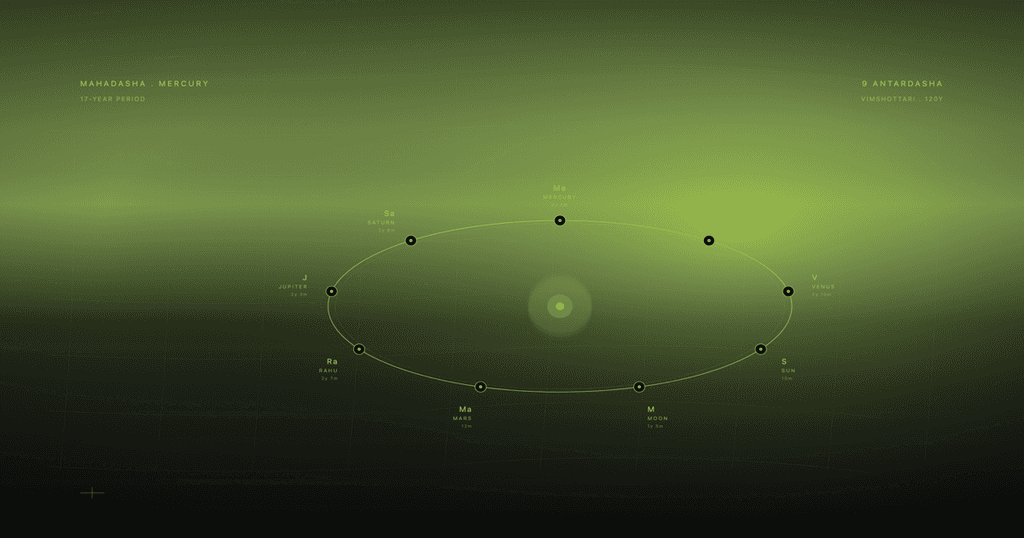
The 17-year Mercury mahadasha divides into nine antardasha sub-periods in fixed Vimshottari order starting with Mercury itself. The Moon sub-period sits at position 5 of 9. Exact start and end dates for any chart can be computed from the natal Moon nakshatra-pada and the date of Mercury mahadasha onset. The Tempora dasha engine produces this to the day.
Friendship status and pairing reading
In the classical Parashari friendship matrix, Mercury views Moon as enemy. The enemy-pair classification means the 1 year 5 months sub-period classically delivers outcomes through friction between Mercury's register (intelligence, communication, commerce, writing and the youthful-skill register) and Moon's register (mind, mother, emotional foundation, public reception and the cyclic register). Classical guidance suggests sustained-effort and patience over decisive-action during enemy-pair sub-periods. Events surface through the friction rather than around it.
The Moon karaka overlay
Moon is the karaka of mind, mother, emotional foundation, public reception and the cyclic register. Across the 1 year 5 months sub-period, this karaka set overlays on top of Mercury's 17-year intelligence, communication, commerce, writing and the youthful-skill register register. The combined reading is the central output of the sub-period.
How Moon's natal dignity shapes the reading
Moon's natal sign and house set the floor for the 1 year 5 months sub-period. Moon at exaltation gives the strongest reading. Own-sign and mooltrikona placement gives clean expression. Debilitation introduces friction that the sub-period must work through. Combust and retrograde state, conjunctions with malefics or benefics and the dispositor's strength all further modulate the reading. See the Moon mahadasha overview for the per-dignity breakdown.
Event classes typical to Mercury-Moon sub-period
The 1 year 5 months Mercury mahadasha Moon antardasha typically surfaces events across these specific domains:
- Friction between Mercury-register and Moon-register: enemy-pair sub-periods classically require careful navigation. Events surface through the friction rather than around it.
- Events in Moon's natural karaka domain: mind, mother, emotional foundation, public reception and the cyclic register.
- Events specific to the natal house Moon occupies in the chart.
- Events where the Mercury-mahalord and Moon-antarlord houses (both natal and ruled) interact (aspect, mutual reception or natal conjunction).
Transit confirmation protocol
The sub-period reading sets a structural pressure floor of 1 year 5 months. Specific event timing inside that window requires the pratyantara (sub-sub-period) overlay and a transit cross-check.
Two transit overlays do most of the work. The standard targets to track: transit Moon through the natal 3rd or 4th house, transit Mercury through the natal 4th house, transit Mercury-Moon conjunctions or oppositions across the 3-4 axis. These transits intensify the Mercury-Moon dynamic within the broader sub-period and concentrate event timing on those windows.
The pratyantara (sub-sub-period) inside the antardasha gives finer timing. The Mercury-Moon-Mercury pratyantara (about 12 days) and the Mercury-Moon-Moon pratyantara (about 18 days) concentrate the emotional-action signal within the 7-month closing window. The Mercury-Moon-Saturn pratyantara (about 34 days) reads as the structural-consolidation window. Cross-checking the pratyantara against the transit overlay gives event timing to the week. Tempora's dasha engine produces this data to the day for any chart.
What the framework does not predict
The Mercury-Moon reading is structural. It flags a 17-month window where the conditional probability of three named event classes lifts above chance, but it does not predict that any specific native will experience a specific event inside that window, nor the direction of any event that does fire.
A real-estate or family-action event during the closing sub-period can read as the grand consolidation of the Mercury Mahadasha's action arc into a stable home-base or as a one-off event whose meaning resolves in the Rahu Mahadasha that follows; the chart's broader 4th house signals determine which. The framework times the pressure, not the result and timing finer than the antardasha band needs the pratyantara sequence and the transit overlay for the date in question.
How this connects to the broader Mercury Mahadasha
The Mercury-Moon sub-period is the fifth antardasha inside the 17-year Mercury Mahadasha. Reading the sub-period in isolation captures the 1 year 5 months; reading it inside the Mahadasha gives the broader arc that places the articulation meets emotion reading in its proper structural context.
The Tempora Mercury Mahadasha method article covers the dispositor analysis, natal-house framework and the broader 6-year texture that this sub-period sits inside. The conditional probability framework holds across the full series: each antardasha is a flagged window for specific event classes whose probability is elevated relative to chance.
The arithmetic of this period
The constants give 17 times 10 over 120, which is 1.4167 years, exactly 1 year 5 months. The Moon holds the fifth of nine positions; the four sub-periods before it (Mercury 2 years 4 months 27 days, Ketu 11 months 27 days, Venus 2 years 10 months, Sun 10 months 6 days) sum to just over 7 years, so this antardasha runs from roughly year 7.1 to year 8.5, closing precisely at the midpoint of the 17-year arc laid out in the Mercury mahadasha overview.
Falling in the middle third matters. The mahadasha's register is fully established by year seven, so an enemy-pair window here strains a working pattern rather than a forming one, and what survives the strain tends to define the cycle's second half. Between the Sun's brief authority before it and the Mars contest after it, the Moon stretch is where the mahadasha discovers whether its public actually likes what the voice has been saying.
Where the source texts part ways on Mercury-Moon
The BPHS antardasha chapters, Mercury mahadasha section, rate a well conditioned Moon here as a very strong benefic yoga: in a kendra or trikona, exalted or in own sign, associated with Jupiter or acting as a yogakaraka, the Moon gives marriage, the birth of a son, construction of a new house, sweet food, music, shastra study, a journey to the South and gains of gems, pearls and clothes from across the seas. The section still carries a shadow side, physical distress for a debilitated Moon or one in an enemy sign, and danger from king, fire and thieves with losses of wealth on account of the wife when the Moon sits weak in the 6th, 8th or 12th from Mercury. A Moon carrying lordship of the 2nd or 7th draws the health caution the text reserves for such lords, with Durga mantras and cloth charity prescribed. Phaladeepika's bhukti chapter assigns headache, eye complaints, disease of the leprosy type, neck pain and danger to life, a uniformly adverse list, which makes this the widest gulf between the two authorities anywhere in the Mercury mahadasha. The gulf has a method behind it: Mantreswara writes short fixed effect lists per bhukti while Parashara ties every result to the antardasha lord's dignity and its position from the lagna and from the dasha lord, so much of the apparent conflict is one author hard-coding what the other leaves conditional. The engine resolves it the Parashari way, reading each classical position as an input conditioned on the natal Moon's actual state.
This period against the 2026 to 2028 sky
For a native running this antardasha across 2026, the calendar's central lunar event is the solar eclipse of 12 August 2026 on the Cancer-Leo cusp, an eclipse being by definition the nodes' interruption of the luminaries. With the Moon holding the antardasha, classical practice marks the eclipse window as a date of note for the sub-period's themes of mind, mother and public reception. The limitation comes attached: an eclipse spans days inside an antardasha of 1 year 5 months, and it acquires personal weight only when the natal chart engages the eclipsed axis. The node change of 27 December 2026 then carries Ketu into the Moon's own sign of Cancer until 15 July 2028, extending the lunar theme through 2027, filtered entirely through the ascendant's house mapping. None of this locates your own Mercury-Moon window; the mahadasha onset computed from the birth chart does that, and the Moon mahadasha overview maps the same lord across its ten-year major period.
Whole-sign arithmetic shows how differently the same axis lands. For a Cancer ascendant the 12 August 2026 eclipse straddles the 1st and 2nd houses, self and livelihood; for a Capricorn ascendant it falls across the 7th and 8th, partnership and shared assets. Same sky, different rooms of the chart.
Frequently asked questions
How long is the Mercury Mahadasha Moon Antardasha and where does it fall in the Vimshottari sequence?
The Mercury Mahadasha Moon Antardasha runs 1 year 5 months. It is the fifth antardasha inside the 17-year Mercury Mahadasha, opening after the Mercury-Sun antardasha (10 months 6 days). The full sequence inside the Mercury Mahadasha runs Mercury-Mercury, Mercury-Ketu, Mercury-Venus, Mercury-Sun, Mercury-Moon, Mercury-Mars, Mercury-Rahu, Mercury-Jupiter and Mercury-Saturn. Exact start and end dates can be computed from the natal Mercury nakshatra-pada and the date of Mercury Mahadasha onset.
What does Moon signify in this sub-period and why does it read as articulation meets emotion?
Moon is the karaka of mind, emotion, mother, public, mass-audience, intuition, fluctuation, water, white, silver. During the broader Mercury Mahadasha's intellect and articulation reading, Moon contributes the personal-expression overlay. The sub-period sits at the fifth position in the antardasha sequence and reads as the Mercury intellect and speech register meeting Moon's mind, emotion, mother and mass-public significations.
How does Moon's natal dignity shape the Mercury-Moon sub-period reading?
Moon's natal house, sign and aspectual state set the floor for the 17-month sub-period. Moon exalted in Taurus, in own sign Cancer or in angular houses (1st, 4th, 7th, 10th) softens the reading toward more auspicious outcomes. Moon debilitated in Scorpio introduces friction. Aspects from Saturn bring sustained structural pressure; aspects from Mercury bring competitive or confrontational pressure.
What kinds of events historically correlate with the Mercury-Moon sub-period?
Three event classes correlate. Real-estate and home-creation events: Land purchases, home construction, residential moves, family-property decisions. The Mercury-Moon sub-period is the most concentrated real-estate window in the closing phase of Mercury Mahadasha. The . Mother-related milestone events: Mother health events, mother-driven family decisions, matriarchal recognition. The Moon karaka of mother activates within the Mercury action register, often producing events that consolidate or close . Emotionally-resolved action events: Action arising from settled emotional position. The native closes the Mercury Mahadasha with decisions whose emotional foundation has already crystallised. These often precede a Rahu Mahadasha that am. The framework reads these as a structural-pressure window for the event class, not a deterministic predictor.
How does this sub-period connect to the broader Mercury Mahadasha?
The Mercury-Moon sub-period is the fifth antardasha inside the 17-year Mercury Mahadasha. It opens after the Mercury-Sun antardasha (10 months 6 days). The sub-period reading is best held in tandem with the broader Mercury Mahadasha reading from the Tempora Mercury Mahadasha method article, which covers the natal house and dispositor framework that sets the texture of the full 16 years.
What does the Tempora framework not predict about this sub-period?
The framework identifies a structural-pressure window of approximately 1 year 5 months. It does not predict whether a specific native will experience a specific event in that window. It does not predict outcome direction. It does not predict timing finer than the sub-period band without overlaying the pratyantara (sub-sub-period) and the transit overlay for the date in question. The readings carry conventional weight from classical literature; the framework treats them as structural-pressure flags to cross-check against transit data.
Which years of the Mercury mahadasha does the Moon antardasha cover?
The four sub-periods before it sum to just over 7 years, so the Moon antardasha runs from roughly year 7.1 to year 8.5 of the 17-year cycle and ends exactly at its midpoint. The duration is 1 year 5 months, computed as 17 times 10 over 120.
Does the 12 August 2026 eclipse matter for a running Mercury-Moon antardasha?
Classical practice marks eclipse dates that fall inside a Moon-ruled sub-period, and the 12 August 2026 eclipse sits on the Cancer-Leo cusp. It is a signal of days rather than months, and it carries personal weight only where the natal chart occupies or aspects that axis. Which houses are involved depends on the ascendant, so the reading is chart-specific.
What do the classical texts say about Mercury-Moon?
This pairing carries the sharpest textual split in the Mercury mahadasha. BPHS calls a well conditioned Moon here a very strong benefic yoga, with marriage, a son's birth, a new house and gains from across the seas, whereas Phaladeepika assigns headache, eye complaints, neck pain and danger to life. The split follows the two books' methods, Mantreswara printing fixed lists where Parashara ties results to the Moon's dignity and its position from the lagna and from Mercury. The engine follows the conditional method and lets the natal Moon decide which reading applies.
Read next
- Mahadasha: the nine-period Vimshottari framework · the broader cluster this sub-period sits inside
- Mercury Mahadasha Mars Antardasha · the next sub-period in the Vimshottari sequence
- Venus Mahadasha Moon Antardasha · the complementary sub-period in the prior Mahadasha
- Jupiter Mahadasha Moon Antardasha · the same antardasha planet in a different Mahadasha
- Mahadasha and Vimshottari planetary periods · the full nine-period framework
- Calibrated lift: the discipline that turns Vedic astrology into research
This article represents conventional Vedic teaching and Tempora Research method documentation. It does not constitute financial, legal or professional advice. Internal audit log maintained.