Rahu in the 5th House: Unconventional Children and Speculative Amplification
The 5th house (Putra Bhava in the Sanskrit, the seat of children, intelligence, creative output, romance, mantra and speculative ventures) is one of the most emotionally weighted seats in the chart. Rahu, the lunar north node, amplifies whichever house it occupies and bends it toward the non-classical register. The combination produces a placement that the conventional literature reads with caution and that the contemporary chart reads with more nuance than the classical books allowed.
What the 5th house holds and why Rahu changes it
The 5th house in the rashi chart (the D-1, the natal birth chart) is the house of purva-punya (the discharge of past-life merit), of children, of intelligence in its creative and pattern-recognising register, of mantra (sound-based spiritual practice) and of speculation. The Sanskrit name Putra Bhava translates as the house of progeny but the practical scope is wider than that label suggests. Anything that arrives as a structured pattern in the mind, anything you create that did not exist before, anything you bet on with an unknown payoff, lives in the 5th. For the foundational reading of this house across all twelve ascendants, see Tempora's 5th house reference.
Rahu is the lunar north node, one of the two shadow points where the Moon's orbit crosses the ecliptic. Rahu does not have physical mass and does not rule a sign in the classical Parashari scheme. What Rahu does is amplify, foreignise and disrupt the house it sits in. A house with Rahu in it gets louder, weirder and more boundary-crossing than the same house without Rahu. The amplification is not the same as Jupiter's expansion (which is benefic and structured) or Mars's intensity (which is direct and combative). Rahu's amplification is unstable, often hidden in its mechanism and tends to deliver the house's themes through routes that the classical literature did not anticipate.
When the lunar north node lands in the seat of children, intelligence and speculation, the resulting placement reads as one of the most dramatic node-house combinations in the natal chart. The 5th house was already a high-stakes house. Rahu adds the further dimension of non-classical arrival.
Children: delay, then unconventional arrival
The classical reading of Rahu in the 5th is that children are delayed, denied or complicated. Brihat Parashara Hora Shastra treats the placement as a putra-dosha (a defect in the children-signature), particularly when the 5th lord is also afflicted or when Jupiter as the natural karaka for children is weak. Older commentaries extend this to suggest that the native may not have biological children at all.
The contemporary reading is more useful. Most Rahu-in-5th charts do deliver children, but they deliver them through routes that the BPHS framework did not have language for. The common patterns:
- Delay then sudden delivery. The conventional timing of children (early adulthood) does not hold. Children arrive in the 30s, often after a phase of medical investigation or several years of trying without conception. The Rahu signature is the suddenness of the eventual delivery, not the impossibility.
- Technology-mediated conception. IVF (in-vitro fertilisation), ICSI (intracytoplasmic sperm injection) and other assisted reproductive technologies are textbook Rahu-in-5th deliveries. The placement that the classical literature read as putra-dosha is the same placement that arrives intact in the era of reproductive medicine.
- Surrogacy or donor-gamete routes. Where the native's own gametes carry medical constraint, surrogacy or donor-egg or donor-sperm routes deliver the children. These are unconventional in the classical sense but increasingly conventional in the contemporary sense.
- Adoption. Charts where biological conception does not happen often deliver children through adoption and the adoption process itself carries Rahu's signature (foreign country, non-traditional family structure, sudden timing).
- Blended or step-parent families. Marriage to a partner with existing children or remarriage that delivers step-children, is a common Rahu-in-5th texture. The 5th house theme is honoured even though the children did not arrive through the classical route.
The structural rule. Rahu in the 5th house does not predict the absence of children. It predicts that the route of arrival will not be the classical route. The reading is more reliable when read alongside the 5th lord and Jupiter than when read in isolation. A strong 5th lord and a well-placed Jupiter alongside Rahu in the 5th biases toward eventual delivery. A debilitated 5th lord and a weakened Jupiter alongside Rahu in the 5th biases toward repeated complications and, in a minority of charts, no biological children.
Speculation: the amplifier on the trading register
The 5th house is the seat of speculation. Stock trading, derivatives, leveraged bets, betting markets, venture investing, lottery and any payoff with non-linear distribution all read from this house. Rahu in the 5th amplifies the speculative register harder than any other natal placement amplifies any other house.
The amplification cuts both ways. A well-placed Rahu in the 5th (favourable sign for Rahu, strong dispositor, supportive 2nd house of accumulated wealth, strong 11th house of gains) can deliver outsized trading returns, successful entrepreneurial bets and the kind of asymmetric upside that the placement is famous for. The native may be drawn early to non-traditional markets (cryptocurrency, options trading, venture allocation, prediction markets) and may build authority in them. The same placement, with a poorly placed dispositor or an afflicted 11th house, tilts hard toward addictive compulsion, leveraged loss, gambling-pattern behaviour and the inability to exit a losing position. The placement is the amplifier; whether the amplifier delivers gain or loss depends on the rest of the chart.
The structural recommendation for Rahu-in-5th natives engaged with speculative markets is behavioural rather than ritual. Position-sizing discipline (never risk more than a small fraction of capital on a single trade), pre-set exit rules (a stop-loss that fires before emotion does) and the separation of speculative capital from operating capital matter more here than for any other 5th-house placement. The placement is a feature to manage. Tempora's reading of Rahu mahadasha covers the broader 18-year window in which the 5th-house speculation theme typically activates.
Intelligence and unconventional education
The 5th house is also the seat of buddhi, the patterning intelligence that recognises structure in data. Rahu in the 5th produces a recognisable intelligence signature: the native often skips or rejects the classical educational track and pursues authority through self-taught domains, foreign credentials or fields that did not exist a generation ago.
The contemporary fields that map cleanly onto this Rahu signature include data science, software engineering of non-traditional kinds, cryptocurrency analysis, alternative medicine, digital content production, podcasting and longform internet research. The unifying thread is that the field carries genuine intellectual rigour but did not have a recognised academic pipeline at the time the native was choosing a track. Rahu in the 5th tends to find the field before the academy catches up to it.
Where the dispositor is benefic and Jupiter aspects the 5th, the native can become a recognised authority in the unconventional field. The pattern: an early phase of self-teaching that looks scattered or undisciplined from the outside, followed by a synthesis phase in which the disparate skills consolidate into a recognisable body of work, followed by an authority phase in which the unconventional field itself becomes mainstream and the native is positioned as one of its early voices. Where the dispositor is afflicted, the early scattered phase persists and the synthesis never crystallises into a finished body of work.
Romance and creative output
The 5th house holds romance in the pre-marital, courtship sense (the 7th house holds the formal partnership) and Rahu in the 5th amplifies the romantic register into an unconventional pattern. Common textures: a sequence of relationships with partners from foreign backgrounds, partners significantly older or younger than the native, partners from a different cultural or religious tradition or relationships that begin in unusual contexts (online platforms, work travel, ashram or retreat settings).
The romantic intensity is typically higher than the placement reads as durable. Many Rahu-in-5th charts see the romance register as a phase that delivers a defining relationship, often with a non-classical trajectory, that ends or transforms when the 7th-house karakas activate. For the marriage-axis reading of these charts, see Tempora's marriage delay diagnosis.
Creative output is the other strong delivery of Rahu in the 5th. The placement supports creative work that does not fit a single genre, that crosses media or that introduces a form the audience did not have a name for. The 5th-house creative register lives alongside the speculative register; both are bets on the unknown and Rahu amplifies both.
Per-ascendant variation
The same Rahu-in-5th placement reads differently across the twelve ascendants because the 5th house sits in a different sign for each lagna. The dispositor (the planet ruling the sign Rahu occupies) varies, the friend-or-enemy relationship between Rahu and that dispositor varies and the natural benefic or malefic status of the dispositor varies. The result is twelve distinct event-class profiles. The table below captures the structural reading for each ascendant.
| Ascendant | 5th sign | Dispositor | Structural reading |
|---|---|---|---|
| Aries | Leo | Sun | Unconventional-authority arc. Children events tied to public-recognition phase. Speculation in self-built ventures rather than passive trading. |
| Taurus | Virgo | Mercury | Pragmatic-intelligence signature. Speculation in analytical or engineering fields. Children often arrive through medical-assistance routes with clean delivery. |
| Gemini | Libra | Venus | Aesthetic-creative amplification. Romance register particularly active. Children carry a partnership-mediated arrival pattern. |
| Cancer | Scorpio | Mars | Among the most demanding placements. Emotional intensity high. Children-events often carry medical investigation. Speculation reads transformational rather than recreational. |
| Leo | Sagittarius | Jupiter | Strong reading. Jupiter as dispositor supports the children karaka directly. Authority in unconventional education or publishing arrives cleanly. |
| Virgo | Capricorn | Saturn | Delayed but structured delivery. Children arrive in the 30s with a serious-partner pattern. Speculation reads as disciplined long-horizon investing. |
| Libra | Aquarius | Saturn | Strong placement for unconventional-community and technology speculation. Children events often tied to non-classical family structures. |
| Scorpio | Pisces | Jupiter | Spiritual and intuitive amplification. Mantra practice register particularly active. Creative output reads visionary rather than commercial. |
| Sagittarius | Aries | Mars | Pioneering-speculation arc. Children events often tied to physical-risk or sport-adjacent context. Authority in fast-moving fields. |
| Capricorn | Taurus | Venus | Wealth-accumulation reading. Speculation often in real assets rather than financial markets. Children events tied to material-stability phase. |
| Aquarius | Gemini | Mercury | Communication-creative amplification. Authority in writing, broadcasting or digital media. Children often arrive through long-distance partner pattern. |
| Pisces | Cancer | Moon | Emotional and home-oriented amplification. Children events tied to mother or maternal-figure arc. Speculation reads risk-averse for this placement. |
For the ascendant-specific reading of Rahu mahadasha (the 18-year period in which 5th-house events typically activate), Tempora maintains a dedicated piece for each lagna. The Cancer ascendant reading at Rahu mahadasha for Cancer ascendant is the place to begin for the most demanding profile in this table.
The computed sky over a natal Rahu in the 5th
A 5th-house Rahu sets a standing charge on children, speculation and creative intelligence; the transiting sky is what dates each discharge. For a Libra ascendant the 5th house is Aquarius, where transiting Rahu returns over its own position from 9 June 2025 to 27 December 2026, lifting the speculation and progeny register to full strength through late 2026. For an Aries ascendant the 5th house is Leo, held by transiting Ketu to 27 December 2026 and marked by the 12 August 2026 solar eclipse on the Cancer to Leo cusp, which places the south node and an eclipse point on the natal Rahu. For a Pisces ascendant the 5th house is Cancer, where exalted Jupiter transits from 27 May 2026 and transiting Ketu follows from 27 December 2026 to 15 July 2028, laying a benefic pass and a node over the placement in turn. These are dated activation windows above a fixed natal condition, so the transit clocks the timing while the natal Rahu keeps the theme and the result stays open. Since Rahu crosses a sign in roughly eighteen months and returns to any given sign about every eighteen years, its own return is the direct same-planet trigger for this placement, present now for the Libra ascendant and arriving for a Virgo ascendant whose 5th house is Capricorn from 27 December 2026 to 15 July 2028.
Timing: when 5th-house events activate
Events in the 5th-house domain typically activate during three timing windows that the reader can compute from the chart. The Vimshottari dasha system is the primary timing engine.
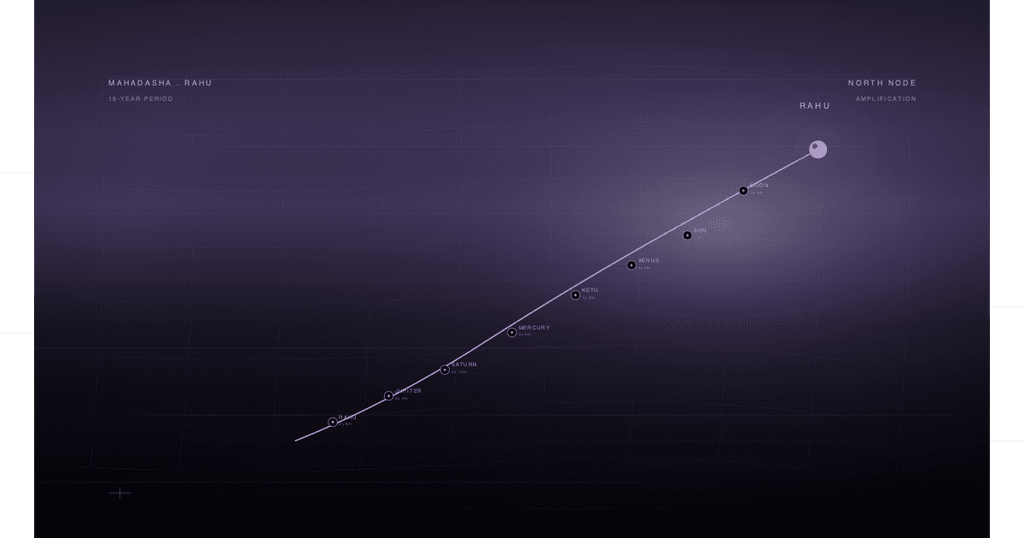
First, Rahu mahadasha itself. The 18-year Rahu period brings the natal Rahu placement to its full register. A native with Rahu in the 5th who runs the Rahu mahadasha at some point in life will see the 5th-house themes deliver during that 18-year window. The Rahu-Jupiter sub-period inside Rahu mahadasha is often the strongest children-delivery window. The Rahu-Venus sub-period often activates the romance register. The Rahu-Mercury sub-period often delivers the intellectual-authority crystallisation.
Second, mahadashas of the 5th lord, of Jupiter (as children karaka), of Mercury and Venus (as intellectual karakas) and of Rahu's dispositor. Each of these periods activates a specific subset of the 5th-house event-classes. The 5th lord's dasha activates the children theme. Jupiter's dasha activates the children karaka. The dispositor's dasha activates the texture of Rahu's delivery for that chart specifically.
Third, transit confirmation. Transit Rahu (which carries the 18.6-year orbital cycle) and transit Saturn over the natal 5th house or transit Jupiter over the natal 5th lord, often deliver the dated event. The dasha sets the disposition; the transit confirms the event. For the broader cycle-based timing of speculative markets relevant to 5th-house traders, see Tempora's AI bubble Saturn-Rahu cycle piece.
What the placement does not predict
Rahu in the 5th house does not predict the absence of children, the inevitability of speculative loss or the failure of education. It predicts the structural texture of how these themes deliver. The conventional literature was more deterministic than the contemporary reading allows; the modern chart treats Rahu in the 5th as a placement to design around rather than a fate to suffer.
The placement also does not stand alone. The 5th lord's placement, the strength of Jupiter, the condition of the dispositor of Rahu and the running mahadasha all modulate the reading. A reader who looks only at Rahu in the 5th without checking these supporting layers will misread the chart in both directions, treating a benign placement as catastrophic or treating a difficult placement as harmless.
Frequently asked questions
What does Rahu in the 5th house mean in Vedic astrology?
Rahu in the 5th house (Putra Bhava) amplifies the domains of children, intelligence, creative output, romance, mantra practice and speculative ventures. The shadow node introduces an unconventional register to each of these. Children events arrive through non-traditional routes (delay then sudden arrival, adoption, technology-mediated conception, step-parenting). Intellectual output skews toward boundary-crossing or non-classical fields. Speculative-trading cycles amplify both gain and loss. The placement is neither universally benefic nor malefic; the practical texture depends on the dispositor of Rahu (the planet ruling the sign Rahu occupies), the lagna and any conjunctions or aspects on the 5th house.
Is Rahu in the 5th house good or bad for children?
The classical reading is mixed. Brihat Parashara Hora Shastra notes Rahu in the 5th can delay or complicate the children signature, particularly when the 5th lord is afflicted or the natural karaka for children (Jupiter) is weak. The contemporary pattern is more nuanced. Many Rahu-in-5th charts deliver children through unconventional routes (IVF, ICSI, surrogacy, adoption, blended families) rather than no children at all. The reading reads better when Jupiter is strong and the 5th lord is well-placed; it reads more difficult when both karakas (Jupiter and the 5th lord) carry affliction alongside Rahu. The structural rule: Rahu in the 5th delays then delivers, often with a non-classical signature.
Does Rahu in the 5th house cause gambling addiction or speculative loss?
Rahu in the 5th house amplifies the speculative register. Whether that amplification delivers gain or loss depends on dignity and dispositor. A well-placed Rahu in the 5th (favourable sign, supportive dispositor, strong 11th house of gains) can deliver outsized trading returns or successful entrepreneurial bets. A poorly placed Rahu in the 5th (debilitated dispositor, afflicted 2nd or 11th house, Saturn aspect) tilts toward addictive compulsion, leveraged loss and pattern-chasing without exit discipline. The placement is the structural amplifier, not the verdict. Tempora flags the speculative register as a feature to manage, not as a fate to surrender to.
How does Rahu in the 5th house affect education and intelligence?
Rahu in the 5th house produces an unconventional-intelligence signature. The native often skips or rejects the classical educational track and pursues authority through self-taught domains, foreign credentials or fields that did not exist a generation ago (data science, crypto, alternative medicine, digital media). The 5th-house intelligence reads as pattern-recognition heavy, with a strong appetite for systems that mainstream pedagogy treats as fringe. Where the dispositor is benefic and Jupiter aspects the 5th, the native can become a recognised authority in the unconventional field. Where the dispositor is afflicted, the intelligence stays scattered across too many domains without a finished body of work.
What is the timing of Rahu-in-5th-house events?
Events in the 5th-house domain typically activate during three timing windows. First, Rahu mahadasha itself (the 18-year period of Rahu) brings the placement to its full register. Second, mahadashas or antardashas of the 5th lord, Jupiter (children karaka), Mercury or Venus (intellectual karakas) and the dispositor of Rahu activate specific event classes. Third, transit Rahu and transit Saturn over the natal 5th house or transit Jupiter over the natal 5th lord, often deliver the dated event. The 18.6-year Rahu nodal cycle is a slow background rhythm. Mid-mahadasha years inside Rahu dasha deliver the structurally heaviest 5th-house events for charts that carry this placement.
Which ascendants are best and worst for Rahu in the 5th house?
Rahu in the 5th house reads most cleanly for ascendants where the 5th lord sits in a strong house and the 5th sign carries a benefic dispositor. Taurus and Virgo ascendants often handle the placement well because the 5th lord operates with practical grounding. Cancer and Scorpio ascendants are the most demanding, because Rahu's amplification register hits the emotional and transformational layer hardest. Aries ascendant with Rahu in the 5th (Leo, ruled by Sun, the 5th lord becoming the 11th in some computations) carries an unconventional-recognition arc. Each ascendant produces a distinct event-class profile, which the body of this article enumerates in full.
What remedies are recommended for Rahu in the 5th house?
Tempora does not prescribe ritual remedies. Classical sources recommend mantra practice for the 5th-house karaka (Jupiter mantras or the 5th lord's mantra), Saraswati upasana for the intelligence register and disciplined exit rules for the speculative register. The structural recommendation is behavioural rather than ritual: build the 5th-house themes (children, creative practice, speculative discipline) with the awareness that Rahu amplifies both reward and risk. Position-sizing and downside-cap discipline matter more than any single ritual for the speculative register. For the children register, the contemporary reading honours non-classical routes (assisted reproduction, adoption) as legitimate Rahu-in-5th deliveries rather than failed deliveries.
When is a natal Rahu in the 5th house activated in 2026 to 2028?
A 5th-house Rahu is the standing charge; a slow transit over its sign dates each activation. A Libra ascendant holds the 5th in Aquarius, where transiting Rahu returns over its own position from 9 June 2025 to 27 December 2026. An Aries ascendant holds it in Leo, occupied by transiting Ketu to 27 December 2026 and marked by the 12 August 2026 solar eclipse on the Cancer to Leo cusp. A Pisces ascendant holds it in Cancer, crossed by exalted Jupiter from 27 May 2026 and by transiting Ketu from 27 December 2026 to 15 July 2028. Rahu spends about eighteen months in each sign and returns to a natal sign about every eighteen years, so its own return is the direct trigger, and each window dates when the progeny and speculation theme comes forward without settling the outcome.
Read next
This article is a method reference for Rahu in the 5th house (Putra Bhava) and the per-ascendant variation in event-class profile. The classical framework follows Brihat Parashara Hora Shastra (BPHS) chapters on house significations and Phaladeepika by Mantreshwara on planetary placement readings. The contemporary reading honours non-classical children-delivery routes (assisted reproductive technology, surrogacy, adoption) as legitimate Rahu-in-5th outcomes rather than failures of the classical signature. Engine: Swiss Ephemeris with True Pushya Paksha (PVRN Rao) ayanamsa. Internal audit log maintained. This article does not constitute medical, financial, legal or professional advice. First published 2026-06-05 by Tempora Research.