Saturn in the 5th House: delayed children and disciplined creativity.
Saturn in the 5th house (Putra Bhava in Sanskrit, the children house) is classically the most pressured Saturn placement on a trikona. Saturn is a natural malefic that restricts whatever house it occupies. The 5th is a trine reading children, discriminating intelligence (buddhi), creativity, romance, mantra and purva-punya past-life merit. The placement delays children, structures creativity into long-arc institutional work and slows speculation but builds durable authority in education and disciplined creative output over time. Per-ascendant variation, mitigations from Jupiter aspect and own-sign Saturn, dasha and transit activation determine when and how the structural pressure delivers. Sources: Brihat Parashara Hora Shastra Chapter 23 (per-planet, per-house reading), Phaladeepika Chapter 15, Saravali Chapter 32.
The 5th house compact recap
The 5th house (Putra Bhava, the children house in Sanskrit) is the chart's seat of children, discriminating intelligence, creativity, romance, mantra practice and purva-punya past-life merit. The classical karaka is Jupiter (children and wisdom). The 5th is a trikona (trine) and forms the dharma trikona with the 1st and 9th: the principled life-direction triplet of houses. The 5th lord is classically among the most beneficial lords on the chart and is one of the Raja-yoga producing lords (the kendra-trikona conjunction framework). Read the full 5th-house article for the lord-placement table and per-planet readings.
The 5th carries both the immediate register (children, romance, creative output, speculation) and the long-arc register (purva-punya discharge, mantra-meditation maturation, the accumulated merit of the chart). A planet at the 5th routes its signification through this dual register. The Putra-axis reading is therefore never a single-event reading. It is a lifetime pattern that compounds.
Saturn's nature and the 5th-house tension
Saturn is the natural malefic of restriction, structure, slowness and time. The Sanskrit name Shani derives from the slow movement of the planet across the zodiac (approximately 2.5 years per sign, 29.5 years per full cycle). Saturn signifies discipline, longevity, institutional authority, sustained effort and the rewards that come from accumulated work rather than from quick action. Saturn at a house restricts the house's immediate expression and structures it into a long-arc register that pays out only after sustained pressure.
The classical reading rule is that natural malefics produce difficulty at the trines (1st, 5th, 9th) because trines are dharmic and benefit from openness rather than from restriction. Saturn at the 5th is therefore classically the most pressured Saturn placement on a trine. The chart owner reads the 5th-house significations through a structure-and-delay overlay: children come late, creativity routes through institution, romance is sober, speculation is risk-averse and even mantra practice operates under a discipline-heavy register that takes years to mature.
The tension is not destructive in the classical sense. Saturn at the 5th does not destroy the 5th register the way Saturn at the 7th destroys early marriage or Saturn at the 8th destroys early longevity assumptions. Saturn at the 5th structures the register. The chart owner does receive children, creativity, romance and merit-discharge. They receive them on Saturn's schedule rather than on the natural 5th-house schedule.
The children-axis reading: delay, not denial
The classical Putra-axis reading for Saturn at the 5th is delay, not denial. The chart owner has children but receives them later than the natural age. The delay register is most active in the first half of the chart's reproductive years. Marriage may come on schedule but children do not arrive on schedule. The classical age-bracket reading is that first children for Saturn-at-5th charts often arrive after age 30, sometimes after age 35. The exact timing reads from the dasha activation rather than from the placement alone.
The denial register applies only when multiple restriction signatures converge: Saturn at the 5th plus 5th lord in dusthana (6th, 8th or 12th) plus Jupiter (karaka) afflicted plus the dasha lord at the reproductive-window not supporting children-axis. A single Saturn-at-5th signature on its own does not produce denial. The classical practice walks all four indicators together before reading the denial outcome. This matters because the lay reading often collapses Saturn at the 5th into childlessness, which the classical sources do not support.
The number-of-children reading also modulates. Saturn restricts quantity. Two children is the classical typical count for unrestricted 5th-house registers; Saturn at the 5th often reads as one child or as restricted-quantity. The structural register is fewer-but-stable rather than many-but-unstable. The classical reading does not penalise this; it reads it as the kind of family structure where each child receives concentrated attention.
The creativity register: institution over inspiration
Saturn at the 5th structures creativity into institutional form. The chart owner reads as the kind of creative practitioner who builds canonical work rather than viral work. Saturn at the 5th rarely produces the inspiration-driven artist who pours out volume in early adulthood. It produces the disciplined artist whose body of work matures across decades and gains standing through accumulation. The classical reading produces educators, scholars, principled creative directors, institutional artists, museum curators, archive editors and the kind of creative figure whose authority comes from the patience and depth of the work rather than from the velocity.
The output register is also slower than the natural 5th. The chart owner produces work at Saturn's rhythm. A novelist with Saturn at the 5th typically takes years between books rather than producing one a year. A painter with Saturn at the 5th typically produces a small focused body of work rather than a large volume. A composer with Saturn at the 5th typically works on long-form compositions rather than short pieces. The pace is the structural signature.
The quality register is often distinguished. Saturn at the 5th does not produce mediocre creative output. It produces work that takes longer than usual and lands with weight when it lands. The classical reading is that Saturn at the 5th is one of the strongest signatures for the long-arc creative reputation that outlives the chart owner. Many canonical figures in scholarship, classical music, institutional painting and traditional literature carry Saturn at the 5th in their natal charts.
Education authority as the dominant professional register
The dominant professional register for Saturn at the 5th is education authority. The 5th house is the classical house of buddhi (discriminating intelligence) and of teaching the foundational subjects (the 9th is the house of teaching the doctrinal subjects). Saturn structures the 5th-house teaching register into institutional form: schoolteachers, headmasters, principals, training-institution heads, professors, deans, vice-chancellors, examination-board chairs and senior figures in education systems. The classical reading is that Saturn at the 5th produces the kind of educator whose authority comes from decades of service in a single institution rather than from rapid career-jumps across institutions.
The secondary professional register is institutional creative work: museum curation, archive editing, traditional-arts teaching, classical-music institutional roles, theatre directorship of established companies, editorial roles at long-running publications. The common thread is that the chart owner does creative work but the work is embedded in an institution and accumulates standing through institutional continuity.
Speculation and quick-gain registers are weak. The chart owner does not read as a trader, a venture investor in early-stage technology or a speculator in fast-moving asset classes. The classical reading produces risk-averse conservatism: deposit-and-bond investor, real-estate accumulator, institutional pension fund participant. Saturn at the 5th does not produce wealth through speculation. It produces wealth through long-arc institutional position and the salary, pension and reputation that accumulate from it.
Per-ascendant variation
The 5th sign changes with each ascendant. Saturn's dignity and lordship in that sign change with it. Per-ascendant variation is substantial. The table reads the per-ascendant Saturn-at-5th configuration and the dominant register.
| Ascendant | 5th sign | Saturn dignity | Lordship status | Dominant register |
|---|---|---|---|---|
| Aries | Leo | Enemy sign | Lord of 10th and 11th | Career delay and slow gains. Children late. Strong-effort artists. |
| Taurus | Virgo | Neutral | Yogakaraka (lord of 9th and 10th) | Strongest single configuration. Raja-yoga register. Distinguished institutional creativity and education authority. |
| Gemini | Libra | Exaltation | Lord of 8th and 9th | Highest-dignity Saturn at the 5th. Late but distinguished children. Scholar-philosopher register. |
| Cancer | Scorpio | Enemy sign | Lord of 7th and 8th | Most pressured Saturn for partnerships. Children very delayed. Marriage register heavy. |
| Leo | Sagittarius | Neutral | Lord of 6th and 7th | Service-creativity register. Educator-teacher register. Children delayed. |
| Virgo | Capricorn | Own sign | Lord of 5th and 6th | Own-sign Saturn at own house: structured creativity matures into institutional standing. Children delayed but stable. |
| Libra | Aquarius | Own sign | Yogakaraka (lord of 4th and 5th) | Yogakaraka own-sign at own house: highest single configuration. Distinguished long-arc creativity and education authority. |
| Scorpio | Pisces | Neutral | Lord of 3rd and 4th | Structured creative communication. Long-arc writers and editors. Children delayed. |
| Sagittarius | Aries | Debilitation | Lord of 2nd and 3rd | Most pressured single configuration. Severe children delay. Creative output blocked early; matures very late. |
| Capricorn | Taurus | Friendly sign | Lord of 1st and 2nd | Lagna lord at the 5th. Children delayed but the chart owner's vitality supports the children register. Wealth-creative register. |
| Aquarius | Gemini | Friendly sign | Lord of 12th and 1st | Lagna lord again at the 5th. Spiritual-creative register. Children delayed; mantra and meditation prominent. |
| Pisces | Cancer | Enemy sign | Lord of 11th and 12th | Gains-and-loss register at the 5th. Children delayed and constrained. Creative output through expense-and-asceticism. |
The three ascendants with the strongest Saturn-5th-house configurations are Taurus (yogakaraka), Libra (yogakaraka own-sign at own house) and Gemini (exaltation). The two ascendants with the most pressured configurations are Sagittarius (debilitation) and Cancer (enemy sign plus dusthana lordship). Capricorn and Aquarius ascendants soften the reading because Saturn is also the lagna lord, which routes Saturn through the chart owner's own identity.
Mitigations
Three classical mitigations modulate Saturn at the 5th. The strongest single mitigation is Jupiter's aspect on the 5th. Jupiter is the karaka of children and the karaka of the 5th house itself. Jupiter aspecting Saturn at the 5th by the 5th, 7th or 9th classical aspect (Jupiter at the 1st, 9th, 11th or 3rd from the chart owner's lagna) converts the delay register into late-but-distinguished register. The chart owner still experiences the delay but the delay produces distinguished outcomes: late children who become highly successful, late creative recognition that brings distinguished standing, late education appointments that carry institutional weight. Jupiter at the 5th conjoining Saturn directly is less common but produces the strongest single mitigation: the karaka and the restrictor at the karaka's own house, jointly. The classical reading is that this configuration produces principled creative work and dharmic children-relationships.
The second mitigation is Saturn's own dignity. Saturn at the 5th in own sign Capricorn (Virgo ascendant) or own sign Aquarius (Libra ascendant) operates with full dignity strength. The restriction is present but the destructive register is absent. The chart owner reads as patient rather than as restricted. Saturn in exaltation Libra (Gemini ascendant) reads as restriction-with-distinction: the chart owner experiences delay but the delayed outcomes are uniformly distinguished.
The third mitigation is the 5th lord. The 5th lord is the underlying ruler of the 5th-house register. Saturn occupies the house but does not rule the underlying register. The 5th lord's natal placement, dignity and aspects modulate the underlying support. A 5th lord well-placed at a kendra or trikona in own sign or exaltation lifts the underlying support and softens the Saturn restriction. A 5th lord debilitated or in dusthana compounds the restriction and produces the worst-case reading.
Combinations of mitigations are stronger than single mitigations. Jupiter aspect plus own-sign Saturn plus well-placed 5th lord is the strongest aggregate reading and converts the placement from restriction to long-arc distinction.
Dasha activation
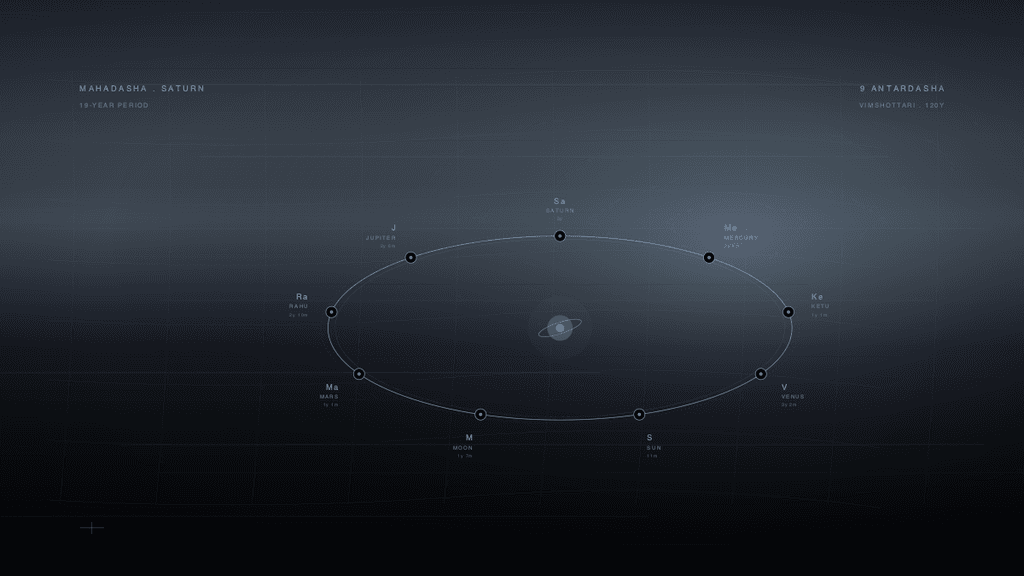
Saturn's own Vimshottari mahadasha (19 years) is the strongest activation window for the 5th-house Saturn signature. The chart owner shifts into the structured-creativity, education-authority and delayed-children phases of the configuration during this period. The classical reading is that the mahadasha's first 8-10 years carry the restriction register most heavily and the second 8-10 years carry the accumulation and recognition register. The mahadasha as a whole reads as a Putra-axis structuring window: children timing, creative output structure, institutional appointments, education-role acquisitions all surface during these 19 years. Read the full Saturn Mahadasha article for the framework on Saturn's period activation.
The 5th lord's mahadasha activates the children and creativity register through the lord's significations. The lord's natal placement determines what register opens. A 5th lord at the 10th activates the career-creative register. A 5th lord at the 2nd activates the wealth-from-creativity register. A 5th lord at the 9th activates the dharma-creative register. The classical practice walks the 5th lord's significations through the mahadasha to identify the specific opening.
The antardasha (sub-period) of Saturn inside the 5th lord's mahadasha or its reverse is the classical signature of distinctively-5th-house Saturn events: children born late, principled creative output published, education appointments received, institutional creative roles confirmed. The classical practice marks these antardasha windows as the chart's highest-confidence 5th-house Saturn timing windows.
Jupiter's mahadasha (16 years) is also significant when Saturn at the 5th is the natal restriction signature. Jupiter is the karaka of children and the karaka of the 5th. Jupiter's mahadasha often opens the children window that Saturn at the 5th delayed. Many chart owners with Saturn at the 5th and natural children at the 9th of life have Jupiter mahadasha or Jupiter antardasha inside another mahadasha running at the children-window age.
Transit activation
Three transit patterns activate Saturn at the 5th. Saturn's own transit through the 5th-house sign returns the natal pressure to its natal location. The chart owner re-experiences the structural pressure for the 2.5-year period the transit lasts. This is one of the chart's signature long-pressure windows. The classical reading is that Saturn-return-to-5th windows produce major children-axis or creativity-axis decisions: family-planning conclusions, creative-project structural commitments, education-role acceptances or refusals.
Jupiter's transit through the 5th-house sign produces the constructive overlay. Jupiter transits each sign for approximately 13 months. Jupiter-at-5th windows often open the children gate that Saturn delayed: many Saturn-at-5th charts have children timing aligned to Jupiter transit through the 5th-house sign. Jupiter-at-5th also produces creative-output windows: book publication, exhibition openings, performance recognitions.
Eclipses on the 5th-house sign or its opposite (the 11th-house sign) mark high-significance inflection windows. The Rahu-Ketu axis through the 5th-11th house produces 18-month windows where the children and creativity register reads under the eclipse-pattern overlay: unconventional pathways, sudden registrations of standing, sometimes loss or dissolution events that re-route the register through Saturn's structural reading.
Worked example
Consider a Libra ascendant chart with Saturn at the 5th in Aquarius (own sign). Saturn is yogakaraka for Libra (lord of the 4th kendra and the 5th trikona) and operates from full own-sign dignity at its own trikona. This is the strongest single Saturn-at-5th configuration.
The classical reading. Saturn yogakaraka in own sign at own house produces Raja-yoga register: distinguished long-arc standing in education and institutional creative work. Children are delayed but stable. Creativity matures over decades into canonical standing. The chart owner reads as the kind of professor or institutional creative figure whose work gains weight across the career.
Mahadasha activation. Saturn mahadasha (19 years) is the chart's distinguished output window: institutional appointments, principled creative work, education authority, late-but-distinguished children timing. Antardashas inside this mahadasha mark sub-windows where specific outcomes deliver. Jupiter mahadasha typically opens the children gate when it runs at the reproductive-age window.
Transit activation. Saturn return to Aquarius (occurs approximately at ages 29-30 and 58-60) is the chart's signature life-structure window. Jupiter transit through Aquarius (approximately every 12 years) opens the constructive overlay windows. The classical reading marks these windows as the chart's highest-confidence 5th-house events.
The example illustrates how Saturn at the 5th with full dignity and yogakaraka status delivers the Putra-axis register on Saturn's schedule rather than on the natural-5th schedule. The chart owner does receive children, creativity, education authority and long-arc standing. They receive them late and distinguished rather than early and ordinary.
Framework limits
The Saturn-5th-house reading covers the structural register for the chart's children, creativity and education authority. The reading does not forecast specific birth dates for children, specific publication events or specific education appointments on its own. Event prediction requires the dasha and transit layers to fire at the same time as the structural support is present. A chart with Saturn at the 5th but no children-supporting dasha at the reproductive window may show no children outcome despite the structural placement allowing children.
The placement does not predict the specific subject of the chart owner's creative or scholarly work. The 5th sign and the dispositors of any planets at the 5th carry the subject reading. A 5th in Cancer (Moon territory) reads emotional or domestic subject orientation. A 5th in Aquarius (Saturn territory) reads structural or systems-thinking orientation. The full subject reading walks the 5th sign, planets and dispositors together with Saturn's natal dignity and aspects.
The Tempora calibrated signature library does not currently include Saturn-5th-house-based event signatures at the individual-chart level. The classical reading is presented as the tradition's own framework rather than as Tempora's calibrated output.
Calibration status
The article documents the classical Saturn-at-5th reading as set out in BPHS Chapter 23 (per-planet, per-house effects), Phaladeepika Chapter 15 (per-house planet readings with dignity modulators) and Saravali Chapter 32 (Saturn's per-house effects). The mahadasha activation framework follows the Vimshottari period sequence documented in BPHS Chapter 46. The Tempora calibrated signature library (Note 005) does not currently include planet-in-house event signatures at the individual-chart level. The reading is presented as the tradition's own framework rather than as Tempora's calibrated output.
When transit bodies light up a 5th-house Saturn
Saturn in the 5th sets a standing register on intellect, children and creative discipline, and the moving sky of 2026 to 2028 gives it datable triggers by ascendant. A Scorpio ascendant carries the 5th house in Pisces, where transit Saturn has held since 20 March 2025 and remains until 23 May 2027, so this native is inside a Saturn return over the creative house through the window, timed by the natal degree. A Sagittarius ascendant places the 5th house in Aries, reached by transit Saturn on 23 May 2027, drawn back to Pisces on 4 November 2027 and re-entered to stay from 11 February 2028, completing the return across that double pass. An Aries ascendant has the 5th house in Leo, a sign lit heavily in this window by the solar eclipse of 12 August 2026 on the Cancer-Leo cusp, by Ketu holding Leo until 27 December 2026 and by Jupiter through Leo from its 23 October 2026 taste into the full stay from 19 June 2027, so the 5th-house Saturn there meets a crowded run of dated contacts. Under it all runs the return cadence: Saturn takes about 29.5 years to come back to a sign, and its re-entry over the natal position is the same-planet contact classical practice reads as the trigger. Each window times a condition already fixed in the chart, where the natal Saturn is the standing fact and the transit sets the clock. None of these dates settles a specific outcome on its own.
Frequently asked questions
What does Saturn in the 5th house mean in Vedic astrology?
Saturn in the 5th house (Putra Bhava, the children house) is classically the most pressured Saturn placement on a trikona. Saturn is a natural malefic that restricts whatever house it occupies; the 5th is a trikona (trine) reading children, discriminating intelligence (buddhi), creativity, romance, mantra and purva-punya past-life merit. The placement delays children, structures creativity into long-arc institutional work and slows speculation but builds durable authority in education and disciplined creative output over time. Per-ascendant variation and benefic aspect from Jupiter or Venus modulate the reading substantially. Sources: BPHS Chapter 23, Phaladeepika Chapter 15, Saravali Chapter 32.
Does Saturn in the 5th house always delay children?
The classical reading is yes for the timing register, but no for the outcome register. Saturn at the 5th delays children by classical rule but does not prevent them when the supporting structure is present. The classical practice walks the 5th lord's strength, Jupiter's natal position (karaka of children), the 9th-from-5th house (the 1st, the chart owner's vitality) and the dasha lord at the relevant life-window. Saturn at the 5th in own sign Capricorn or Aquarius reads as delay with eventual stable children. Saturn at the 5th in exaltation Libra reads as late but distinguished children. Saturn at the 5th in debilitation Aries is the most pressured case and reads as severe delay or limited children. Jupiter aspecting the 5th (especially from the 9th or 11th by classical aspect) is the strongest single mitigation.
What does Saturn in the 5th house do for career and creativity?
Saturn structures the 5th-house creativity register into long-arc institutional work. The classical reading produces educators, scholars, principled creative directors, institutional artists and the kind of creative output that accumulates value through discipline rather than through inspiration alone. Saturn at the 5th rarely produces commercial bestseller speculation; it produces canonical work that gains standing over decades. Authority in education is a strong secondary register: professors, headmasters, principals, training-institution heads and senior teachers commonly carry Saturn at the 5th. Speculation and trading registers are slow and risk-averse; the chart owner reads as disciplined investor rather than as quick-gain speculator.
How does each ascendant change the Saturn-5th-house reading?
Per-ascendant variation is substantial because the 5th sign changes with each ascendant and Saturn's dignity and lordship change with it. Taurus and Libra ascendants are the strongest: Saturn is yogakaraka (lord of both a kendra and a trikona) for these signs and produces strong Raja-yoga results even when at the 5th. Saturn at the 5th in Libra (exaltation) for Gemini ascendant is the dignity-strongest reading. Saturn at the 5th in Aries (debilitation) for Sagittarius ascendant is the most pressured single configuration. Cancer and Leo ascendants are also pressured because Saturn rules dusthana houses (8th or 6th from those ascendants). Capricorn and Aquarius ascendants have Saturn as the chart-owner's own lagna lord, which softens the reading. Full per-ascendant table appears in the body section.
What mitigations help Saturn in the 5th house?
Three classical mitigations modulate the reading. First, Jupiter's aspect on the 5th (classically the karaka of children and the karaka of the 5th house) is the strongest single relief: Jupiter aspecting Saturn at the 5th converts the delay register into late-but-distinguished register. Second, Saturn in own sign Capricorn or Aquarius or in exaltation Libra carries dignity strength: the restriction operates without the destructive register. Third, the 5th lord well-placed at a kendra or trikona in own sign or exaltation lifts the underlying support even when Saturn occupies the house. Per-ascendant yogakaraka status (Taurus and Libra ascendants) further softens the reading by routing Saturn through Raja-yoga rather than pure malefic restriction.
When does Saturn in the 5th house activate through dasha?
Saturn's own mahadasha (19 years) is the strongest single activation window for the 5th-house register. The chart owner shifts into the structured-creativity, education-authority and delayed-children phases of the configuration during this period. The 5th lord's mahadasha activates the children and creativity register through the lord's significations. Antardasha of Saturn inside the 5th lord's mahadasha or its reverse is the classical signature of 5th-house Saturn events: children born late, principled creative output published, education appointments received. Jupiter's mahadasha typically opens the children window when Saturn at the 5th is the natal restriction signature.
When is a natal Saturn in the 5th house activated in 2026 to 2028?
It depends on the ascendant. A Scorpio ascendant carries the 5th-house Saturn in Pisces and is in a Saturn return over the creative house now, with transit Saturn in Pisces from 20 March 2025 to 23 May 2027. A Sagittarius ascendant holds it in Aries, triggered as transit Saturn enters on 23 May 2027, retreats on 4 November 2027 and returns from 11 February 2028. An Aries ascendant has the 5th house in Leo, lit by the 12 August 2026 eclipse, by Ketu through Leo until 27 December 2026 and by Jupiter across Leo from 19 June 2027. Saturn returns to a sign about every 29.5 years, the deeper same-planet trigger. Each is a dated activation window over the standing placement rather than a fixed event.
- 5th house · full Putra Bhava reading
- Saturn Mahadasha · the 19-year Saturn period framework
- Saturn in the 6th house · the upachaya strength configuration
- Saturn in the 7th house · the digbala marriage-delay configuration
- Saturn in the 8th house · longevity, occult and hidden discipline
- The Houses cluster · all 12 houses and classification groups
This article was prepared by Tempora Research as an informational piece in the Planet-in-House cluster. Methodology and reconciliation entries are documented in Tempora's research-publishing standards and reproducible against the public engine. Internal audit log maintained. This article does not constitute medical, financial, legal or professional advice. First published 2026-06-05 by Tempora Research.