Saturn in the 7th House: delayed marriage, digbala (directional strength).
Saturn in the 7th house (Kalatra Bhava in Sanskrit, the partnership house) sits at one of the chart's most distinctive configurations. The 7th is a kendra (angular house) ruling marriage, business agreements, public dealings and open enemies. Saturn has digbala (directional strength) at the 7th: this is the planet's strongest directional placement on the chart. Yet Saturn at the 7th classically delays marriage. The combination produces late-but-sustained partnerships, long-arc business arrangements, structural-relationship reading and a partnership register that compounds value over decades once it forms. Per-ascendant variation across the 12 ascendants is substantial. Sources: Brihat Parashara Hora Shastra Chapter 23, Phaladeepika Chapter 15, Saravali Chapter 32.
The 7th house compact recap
The 7th house (Kalatra Bhava, the partnership house in Sanskrit) is the chart's seat of marriage, all formal partnerships including business partnerships, public dealings, open enemies, foreign travel and the kind of long-arc bilateral commitment that requires two parties signing on. The classical karaka pair is Venus (the marriage karaka for male charts) and Jupiter (the husband karaka for female charts). The 7th is a kendra (angular house) and one of the four chart-pillar houses (the 1st, 4th, 7th and 10th together). Read the full 7th-house article for the lord-placement table and per-planet reading.
The 7th sits directly opposite the lagna (1st house) on the chart. The 1st reads the chart owner; the 7th reads what the chart owner attracts as long-arc partnership. The two houses are not independent. The 7th lord's strength and natal placement modulate the 1st-house identity register: a strong 7th lord produces a chart owner whose identity is partly built through partnership. The 7th lord at the lagna is the classical configuration for chart owners whose identity is partnership-oriented. Saturn at the 7th places a malefic at this critical kendra, which is the structural reason the placement carries such substantial influence over the chart's relationship register.
Digbala: Saturn's directional strength at the 7th
Digbala (directional strength) is one of the six classical sources of planetary strength documented in BPHS Chapter 27. Each planet has a strongest directional house on the chart. The Sun and Mars have digbala at the 10th house (overhead, the strongest career-public position). The Moon and Venus have digbala at the 4th house (the foundation, the strongest emotional-asset position). Jupiter and Mercury have digbala at the 1st house (the lagna, the strongest identity position). Saturn has digbala at the 7th house (the partnership position).
The classical reading is that Saturn at the 7th operates with full directional strength. The planet's significations (structure, sustained effort, long-arc commitment, institutional standing, patience) deliver at maximum efficiency at this position. This means that the Saturn-7th placement is structurally strong even though its impact on the partnership register reads as restriction.
The digbala-strength register is the structural reason that delayed-marriage Saturn-at-7th charts produce sustained marriages once the marriage forms. The same digbala that delays the formation also stabilises the result. The chart owner reads as someone who does not enter partnership lightly and whose partnerships, once formed, do not dissolve easily. The classical reading is one of the strongest single configurations for long-arc marriage stability after the delay-window passes.
The digbala also strengthens the business-partnership register. Saturn at the 7th produces business partnerships that take time to form but operate at full institutional strength once formed. The chart owner reads as a sober institutional-partnership counterparty rather than as a quick-deal partnership counterparty. Joint ventures, formal alliances, partnership-track law-firm or accounting-firm roles and long-arc institutional alliances are all in the Saturn-7th register.
The marriage-delay register
The classical reading for Saturn at the 7th is marriage delay. The chart owner typically marries later than the cultural average. The classical age-bracket reading is that first marriage for Saturn-at-7th charts often occurs after age 30, sometimes after age 35 and occasionally after age 40. The exact timing reads from the dasha activation rather than from the placement alone. Saturn's own mahadasha and the antardasha of Venus inside Saturn mahadasha (or of Saturn inside Venus mahadasha) are the classical marriage-timing windows for these charts.
The delay does not mean denial. The classical practice walks the 7th lord's strength, Venus's natal position (for male charts), Jupiter's natal position (for female charts), the dasha lord at the marriage-window and the navamsa (D9 chart) 7th house. A single Saturn-at-7th signature on its own does not produce denial when these supporting indicators carry strength. The chart owner does marry; the marriage forms on Saturn's schedule rather than on the natural-7th schedule.
The denial register applies only when multiple restriction signatures converge: Saturn at the 7th plus 7th lord in dusthana (6th, 8th or 12th) plus Venus (or Jupiter for female charts) afflicted plus the navamsa 7th house pressured plus the dasha lord at the marriage-window not supporting partnership. The lay reading often collapses Saturn at the 7th into "no marriage", which the classical sources do not support without these additional indicators. Read the dedicated why is marriage delayed article for the complete framework.
The partner register
The classical reading produces a partner who is structurally serious, often older or more institutionally established and who carries a register of patience and long-arc commitment. The partner is rarely the dramatic-romantic register. The partner is typically the steady-reliable register. Saturn-7th charts often have partners several years older. Even when the partner is younger or the same age, the partner's energy reads as older through institutional standing, sustained-work register or accumulated life-experience.
The partner's professional register often aligns with Saturn's domains: institutional service, education, government, regulatory work, medical or healthcare practice, judicial work, engineering and the kind of role that demands sustained discipline. The classical reading is that the chart owner's structural-partnership orientation attracts a partner who shares the same orientation. Many Saturn-7th charts marry partners whose family of origin is also institutional or service-career oriented.
The partner brings structural weight to the chart owner's life. The partnership often re-orients the chart owner toward longer-term commitments, institutional choices, family-of-origin obligations and the kind of life-structure that compounds across decades. Saturn-7th partners rarely produce volatility in the chart owner's life direction. They typically produce the opposite: stability, predictability and the structural support for long-arc accumulation.
Business and institutional partnership register
The 7th house carries all formal partnerships, not just marriage. Saturn at the 7th routes business partnership through the same structural-stability register. The chart owner reads as the kind of business counterparty whose partnerships are slow to form, carefully negotiated, formally documented and durable once formed. Joint ventures, formal alliances, partnership-track roles at law firms or accounting firms, long-arc institutional alliances, foreign joint ventures and the kind of strategic partnership that requires multi-year structural commitment all favour the Saturn-7th register.
The placement does not favour quick-deal partnership-making. The chart owner reads as poorly suited to high-volume transactional partnership where the partnership must form quickly, deliver fast and dissolve cleanly. Saturn-7th charts in roles requiring this energy often face structural-friction. The placement favours slow institutional alliance over rapid deal-making.
The public-dealings register also follows Saturn's structural orientation. The 7th house reads public dealings, public reputation through partnership and the kind of bilateral public-facing engagement that produces standing. The chart owner with Saturn at the 7th reads as a structurally serious public figure when public roles emerge: institutional spokesperson, public-facing senior figure, formal representative roles, ambassadorial functions. The energy reads as gravitas rather than as charisma.
Per-ascendant variation
The 7th sign changes with each ascendant. Saturn's dignity and lordship in that sign change with it. Per-ascendant variation is substantial.
| Ascendant | 7th sign | Saturn dignity | Lordship status | Dominant register |
|---|---|---|---|---|
| Aries | Libra | Exaltation | Lord of 10th and 11th | Dignity-strongest configuration. Marriage delay with distinguished partner. Institutional and government-service marriage register. |
| Taurus | Scorpio | Enemy sign | Yogakaraka (lord of 9th and 10th) | Yogakaraka at kendra: Raja-yoga register through partnership. Marriage delay with strong long-arc strength. |
| Gemini | Sagittarius | Neutral | Lord of 8th and 9th | Dharmic-partner register. Foreign or scholarly partner. Marriage delay with philosophical-overlay. |
| Cancer | Capricorn | Own sign | Lord of 7th and 8th | Own-sign Saturn at own house but 7th-8th lord at 7th: structurally strong but with mortality-axis pressure on marriage. Significant marriage challenges. |
| Leo | Aquarius | Own sign | Lord of 6th and 7th | Own-sign Saturn at own house. Structured marriage with service-pressure overlay. 7th lord at own house: classical own-house lord configuration. |
| Virgo | Pisces | Neutral | Lord of 5th and 6th | Marriage delay with creative-service overlay. Partner often from creative or service-institutional background. |
| Libra | Aries | Debilitation | Yogakaraka (lord of 4th and 5th) | Most pressured single dignity. Debilitated yogakaraka at kendra: severe marriage delay despite the yogakaraka status. The classical reading marks this as one of the chart's most challenging configurations for marriage timing. |
| Scorpio | Taurus | Friendly sign | Lord of 3rd and 4th | Stable marriage register. Asset-oriented partner. Marriage delay moderate. |
| Sagittarius | Gemini | Friendly sign | Lord of 2nd and 3rd | Wealth-and-communication-oriented partner. Marriage delay moderate. |
| Capricorn | Cancer | Enemy sign | Lord of 1st and 2nd | Lagna lord at the 7th: classical partnership-identity merger. Marriage delay with strong identity-overlay. |
| Aquarius | Leo | Enemy sign | Lord of 12th and 1st | Lagna lord at the 7th with enemy-sign dignity. Foreign or institutionally-distant marriage register. |
| Pisces | Virgo | Neutral | Lord of 11th and 12th | Gains-and-expense register on the partnership. Service-oriented partner. |
The three ascendants with the strongest Saturn-7th-house configurations are Aries (exalted Saturn), Taurus (yogakaraka at kendra) and Leo (own-sign Saturn with 7th lord at the 7th itself). The two most pressured configurations are Libra (debilitated yogakaraka) and Cancer (7th-8th lord at 7th producing mortality-axis pressure on marriage). Cancer ascendant especially deserves attention: even though Saturn is in own sign at the 7th, the lordship combination of 7th and 8th places dusthana-lord influence on the partnership register, which classical sources read as producing significant marital challenges including separation, widowhood or extended health pressure on the partner.
Mitigations
Three classical mitigations modulate Saturn at the 7th. The strongest single mitigation is Jupiter's aspect on the 7th from the 1st (the lagna). Jupiter at the lagna aspects the 7th by classical 7th-aspect. The chart owner reads as someone whose own identity (1st house) carries Jupiter's wisdom, dharma and benevolent dignity register, which softens the Saturn-restriction on partnership. The combination produces delay with distinction: late marriage to a dharmic-distinguished partner.
The second mitigation is Venus's strength. Venus is the karaka of marriage for male charts. Venus well-placed (at a kendra or trikona in own-sign or exaltation) supports the marriage register independently of Saturn at the 7th. The classical practice walks Venus's natal position alongside the Saturn-7th placement. Strong Venus at the 5th (own-sign in Libra for Pisces lagna or own-sign in Taurus for Capricorn lagna or similar) often unblocks the Saturn-7th delay through the Venus-dasha or Venus-antardasha activation.
The third mitigation is the 7th lord. The 7th lord is the underlying ruler of the partnership register. Saturn occupies the house but does not rule the underlying register unless Saturn is also the 7th lord (Cancer or Leo ascendant). A 7th lord well-placed at a kendra or trikona in own sign or exaltation lifts the partnership register and softens the Saturn restriction. A 7th lord debilitated or in dusthana compounds the restriction.
Dasha activation
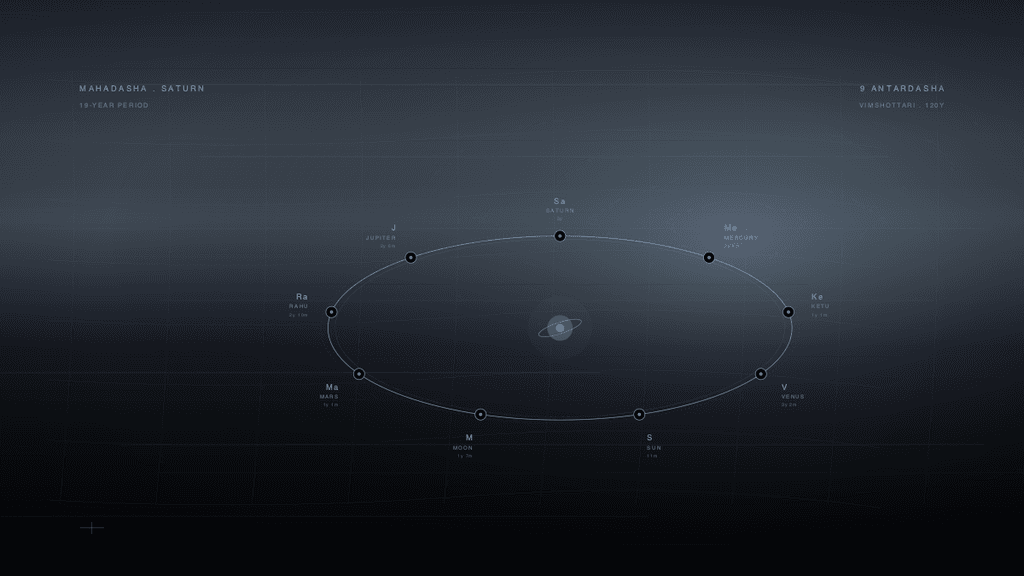
Saturn's own Vimshottari mahadasha (19 years) is the strongest activation window for the 7th-house Saturn signature. The chart owner shifts into the structural-partnership phase of the configuration during this period. Many delayed marriages confirm during Saturn mahadasha, particularly in Saturn-Venus or Saturn-Jupiter antardasha windows when the karaka of marriage (Venus for male charts, Jupiter for female charts) joins the structural-partnership mahadasha. The classical reading marks these antardasha windows as the chart's highest-confidence marriage-timing windows. Read the full Saturn Mahadasha article for the framework on Saturn's period activation.
The 7th lord's mahadasha activates the partnership register through the lord's significations. The lord's natal placement determines the specific opening. A 7th lord at the 5th activates the romance-partnership register. A 7th lord at the 9th activates the dharmic-partnership register. A 7th lord at the 10th activates the career-partnership register. The classical practice walks the 7th lord's significations through the mahadasha to identify the specific opening.
The antardasha of Saturn inside Venus mahadasha or Jupiter mahadasha is also a classical marriage-timing window for Saturn-at-7th charts. The structural mahadasha provides the marriage karaka-activation register; the Saturn antardasha brings the structural-partnership configuration into the timing window. Many delayed-marriage charts confirm during these antardasha sub-windows even when Saturn mahadasha is not yet active.
Transit activation
Three transit patterns activate Saturn at the 7th. Saturn's own transit return to the 7th-house sign (every approximately 29.5 years) is the chart's signature partnership-structural window. The first Saturn-return-to-7th occurs at age 29-30 for early-placement Saturn-7th charts and at age 30-32 for later-placement Saturn-7th charts. Many first marriages on Saturn-7th charts align to this first Saturn-return-to-7th window or to the year immediately following it. The second Saturn-return-to-7th at age 58-60 typically marks long-arc partnership-structural decisions: renewal commitments, partnership restructuring, business-partnership conclusions.
Jupiter's transit through the 7th-house sign produces the constructive overlay. Jupiter transits each sign for approximately 13 months. Jupiter-at-7th windows often open the marriage-formation gate that Saturn at the 7th delayed: many Saturn-at-7th charts have marriage timing aligned to Jupiter transit through the 7th-house sign. Jupiter-at-7th also produces business-partnership formation windows for the same reason.
The Rahu-Ketu axis through the 1st-7th house produces 18-month windows where the partnership register reads under the eclipse-pattern overlay. The Saturn-at-7th register continues operating but the specific partnership outcomes during Rahu-Ketu transits often carry sudden-shift register: unexpected partnership offers, unconventional partner backgrounds, surprise partnership dissolutions in pre-existing relationships.
Worked example
Consider an Aries ascendant chart with Saturn at the 7th in Libra (exaltation). Saturn is the 10th lord (career) and 11th lord (gains) and operates from full exaltation dignity at the partnership kendra with digbala simultaneously. This is the dignity-strongest single Saturn-at-7th configuration.
The classical reading. Saturn exalted with digbala at the partnership kendra produces marriage delay with distinguished partner: the chart owner marries later than average but the marriage carries institutional weight and the partner brings distinguished career-standing. The 10th and 11th lordship routes Saturn through career-gains-via-partnership: the chart owner's career advances through institutional alliances and the gains accumulate through the partnership register. Business-partnership register is very strong.
Mahadasha activation. Saturn mahadasha (19 years) is the chart's distinguished partnership-formation window: marriage confirmation, business-partnership formation, distinguished public-dealings appointments. Antardashas inside this mahadasha mark sub-windows where specific outcomes deliver. Saturn-Venus antardasha is the classical marriage-confirmation window for male charts; Saturn-Jupiter antardasha is the equivalent for female charts.
Transit activation. Saturn return to Libra (occurs approximately at ages 28-30 and 57-60) is the chart's signature life-partnership window. Many first marriages on this chart align to the first Saturn-return-to-Libra window. Jupiter transit through Libra (approximately every 12 years) opens the constructive overlay windows where the partnership register activates.
The example illustrates how Saturn at the 7th with full exaltation dignity, digbala and supportive lordships delivers the partnership register at maximum institutional strength. The chart owner experiences the classical delay but the delayed outcome is uniformly distinguished.
Framework limits
The Saturn-7th-house reading covers the structural register for the chart's partnership, marriage timing and business-alliance formation. The reading does not forecast specific marriage dates, specific partner identities or specific business-partnership outcomes on its own. Event prediction requires the dasha and transit layers to fire at the same time as the structural support is present. A chart with Saturn at the 7th but no Venus or Jupiter dasha activation at the marriage-window may show no marriage formation during that window despite the structural placement supporting eventual marriage.
The placement does not predict whether the marriage that forms remains durable across the entire life. The 7th house reads partnership-formation; the 8th house reads what binds the partnership and the conditions that test it. Saturn at the 7th with supportive 8th-house indicators produces durable marriage. Saturn at the 7th with afflicted 8th-house indicators may produce a marriage that forms after delay and then dissolves under structural pressure mid-life. The full marriage-durability reading walks the 7th, 8th and navamsa 7th together.
The Tempora calibrated signature library does not currently include Saturn-7th-house-based event signatures at the individual-chart level. The classical reading is presented as the tradition's own framework rather than as Tempora's calibrated output.
Calibration status
The article documents the classical Saturn-at-7th reading as set out in BPHS Chapter 23 (per-planet, per-house effects), Phaladeepika Chapter 15 (per-house planet readings with dignity modulators), Saravali Chapter 32 (Saturn's per-house effects) and BPHS Chapter 27 (digbala framework). The marriage-delay framework with mitigations and dasha-timing rules is drawn from BPHS Chapter 80 (kalatra-vichara, the marriage-reading chapter) and Phaladeepika Chapter 16. The Tempora calibrated signature library (Note 005) does not currently include planet-in-house event signatures at the individual-chart level. The reading is presented as the tradition's own framework rather than as Tempora's calibrated output.
Dated triggers for a 7th-house Saturn, 2026 to 2028
A 7th-house Saturn holds the partnership axis as a standing feature, and the 2026 to 2028 transits time when it is activated by ascendant. A Virgo ascendant carries the 7th house in Pisces, where transit Saturn has held since 20 March 2025 and remains until 23 May 2027, so this native is inside a Saturn return over the partnership house across the window, fixed by the natal degree. A Libra ascendant places the 7th house in Aries, reached by transit Saturn on 23 May 2027, drawn back to Pisces on 4 November 2027 and re-entered to stay from 11 February 2028, completing the return over that double pass. A Capricorn ascendant has the 7th house in Cancer, which exalted Jupiter crosses from 27 May 2026 to 19 June 2027 directly opposite the lagna, a benefic pass over the marriage-and-alliance house that reads as opening rather than a Saturn contact. The cadence underlies the dates: Saturn takes about 29.5 years to circle back to a sign, and its re-entry over the natal position forms the same-planet contact classical practice treats as the placement coming due. Each window times a condition already written into the chart, where the natal Saturn stands and the transit only triggers it. No date here forces a partnership event.
Frequently asked questions
What does Saturn in the 7th house mean in Vedic astrology?
Saturn in the 7th house (Kalatra Bhava, the partnership house) carries digbala (directional strength: Saturn's strongest directional placement on the chart) but classically delays marriage. The 7th is a kendra (angular house) ruling partnership, marriage, business agreements, public dealings and open enemies. Saturn at the 7th produces late-but-sustained partnerships, long-arc business arrangements, structural-relationship reading and per-ascendant variation across the 12 ascendants. The placement is one of the chart's strongest single signatures for marriage delay but does not predict denial when supporting structure is present. Sources: BPHS Chapter 23, Phaladeepika Chapter 15, Saravali Chapter 32.
What is digbala and why does Saturn in the 7th have it?
Digbala (directional strength) is one of the six classical sources of planetary strength documented in BPHS Chapter 27. Each planet has a strongest directional house on the chart. The Sun and Mars have digbala at the 10th house (overhead, the strongest career-public position). The Moon and Venus have digbala at the 4th house (the foundation, the strongest emotional-asset position). Jupiter and Mercury have digbala at the 1st house (the lagna, the strongest identity position). Saturn has digbala at the 7th house (the partnership position). The classical reading is that Saturn at the 7th operates with full directional strength: the planet's significations (structure, sustained effort, long-arc commitment, institutional standing) deliver at maximum efficiency. The digbala-strength register is the structural reason that delayed-marriage Saturn-at-7th charts produce sustained marriages once the marriage forms.
Does Saturn in the 7th house delay marriage?
The classical reading is yes for the timing register, no for the denial register. Saturn at the 7th is one of the strongest single signatures for marriage delay. The chart owner typically marries later than the cultural average, often after age 30 and sometimes after age 35. The classical practice walks the 7th lord's strength, Venus's natal position (karaka of marriage for male charts) or Jupiter's natal position (karaka of husband for female charts), the dasha lord at the marriage-window and the navamsa (D9 chart) 7th house. A single Saturn-at-7th signature on its own does not produce denial when these supporting indicators carry their own strength. The marriage that forms after the delay typically reads as sustained and structurally stable through Saturn's digbala strength. Read the dedicated why is marriage delayed article for the full classical framework.
What kind of partner does Saturn in the 7th house produce?
The classical reading is a partner who is structurally serious, older or more institutionally established, often from a service-career or institutional-research background and who carries a register of patience and long-arc commitment. The partner is rarely the dramatic-romantic register. The partner is typically the steady-reliable register. Saturn-7th charts often have partners who are several years older or younger but whose energy reads as older through institutional standing or sustained-work register. The classical reading is also that the partner brings structural weight to the chart owner's life: the partnership often re-orients the chart owner toward longer-term commitments, institutional choices and the kind of life-structure that compounds across decades. Saturn at the 7th rarely produces casual or short-term partnerships.
How does each ascendant change the Saturn-7th-house reading?
Per-ascendant variation is substantial. Taurus and Libra ascendants get the strongest configurations: Saturn is yogakaraka and Saturn at the 7th produces Raja-yoga register through partnership. Aries ascendant has Saturn at the 7th in Libra (exaltation) for one of the dignity-strongest readings on the chart. Cancer ascendant has Saturn at the 7th in Capricorn but as 7th-8th lord at the 7th, which produces strong marital pressure even with own-sign Saturn. Leo ascendant has Saturn at the 7th in Aquarius (own sign) but as 6th-7th lord at the 7th: structured marriage with service-pressure overlay. Libra ascendant has Saturn at the 7th in Aries (debilitation) which is one of the most pressured single configurations. Full per-ascendant table appears in the body section.
When does Saturn in the 7th house activate through dasha?
Saturn's own mahadasha (19 years) is the strongest single activation window for the 7th-house Saturn signature. The chart owner shifts into the structural-partnership phase of the configuration during this period. Many delayed marriages confirm during Saturn mahadasha, particularly in Saturn-Venus or Saturn-Jupiter antardasha windows when the karaka of marriage joins the structural-partnership dasha. The 7th lord's mahadasha activates the partnership register through the lord's significations. Antardasha of Saturn inside Venus mahadasha or Jupiter mahadasha is also a classical marriage-timing window for Saturn-at-7th charts. Saturn's transit return to the 7th-house sign (every approximately 29.5 years) is the chart's signature partnership-structural window.
When is a natal Saturn in the 7th house activated in 2026 to 2028?
It varies by ascendant. A Virgo ascendant carries the 7th-house Saturn in Pisces and is in a Saturn return over the partnership house now, with transit Saturn in Pisces from 20 March 2025 to 23 May 2027. A Libra ascendant holds it in Aries, triggered as transit Saturn enters on 23 May 2027, retreats on 4 November 2027 and returns from 11 February 2028. A Capricorn ascendant sees exalted Jupiter cross the 7th house from 27 May 2026 to 19 June 2027. Saturn returns to a sign about every 29.5 years, the deeper same-planet trigger. Each date is an activation window over the standing placement rather than a fixed event.
- 7th house · full Kalatra Bhava reading
- Why is marriage delayed · the complete classical marriage-delay framework
- Saturn Mahadasha · the 19-year Saturn period framework
- Saturn in the 5th house · delayed children and disciplined creativity
- Saturn in the 6th house · sustained-service victory, upachaya strength
- Saturn in the 8th house · longevity, occult and hidden discipline
- The Houses cluster · all 12 houses and classification groups
This article was prepared by Tempora Research as an informational piece in the Planet-in-House cluster. Methodology and reconciliation entries are documented in Tempora's research-publishing standards and reproducible against the public engine. Internal audit log maintained. This article does not constitute medical, financial, legal or professional advice. First published 2026-06-05 by Tempora Research.