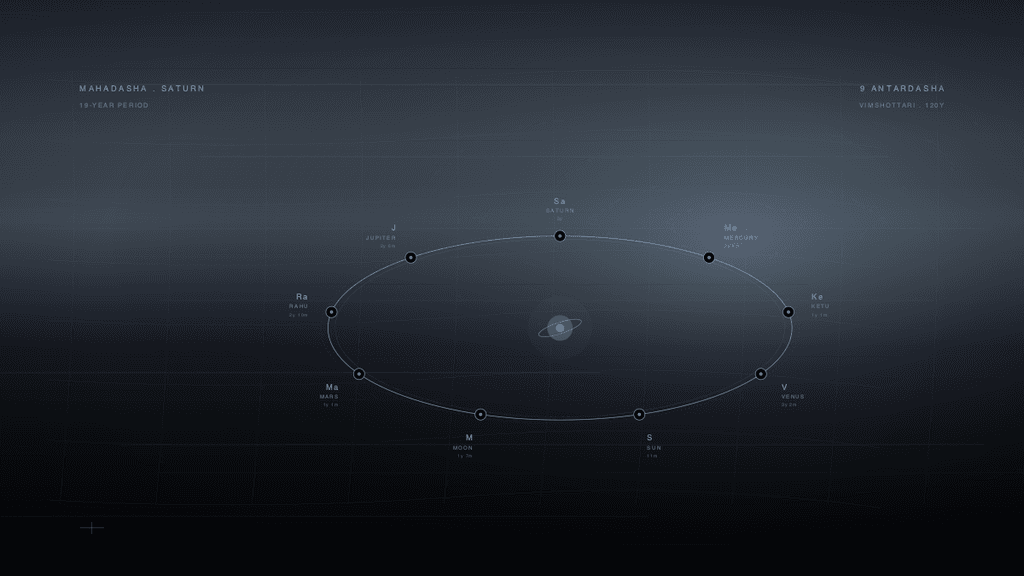
Saturn in the 12 houses: what each placement means and when transits activate it
Saturn is the slowest of the classical planets, so the house it occupied at birth describes a theme that runs through a whole life, and the house it crosses in the sky marks a stretch of about two and a half years. This page condenses what the classical texts say about natal Saturn in each of the twelve houses and adds a computed table: the house transiting Saturn occupies for every ascendant from January 2025 to December 2030, with every sign change dated to the day in IST.
Check your own Sade Sati dates with the free Sade Sati calculator: enter your birth details, no sign-up.
Dates here use the True Pushya Paksha ayanamsa. Most almanacs and apps use Lahiri, which gives Saturn into Aries on 3 June 2027 (23 May here), Saturn back into Pisces on 20 October 2027 (3 November here) and Saturn into Aries for the second time on 23 February 2028 (11 February here). Why the two differ.
How to read Saturn in a house
This page counts houses by whole sign, the default in Parashari practice: the sign rising at birth is the 1st house in full, the next sign is the 2nd and so on around the zodiac. A planet in a house is the first layer of a reading and never the whole of it. Brihat Parashara Hora Shastra, Phaladeepika and Saravali each give a short verdict for Saturn in every house, and they then qualify it by the sign Saturn occupies, by the houses it rules for that ascendant and by the planets aspecting it.
Four rules carry most of the weight in the sections below. First, dignity: Saturn is exalted in Libra, holds its own signs in Capricorn and Aquarius and is debilitated in Aries. Second, house type: the 3rd, 6th, 10th and 11th are upachaya houses, said to improve with time, and a slow malefic such as Saturn is classically welcome there, while the 6th, 8th and 12th are dusthana houses, the houses of difficulty. Third, aspect: Saturn casts full aspects on the 3rd, 7th and 10th houses counted from wherever it sits, so a placement always touches three other houses. Fourth, Sasa yoga: Saturn in its own or exaltation sign in an angle (the 1st, 4th, 7th or 10th) forms one of the five Pancha Mahapurusha yogas, a classical marker of standing.
The sections condense twelve earlier Tempora pages into one place. Each keeps the classical verdict, the ascendants that change it and the transit dates that bring the house into focus between 2025 and 2030.
Which house Saturn transits for each ascendant, 2025 to 2030
The sign Saturn occupies is the same for everyone at a given moment. What differs is which house that sign is in your chart. The first table lists every Saturn sign change and station in the window. The second converts the sign spans into a house for each of the twelve ascendants. Both are generated by a script committed alongside this page, which calls the same ephemeris engine as every other Tempora date.
Saturn sign changes and stations
| Date (IST) | Time (IST) | Event |
|---|---|---|
| 20 March 2025 | 14:45 | Saturn enters Pisces from Aquarius |
| 13 July 2025 | 09:37 | Saturn stations retrograde in Pisces |
| 28 November 2025 | 09:21 | Saturn stations direct in Pisces |
| 27 July 2026 | 01:27 | Saturn stations retrograde in Pisces |
| 11 December 2026 | 05:01 | Saturn stations direct in Pisces |
| 23 May 2027 | 05:29 | Saturn enters Aries from Pisces |
| 9 August 2027 | 23:36 | Saturn stations retrograde in Aries |
| 3 November 2027 | 23:31 | Saturn enters Pisces from Aries (retrograde) |
| 24 December 2027 | 08:17 | Saturn stations direct in Pisces |
| 11 February 2028 | 02:00 | Saturn enters Aries from Pisces |
| 23 August 2028 | 03:47 | Saturn stations retrograde in Aries |
| 5 January 2029 | 18:09 | Saturn stations direct in Aries |
| 21 July 2029 | 14:43 | Saturn enters Taurus from Aries |
| 6 September 2029 | 14:05 | Saturn stations retrograde in Taurus |
| 24 October 2029 | 04:18 | Saturn enters Aries from Taurus (retrograde) |
| 19 January 2030 | 09:23 | Saturn stations direct in Aries |
| 7 April 2030 | 15:47 | Saturn enters Taurus from Aries |
| 21 September 2030 | 03:00 | Saturn stations retrograde in Taurus |
House transited by ascendant
| Ascendant | Aquarius 1 Jan 2025 to 20 Mar 2025 | Pisces 20 Mar 2025 to 23 May 2027 | Aries 23 May 2027 to 3 Nov 2027 | Pisces 3 Nov 2027 to 11 Feb 2028 | Aries 11 Feb 2028 to 21 Jul 2029 | Taurus 21 Jul 2029 to 24 Oct 2029 | Aries 24 Oct 2029 to 7 Apr 2030 | Taurus 7 Apr 2030 to 31 Dec 2030 |
|---|---|---|---|---|---|---|---|---|
| Aries | 11th | 12th | 1st | 12th | 1st | 2nd | 1st | 2nd |
| Taurus | 10th | 11th | 12th | 11th | 12th | 1st | 12th | 1st |
| Gemini | 9th | 10th | 11th | 10th | 11th | 12th | 11th | 12th |
| Cancer | 8th | 9th | 10th | 9th | 10th | 11th | 10th | 11th |
| Leo | 7th | 8th | 9th | 8th | 9th | 10th | 9th | 10th |
| Virgo | 6th | 7th | 8th | 7th | 8th | 9th | 8th | 9th |
| Libra | 5th | 6th | 7th | 6th | 7th | 8th | 7th | 8th |
| Scorpio | 4th | 5th | 6th | 5th | 6th | 7th | 6th | 7th |
| Sagittarius | 3rd | 4th | 5th | 4th | 5th | 6th | 5th | 6th |
| Capricorn | 2nd | 3rd | 4th | 3rd | 4th | 5th | 4th | 5th |
| Aquarius | 1st | 2nd | 3rd | 2nd | 3rd | 4th | 3rd | 4th |
| Pisces | 12th | 1st | 2nd | 1st | 2nd | 3rd | 2nd | 3rd |
Conventions: whole sign houses counted from the ascendant; sidereal positions from Swiss Ephemeris with the True Pushya Paksha ayanamsa; each sign change found on a daily scan and narrowed to the minute, then converted to Indian Standard Time (UT plus 5 hours 30 minutes). A column's end date is the next column's start date. Lahiri dates differ: the engine's Lahiri value in 2027 is 1.13 degrees larger, and the same script finds Lahiri placing these seven Saturn boundaries 9 to 19 days away, later for the forward entries and earlier for the two retrograde exits.
Three rows as worked examples. For an Aries ascendant Saturn moves from the 12th house through the 1st and back to the 12th before it settles in the 1st from 11 February 2028, so the Aries pass over the body and self arrives as a five month preview in 2027. For a Libra ascendant the same dates run the 6th, the 7th, the 6th and then the 7th: partnership comes into focus while Saturn sits in its debilitation sign. For a Cancer ascendant Saturn crosses the 9th and then the 10th, the house of career, where the classical texts give it a karaka role.
How natal and transiting Saturn combine
Read the two layers in order. Natal Saturn's house names the life area where Saturn's slow, effortful style is permanent. Transiting Saturn's house names the area under that same pressure for the current two and a half years. When the transit reaches the sign natal Saturn occupies, the classical Saturn return, about every 29.5 years, the natal theme is read as renewed; when transiting Saturn aspects the natal Saturn sign by its 3rd, 7th or 10th aspect, the natal house is read as touched from outside. The limits are real. This is sign level reading, the coarsest resolution the method offers, and the running dasha usually outweighs any single transit. A birth time off by an hour or two can move the ascendant a sign and every house in this table by one. Tempora has measured no base rate for events under these combinations, so treat them as windows for attention, with no forecast attached.
Saturn in the 1st house
The 1st house, Tanu Bhava or the house of the body, covers the physical constitution, the temperament and the direction a life takes. Saturn there is the classical late start. The texts describe a person who takes responsibility early, carries a serious manner from youth and grows into authority over decades, with health attention on bones, joints, teeth and the lower back, the parts of the body Saturn signifies. Phaladeepika, like the other texts, gives the usual verdict of hardship and then reverses it when Saturn holds its own or exaltation sign in the ascendant, where it describes the person as rising to rank.
That reversal is the part of the reading worth checking first. For a Libra ascendant Saturn in the 1st is in Libra, its exaltation sign; for Capricorn and Aquarius ascendants it is in its own sign and is also the lord of the chart. In all three cases Saturn in the 1st forms Sasa yoga. For an Aries ascendant the 1st is Aries, Saturn's debilitation sign, which is the case the cautions were written for; the tradition then looks for neecha bhanga, the cancellation of debilitation, through a strong dispositor (here Mars) before giving a verdict.
From the 1st, Saturn aspects the 3rd, the 7th and the 10th. The 7th aspect is why the 1st house placement is also read for partnership: the tradition describes a spouse who is older, more serious or arrives later than average. The 10th aspect slows the early career and lends it endurance.
Saturn's first return, near age 29 to 30, brings transiting Saturn back to the natal sign and is the classical turning point for this placement. Sade Sati, the seven and a half years Saturn takes to cross the sign before the natal Moon, the Moon sign and the sign after it, adds weight when the Moon also sits in or beside the 1st.
Transit check: transiting Saturn occupies the 1st house of Pisces ascendants from 20 March 2025 to 23 May 2027 and again from 3 November 2027 to 11 February 2028. For Aries ascendants it is in the 1st from 23 May to 3 November 2027 and from 11 February 2028 to 7 April 2030, apart from the Taurus interval of 21 July to 24 October 2029.
Saturn in the 2nd house
The 2nd house, Dhana Bhava, holds accumulated wealth, the family of origin, speech, food and early schooling. Saturn there is the classical slow build of money. The texts describe income that arrives through steady work and lands late, a family that carries some hardship or change the person has to absorb and speech that is measured, sparse or blunt. The 2nd is also one of the two maraka houses, the houses read for threats to longevity in the classical system, so a 2nd house Saturn enters the longevity calculation as well.
The sign decides how hard this reads. For a Virgo ascendant the 2nd is Libra, where Saturn is exalted and also rules the 5th and 6th. For Sagittarius and Capricorn ascendants the 2nd is Capricorn and Aquarius respectively, Saturn's own signs, and for a Capricorn ascendant Saturn is the lord of the chart sitting in the house of wealth, a pattern the texts read as wealth built through one's own effort. For a Pisces ascendant the 2nd is Aries, Saturn's debilitation sign, and that is the chart the cautions about family strain and delayed savings were written for.
From the 2nd, Saturn aspects the 4th (home and inner comfort), the 8th (joint money and inheritance) and the 11th (income and gains). Readers often treat a 2nd house Saturn and an 11th house Saturn as the same money signal; they differ. The 2nd measures what is kept, the 11th what flows in, and Saturn in the 2nd casts its 10th aspect onto the 11th, which is why the tradition reads earnings as slow to start and durable once in place.
Dasha timing carries extra weight here because the 2nd is a maraka house: the mahadasha of Saturn, its 19 year Vimshottari period, and the period of the 2nd lord are the windows the tradition watches for both money and health.
Transit check: Saturn transits the 2nd house of Aquarius ascendants while it is in Pisces, from 20 March 2025 to 23 May 2027 and from 3 November 2027 to 11 February 2028, and the 2nd house of Pisces ascendants while it is in Aries. Its first entry into Aries on 23 May 2027 is therefore the start of a 2nd house transit for every Pisces rising chart.
Saturn in the 3rd house
The 3rd house, Sahaja Bhava, covers effort, courage, younger siblings, short journeys, the hands and written or spoken communication. It is the first of the upachaya houses, and the classical texts treat it as a good home for Saturn: the slow malefic gains strength in a house that is itself said to improve with time. The usual description is a person whose initiative grows with age, whose writing or technical skill gathers weight over decades and whose stamina in middle life exceeds what it was in youth.
The caution in the 3rd concerns siblings. The tradition reads Saturn here as distance from, responsibility for or loss involving a younger sibling, and as relationships with siblings that become serious early. This is a sibling reading, and it should be checked against Mars, the karaka (significator) of siblings, before it is applied to any one chart.
Dignity changes the tone. For a Leo ascendant the 3rd is Libra, Saturn's exaltation, with Saturn ruling the 6th and 7th. For Scorpio and Sagittarius ascendants the 3rd falls in Capricorn and Aquarius, Saturn's own signs. For an Aquarius ascendant the 3rd is Aries, so the lord of the chart sits debilitated in the house of effort, a placement the tradition reads as hard won initiative that needs the support of Mars to work well.
From the 3rd, Saturn aspects the 5th, the 9th and the 12th. Its aspect on the 5th is one reason the texts link this placement with delay in children even while they praise its effect on courage. The aspect on the 9th brings a serious, duty bound tone to beliefs and to the relationship with the father.
One concrete and checkable point: of the four upachaya houses, the 3rd is the only one where Saturn's 10th aspect falls on the 12th house of expense and retreat, which the texts read as work and travel that cost money before they repay it.
Transit check: transiting Saturn occupies the 3rd house of Capricorn ascendants while it is in Pisces, from 20 March 2025 to 23 May 2027 and from 3 November 2027 to 11 February 2028, and the 3rd house of Aquarius ascendants while it is in Aries. Classical gochara (transit) rules, which count from the natal Moon, rate Saturn's passage through the 3rd, 6th and 11th as favourable.
Saturn in the 4th house
The 4th house, Sukha Bhava, holds home, mother, land and vehicles, schooling and the sense of inner ease. It is an angle (kendra) and the Moon is its karaka, which is why Saturn here is a classical difficulty: Saturn and the Moon are natural enemies in the planetary friendship table, and Saturn presses on the house that the Moon is meant to make comfortable. The texts describe a home life that feels heavy or restricted in early years, distance from or responsibility for the mother, late ownership of property and a mind that settles slowly.
The same texts give the second half of the picture: property, when it comes, comes late and stays, and the person often ends up owning land or buildings through long saving or institutional channels. Sade Sati reads more heavily when the natal Moon sits in or beside the 4th, because the transit then lands on a house that natal Saturn already presses.
The 4th is an angle, so Sasa yoga is possible. For a Cancer ascendant the 4th is Libra and Saturn is exalted there. For a Libra ascendant the 4th is Capricorn, Saturn's own sign, and Saturn is also the yogakaraka for Libra, ruling the 4th and the 5th, which makes this one of the readings the tradition treats as a clear exception to the usual cautions. For a Scorpio ascendant the 4th is Aquarius, again own sign. For a Capricorn ascendant the 4th is Aries, where the lord of the chart is debilitated in the house of home.
From the 4th, Saturn aspects the 6th, the 10th and the 1st. Its 7th aspect on the 10th is the reason this placement is read as a career that rests on long, unglamorous foundations; its 10th aspect on the 1st adds a serious manner to the person.
Transit check: transiting Saturn occupies the 4th house of Sagittarius ascendants while it is in Pisces, until 23 May 2027 and again from 3 November 2027 to 11 February 2028, and the 4th house of Capricorn ascendants once it settles in Aries on 11 February 2028. Counted from the natal Moon, a Saturn transit of the 4th is called ardhashtama Shani and is read as a heavier stretch for home and mood.
Saturn in the 5th house
The 5th house, Putra Bhava, covers children, intelligence and judgement, creative work, romance, speculation and purva punya, the merit a chart is said to carry in from earlier lives. It is a trine (trikona) and Jupiter is its karaka. Saturn in a trine is a pressured combination in the classical texts, and the 5th is where that pressure is described most plainly: children arrive late or with difficulty, creativity runs through discipline and long training, romance is serious or delayed and speculation does poorly.
The texts are careful to describe delay, and the same chapters describe the person later in life as a teacher, scholar or senior figure in an institution, whose judgement is respected because it was slow to form. Jupiter's aspect on the 5th, or a strong 5th lord, is the main mitigation the tradition names.
Ascendant changes the verdict a great deal. For Taurus and Libra ascendants Saturn is the yogakaraka, ruling both an angle and a trine, and its placement in the 5th, a trine, connects the two in a way the texts treat as a raja yoga, a combination for standing. For a Libra ascendant the 5th is Aquarius, so Saturn is yogakaraka and in its own sign at once. For a Gemini ascendant the 5th is Libra, where Saturn is exalted. For a Virgo ascendant the 5th is Capricorn, own sign. For a Sagittarius ascendant the 5th is Aries, where Saturn is debilitated, which is where the classical warnings about children apply in full.
From the 5th, Saturn aspects the 7th, the 11th and the 2nd. The aspect on the 7th is why the tradition reads marriage as late in charts with this placement, and the aspect on the 11th slows gains from speculation and investments.
Transit check: transiting Saturn occupies the 5th house of Scorpio ascendants while it is in Pisces, until 23 May 2027 and again from 3 November 2027 to 11 February 2028. It occupies the 5th house of Sagittarius ascendants while it is in Aries, from 11 February 2028 to 7 April 2030 apart from the Taurus interval of 21 July to 24 October 2029.
Saturn in the 6th house
The 6th house, Shatru Bhava, covers opponents, disputes, debt, illness and daily service work. It is both a dusthana and an upachaya, and the classical texts treat it as one of Saturn's favourable houses: a slow, patient planet in the house of conflict and routine is read as a person who outlasts opposition, clears debts over time and builds a career on service. Saturn is one of the two karakas of the 6th, with Mars, so it is working in a house it already signifies.
The professions the texts and later commentators link with this placement are those of sustained duty: civil service, the courts, medicine and nursing, the armed forces and police, audit and regulation. Disputes are described as long and are often settled in the person's favour. The health caution is chronic in character, illness that needs long management.
For a Taurus ascendant the 6th is Libra, so the yogakaraka is exalted in the house of service. For a Leo ascendant the 6th is Capricorn, Saturn's own sign; Saturn rules the 6th and 7th for Leo, so the tradition reads a strong work life and a more demanding marriage. For a Virgo ascendant the 6th is Aquarius, again own sign. For a Scorpio ascendant the 6th is Aries, where Saturn is debilitated and rules the 3rd and 4th, the variant the texts read as a hard start that improves only over many years.
From the 6th, Saturn aspects the 8th, the 12th and the 3rd. The aspects on the 8th and 12th tie this placement to hospitals, insurance and long periods of work away from home in some readings. A checkable point for anyone with this placement: viparita raja yoga, the classical combination where the lord of one dusthana sits in another, forms when Saturn rules the 8th or 12th and occupies the 6th, which happens for Gemini (Saturn rules the 8th) and Pisces (Saturn rules the 12th) ascendants.
Transit check: transiting Saturn occupies the 6th house of Libra ascendants while it is in Pisces, from 20 March 2025 to 23 May 2027 and from 3 November 2027 to 11 February 2028, and the 6th house of Scorpio ascendants while it is in Aries. Saturn's transit of the 6th from the Moon is one of the three positions classical gochara rules rate as favourable.
Saturn in the 7th house
The 7th house, Kalatra Bhava, holds marriage, business partnership, contracts, public dealings and open opponents. It is an angle and, with the 2nd, a maraka house. Saturn gains digbala, directional strength, in the 7th: Brihat Parashara Hora Shastra assigns each planet one house where its strength by direction is full, and for Saturn that house is the 7th. The same texts read Saturn here as the classical signature of late marriage. The two statements are compatible: the tradition describes partnerships that form late, often with someone older or more established, and that last once formed.
Business partnerships follow the same pattern: slow to agree, long once signed. The 7th is also the house of open opponents, and a strong Saturn here is read as an ability to outlast public disputes.
In the classical reading delay and denial are separate verdicts, and the strength of Venus, of the 7th lord and of Jupiter's aspects decides how far the delay runs. Ages such as "after 30" are often attached to this placement online; no classical text gives that age and Tempora has not measured one.
As an angle the 7th can host Sasa yoga. For an Aries ascendant the 7th is Libra, so Saturn is exalted there and also rules the 10th and 11th. For a Cancer ascendant the 7th is Capricorn and for a Leo ascendant Aquarius, Saturn's own signs, though for both it also rules a dusthana (the 8th for Cancer, the 6th for Leo). For a Libra ascendant the 7th is Aries: the yogakaraka is debilitated in the house of marriage, and the warnings about delay apply with little offset.
From the 7th, Saturn aspects the 9th, the 1st and the 4th. The aspect on the 1st is why the texts describe the person as serious in manner when Saturn sits opposite the ascendant.
Transit check: transiting Saturn occupies the 7th house of Virgo ascendants while it is in Pisces, and of Libra ascendants while it is in Aries: 23 May to 3 November 2027, then 11 February 2028 to 7 April 2030 apart from the Taurus interval of 21 July to 24 October 2029.
Saturn in the 8th house
The 8th house, Ayur Bhava, covers length of life, sudden change, chronic illness, inheritance, insurance, joint money and hidden or research work. It is a dusthana, and Saturn is its karaka: the significator of longevity sitting in the house of longevity. The classical sources split on what that means. One line of reading holds that Saturn here grants long life, because the ayushkaraka (longevity significator) strengthens its own house; the opposing rule, karako bhava nashaya, holds that a karaka placed in its own house harms what the house signifies. Both views appear in the commentaries, which is why this placement is read through Saturn's dignity before any verdict.
The rest of the picture is more settled. The texts link the placement with chronic conditions that need long management, inheritance that arrives late and through paperwork, and an aptitude for work done out of public view: research, investigation, insurance, surgery and the study of hidden subjects. Sade Sati phases that land on or beside the 8th are read as heavier for this chart.
For a Pisces ascendant the 8th is Libra, so Saturn is exalted in the house of longevity. For a Gemini ascendant the 8th is Capricorn, own sign, and Saturn rules the 8th and 9th; for a Cancer ascendant the 8th is Aquarius, own sign, and Saturn rules the 7th and 8th. For a Virgo ascendant the 8th is Aries, where Saturn is debilitated while ruling the 5th and 6th. Viparita raja yoga forms when Saturn rules the 6th or 12th and sits in the 8th, which happens for Leo (Saturn rules the 6th), Virgo (the 6th) and Pisces (the 12th) ascendants.
From the 8th, Saturn aspects the 10th, the 2nd and the 5th. The aspect on the 2nd links this placement to family money and to the maraka calculation; the aspect on the 10th to careers in institutions that deal with risk and loss.
Transit check: transiting Saturn occupies the 8th house of Leo ascendants while it is in Pisces, from 20 March 2025 to 23 May 2027 and again from 3 November 2027 to 11 February 2028. It occupies the 8th of Virgo ascendants while it is in Aries. A Saturn transit of the 8th from the Moon is called ashtama Shani in the tradition and is read as one of its heavier stretches.
Saturn in the 9th house
The 9th house, Dharma Bhava, covers the father, teachers, belief and ethics, higher learning, long journeys and fortune in the broad sense. It is the highest ranked trine in the classical scheme. Saturn here is read as fortune that is built over time and arrives late: long degrees, a career with a clear ethical spine, residence abroad through formal channels and a father who is serious, dutiful, older or at a distance. The texts often add that the person keeps tradition firmly or questions it seriously, and either way takes belief as a matter of discipline.
The father reading is the part to check against the Sun, the karaka of the father, and against the 9th lord; Saturn alone is a weak basis for statements about one parent. Higher education under this placement is described as long and certified: doctorates, professional qualifications and late study are common in the commentaries.
For a Taurus ascendant the 9th is Capricorn, so Saturn is the yogakaraka in its own sign in the leading trine, a combination the texts rate very well. For a Gemini ascendant the 9th is Aquarius, own sign, with Saturn ruling the 8th and 9th. For an Aquarius ascendant the 9th is Libra: the lord of the chart is exalted in the house of fortune. For a Leo ascendant the 9th is Aries, where Saturn is debilitated while ruling the 6th and 7th, the chart where the cautions about the father and about delayed luck apply in full.
From the 9th, Saturn aspects the 11th, the 3rd and the 6th, three of the four upachaya houses. That is a checkable point and the reason the texts expect gains, effort and work in service to improve with age under this placement even while the 9th itself starts slowly.
Saturn's returns near 29 and 58 bring the transit back over the 9th and are the classical points at which beliefs and long term direction are re-examined.
Transit check: transiting Saturn occupies the 9th house of Cancer ascendants while it is in Pisces, until 23 May 2027 and again from 3 November 2027 to 11 February 2028, and the 9th of Leo ascendants once it is in Aries. Saturn's transit of the 9th from the ascendant is the stretch the tradition associates with study, travel and questions about belief.
Saturn in the 10th house
The 10th house, Karma Bhava, holds career, public standing, authority and action in the world. It is an angle and an upachaya. Brihat Parashara Hora Shastra lists Saturn among the karakas of the 10th, with the Sun, Mercury and Jupiter, so Saturn here sits in a house it signifies. The texts describe a slow climb that ends in a lasting position, often in the second half of life: responsibility before recognition, work in large institutions, government or industries built on long cycles, and a public reputation for reliability.
The tradition also attaches a warning to sudden falls from rank in some charts with this placement, and connects it to conduct: authority gained slowly is described as lost quickly through shortcuts. This is a moral teaching in the texts more than a timing rule.
As an angle the 10th can host Sasa yoga. For a Capricorn ascendant the 10th is Libra, so the lord of the chart is exalted in the house of career. For an Aries ascendant the 10th is Capricorn, own sign, with Saturn ruling the 10th and 11th, two upachaya houses. For a Taurus ascendant the 10th is Aquarius: the yogakaraka in its own sign in the house of career, a combination the texts rate among their more favourable career placements. For a Cancer ascendant the 10th is Aries, where Saturn is debilitated and rules the 7th and 8th; the tradition reads a career with interruptions and partnerships that affect work.
From the 10th, Saturn aspects the 12th, the 4th and the 7th. Its 7th aspect on the 4th is the classical reason this placement is read as a career that takes time away from home and family.
The first Saturn return near 29 is described as a career re-set for this placement and the second near 58 as the point of seniority.
Transit check: transiting Saturn occupies the 10th house of Gemini ascendants while it is in Pisces, from 20 March 2025 to 23 May 2027 and again from 3 November 2027 to 11 February 2028, and the 10th of Cancer ascendants while it is in Aries. Saturn's transit of the 10th from the ascendant is the classical career transit.
Saturn in the 11th house
The 11th house, Labha Bhava, covers income, gains, the fulfilment of aims, elder siblings, friends and networks. It is the last of the upachaya houses, and the classical texts rate Saturn here very favourably: a planet that rewards persistence, in a house that grows with time, is read as income that rises steadily over a career and gains that arrive in long cycles. The commentaries name salary from a durable institution, pensions, rent from property held for years and returns on long investments as the typical sources.
The cautions are mild by comparison. Elder siblings may carry heavy responsibilities or be at a distance; friendships are few and long; ambitions are reached late. The texts also note that gains here can come through older people or through work with large groups.
Aquarius is the natural 11th sign of the zodiac and one of Saturn's own signs, which is part of why the tradition sees an affinity. For an Aries ascendant the 11th is Aquarius, so Saturn is in its own sign and rules both the 10th and 11th, career and gains together. For a Pisces ascendant the 11th is Capricorn, also own sign. For a Sagittarius ascendant the 11th is Libra, where Saturn is exalted. For a Gemini ascendant the 11th is Aries: Saturn is debilitated in the house of gains while ruling the 8th and 9th, the variant where income is read as uneven before it steadies.
From the 11th, Saturn aspects the 1st, the 5th and the 8th. The aspect on the 5th is a checkable reason the texts pair steady income with late or few children in some charts, and the aspect on the 1st gives the person a serious manner.
Transit check: transiting Saturn occupies the 11th house of Taurus ascendants while it is in Pisces, until 23 May 2027 and from 3 November 2027 to 11 February 2028, and the 11th of Gemini ascendants while it is in Aries. Saturn transiting the 11th from the Moon is one of the three transit positions the classical gochara rules count as favourable, along with the 3rd and 6th.
Saturn in the 12th house
The 12th house, Vyaya Bhava, covers expense and loss, foreign residence, hospitals and institutions of confinement, sleep, retreat and moksha, liberation in the spiritual sense. It is a dusthana and also the only house the tradition reads for liberation. Saturn here has a mixed classical reputation: expenses that are steady and hard to cut, periods of isolation, time in hospitals or institutions and difficulty resting. The same texts describe a constructive version: long residence abroad through formal channels, a career inside hospitals, prisons, monasteries or research stations, and a meditative practice that deepens over decades.
Which version applies is set by Saturn's sign, by the 12th lord and by the condition of Jupiter and the Moon. The tradition is explicit that this placement is conditional, and a reading that calls it uniformly bad leaves out half of the classical text.
For a Scorpio ascendant the 12th is Libra, so Saturn is exalted there while ruling the 3rd and 4th. For an Aquarius ascendant the 12th is Capricorn, Saturn's own sign; the lord of the chart sits in the house of loss and retreat, which the texts read as a life with a strong pull toward foreign places or seclusion. For a Pisces ascendant the 12th is Aquarius, own sign, with Saturn ruling the 11th and 12th. For a Taurus ascendant the 12th is Aries: the yogakaraka is debilitated in the house of expense, and here the cautious reading of the 12th applies with little offset.
From the 12th, Saturn aspects the 2nd, the 6th and the 9th. Viparita raja yoga forms when Saturn rules the 6th or 8th and sits in the 12th, which happens for Gemini (Saturn rules the 8th), Cancer (the 8th), Leo (the 6th) and Virgo (the 6th) ascendants.
Transit check: transiting Saturn occupies the 12th house of Aries ascendants while it is in Pisces, from 20 March 2025 to 23 May 2027 and from 3 November 2027 to 11 February 2028, and the 12th of Taurus ascendants while it is in Aries. Counted from the natal Moon, the 12th is the first phase of Sade Sati.
Frequently asked
Which house is Saturn transiting for my ascendant?
Count from your rising sign to the sign Saturn occupies, with your rising sign as the 1st house. Saturn is in Pisces until 23 May 2027, so it transits the 12th house for an Aries ascendant, the 6th for Libra and the 1st for Pisces. From 11 February 2028 it is in Aries, one house further on for every ascendant. The table on this page gives every ascendant for every span from 2025 to 2030.
When does Saturn enter Aries?
Under the True Pushya Paksha ayanamsa Saturn enters Aries on 23 May 2027 at 05:29 IST, retrogrades back into Pisces on 3 November 2027 at 23:31 IST and re-enters Aries on 11 February 2028 at 02:00 IST. It first touches Taurus on 21 July 2029, slips back into Aries on 24 October 2029 and leaves Aries for good on 7 April 2030.
Why do these Saturn dates differ from other websites?
Most listings use the Lahiri ayanamsa. In 2027 the engine's Lahiri value is 1.13 degrees larger than True Pushya Paksha, and at the 2025 to 2030 boundaries Saturn takes 9 to 19 days to cover that distance. Lahiri dates therefore fall 9 to 19 days away from the dates on this page, later for forward entries and earlier for retrograde exits. Neither set of dates is an ephemeris error; they rest on different zodiac anchors.
Is Saturn in any house simply good or bad?
No single house settles it. Classical texts rate Saturn well in the 3rd, 6th and 11th houses, where difficulty tends to turn into stamina with age, and give it directional strength in the 7th. The sign matters as much as the house: Saturn is exalted in Libra, rules Capricorn and Aquarius and is debilitated in Aries. The ascendant decides which houses Saturn rules, and that changes the reading again.
Does Saturn in the 7th house delay marriage?
The classical texts read Saturn in the 7th as a signature of late marriage, often to someone older or more established, and also give Saturn directional strength in that house, so the partnership that forms is described as lasting. Delay and denial are separate verdicts in the tradition: Venus, the 7th lord and Jupiter's aspect decide how far the delay runs. No classical text gives a fixed age, and Tempora has not measured one.
Which Saturn placements do the classical texts rate favourably?
The 3rd, 6th, 10th and 11th houses, the upachaya houses that are said to improve with time, and the 7th, where Saturn has directional strength. Sign can override house: Saturn in Libra, Capricorn or Aquarius in an angle forms Sasa yoga, and for Taurus and Libra ascendants Saturn is a yogakaraka wherever it sits. A debilitated Saturn in Aries weakens even a favourable house.
What is the difference between natal Saturn in a house and Saturn transiting a house?
Natal Saturn is fixed at birth and describes a standing theme of the chart for life. Transiting Saturn is where Saturn is in the sky now; it spends about two and a half years in each house counted from your ascendant. A transit is temporary and the same for everyone with your rising sign, while the natal placement is yours alone. Classical practice reads a transit through the natal chart, never on its own.
How do I find which house Saturn occupies in my own chart?
You need an accurate birth time, because the ascendant changes about every two hours and a shift of one sign moves every house by one. Kaal Imprint draws your chart for free from your date, time and place of birth on the same Swiss Ephemeris and True Pushya Paksha calculation this page uses, shows the house of natal Saturn and answers a question you ask against your chart.
Read next
This page condenses conventional Parashari teaching on Saturn in the twelve houses, drawn from Brihat Parashara Hora Shastra, Phaladeepika and Saravali, and adds a transit table computed sidereally with the True Pushya Paksha ayanamsa via Swiss Ephemeris by a script committed with this page. Boundary dates depend on the ayanamsa and differ from Lahiri listings by design. House readings describe classical tendencies and carry no measured base rate; individual charts vary in ways a house level page cannot capture. This page does not constitute financial, medical, legal or personal advice. Published 8 November 2026 by Tempora Research; it replaces twelve earlier single house pages.