Sun Mahadasha Mars Antardasha: the decisive-leadership action window
When Mars takes over from the Moon inside the Sun mahadasha, the register shifts from reception to execution. Classical friendship runs both ways here, the Sun as king and Mars as the commander of his forces, so the tradition reads the pairing as delegated fire: authority that now moves, builds and contests rather than presides. The handover is a genuine change of temperature, six reflective months of Sun-Moon giving way to the mahadasha's first push outward. Classical texture for Sun-Mars is brief and pitta-hot, a short campaign rather than a long administration, with brothers, land, engineering and contested ground as its traditional subject matter.
Mars's natal state tells the tradition which version of the campaign to expect. Well placed, exalted in Capricorn or at home in Aries or Scorpio, Mars is read as giving the period disciplined force, decisions that land and physical energy to spend. Debilitated in Cancer or afflicted, the same months lean toward haste, friction with authority figures and injuries of the self-inflicted kind, which is why classical counsel for a weak Mars period is to slow the tempo the period itself wants to raise.
Where the sub-period falls in the Vimshottari sequence
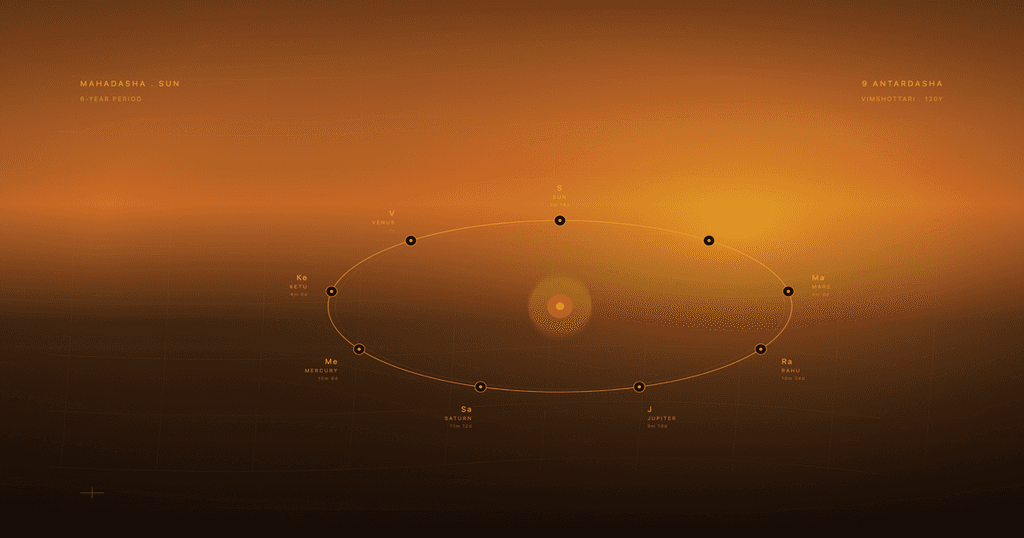
The 6-year Sun mahadasha divides into nine antardasha sub-periods in fixed Vimshottari order starting with Sun itself. The Mars sub-period sits at position 3 of 9. Exact start and end dates for any chart can be computed from the natal Moon nakshatra-pada and the date of Sun mahadasha onset. The Tempora dasha engine produces this to the day.
The arithmetic of this period
Mars holds 7 of the 120 Vimshottari years, so its share of the 6-year Sun mahadasha is 6 x 7 / 120 = 0.35 years, or 4 months 6 days. The Sun and Moon sub-periods before it sum to 9 months 18 days, which places Mars from 9 months 18 days to 13 months 24 days of the mahadasha, straddling the close of the first year. The six-year structure around it is laid out in the Sun mahadasha overview.
Its neighbours define it by contrast. Mars runs shorter than the Moon period before it and well under half the Rahu period after it, a spike of heat between a cool stretch and a long smoky one, and classical writers read short antardashas of this kind as concentrated rather than diluted: one campaign, one decision, one fight. Early position matters too, since at this stage of a 6-year arc a Mars period opens fronts rather than settles them, where the same antardasha near a mahadasha's end tends to conclude campaigns already fought.
BPHS and Phaladeepika on this period
In the BPHS antardasha chapters, Sun mahadasha section, the Mars sub-period divides cleanly along dignity: exalted or in own sign, in a kendra or trikona, Mars is assigned land, house, wealth and grain, and joined with the lagna lord the grant extends to army command, destruction of enemies, peace of mind and an increase of siblings. Afflicted, undignified or in the 8th or 12th from the dasha lord, the same lord delivers brutality, mental ailment, imprisonment, disputes with brothers and failed ventures, and a debilitated Mars is said to see wealth destroyed through royal displeasure. Where Mars carries lordship of the 2nd or the 7th the chapter notes diseases of mind and body and prescribes Veda recitation, japa and Vrishotsarga as remedial measures. Phaladeepika's chapter on bhukti effects gives diseases, wounds, loss of position and enemy trouble, a fixed list that matches the BPHS adverse branch. Both records enter the Tempora engine as inputs whose weight the natal chart decides.
Friendship status and pairing reading
In the classical Parashari friendship matrix, Sun views Mars as friend. The friend-pair classification means the 4 months 6 days sub-period classically delivers outcomes where Sun's register (authority, identity, the father-line, dignified-recognition and the visible self) and Mars's register (action, courage, brothers, surgery, property and the warrior register) integrate constructively. Events typically surface from both karaka domains in alignment rather than friction.
The Mars karaka overlay
Mars is the karaka of action, courage, brothers, surgery, property and the warrior register. Across the 4 months 6 days sub-period, this karaka set overlays on top of Sun's 6-year authority, identity, the father-line, dignified-recognition and the visible self register. The combined reading is the central output of the sub-period.
How Mars's natal dignity shapes the reading
Mars's natal sign and house set the floor for the 4 months 6 days sub-period. Mars at exaltation gives the strongest reading. Own-sign and mooltrikona placement gives clean expression. Debilitation introduces friction that the sub-period must work through. Combust and retrograde state, conjunctions with malefics or benefics and the dispositor's strength all further modulate the reading. See the Mars mahadasha overview for the per-dignity breakdown.
Event classes typical to Sun-Mars sub-period
The 4 months 6 days Sun mahadasha Mars antardasha typically surfaces events across these specific domains:
- Constructive integration of Sun-register with Mars-register: friend-pair sub-periods classically deliver outcomes where both planets' karakas align rather than friction.
- Events in Mars's natural karaka domain: action, courage, brothers, surgery, property and the warrior register.
- Events specific to the natal house Mars occupies in the chart.
- Events where the Sun-mahalord and Mars-antarlord houses (both natal and ruled) interact (aspect, mutual reception or natal conjunction).
Transit confirmation protocol
The sub-period reading sets a structural pressure floor of 4 months 6 days. Specific event timing inside that window requires the pratyantara (sub-sub-period) overlay and a transit cross-check.
Two transit overlays do most of the work. The standard targets to track: transit Sun aspecting natal Mars, transit Mars through the natal 3rd or 10th house, transit Saturn aspecting natal Mars, transit Mars through Aries or Scorpio or Capricorn. These transits intensify the Sun-Mars dynamic within the broader sub-period and concentrate event timing on those windows.
The pratyantara (sub-sub-period) inside the antardasha gives finer timing. The Sun-Mars-Sun pratyantara (about 1 month 15 days) and the Sun-Mars-Mars pratyantara (about 22 days) carry the most concentrated decisive-action signal within the 11-month sub-period. The Sun-Mars-Saturn pratyantara (about 1 month 23 days) reads as the durable-execution window for property and land decisions. Cross-checking the pratyantara against the transit overlay gives event timing to the week. Tempora's dasha engine produces this data to the day for any chart.
What the framework does not predict
The Sun-Mars reading is structural. It flags a 4-month window where the conditional probability of three named event classes lifts above chance, but it does not predict that any specific native will experience a specific event inside that window, nor the direction of any event that does fire.
A decisive-action event during the sub-period can read as the well-timed execution of long-built intention or as an impulsive move whose consequences extend beyond the 11-month window; the chart's Mars strength and natal aspect pattern determines which. The framework times the pressure, not the result and timing finer than the antardasha band needs the pratyantara sequence and the transit overlay for the date in question.
How this connects to the broader Sun Mahadasha
The Sun-Mars sub-period is the third antardasha inside the 6-year Sun Mahadasha. Reading the sub-period in isolation captures the 4 months 6 days; reading it inside the Mahadasha gives the broader arc that places the authority meets initiative reading in its proper structural context.
The Tempora Sun Mahadasha method article covers the dispositor analysis, natal-house framework and the broader 6-year texture that this sub-period sits inside. The conditional probability framework holds across the full series: each antardasha is a flagged window for specific event classes whose probability is elevated relative to chance.
This period against the 2026 to 2028 sky
Mars itself carries no dated event in the engine-verified 2026 to 2028 calendar, so the sky reading routes through the mahadasha lord. The solar eclipse of 12 August 2026 falls on the Cancer-Leo cusp, Leo being the Sun's own sign, and a native running the fiery Sun-Mars months across that date meets the classical counsel to hold rather than force decisions inside an eclipse window. The counsel stays proportionate: the antardasha lasts 4 months 6 days, the eclipse a single afternoon, and for most charts the window passes without a datable mark. The nodal shift of 27 December 2026 moves Ketu, the graha the tradition treats as Mars-like in action, from Leo into Cancer, background colouring rather than a trigger for this pairing. Where any of it lands by house is decided by the natal ascendant alone, which is why the reading starts from the birth chart and the Mars mahadasha overview rather than from the calendar.
Frequently asked questions
How long is the Sun Mahadasha Mars Antardasha and where does it fall in the Vimshottari sequence?
The Sun Mahadasha Mars Antardasha runs 4 months 6 days. It is the third antardasha inside the 6-year Sun Mahadasha, opening after the Sun-Moon antardasha (6 months). The full sequence inside the Sun Mahadasha runs Sun-Sun, Sun-Moon, Sun-Mars, Sun-Rahu, Sun-Jupiter, Sun-Saturn, Sun-Mercury, Sun-Ketu and Sun-Venus. Exact start and end dates can be computed from the natal Moon nakshatra-pada and the date of Sun Mahadasha onset.
What does Mars signify in this sub-period and why does it read as authority meets initiative?
Mars is the karaka of action, courage, war, sport, surgery, real estate, brothers, energy, conflict, competition, land. During the broader Sun Mahadasha's authority and identity reading, Mars contributes the decisive-action overlay. The sub-period sits at the third position in the antardasha sequence and reads as the Sun authority register meeting Mars's drive, will, conflict, sibling and surgical significations.
How does Mars's natal dignity shape the Sun-Mars sub-period reading?
Mars's natal house, sign and aspectual state set the floor for the 4-month sub-period. Mars exalted in Capricorn, in own sign Aries or Scorpio or in angular houses (1st, 4th, 7th, 10th) softens the reading toward more auspicious outcomes. Mars debilitated in Cancer introduces friction. Aspects from Saturn bring sustained structural pressure; aspects from Mars bring competitive or confrontational pressure.
What kinds of events historically correlate with the Sun-Mars sub-period?
Three event classes correlate. Decisive-action events: Strategic moves, long-deferred decisions executed, career pivots completed, business-launch events. The Sun-Mars sub-period is the most concentrated decisive-action window in the Sun Mahadasha for nat. Property and real-estate events: Property purchases, sales, construction milestones, real-estate development decisions, land acquisitions. The Mars bhumi-karaka register combined with Sun's expansion produces concentrated property ac. Sibling and brother events: Brother health transitions, sibling-led family decisions, brother-relationship transitions. Where the native carries unresolved sibling material, the sub-period often brings it to definition. The framework reads these as a structural-pressure window for the event class, not a deterministic predictor.
How does this sub-period connect to the broader Sun Mahadasha?
The Sun-Mars sub-period is the third antardasha inside the 6-year Sun Mahadasha. It opens after the Sun-Moon antardasha (6 months). The sub-period reading is best held in tandem with the broader Sun Mahadasha reading from the Tempora Sun Mahadasha method article, which covers the natal house and dispositor framework that sets the texture of the full 16 years.
What does the Tempora framework not predict about this sub-period?
The framework identifies a structural-pressure window of approximately 4 months 6 days. It does not predict whether a specific native will experience a specific event in that window. It does not predict outcome direction. It does not predict timing finer than the sub-period band without overlaying the pratyantara (sub-sub-period) and the transit overlay for the date in question. The readings carry conventional weight from classical literature; the framework treats them as structural-pressure flags to cross-check against transit data.
Why is the Sun-Mars antardasha one of the shortest in the Sun mahadasha?
Durations scale with the antardasha lord's share of the 120-year cycle. Mars holds 7 years, so 6 x 7 / 120 gives 4 months 6 days, the same length as the Ketu sub-period and longer only than the Sun's own 3 months 18 days. Summing the prior sub-periods places it from 9 months 18 days to 13 months 24 days of the mahadasha, closing out the first year.
Does the August 2026 eclipse matter for a Sun-Mars antardasha?
The 12 August 2026 solar eclipse touches the mahadasha lord rather than Mars, falling on the Cancer-Leo cusp with Leo the Sun's own sign. Classical practice suggests restraint on major initiations near eclipse windows inside Sun periods, a caution with limits: the eclipse is a point event, house relevance depends on the natal chart and no outcome is implied for any specific native.
What do the classical texts say about Sun-Mars?
The BPHS Sun mahadasha section makes the Sun-Mars verdict conditional: a dignified Mars in a kendra or trikona brings land, house, wealth and command, while an afflicted Mars or one in the 8th or 12th from the dasha lord brings imprisonment, fraternal disputes and failed ventures. Maraka lordship draws a health note with prescribed remedial acts. Phaladeepika assigns the bhukti a fixed adverse list of diseases, wounds and loss of position, which matches the darker BPHS branch. The engine holds both as classical inputs conditioned on the natal chart.
Read next
- Mahadasha: the nine-period Vimshottari framework · the broader cluster this sub-period sits inside
- Sun Mahadasha Rahu Antardasha · the next sub-period in the Vimshottari sequence
- Venus Mahadasha Mars Antardasha · the complementary sub-period in the prior Mahadasha
- Jupiter Mahadasha Mars Antardasha · the same antardasha planet in a different Mahadasha
- Mahadasha and Vimshottari planetary periods · the full nine-period framework
- Calibrated lift: the discipline that turns Vedic astrology into research
This article represents conventional Vedic teaching and Tempora Research method documentation. It does not constitute financial, legal or professional advice. Internal audit log maintained.