Saturn Mahadasha Mars Antardasha: the sustained-effort window
Saturn counts Mars among its enemies in the Parashari matrix, and the pairing of the slowest graha with the fastest-burning one is the classical template for friction under load. This is the seventh of the nine sub-periods in the 19-year Saturn cycle and it opens after the 1 year 7 months of Saturn-Moon, so the register shifts from the mind and its moods to action and its costs.
Tradition reads the 13 months of Saturn-Mars as effort against resistance, heat applied to a cold structure, with outcomes that arrive through work and contest rather than through ease. Whether that friction forges or fractures is held to depend on the natal condition of both lords.
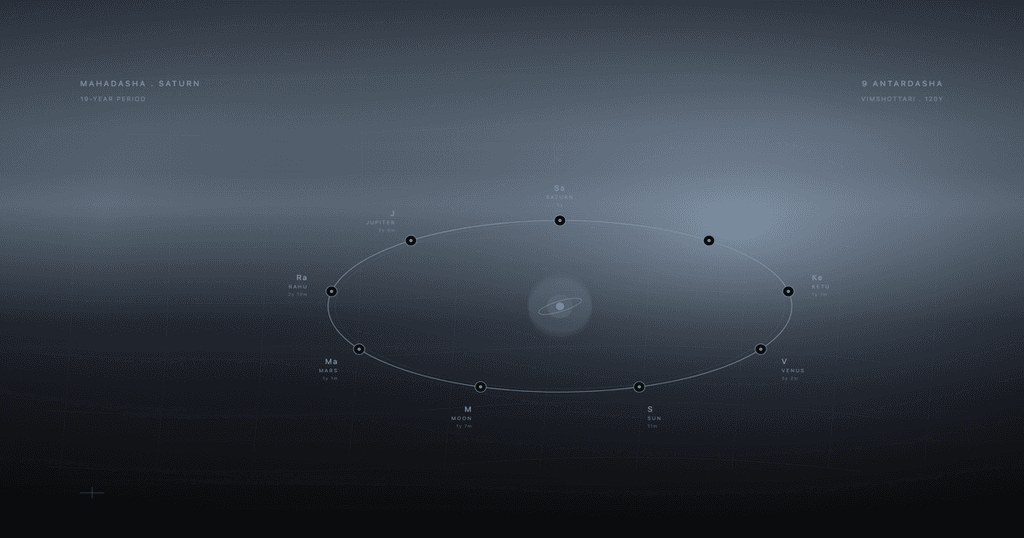
Where the sub-period falls in the Vimshottari sequence
The 19-year Saturn mahadasha divides into nine antardasha sub-periods in fixed Vimshottari order starting with Saturn itself. The Mars sub-period sits at position 7 of 9. Exact start and end dates for any chart can be computed from the natal Moon nakshatra-pada and the date of Saturn mahadasha onset. The Tempora dasha engine produces this to the day.
The arithmetic of this period
Mars carries 7 of the 120 Vimshottari years, so its share of a 19-year mahadasha is 19 times 7 over 120, which is 1.108 years, or 1 year 1 month 9 days. Six sub-periods precede it and their durations sum to about 12 years 6 months, placing Saturn-Mars from roughly year 12.5 to year 13.6 of the mahadasha.
That is deep in the second half. A native who began the mahadasha at 35 meets this friction window near 48, with most of Saturn's structures already standing, and an enemy-pair antardasha that late tends to test what exists rather than interrupt what is being built. The full sequence sits in the Saturn mahadasha overview and the antardasha lord's own 7-year cycle in the Mars mahadasha page.
The sequence places it between opposites. The Saturn-Moon period before it turns the mahadasha inward for 19 months, and the Saturn-Rahu period after it runs 2 years 10 months 6 days of enlargement, so Mars is the pivot where interior pressure becomes exterior contest and whatever survives the contest is then amplified. Read as a run of three, the stretch from year 10.9 to year 16.5 is the mahadasha's working climax, with Mars as its shortest and hottest segment.
BPHS and Phaladeepika on this period
In the BPHS antardasha chapters, Saturn mahadasha section, the grammar is conditional throughout: a Mars exalted, in own sign or joined to the lagna lord or the dasha lord is assigned enjoyments, wealth, royal reverence, command of an army and agricultural growth from the very commencement of the sub-period. The adverse branch turns on dignity and house: debilitated or combust, or placed in the 8th or 12th with malefics, Mars is assigned loss of wealth, wounds, danger from thieves and weapons, quarrels with partners and wasteful expenditure. Where Mars occupies the 2nd or rules the 7th or 8th, the text attaches its strongest health cautions for this pairing and prescribes remedies, havan and the charity of a bull. Phaladeepika's chapter on bhukti effects lists loss of position, discord with relations and fever and weapon trouble, matching the afflicted BPHS branch rather than the dignified one.
Both texts agree on where the danger sits, and BPHS alone supplies the conditions under which it lifts. The engine treats these classical assignments as inputs, resolved against the natal Mars before the sub-period is scored.
Classical Saturn-Mars Friction pairing
Saturn and Mars are classical enemies (the slow-and-restricting planet vs the fast-and-decisive planet). The Mars antardasha inside Saturn mahadasha is classically friction-prone but produces sustained-effort openings through accumulated discipline. Property-axis and competitive events surface.
Friendship status and pairing reading
In the classical Parashari friendship matrix, Saturn views Mars as enemy. The enemy-pair classification means the 1 year 1 month 9 days sub-period classically delivers outcomes through friction between Saturn's register (discipline, longevity, institutional structure and sustained-effort outcomes) and Mars's register (action, courage, brothers, surgery, property and the warrior register). Classical guidance suggests sustained-effort and patience over decisive-action during enemy-pair sub-periods. Events surface through the friction rather than around it.
The Mars karaka overlay
Mars is the karaka of action, courage, brothers, surgery, property and the warrior register. Across the 1 year 1 month 9 days sub-period, this karaka set overlays on top of Saturn's 19-year discipline, longevity, institutional structure and sustained-effort outcomes register. The combined reading is the central output of the sub-period.
How Mars's natal dignity shapes the reading
Mars's natal sign and house set the floor for the 1 year 1 month 9 days sub-period. Mars at exaltation gives the strongest reading. Own-sign and mooltrikona placement gives clean expression. Debilitation introduces friction that the sub-period must work through. Combust and retrograde state, conjunctions with malefics or benefics and the dispositor's strength all further modulate the reading. See the Mars mahadasha overview for the per-dignity breakdown.
Event classes typical to Saturn-Mars sub-period
The 1 year 1 month 9 days Saturn mahadasha Mars antardasha typically surfaces events across these specific domains:
- Friction between Saturn-register and Mars-register: enemy-pair sub-periods classically require careful navigation. Events surface through the friction rather than around it.
- Activation of Saturn-Mars Friction (where the natal configuration supports it).
- Events in Mars's natural karaka domain: action, courage, brothers, surgery, property and the warrior register.
- Events specific to the natal house Mars occupies in the chart.
- Events where the Saturn-mahalord and Mars-antarlord houses (both natal and ruled) interact (aspect, mutual reception or natal conjunction).
Transit confirmation protocol
The sub-period reading sets a structural pressure floor of 1 year 1 month 9 days. Specific event timing inside that window requires the pratyantara (sub-sub-period) overlay and a transit cross-check.
Two transit overlays do most of the work. The standard targets to track: transit Mars aspecting natal Saturn or natal Mars, transit Saturn through the natal 3rd or 6th house, transit Mars-Saturn conjunctions or oppositions across the 3-6 axis. These transits intensify the Saturn-Mars dynamic within the broader sub-period and concentrate event timing on those windows.
The pratyantara (sub-sub-period) inside the antardasha gives finer timing. The Saturn-Mars-Saturn pratyantara (about 36 days) and the Saturn-Mars-Mars pratyantara (about 21 days) concentrate the sharp-debate signal within the 12-month sub-period. The Saturn-Mars-Saturn pratyantara (about 57 days) reads as the structural-litigation window. Cross-checking the pratyantara against the transit overlay gives event timing to the week. Tempora's dasha engine produces this data to the day for any chart.
What the framework does not predict
The Saturn-Mars reading is structural. It flags a 13-month window where the conditional probability of three named event classes lifts above chance, but it does not predict that any specific native will experience a specific event inside that window, nor the direction of any event that does fire.
A debate or commercial-conflict event during the sub-period can read as the turn that establishes the native's sharp articulation or as an adversarial phase whose meaning resolves only in the Rahu Mahadasha that follows; the chart's broader 3rd house signals determine which. The framework times the pressure, not the result and timing finer than the antardasha band needs the pratyantara sequence and the transit overlay for the date in question.
How this connects to the broader Saturn Mahadasha
The Saturn-Mars sub-period is the seventh antardasha inside the 19-year Saturn Mahadasha. Reading the sub-period in isolation captures the 1 year 1 month 9 days; reading it inside the Mahadasha gives the broader arc that places the discipline meets initiative reading in its proper structural context.
The Tempora Saturn Mahadasha method article covers the dispositor analysis, natal-house framework and the broader 6-year texture that this sub-period sits inside. The conditional probability framework holds across the full series: each antardasha is a flagged window for specific event classes whose probability is elevated relative to chance.
This period against the 2026 to 2028 sky
Mars has no dated transit event in Tempora's 2026 to 2028 calendar, but the mahadasha lord walks straight into Mars territory. Saturn enters Aries, a sign Mars rules and the sign of Saturn's own debilitation, on 23 May 2027, retreats to Pisces on 4 November 2027 and returns to Aries for good on 11 February 2028, staying until 2030. A native running Saturn-Mars across those dates has the mahadasha lord transiting the antardasha lord's sign at low dignity, which classical reading takes as the enemy-pair friction written into the sky itself. The signal deserves its limitation. Sign-level contact is the broadest kind of transit statement, it says nothing about degrees or houses in a given chart, and this antardasha only coincides with those dates for natives whose Saturn mahadasha began around 2014, a narrow slice of all charts.
None of that background chooses a direction, which the natal Mars does. A Mars strong at birth, in its own Aries or Scorpio, exalted in Capricorn or dignified in a kendra, is the classical picture of friction converted to output, effort that holds its edge for the whole 13 months. A Mars debilitated in Cancer or combust inclines the same period toward disputes that spend energy without yield, and the texts read injuries and quarrels into that variant often enough that they built caution into the standard delineations.
Frequently asked questions
How long is the Saturn Mahadasha Mars Antardasha and where does it fall in the Vimshottari sequence?
The Saturn Mahadasha Mars Antardasha runs 1 year 1 month 9 days. It is the seventh antardasha inside the 19-year Saturn Mahadasha, opening after the Saturn-Moon antardasha (1 year 7 months). The full sequence inside the Saturn Mahadasha runs Saturn-Saturn, Saturn-Mercury, Saturn-Ketu, Saturn-Venus, Saturn-Sun, Saturn-Moon, Saturn-Mars, Saturn-Rahu and Saturn-Jupiter. Exact start and end dates can be computed from the natal Saturn nakshatra-pada and the date of Saturn Mahadasha onset.
What does Mars signify in this sub-period and why does it read as discipline meets initiative?
Mars is the karaka of drive, will, courage, action, conflict, war, surgery, blood, siblings, real estate, machinery, sports, energy. During the broader Saturn Mahadasha's discipline and structure reading, Mars contributes the sustained-effort overlay. The sub-period sits at the seventh position in the antardasha sequence and reads as the Saturn discipline and structure register meeting Mars's drive, will, conflict, sibling and surgical significations.
How does Mars's natal dignity shape the Saturn-Mars sub-period reading?
Mars's natal house, sign and aspectual state set the floor for the 13-month sub-period. Mars exalted in Capricorn, in own sign Aries or Scorpio or in angular houses (1st, 4th, 7th, 10th) softens the reading toward more auspicious outcomes. Mars debilitated in Cancer introduces friction. Aspects from Saturn bring sustained structural pressure; aspects from Saturn bring competitive or confrontational pressure.
What kinds of events historically correlate with the Saturn-Mars sub-period?
Three event classes correlate. Debate, polemic and adversarial articulation events: Public debates, polemic essays published, litigation involving documents or contracts, adversarial commercial negotiations resolved. The 12-month window is the most concentrated adversarial-articulati. Sibling and competitive-commerce milestones: Sibling-related business decisions, family-business disputes resolved, competitive commercial victories against rivals. The Mars sibling karaka activates within Saturn's commerce register. Surgical and precision-intervention events: Surgical procedures, sharp business pivots, precision edits to contracts or commercial terms. The Mars surgery karaka activates within Saturn's analysis register. The framework reads these as a structural-pressure window for the event class, not a deterministic predictor.
How does this sub-period connect to the broader Saturn Mahadasha?
The Saturn-Mars sub-period is the seventh antardasha inside the 19-year Saturn Mahadasha. It opens after the Saturn-Moon antardasha (1 year 7 months). The sub-period reading is best held in tandem with the broader Saturn Mahadasha reading from the Tempora Saturn Mahadasha method article, which covers the natal house and dispositor framework that sets the texture of the full 16 years.
What does the Tempora framework not predict about this sub-period?
The framework identifies a structural-pressure window of approximately 1 year 1 month 9 days. It does not predict whether a specific native will experience a specific event in that window. It does not predict outcome direction. It does not predict timing finer than the sub-period band without overlaying the pratyantara (sub-sub-period) and the transit overlay for the date in question. The readings carry conventional weight from classical literature; the framework treats them as structural-pressure flags to cross-check against transit data.
Why does the position of Saturn-Mars in the seventh slot matter?
Because the six sub-periods before it consume about 12 years 6 months of the mahadasha, the Mars antardasha arrives when most of Saturn's 19-year work already stands. An enemy-pair friction period at that depth tends to stress-test existing structures, established roles and long-held commitments, where the same pairing early in a cycle would collide with construction still underway. The classical reading of the friction is unchanged, only its object differs with position.
What should a native running Saturn-Mars note about Saturn's Aries entry in 2027?
Three dates. Saturn first enters Aries on 23 May 2027, withdraws into Pisces on 4 November 2027 and enters Aries to stay on 11 February 2028, remaining until 2030. Aries is ruled by Mars and is also the sign of Saturn's debilitation, so the mahadasha lord spends those months moving into the antardasha lord's territory at low dignity. It is a background condition rather than an event, and it only concerns natives whose personal dasha calendar places Saturn-Mars across those dates, roughly those whose Saturn mahadasha began around 2014.
What do the classical texts say about Saturn-Mars?
The BPHS antardasha chapters, Saturn mahadasha section, split this sub-period by dignity: a strong or well-joined Mars earns wealth, royal reverence and army command from the outset, while a debilitated or afflicted Mars draws wounds, theft danger and wasteful expenditure. The heaviest cautions, with havan and bull charity prescribed, attach where Mars occupies the 2nd or rules the 7th or 8th. Phaladeepika's bhukti chapter lists loss of position, discord and fever, siding with the afflicted branch. Tempora treats both records as chart-conditioned inputs.
Read next
- Mahadasha: the nine-period Vimshottari framework · the broader cluster this sub-period sits inside
- Saturn Mahadasha Rahu Antardasha · the next sub-period in the Vimshottari sequence
- Venus Mahadasha Mars Antardasha · the complementary sub-period in the prior Mahadasha
- Jupiter Mahadasha Mars Antardasha · the same antardasha planet in a different Mahadasha
- Mahadasha and Vimshottari planetary periods · the full nine-period framework
- Calibrated lift: the discipline that turns Vedic astrology into research
This article represents conventional Vedic teaching and Tempora Research method documentation. It does not constitute financial, legal or professional advice. Internal audit log maintained.