Sun Mahadasha Saturn Antardasha: the formal-authority consolidation window
Of the nine sub-periods inside the Sun mahadasha, the classical texts weigh this one most carefully. Sun and Saturn are mutual enemies in the Parashari matrix, and the image behind the enmity is domestic: Saturn is the Sun's own son, estranged, slow and exacting where the father is radiant and immediate. The handover sharpens the point, because Saturn takes over directly from the benefic Sun-Jupiter months, the guru's blessing giving way to the auditor's ledger. Tradition assigns the pairing a dry, structural texture, duties, institutions, delays and the long consequences of how authority has been used, and reads its outcomes as earned against resistance rather than conferred.
Saturn's natal condition sets which face of the auditor appears. Strong, exalted in Libra or in its own Capricorn or Aquarius, Saturn is classically read as making the period constructive, formalisation, tenure and structures that outlast the mahadasha. Weak, debilitated in Aries or heavily afflicted, the same months lean toward obstruction, fatigue and friction with superiors and the father-line, and the classical counsel in that case is endurance over confrontation, since the pairing rewards outlasting far more reliably than outshining.
Where the sub-period falls in the Vimshottari sequence
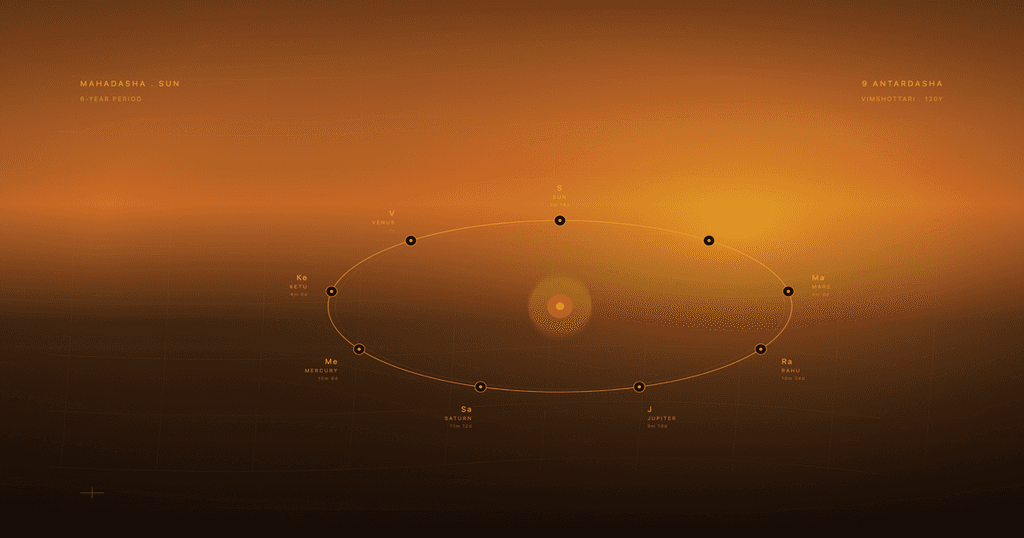
The 6-year Sun mahadasha divides into nine antardasha sub-periods in fixed Vimshottari order starting with Sun itself. The Saturn sub-period sits at position 6 of 9. Exact start and end dates for any chart can be computed from the natal Moon nakshatra-pada and the date of Sun mahadasha onset. The Tempora dasha engine produces this to the day.
Classical Sun-Saturn Friction pairing
Sun and Saturn are classical enemies. The Saturn antardasha inside Sun mahadasha brings authority and structure together with friction-prone register: career-burden, institutional-friction, defining authority-tension events. Classical warning for sustained-effort over decisive-action during this window.
The arithmetic of this period
Saturn's 19 years against the Sun's 6 give 6 x 19 / 120 = 0.95 years, an antardasha of 11 months 12 days, second in length only to the closing Venus year. The five sub-periods before it sum to 34 months 6 days, so Saturn opens at 2 years 10 months 6 days and closes at 3 years 9 months 18 days, crossing the exact midpoint of the mahadasha in its early weeks. The arc it audits is described in the Sun mahadasha overview.
The placement is the point. Saturn arrives after Jupiter's 9 months 18 days of counsel and hands over to Mercury's 10 months 6 days of articulation, which means the mahadasha's hardest stretch is cushioned on both sides by its most constructive ones. And because it straddles the halfway line, the period examines results rather than intentions: the same enemy-pair early in a mahadasha would resist plans not yet formed, while here it tests three years of actual conduct, the reason classical writers treat mid-arc Saturn sub-periods as the proving stage of a Sun mahadasha.
Classical positions on the Sun-Saturn stretch
In the BPHS antardasha chapters, Sun mahadasha section, Saturn's sub-period earns real grants when the lord is dignified: a kendra or trikona placement is assigned destruction of foes, full enjoyment, grain-gain and marriage-type functions at home, and an exalted or own-sign Saturn with a friendly graha adds property, royal recognition and national renown. The chapter also fixes a phase order, loss of friends at the start, good results through the middle and distress at the end, with a debilitated Saturn adding separation from parents and wandering. Afflicted, or in the 8th or 12th from the dasha lord, the period turns to rheumatism, fevers, imprisonment and quarrels with co-heirs, and maraka lordship of the 2nd or the 7th draws a health caution with Mrityunjaya japa and the charity of a black cow among the prescriptions. Phaladeepika's bhukti chapter states wealth loss, separation from children and phlegmatic troubles without qualification, which the record logs as a disagreement of emphasis with the conditional BPHS grant. The pattern is general across the two works: Mantreswara fixes one effect-list per bhukti while Parashara makes every effect contingent on dignity, on the house from the lagna and on the house from the dasha lord. The engine follows the Parashari grammar, taking each textual position as an input conditioned on the chart in hand.
Friendship status and pairing reading
In the classical Parashari friendship matrix, Sun views Saturn as enemy. The enemy-pair classification means the 11 months 12 days sub-period classically delivers outcomes through friction between Sun's register (authority, identity, the father-line, dignified-recognition and the visible self) and Saturn's register (discipline, longevity, institutional structure and sustained-effort outcomes). Classical guidance suggests sustained-effort and patience over decisive-action during enemy-pair sub-periods. Events surface through the friction rather than around it.
The Saturn karaka overlay
Saturn is the karaka of discipline, longevity, institutional structure and sustained-effort outcomes. Across the 11 months 12 days sub-period, this karaka set overlays on top of Sun's 6-year authority, identity, the father-line, dignified-recognition and the visible self register. The combined reading is the central output of the sub-period.
How Saturn's natal dignity shapes the reading
Saturn's natal sign and house set the floor for the 11 months 12 days sub-period. Saturn at exaltation gives the strongest reading. Own-sign and mooltrikona placement gives clean expression. Debilitation introduces friction that the sub-period must work through. Combust and retrograde state, conjunctions with malefics or benefics and the dispositor's strength all further modulate the reading. See the Saturn mahadasha overview for the per-dignity breakdown.
Event classes typical to Sun-Saturn sub-period
The 11 months 12 days Sun mahadasha Saturn antardasha typically surfaces events across these specific domains:
- Friction between Sun-register and Saturn-register: enemy-pair sub-periods classically require careful navigation. Events surface through the friction rather than around it.
- Activation of Sun-Saturn Friction (where the natal configuration supports it).
- Events in Saturn's natural karaka domain: discipline, longevity, institutional structure and sustained-effort outcomes.
- Events specific to the natal house Saturn occupies in the chart.
- Events where the Sun-mahalord and Saturn-antarlord houses (both natal and ruled) interact (aspect, mutual reception or natal conjunction).
Transit confirmation protocol
The sub-period reading sets a structural pressure floor of 11 months 12 days. Specific event timing inside that window requires the pratyantara (sub-sub-period) overlay and a transit cross-check.
Two transit overlays do most of the work. The standard targets to track: transit Saturn aspecting natal Sun or natal Saturn, transit Sun transiting the natal 10th house, transit Saturn through the natal 4th or 10th house, transit Mars-Saturn conjunctions or oppositions in any sign. These transits intensify the Sun-Saturn dynamic within the broader sub-period and concentrate event timing on those windows.
The pratyantara (sub-sub-period) inside the antardasha gives finer timing. The Sun-Saturn-Sun pratyantara (about 4 months) and the Sun-Saturn-Mercury pratyantara (about 3 months 17 days) carry the most concentrated career-consolidation signal within the 30-month sub-period. The Sun-Saturn-Sun pratyantara (about 1 month 15 days) reads as the recognition window within the consolidation. Cross-checking the pratyantara against the transit overlay gives event timing to the week. Tempora's dasha engine produces this data to the day for any chart.
What the framework does not predict
The Sun-Saturn reading is structural. It flags a 11-month window where the conditional probability of three named event classes lifts above chance, but it does not predict that any specific native will experience a specific event inside that window, nor the direction of any event that does fire.
A consolidation event during the sub-period can read as the institutional confirmation of work done across the broader Mahadasha or as a constraint the native must work within for the next several years; the chart's broader signals determine which. The framework times the pressure, not the result and timing finer than the antardasha band needs the pratyantara sequence and the transit overlay for the date in question.
How this connects to the broader Sun Mahadasha
The Sun-Saturn sub-period is the sixth antardasha inside the 6-year Sun Mahadasha. Reading the sub-period in isolation captures the 11 months 12 days; reading it inside the Mahadasha gives the broader arc that places the authority meets structural discipline reading in its proper structural context.
The Tempora Sun Mahadasha method article covers the dispositor analysis, natal-house framework and the broader 6-year texture that this sub-period sits inside. The conditional probability framework holds across the full series: each antardasha is a flagged window for specific event classes whose probability is elevated relative to chance.
This period against the 2026 to 2028 sky
Saturn is the one lord on this page with dated transits of its own in the verified calendar. It sits in Pisces from 20 March 2025, enters Aries on 23 May 2027, retreats into Pisces on 4 November 2027 and re-enters Aries to stay on 11 February 2028, holding the sign until 2030. Aries is Saturn's debilitation sign, so a native running Sun-Saturn across mid-2027 watches the antardasha lord enter its weakest placement, withdraw and then commit, a stutter the tradition reads as institutional matters opening, stalling and resuming rather than resolving in one motion. The 12 August 2026 solar eclipse on the Cancer-Leo cusp separately touches the mahadasha lord for anyone running this period earlier in the window. Every signal here ends at the same boundary: transit condition describes the planet and never the person, and which life departments are even in play depends on the houses these signs hold from the natal ascendant. Saturn's own nineteen-year period is covered in the Saturn mahadasha overview.
Frequently asked questions
How long is the Sun Mahadasha Saturn Antardasha and where does it fall in the Vimshottari sequence?
The Sun Mahadasha Saturn Antardasha runs 11 months 12 days. It is the sixth antardasha inside the 6-year Sun Mahadasha, opening after the Sun-Jupiter antardasha (9 months 18 days). The full sequence inside the Sun Mahadasha runs Sun-Sun, Sun-Moon, Sun-Mars, Sun-Rahu, Sun-Jupiter, Sun-Saturn, Sun-Mercury, Sun-Ketu and Sun-Venus. Exact start and end dates can be computed from the natal Moon nakshatra-pada and the date of Sun Mahadasha onset.
What does Saturn signify in this sub-period and why does it read as authority meets structural discipline?
Saturn is the karaka of discipline, responsibility, hard work, restriction, ageing, longevity, public duty, structure, time, consequence. During the broader Sun Mahadasha's authority and identity reading, Saturn contributes the formal-authority overlay. The sub-period sits at the sixth position in the antardasha sequence and reads as the Sun authority register meeting Saturn's structure, restriction, longevity and public-duty significations.
How does Saturn's natal dignity shape the Sun-Saturn sub-period reading?
Saturn's natal house, sign and aspectual state set the floor for the 11-month sub-period. Saturn exalted in Libra, in own sign Capricorn or Aquarius or in angular houses (1st, 4th, 7th, 10th) softens the reading toward more auspicious outcomes. Saturn debilitated in Aries introduces friction. Aspects from Saturn bring sustained structural pressure; aspects from Mars bring competitive or confrontational pressure.
What kinds of events historically correlate with the Sun-Saturn sub-period?
Three event classes correlate. Career consolidation events: Promotions, long-term contracts, partnership agreements, institutional affiliations. The texture is sustained build then formal recognition. The conditional probability is highest for natives whose na. Religious commitment and dharmic-institution events: Vows, formal teacher commitments, ashram or religious-institution affiliations, sustained practice habits consolidating into identity. Marriage in dharmic context. Institutional educational affiliatio. Property and long-term wealth events: Real estate purchases, pension or retirement-asset accumulation, long-term investment commitments. The Sun authority meets Saturn's slow accumulation. Wealth here arrives through patience not speculat. The framework reads these as a structural-pressure window for the event class, not a deterministic predictor.
How does this sub-period connect to the broader Sun Mahadasha?
The Sun-Saturn sub-period is the sixth antardasha inside the 6-year Sun Mahadasha. It opens after the Sun-Jupiter antardasha (9 months 18 days). The sub-period reading is best held in tandem with the broader Sun Mahadasha reading from the Tempora Sun Mahadasha method article, which covers the natal house and dispositor framework that sets the texture of the full 16 years.
What does the Tempora framework not predict about this sub-period?
The framework identifies a structural-pressure window of approximately 11 months 12 days. It does not predict whether a specific native will experience a specific event in that window. It does not predict outcome direction. It does not predict timing finer than the sub-period band without overlaying the pratyantara (sub-sub-period) and the transit overlay for the date in question. The readings carry conventional weight from classical literature; the framework treats them as structural-pressure flags to cross-check against transit data.
Why does the Sun-Saturn antardasha cross the midpoint of the mahadasha?
The five sub-periods before it, Sun, Moon, Mars, Rahu and Jupiter, total 34 months 6 days. Saturn therefore opens at 2 years 10 months 6 days and its 11 months 12 days carry it past the 3-year midpoint to 3 years 9 months 18 days. The duration itself is 6 x 19 / 120 years, second in length only to the closing Venus antardasha.
How does Saturn's 2027 Aries entry interact with a Sun-Saturn antardasha?
Saturn first enters Aries, its debilitation sign, on 23 May 2027, retreats into Pisces on 4 November 2027 and re-enters Aries on 11 February 2028 to stay until 2030. A native running Sun-Saturn through those months has the antardasha lord changing state three times, which classical practice reads as structural matters opening, pausing and resuming. House relevance and outcome remain chart-specific; the transit dates alone predict nothing for an individual.
What do the classical texts say about Sun-Saturn?
The BPHS Sun mahadasha section grants a dignified Saturn destruction of foes, property and recognition, sets a phase order of hard start, better middle and difficult end, and reserves rheumatism, imprisonment and co-heir quarrels for a Saturn afflicted or badly placed from the dasha lord, with a health caution and remedies under maraka lordship. Phaladeepika states an unconditional adverse list for the bhukti, wealth loss, separation from children and phlegmatic troubles. The difference is one of emphasis, fixed list against conditional grant, and the engine works with the conditional form, weighted by the natal chart.
Read next
- Mahadasha: the nine-period Vimshottari framework · the broader cluster this sub-period sits inside
- Sun Mahadasha Mercury Antardasha · the next sub-period in the Vimshottari sequence
- Venus Mahadasha Saturn Antardasha · the complementary sub-period in the prior Mahadasha
- Jupiter Mahadasha Saturn Antardasha · the same antardasha planet in a different Mahadasha
- Mahadasha and Vimshottari planetary periods · the full nine-period framework
- Calibrated lift: the discipline that turns Vedic astrology into research
This article represents conventional Vedic teaching and Tempora Research method documentation. It does not constitute financial, legal or professional advice. Internal audit log maintained.